KAIFA(000021)

Search documents
深科技:公司目前深圳、合肥封测处于满产状态,并根据客户近期需求在扩产,产能利用率良好
Mei Ri Jing Ji Xin Wen· 2025-12-26 09:41
Group 1 - The core viewpoint of the article is that Deep Technology (深科技) is currently operating at full capacity in its packaging and testing facilities located in Shenzhen and Hefei, and is expanding production based on recent customer demand [1] - The company reported that its capacity utilization rate is good, indicating a strong demand for its storage products [1]

私募基金经理刘明达:在中国资本市场寻找“必然性”|我们的四分之一世纪
经济观察报· 2025-12-24 11:30
Core Viewpoint - The article reflects on the journey of Liu Mingda, a pioneer in China's private equity sector, highlighting his investment philosophy and adaptation to market changes over 25 years, emphasizing the shift from consumer stocks to hard technology investments in response to evolving economic conditions [4][5][12]. Group 1: Historical Context and Early Investments - In 1996, the Chinese stock market was characterized by rampant speculation and insider trading, yet Liu Mingda distinguished himself by investing in technology stocks based on a simple belief in their future potential [7][8]. - His early investment in Shenzhen Development Technology Co. yielded significant returns during a time when average salaries were only a few hundred yuan [8]. - In 2005, during a market downturn, Liu made a pivotal decision to establish one of the first trust-based securities investment products in China, marking a shift towards a more regulated investment approach [10][11]. Group 2: Investment Philosophy and Strategies - Liu's investment strategy evolved to focus on "blue-chip" and "oligopoly" companies, betting on the concentration of resources and profits among leading firms as the Chinese economy matured [14][15]. - He identified Kweichow Moutai as a cornerstone of his portfolio, arguing that its cultural significance and social currency would ensure its continued demand despite market skepticism [15][16]. - Liu's approach emphasized the importance of stable, cash-rich companies with clear competitive advantages, even as he faced criticism for missing opportunities in emerging tech sectors [15][16]. Group 3: Shift to Hard Technology - In the new decade, Liu's investment focus shifted towards hard technology, driven by the belief that national security and technological self-sufficiency are paramount in the current geopolitical climate [19][20]. - He began investing in hard tech projects, acknowledging the risks involved but also the necessity of adapting to the changing landscape of investment opportunities [21][22]. - Liu expressed concerns about traditional internet giants and their sustainability, predicting that companies failing to innovate in disruptive technologies could face significant challenges [22]. Group 4: Philanthropy and Personal Philosophy - Liu's involvement in environmental philanthropy through the Alashan SEE Ecological Association reflects his desire for sustainable and transparent charitable initiatives, paralleling his investment principles [25][26]. - He believes that true wealth is measured not by monetary accumulation but by the freedom it provides, emphasizing a balanced approach to life and investment [28][29]. - Liu's philanthropic efforts serve as a counterbalance to the competitive nature of the financial markets, allowing him to contemplate the deeper meaning of wealth [29]. Group 5: Future Outlook and Advice - Liu acknowledges the challenges facing the economy and the difficulty for ordinary individuals to generate wealth, yet he remains optimistic about China's market resilience and technological advancements [31][32]. - He advises young investors to adopt a long-term perspective, warning against the pitfalls of seeking quick profits in a competitive market environment [32].



主力资金丨尾盘大幅加仓股出炉
Zheng Quan Shi Bao Wang· 2025-12-24 11:21
Group 1 - The electronic industry saw a net inflow of 4.916 billion yuan, leading the market [1] - The A-share market indices collectively rose, with the Shanghai Composite Index achieving six consecutive days of gains [1] - Among the 13 industries with net inflows, the power equipment and defense industries also saw significant inflows of 2.217 billion yuan and 1.233 billion yuan, respectively [1] Group 2 - A total of 45 stocks experienced net inflows exceeding 200 million yuan, with 15 stocks seeing inflows over 400 million yuan [2] - Demingli topped the list with a net inflow of 955 million yuan, driven by increasing data storage demand influenced by AI [2] - Tianji Co. reached a trading limit with a net inflow of 885 million yuan, focusing on the industrialization of lithium sulfide material preparation [2] Group 3 - At the market close, there was a net inflow of 129 million yuan, with the communication sector leading with over 500 million yuan in inflows [3] - Individual stocks such as Zhongji Xuchuang and Qingshan Paper experienced net inflows exceeding 200 million yuan [3] Group 4 - Beijing Junzheng and Wolong Electric Drive saw net outflows exceeding 100 million yuan at the market close [4] - Companies like Midea Group and Sihua Intelligent Control had net outflows exceeding 70 million yuan [5]



7股尾盘主力资金净流入均超1亿元
Zheng Quan Shi Bao Wang· 2025-12-24 11:10
Group 1 - The core point of the article highlights that on December 24, the net inflow of main funds in the Shanghai and Shenzhen markets reached 129 million yuan [1] - The telecommunications industry saw a significant net inflow of over 500 million yuan in main funds [1] - Other industries such as electronics, banking, light manufacturing, and non-ferrous metals also experienced net inflows exceeding 100 million yuan [1] Group 2 - Among individual stocks, Zhongji Xuchuang had a net inflow of over 200 million yuan in main funds [1] - Companies like Qingshan Paper, Haixia Innovation, Lingyi Zhizao, Luxshare Precision, Deep Technology, and Dongshan Precision each saw net inflows exceeding 100 million yuan [1]

资深科技分析师:英伟达真的很便宜
Hua Er Jie Jian Wen· 2025-12-24 08:33
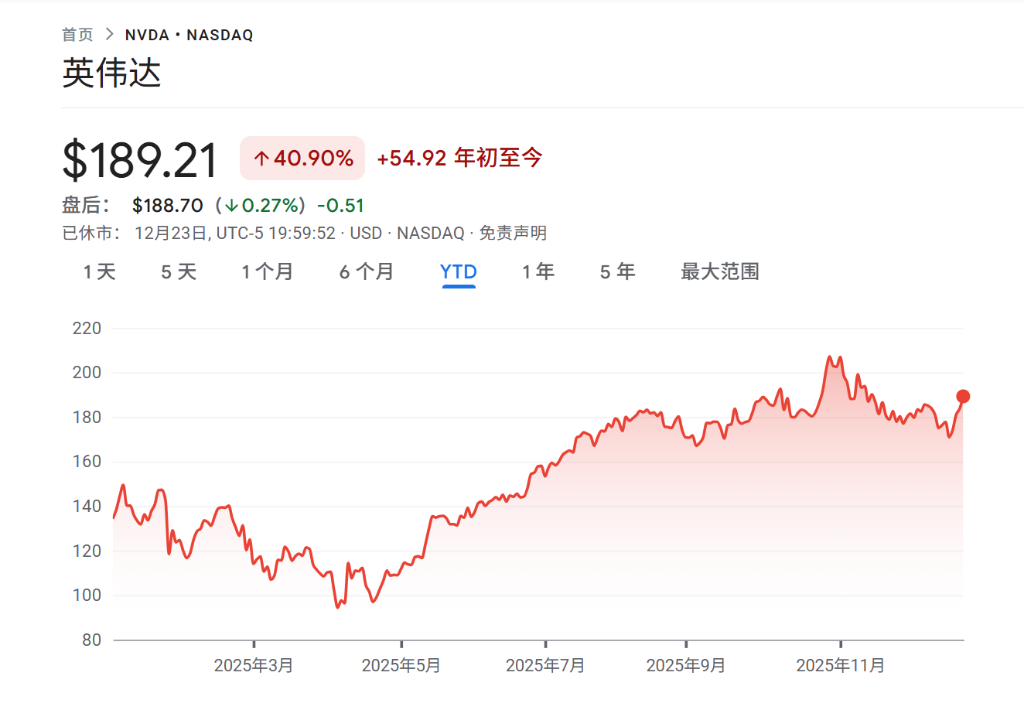
Core Viewpoint - Bernstein's report indicates that despite Nvidia's decent stock performance this year, its valuation has undergone significant compression, currently sitting at an attractive historical low [1][4]. Group 1: Stock Performance and Valuation - Since July, Nvidia's stock price has stagnated, with a year-to-date increase of approximately 30%, underperforming the Philadelphia Semiconductor Index (SOX) which rose by 38% [1]. - This stagnation in stock price, coupled with rising earnings expectations, has led to a substantial decline in its expected price-to-earnings ratio (P/FE) to below 25 times [1][4]. Group 2: Relative Valuation - Nvidia is currently trading at about a 13% discount relative to the overall semiconductor industry, placing it in the first percentile of its valuation over the past decade [4]. - Historical data shows that when Nvidia's P/E ratio falls below 25 times, investors typically see substantial returns, with an average one-year return exceeding 150%, and no negative returns during such periods [4]. Group 3: Future Catalysts - Bernstein estimates that a 25 times expected P/E ratio indicates Nvidia's valuation is at the 11th percentile of its range over the past ten years, marking an absolute low [5]. - The report highlights that there are multiple catalysts on the horizon, including healthy capital expenditure intentions and the upcoming CES and GTC conferences, which are expected to provide further momentum [5]. - The anticipated release of the Rubin architecture products and potential market opportunities in China due to the Trump administration's approval of H200 chips are also noted as positive developments [5]. Group 4: Analyst Rating and Price Target - Bernstein reaffirms its "outperform" rating for Nvidia, setting a target price of $275, suggesting that current market expectations may be too low given the company's guidance of over $500 billion from Blackwell/Rubin [5].

深科技涨2.01%,成交额10.90亿元,主力资金净流入7854.19万元
Xin Lang Cai Jing· 2025-12-24 05:56
Core Viewpoint - The stock of Shenzhen Technology Co., Ltd. (深科技) has shown significant growth, with a year-to-date increase of 31.85% and a recent trading volume indicating strong investor interest [1][2]. Group 1: Stock Performance - As of December 24, the stock price reached 24.88 CNY per share, with a trading volume of 10.90 billion CNY and a market capitalization of 391.03 billion CNY [1]. - The stock has experienced a 5.25% increase over the last five trading days, a 6.32% increase over the last 20 days, and a 9.46% increase over the last 60 days [1]. - The company has appeared on the "龙虎榜" (a list of stocks with significant trading activity) five times this year, with the most recent appearance on October 17, where it recorded a net buy of -57.07 million CNY [1]. Group 2: Financial Performance - For the period from January to September 2025, the company reported a revenue of 11.278 billion CNY, reflecting a year-on-year growth of 3.93%, and a net profit attributable to shareholders of 756 million CNY, which is a 14.27% increase [2]. - Cumulatively, the company has distributed 3.958 billion CNY in dividends since its A-share listing, with 702 million CNY distributed over the last three years [3]. Group 3: Shareholder Information - As of December 10, the number of shareholders stood at 217,500, a decrease of 1.64% from the previous period, while the average number of tradable shares per person increased by 1.67% to 7,223 shares [2]. - Among the top ten circulating shareholders, Hong Kong Central Clearing Limited holds 28.622 million shares, an increase of 15.6346 million shares compared to the previous period [3].
12月22日深证国企ESGR(470055)指数涨0.46%,成份股中钨高新(000657)领涨
Sou Hu Cai Jing· 2025-12-22 11:01
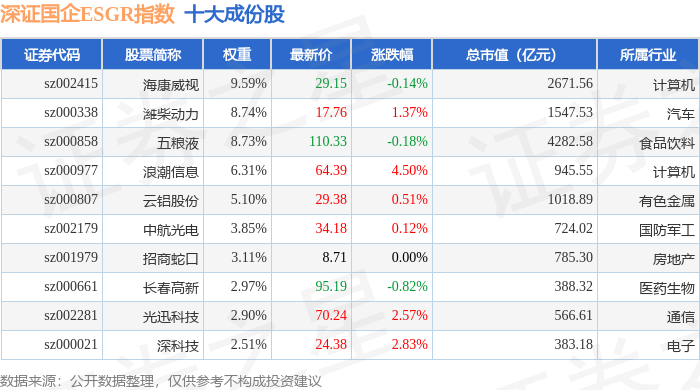
Core Viewpoint - The Shenzhen State-Owned Enterprises ESGR Index (470055) closed at 1590.4 points on December 22, with a gain of 0.46% and a trading volume of 32.354 billion yuan, indicating a stable performance in the market [1]. Group 1: Index Performance - The ESGR Index had 25 stocks rising and 19 stocks falling on the reporting day, with Zhongtung High-Tech leading the gainers at an increase of 8.57%, while Xugong Machinery led the decliners with a drop of 2.67% [1]. - The index's turnover rate was 1.25%, reflecting moderate trading activity among its constituents [1]. Group 2: Component Stocks - The top ten constituent stocks of the ESGR Index include Hikvision (9.59% weight), Weichai Power (8.74% weight), and Wuliangye (8.73% weight), with total market capitalizations of 267.156 billion yuan, 154.753 billion yuan, and 428.258 billion yuan respectively [1]. - Notable price movements include Langchao Information with a 4.50% increase and Changchun Gaoxin with a 0.82% decrease [1]. Group 3: Capital Flow - On the reporting day, the main funds experienced a net outflow of 427 million yuan, while retail investors saw a net inflow of 167 million yuan [1]. - The detailed capital flow indicates that Langchao Information had a net inflow of 564 million yuan from main funds, despite a net outflow from retail investors [2]. Group 4: Index Adjustments - Recent adjustments to the ESGR Index included the addition of 15 new stocks and the removal of 15 stocks, reflecting a dynamic rebalancing of the index [3]. - Newly included stocks such as Yunda Co. (138.09 billion yuan market cap) and Tai Sheng Wind Power (77.41 billion yuan market cap) indicate a focus on sectors like power equipment and basic chemicals [3].



存储芯片涨价潮来袭!AI驱动“以存代算”,哪些上游材料商将率先受益?
Jin Rong Jie· 2025-12-17 12:15
Group 1: Market Overview - The global storage chip market is experiencing significant structural changes due to a shortage and price surge, leading major PC manufacturers to raise product prices, with Dell increasing prices across its commercial computer range [1] - The driving force behind this price increase is the shift in AI development from training to application, resulting in a surge in demand for storage chips as they become strategic components in AI infrastructure [1] - Omdia forecasts that semiconductor industry revenue will reach a record high of $216.3 billion by Q3 2025, with a quarter-over-quarter growth of 14.5%, driven by storage chips and AI accelerators [1] Group 2: Industry Insights - Northeast Securities reports that the storage industry has passed its cyclical bottom, benefiting from the real demand explosion driven by AI infrastructure, leading to continuous chip price increases [2] - The demand for materials is expected to rise due to the expansion of domestic storage chip manufacturers [2] - The report from Zhongyou Securities highlights the increasing demand for plating solutions and photoresists in the storage chip sector, driven by advancements in HBM and 3D NAND technologies [2] Group 3: Key Companies in Storage Chip Sector - Zhaoyi Innovation (兆易创新) is a leading storage chip designer with a market share of 18.5% in global NOR Flash and has begun mass production of DDR4 DRAM in collaboration with Hefei Changxin [2] - Lanke Technology (澜起科技) holds over 40% market share in DDR5 memory interface chips and benefits from the increasing penetration of AI servers [2] - Baiwei Storage (佰维存储) specializes in embedded storage and PCIe SSDs, with products suitable for AI PCs and cloud service providers [3] Group 4: Storage Modules and Controllers - Jiangbolong (江波龙) is a leading domestic storage module company with over 100 million self-developed controller chips deployed [4] - Shannon Chip (香农芯创) is a core agent for SK Hynix, entering the Alibaba Cloud supply chain with its enterprise SSDs [4] - Demingli (德明利) focuses on self-developed storage controller chips and has accelerated the domestic replacement of its products [4] Group 5: Packaging and Manufacturing - Changdian Technology (长电科技) is the third-largest packaging and testing company globally, with a 25% market share in storage packaging [6] - SMIC (中芯国际) is a key player in domestic storage chip manufacturing, providing foundry services for NOR Flash and embedded storage chips [6] - Huahong (华虹公司) specializes in unique process storage chip foundry services, supporting production for IoT and automotive electronics [6] Group 6: Upstream Equipment and Materials - Northern Huachuang (北方华创) supplies core equipment for storage chip manufacturing, with growing orders for etching and deposition equipment [7] - Tuojing Technology (拓荆科技) leads in PECVD equipment, facilitating the expansion of storage capacity for major manufacturers [7] - Yake Technology (雅克科技) is a leading supplier of storage chip materials, breaking overseas monopolies and entering the supply chains of major global storage manufacturers [7] Group 7: Supporting Chips and Ecosystem - Jucheng Co. (聚辰股份) holds over 30% market share in DDR5 SPD chips, supporting platforms like NVIDIA H100 [8] - Guoxin Technology (国芯科技) is a leader in RAID storage chips, enhancing data security and performance for enterprise storage systems [8]




超级电容概念下跌3.10%,11股主力资金净流出超5000万元
Zheng Quan Shi Bao Wang· 2025-12-16 09:48
Core Viewpoint - The supercapacitor sector experienced a decline of 3.10% as of the market close on December 16, with companies like China National Heavy Machinery, Black Peony, and Meiansen leading the losses [1]. Market Performance - The supercapacitor concept ranked among the top decliners in the market, with a drop of 3.10%, while other sectors like duty-free shops and ride-hailing services saw gains of 1.44% and 0.89%, respectively [2]. - The supercapacitor sector was part of a broader trend where several sectors faced declines, including superconductors (-3.32%) and silicon energy (-3.16%) [2]. Fund Flow Analysis - The supercapacitor sector saw a net outflow of 1.125 billion yuan, with 32 stocks experiencing net outflows, and 11 stocks seeing outflows exceeding 50 million yuan [3]. - The stock with the highest net outflow was Zhongtian Technology, which had a net outflow of 144.38 million yuan, followed by Shentech and Xinzhoubang with outflows of 84.55 million yuan and 83.49 million yuan, respectively [3]. - Other notable stocks with significant net outflows included China National Heavy Machinery (-7.95%) and Shanshan Co. (-3.50%) [3][4]. Individual Stock Performance - The top stocks in the supercapacitor sector by net outflow included: - Zhongtian Technology: -4.21% with a turnover rate of 2.88% and a net outflow of 144.38 million yuan [3]. - Shentech: -2.91% with a turnover rate of 2.23% and a net outflow of 84.55 million yuan [3]. - Xinzhoubang: -1.85% with a turnover rate of 2.31% and a net outflow of 83.49 million yuan [3]. - Other companies with notable declines included China National Heavy Machinery (-7.95%) and Shanshan Co. (-3.50%) [3][4].


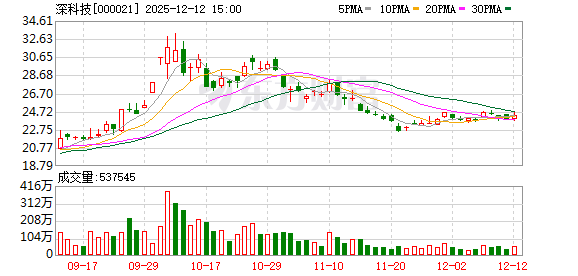
深科技:截至2025年12月10日公司股东户数为217539户
Zheng Quan Ri Bao· 2025-12-12 13:41
(文章来源:证券日报) 证券日报网讯 12月12日,深科技在互动平台回答投资者提问时表示,截至2025年12月10日,公司股东 户数为217539户。 ...