
ZTE(000063)

Search documents
通信行业2026年度投资策略:聚焦AI:算力降本向光而行,应用落地网络先行
Guolian Minsheng Securities· 2026-01-23 12:20
Group 1 - The core viewpoint of the report emphasizes that the demand for AI computing power will continue to grow and diversify in 2026, extending from data centers to network edges and even internal terminals [8][13][27] - The report highlights the significant capital expenditure (Capex) growth driven by business revenue, with major cloud service providers like Google, Microsoft, and Amazon showing consistent revenue growth exceeding 20% year-on-year [27][31][35] - The report identifies the increasing importance of silicon photonics technology, particularly the 1.6T optical module, which is expected to maintain accelerated growth and enhance the global market share of domestic optical chips and devices [7][54][70] Group 2 - The report discusses the emergence of new technologies such as Scale-UP supernodes and their impact on optical link demand, indicating that these technologies will drive additional link requirements in 2026 [7][9][66] - It notes that the AI infrastructure is experiencing a high level of prosperity, with significant investments in data centers and AI capabilities expected to continue, particularly in the U.S. [47][49][53] - The report anticipates that the integration of silicon photonics will significantly increase its market penetration, projecting that by 2026, over half of optical module sales will come from silicon photonics solutions [70][75]


中光防雷:公司是爱立信、中兴通讯、诺基亚、三星等全球主要通信设备制造商的防雷产品供应商
2 1 Shi Ji Jing Ji Bao Dao· 2026-01-23 10:27
Group 1 - The company, Zhongguang Lightning Protection, is a supplier of lightning protection products for major global telecommunications equipment manufacturers such as Ericsson, ZTE, Nokia, and Samsung [1] - The technical reserves for lightning protection products for 5G communication equipment have been validated in the market [1] - The company's revenue in the telecommunications sector for the first half of 2025 is projected to be 111.23 million yuan, representing a year-on-year growth of 12.43% [1] Group 2 - The demand for the telecommunications technology service industry is expected to enter a rapid growth phase due to the ongoing construction of 5G and 6G networks and new infrastructure initiatives [1]


通信行业双周报:关注业绩预告密集披露期表现-20260123
Dongguan Securities· 2026-01-23 09:59
Investment Rating - The report maintains an "Overweight" rating for the communication industry, expecting the industry index to outperform the market index by more than 10% in the next six months [2][44]. Core Insights - The communication industry index has shown a cumulative increase of 1.61% over the past two weeks (January 9 to January 22), outperforming the CSI 300 index by 1.91 percentage points, ranking 21st among 31 first-level industries [4][11]. - In January, the communication sector has risen by 2.48%, again surpassing the CSI 300 index by 0.45 percentage points [4][11]. - The report highlights a critical period of annual performance forecasts for listed companies, which serves as a key window to validate the growth potential and market conditions of various sectors [4][39]. Industry Performance Review - The communication sector's six sub-sectors have varied performance over the past two weeks, with the highest increase in the SW Communication Application Value-Added Services (+11.59%) and the lowest in SW Communication Terminals and Accessories (-1.64%) [4][15]. - The report notes that the communication industry is entering a phase of technological iteration and policy benefits, with new growth drivers expected from AI, quantum communication, and low-altitude economy [4][39]. Industry News and Company Announcements - IDC predicts that by 2030, AI agents will become a significant part of the global workforce, with a projected increase from approximately 28.6 million active agents in 2025 to 2.216 billion [16]. - China Mobile has established a special office for computing power strategy, marking a new phase in its systematic approach to computing power deployment [17][19]. - The Ministry of Industry and Information Technology reports that AI has penetrated over 70% of business scenarios in leading smart factories [20]. - Tianfu Communication expects a net profit increase of 40%-60% for 2025, driven by the growth in AI and data center construction [23]. - Changxin Bochuang anticipates a net profit increase of 344%-413% for 2025, fueled by demand in cloud computing and AI [24]. Industry Data Updates - As of November 2025, the mobile phone user base reached approximately 1.828 billion, a year-on-year increase of 2.20% [27]. - The internet broadband access user base was about 697 million, reflecting a year-on-year increase of 4.28% [29]. - The length of optical cable lines reached approximately 74.44 million kilometers, with a year-on-year growth of 3.63% [30]. - By November 2025, the total number of 5G base stations reached 4.83 million, with a net increase of 579,000 from the previous year [36]. Investment Recommendations - The report suggests focusing on companies that align with the themes of "technology commercialization, policy catalysis, and earnings certainty," highlighting potential opportunities in the sector [4][39]. - Recommended stocks include China Mobile (600941.SH), China Telecom (601728.SH), ZTE Corporation (000063.SZ), Changfei Optical Fiber (601869.SH), and Weisheng Information (688100.SH) [40][42].






努比亚总裁倪飞:若iPhone真全面屏等到2030年实现商用,将比国产手机晚近10年
Xin Lang Cai Jing· 2026-01-23 03:58
Group 1 - The core viewpoint is that ZTE and Nubia have been leading the innovation in under-display camera technology, having commercialized it since 2020, while Apple is perceived to be lagging behind in this area [1][3] - ZTE has iterated its under-display technology through seven generations, from the Axon 20 to the Nubia Z80 Ultra, achieving a nearly invisible front camera and a seamless full-screen experience [1][3] - If Apple plans to introduce true full-screen technology by 2030, it may be nearly a decade behind the advancements made by Chinese manufacturers [1][3] Group 2 - ZTE's Vice President and Nubia's flagship product manager emphasized that the development of full-screen technology requires significant time and technical accumulation, which Nubia has achieved over seven generations [1][3] - The Nubia Z80 Ultra is highlighted as a leading product in the full-screen category, expected to dominate various rankings by 2025 [1][3]


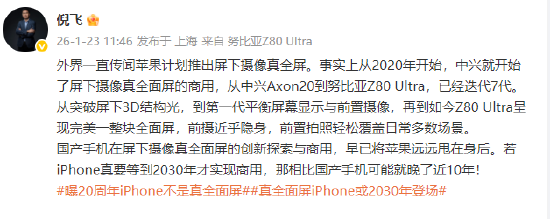
曝20周年iPhone不是真全面屏 努比亚张雷:全面屏技术不是谁想做就能做出来的
Xin Lang Cai Jing· 2026-01-23 02:51
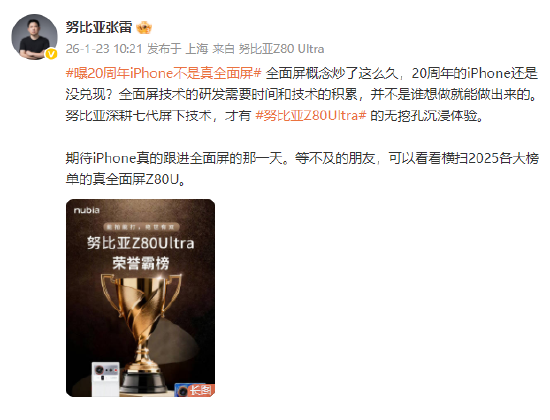
Core Viewpoint - The Vice President of ZTE and General Manager of Nubia's flagship products, Zhang Lei, expressed skepticism about the 20th anniversary iPhone not featuring a true full-screen design, emphasizing that the development of full-screen technology requires time and technical accumulation [1][4]. Group 1 - Zhang Lei highlighted that the concept of full-screen has been discussed for a long time, yet the 20th anniversary iPhone has not delivered on this promise [1][4]. - He pointed out that the development of full-screen technology is not something that can be achieved easily or quickly, indicating the complexity involved [1][4]. - Nubia has invested in seven generations of under-screen technology, which has led to the creation of the Nubia Z80 Ultra, offering a true full-screen experience without any cutouts [1][4]. Group 2 - Zhang Lei expressed anticipation for Apple to eventually adopt full-screen technology, suggesting that consumers who are eager for such features should consider the Nubia Z80 Ultra, which is expected to perform well in various rankings by 2025 [1][4].
未知机构:天风通信推荐中兴通讯珠峰CPU大客户放量自研芯片能力值得重视26年多产品-20260123
未知机构· 2026-01-23 02:20
Summary of Conference Call Records Company: ZTE Corporation Key Points - ZTE Corporation's self-developed chip capabilities are gaining market attention, with the company possessing the ability to develop core chips such as CPUs, switching chips, inter-card connection chips, and DPUs [1] - In 2026, multiple product iterations are expected to be launched, highlighting ZTE Micro's undervalued core competitiveness [1] - ZTE Micro's chip self-development capabilities are notable, with anticipated releases including a 51.2T switching chip and a 51.2T inter-card connection chip [1][1] - The company's CPU, the Summit chip, is expanding its market share among operators and has achieved mass application with major clients, which is significant [1] - ZTE is also focusing on breakthroughs in AI, particularly in the DPU and GPU sectors [1] Company: Nubia Technology Key Points - Nubia's smartphone division is enhancing its influence with flagship releases such as the Red Magic 11 Pro series and Nubia Z80 Ultra, integrating AI capabilities deeply with the Doubao model [2] - The company has launched the M153, further collaborating with Doubao to incorporate the Doubao mobile assistant, indicating a strong outlook for Nubia in the AI smartphone sector [2] - In the server domain, Nubia is experiencing high growth driven by breakthroughs with internet giants, with computing revenue increasing by 180% year-on-year, accounting for 25% of total revenue [2] - Server and storage revenue grew by 250% year-on-year, while data center product revenue increased by 120% [2] - Nubia's intelligent computing servers have entered the core business scenarios of major domestic internet and financial companies, including Alibaba, Tencent, ByteDance, Baidu, JD.com, Meituan, and Kuaishou [2] - The company is fully integrating AI and expanding its "connection + computing" strategy, with promising developments in the computing + AI terminal field [2] - Nubia is investing in AI direction, building a core competitiveness in "chips + complete machines + modular R&D + AI" [2][3] Additional Insights - Nubia is positioning itself as a rare leading enterprise in the computing field, spanning across "chips," "connectivity," and "terminals," which enhances its market competitiveness [5] - The introduction of intelligent computing supernode systems aims to support the creation of highly efficient large-scale intelligent computing clusters [4]
“数字丝绸之路”,串联拉美创新发展图景(国际视点)
Ren Min Ri Bao· 2026-01-22 21:55
Core Insights - Latin America has emerged as one of the most fruitful regions for the "Digital Silk Road" cooperation, driven by Chinese digital technology and collaboration concepts [1] - The digital infrastructure initiatives in Latin America, particularly in cloud computing, 5G communication, and smart agriculture, are significantly enhancing regional cooperation and development [2][3] Digital Infrastructure as a Foundation for Cooperation - Huawei's cloud data center in Santiago, Chile, is providing quality cloud services and attracting clients from neighboring countries like Argentina and Peru, reinforcing Chile's position as a digital hub in Latin America [2] - Chile's "Digital Nation Strategy" aims to establish a data hub in the Southern Hemisphere, with Chinese companies playing a crucial role in this transformation [2] - Various countries in Latin America, including Brazil and Mexico, are collaborating with Chinese firms to enhance their digital infrastructure, which is vital for bridging the development gap [3] Empowering Industries and Enhancing Livelihoods - Chinese smart port technology is being implemented in Santos Port, Brazil, improving operational safety and efficiency [4] - The integration of digital technologies in traditional industries, such as agriculture in Brazil and Argentina, is leading to significant improvements in productivity and efficiency [4] Realizing Digital Benefits in Daily Life - Farmers in Puebla, Mexico, are benefiting from the "Digital Rural Project," which has increased their profits by 20% through digital marketing and e-commerce platforms [5] - Cross-border e-commerce is facilitating the flow of goods between China and Latin America, enhancing trade efficiency and creating job opportunities in logistics and customer service [6] Cultivating Digital Talent for Development - The "Future Seeds" program in Peru is fostering digital skills among youth while promoting cultural exchange, exemplifying the educational cooperation between China and Latin America [7] - Initiatives like the China-Latin America Digital Education Alliance are aimed at nurturing a skilled workforce capable of driving digital transformation in the region [7] Expanding Cooperation Across Various Fields - The "Digital Silk Road" is not only about technology transfer but also about building trust and collaboration between China and Latin America, enhancing e-commerce vitality and digital infrastructure coverage [8] - Latin American countries are eager to deepen cooperation with China in digital economy and education, recognizing the potential for sustainable development [8]
欧洲光伏90%靠中国,欧盟要强推禁令?德法西会反弹吗
Sou Hu Cai Jing· 2026-01-22 05:06
Group 1 - The EU is preparing a new proposal to shift from voluntary guidelines to mandatory regulations targeting Chinese suppliers, including telecom networks, security equipment, and solar systems [1] - The previous 5G security toolbox allowed member states to make their own decisions, leading to inconsistent implementations across countries, with some like Sweden and Germany tightening regulations while others like Spain and Greece continued using Huawei and ZTE due to cost and reliability [1] - The new proposal aims to unify regulations and impose penalties for using high-risk Chinese equipment in critical infrastructure, potentially leading to lawsuits and fines at the EU level [1] Group 2 - The EU's energy transition goals are at odds with the current supply chain realities, as over 90% of solar panels installed in the EU come from China, raising concerns about the feasibility of replacing these supplies without significant cost increases and project delays [3] - The push for strategic autonomy from China and the US is complicated by the lack of viable alternatives, leading to fears that a forced decoupling could harm the EU's green transition efforts [3] - The proposal's success depends on the reactions of member states, as national security is traditionally managed by individual countries, and the EU's attempt to enforce compliance may face strong resistance from nations like Germany and Spain [3] Group 3 - Telecom operators are particularly concerned about the financial burden of replacing Chinese equipment, which could cost billions of euros and slow down network development, ultimately impacting consumers through higher fees and reduced service quality [5] - Some countries, like Spain, are taking a pragmatic approach, with contracts in place that assert no security risks associated with Chinese suppliers, contrasting with the EU's more aggressive stance [5] - Germany's situation is sensitive due to the significant presence of Huawei equipment, and any forced timeline for equipment removal could lead to backlash from the government and industry, especially in a fragile economic environment [5] Group 4 - The proposal will undergo a lengthy legislative process, requiring approval from the EU Parliament and negotiations with member states, indicating that the path to implementation will be complex and contentious [7] - The debate reflects a clash between political correctness and economic rationality, with stakeholders weighing the importance of security against the potential costs and inefficiencies of strict regulations [7] - The overarching risk lies in potentially missing opportunities for digital and green advancements due to a focus on security, which could lead to greater inefficiencies and costs in the long run [7]

6G第二阶段技术试验已启动 上市公司前瞻布局抢占先机
Shang Hai Zheng Quan Bao· 2026-01-21 18:12
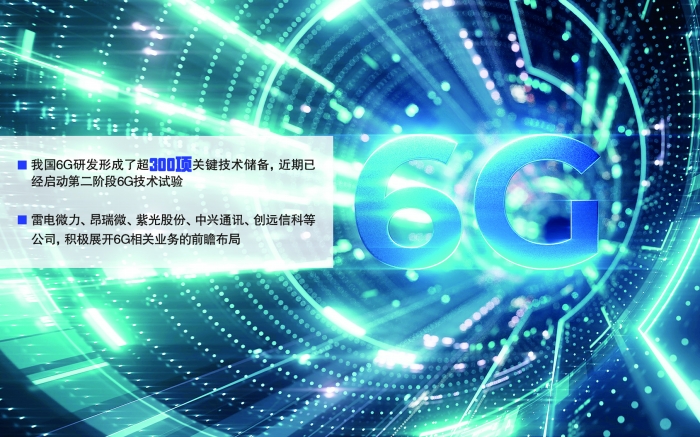
Group 1 - The global share of China's essential patents for 5G standards has reached 42%, and the first phase of 6G technology trials has been completed, with over 300 key technology reserves formed [2] - The development of 6G technology is entering a critical window, with significant focus on the integration of low-orbit satellite networks and a comprehensive space-ground-sea network [2] - Companies are actively engaging in 6G-related business, with a focus on millimeter-wave technology as a core frequency band for 6G [3] Group 2 - Companies like 创远信科 are upgrading testing technologies and instruments towards higher frequency bands and greater bandwidth, with a focus on terahertz testing and AI communication testing [3] - 昂瑞微 is targeting the U6G frequency band and developing high-performance components, including high-power amplifiers and low-noise amplifiers, to enhance their competitive edge in RF solutions [4] - 紫光股份 is leveraging its strengths in ICT infrastructure to provide comprehensive ICT services for 6G networks, participating in various hardware and software service projects [4] Group 3 - 中兴通讯 has been actively involved in the IMT 2030 (6G) promotion group, contributing to testing and research in key technology areas such as 6G and AI integration [4] - 创远信科 has initiated the second phase of 6G technology trials and is focusing on the application of 6G+AI technology in specific scenarios like satellite internet and smart connected vehicles [5] - 瑞可达 is developing solutions for 6G communication and commercial satellite applications, while 臻镭科技 is positioning itself as a core chip supplier for 6G satellite internet [5]


中兴通讯:截至2026年1月20日股东总数为610003户
Zheng Quan Ri Bao· 2026-01-21 14:16
Group 1 - The core point of the article is that ZTE Corporation reported its total number of shareholders as of January 20, 2026, which stands at 610,003, including 609,717 A-share shareholders and 286 H-share shareholders [1] Group 2 - The breakdown of shareholders indicates a significant majority of A-share holders compared to H-share holders, highlighting the company's stronger presence in the A-share market [1] - The data reflects the company's engagement with its investors through interactive platforms, showcasing transparency and communication [1] - The inclusion of both registered and non-registered shareholders in the H-share count suggests a comprehensive approach to shareholder representation [1]