Addsino (000547)

Search documents
航天发展(000547) - 关于变更公司住所并修订《公司章程》的公告
2026-01-23 10:15
证券代码:000547 证券简称:航天发展 公告编号:2026-005 航天工业发展股份有限公司 关于变更公司住所并修订《公司章程》的公告 本公司及董事会全体成员保证信息披露的内容真实、准确、完整,没有虚假记载、误导性陈 述或重大遗漏。 航天工业发展股份有限公司(以下简称"公司")于2026年1月23日召开的第十 一届董事会第二次(临时)会议审议通过了《关于变更公司住所的议案》及《关于修 订<公司章程>的议案》,以上两项议案尚需提交公司2026年第一次临时股东会审议。 现将有关事项公告如下: 一、公司住所变更情况 1 | 高级管理人员的董事,其中独立 | 管理人员的董事,其中独立董事 | | --- | --- | | 董事应当过半数,由独立董事中 | 应当过半数,由独立董事中会计 | | 会计专业人士担任召集人。 | 专业人士担任召集人。 | 除上述修订外,《公司章程》其他条款保持不变。 三、备查文件 第十一届董事会第二次(临时)会议决议。 特此公告。 根据公司经营需要,拟对公司住所进行变更,住所由"福州市台江区五一南路67 号"变更为"福建省福州市仓山区上三路256号二层"。本次变更尚需取得市场监督 管理 ...
航天发展(000547) - 关于召开2026年第一次临时股东会的通知
2026-01-23 10:15
证券代码:000547 证券简称:航天发展 公告编号:2026-006 3.会议召开的合法、合规性:本次股东会会议召开程序符合有关法律、行 政法规、部门规章、规范性文件、深圳证券交易所业务规则和《公司章程》等有 关规定。 4.会议召开时间 (1)现场会议的时间:2026 年 2 月 10 日 14:30; (2)网络投票时间:其中,通过深圳证券交易所互联网投票系统进行网络 投票的时间:2026 年 2 月 10 日 9:15-15:00 期间的任意时间;通过深圳证券交 易所交易系统进行网络投票的时间:2026 年 2 月 10 日 9:15-9:25,9:30-11:30 和 13:00-15:00。 5.会议召开方式 航天工业发展股份有限公司 关于召开 2026 年第一次临时股东会的通知 本公司及董事会全体成员保证信息披露的内容真实、准确、完整,没有虚假记载、误导 性陈述或重大遗漏。 一、召开会议的基本情况 1.股东会届次:公司 2026 年第一次临时股东会 2.会议召集人:公司第十一届董事会。公司第十一届董事会第二次(临时) 会议审议通过,决定召开本次股东会。 本次会议采取现场表决与网络投票相结合的方式。 ...
航天发展(000547) - 第十一届董事会第二次(临时)会议决议公告
2026-01-23 10:15
证券代码:000547 证券简称:航天发展 公告编号:2026-004 航天工业发展股份有限公司 第十一届董事会第二次(临时)会议决议公告 本公司及董事会全体成员保证信息披露的内容真实、准确、完整,没有虚假记载、误导 性陈述或重大遗漏。 航天工业发展股份有限公司(以下简称"公司")第十一届董事会第二次(临 时)会议于 2026 年 1 月 23 日以现场结合通讯方式召开,会议通知于 2026 年 1 月 20 日以电子邮件及微信方式发出。会议应到董事 9 名,实到董事 9 名。会议的召 集和召开程序符合《公司法》及《公司章程》的有关规定。 会议经过认真审议,一致通过如下决议: 一、审议通过《关于变更公司住所的议案》 具体内容详见公司同日在巨潮资讯网刊登的《航天工业发展股份有限公司关 于变更公司住所并修订<公司章程>的公告》。 表决结果:同意 9 票,反对 0 票,弃权 0 票。本议案尚需提交公司 2026 年第 一次临时股东会审议。 四、备查文件 第十一届董事会第二次(临时)会议决议。 特此公告。 1 具体内容详见公司同日在巨潮资讯网刊登的《航天工业发展股份有限公司关 于变更公司住所并修订<公司章程>的公告》 ...
解密主力资金出逃股 连续5日净流出410股


Zheng Quan Shi Bao Wang· 2026-01-23 09:36
Group 1 - As of January 23, a total of 410 stocks in the Shanghai and Shenzhen markets have experienced net outflows of main funds for five consecutive days or more [1] - Qin'an Co., Ltd. has the longest streak of net outflows, with 23 consecutive days [1] - Aerospace Development has the largest total net outflow amount, with a cumulative outflow of 7.516 billion yuan over 12 days [1] Group 2 - The stock with the highest percentage of net outflow relative to trading volume is *ST Wanfang, which has seen a 37.35% decline over the past nine days [1] - Other notable stocks with significant net outflows include Sannuo Technology and BYD, with net outflows of 5.734 billion yuan and 3.355 billion yuan respectively [1] - The data indicates a trend of significant capital withdrawal from certain sectors, reflecting potential investor concerns [1][2]
一则大消息!掀起一个涨停潮
格隆汇APP· 2026-01-22 12:04
Core Viewpoint - The article discusses the resurgence of the commercial aerospace sector in China, highlighting significant developments and investment opportunities driven by government policies and technological advancements [12][42]. Group 1: Market Dynamics - The recent rebound in the A-share market reflects a broader recovery in the technology sector, particularly in the commercial aerospace segment, with over 20 stocks hitting the daily limit up [3][14]. - The Aerospace ETF (159227) has shown a remarkable performance, increasing by 53.64% since its launch in May last year, and has been included in the top ten core ETFs for global investment in China by 2026 [4][14]. Group 2: Industry Developments - Five key commercial aerospace companies, including Xinghe Power and Blue Arrow Aerospace, are progressing towards IPOs, aiming to raise funds for ambitious projects [9][11]. - China's commercial aerospace industry is projected to reach a scale of 2.5 to 2.8 trillion yuan by 2025, with an annual growth rate exceeding 20% and over 600 companies expected to operate in this sector [13][22]. Group 3: Technological Advancements - Significant advancements in technology are being made, such as the construction of the first offshore liquid rocket launch and recovery platform in Yantai, and successful tests of manned spacecraft landing systems [13][21]. - The development of reusable rocket technology is identified as a critical factor for reducing launch costs and enhancing capacity, with expectations for multiple successful test flights in 2026 [43][44]. Group 4: Investment Opportunities - The commercial aerospace sector is viewed as a major investment opportunity, with the potential for substantial returns as the industry matures and expands [36][42]. - The Aerospace ETF (159227) is highlighted as a strategic investment tool, focusing on high-purity military applications and leading commercial aerospace content, with a market size of 2.975 billion yuan and an average daily trading volume of 843 million yuan [41][39].




解密主力资金出逃股 连续5日净流出544股



Zheng Quan Shi Bao Wang· 2026-01-21 09:24
Core Viewpoint - As of January 21, a total of 544 stocks in the Shanghai and Shenzhen markets have experienced net outflows of main funds for five consecutive days or more, indicating a significant trend of capital withdrawal from these stocks [1]. Group 1: Stocks with Longest Net Outflow - Qinan Co., Ltd. has the longest net outflow period, with main funds withdrawing for 21 consecutive days [1]. - Kain Technology follows with a net outflow for 18 consecutive days [1]. Group 2: Stocks with Largest Total Net Outflow - Shenghong Technology has the highest total net outflow amounting to 9.277 billion yuan over 11 days [1]. - Aerospace Development ranks second with a total net outflow of 6.928 billion yuan over 10 days [1]. Group 3: Stocks with Highest Net Outflow Proportion - *ST Yanshi has the highest proportion of net outflow relative to trading volume, with a 30% drop in the last 7 days [1]. - Other notable stocks with significant net outflow proportions include China Satellite and China Satcom, with respective proportions of 6.59% and 8.40% [1]. Group 4: Performance of Affected Stocks - Shenghong Technology has seen a cumulative decline of 14.99% during the net outflow period [1]. - Aerospace Development has experienced a cumulative drop of 29.48% [1]. - China Satellite and China Satcom have also faced declines of 17.90% and 26.81%, respectively [1].
机构:商业航天有望迎来“政策+技术+资本”三重共振
Zheng Quan Shi Bao Wang· 2026-01-21 08:59
Group 1 - The core viewpoint is that China's commercial space industry is experiencing rapid development, with projections for 2025 indicating 50 launches, accounting for 54% of the total national space launches [1] - In 2025, commercial rockets are expected to complete 25 launches, and the Hainan commercial space launch site will have conducted 9 launches, totaling 10 since its establishment [1] - A total of 311 commercial satellites are projected to be placed into orbit, representing 84% of the total satellites launched in China [1] Group 2 - The commercial space industry is entering a golden era driven by both demand and supply, with recommendations to focus on structural component suppliers such as Aerospace Power, Srey New Materials, and others [1] - In satellite manufacturing, the focus is on low Earth orbit satellites and related infrastructure, with suggested companies including China Satellite and Aerospace Electronics [1] - The upstream and midstream sectors, particularly subsystems and materials supporting satellite mass production, are expected to benefit first, with companies like Zhenlei Technology and Guangwei Composites highlighted [1] Group 3 - In 2026, the domestic commercial space sector is anticipated to experience a "triple resonance" of policy, technology, and capital, making it highly promising [2] - Beneficiary companies in the rocket industry chain include Aerospace Power, Western Materials, and others [2] - In the satellite industry and space computing, recommended companies include Zhongke Xingtou, Aerospace Hongtu, and several others [2]



商业航天板块走弱 航天动力触及跌停
2 1 Shi Ji Jing Ji Bao Dao· 2026-01-21 01:43
Core Viewpoint - The commercial aerospace sector is experiencing a downturn, with significant declines in stock prices for various companies involved in the industry [1] Group 1: Company Performance - Aerospace Power has hit the daily limit down, indicating a severe drop in its stock price [1] - Other companies such as Aerospace Nanhai, Aerospace Mechatronics, Aerospace Development, Ruike Laser, China Satellite Communications, and Lekai Film have also seen declines in their stock prices, following the trend set by Aerospace Power [1]



商业航天板块走弱,航天动力触及跌停
Xin Lang Cai Jing· 2026-01-21 01:37
Group 1 - The commercial aerospace sector is experiencing a downturn, with significant declines in stock prices [1] - Aerospace Power has hit the daily limit down, indicating severe market pressure [1] - Other companies such as Aerospace Nanhu, Aerospace Mechatronics, Aerospace Development, Ruike Laser, China Satellite Communications, and Lucky Film have also seen their stock prices drop in tandem [1]
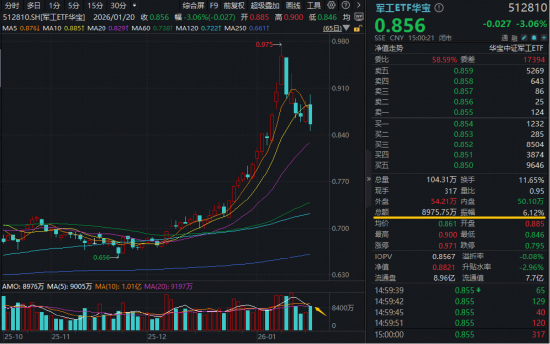
从大涨到大跌,军工坐上“过山车”!商业航天再杀跌,军工ETF华宝(512810)放量巨震6%,调整到位了吗?
Xin Lang Cai Jing· 2026-01-20 11:32
Core Viewpoint - The market experienced a collective decline on January 20, with a shift in investment style from high-valuation growth sectors to value sectors, leading to significant volatility in the military industry, particularly in the aerospace and low-altitude economy themes [1][5]. Military Industry Performance - The military ETF Huabao (512810) saw a trading range of 6.12% throughout the day, closing down 3.06%, erasing previous gains, with a trading volume of 89.76 million yuan [1][5]. - Leading stocks in the military ETF, particularly in commercial aerospace, faced significant declines, with Zhenlei Technology dropping nearly 9% and China Satellite Communications falling 7%, while several others dropped over 6% [3][13]. Market Analysis - Analysts attribute the volatility in the military sector to cautious liquidity expectations ahead of the Spring Festival and institutional portfolio adjustments, which have heightened risk aversion [5][15]. - The military sector is characterized by high growth potential, with small-cap stocks (market cap below 50 billion yuan) making up 56.47% of the military ETF's index, indicating high elasticity and volatility [5][15]. Investment Opportunities - The military sector is viewed as having high configuration value, with potential for investment during price dips, driven by historical opportunities in military trade, new quality-driven growth, and key timing catalysts [6][16]. - The global arms race is intensifying, with conflicts like India-Pakistan showcasing China's advanced equipment manufacturing capabilities, suggesting a historical opportunity for military trade to become a second growth curve for the industry [6][17]. - The new quality of combat power, characterized by intelligence, systematization, and informatization, is becoming a critical factor in strategic competition among major powers, with new production capabilities in commercial aerospace and low-altitude economy expected to further enhance military growth [7][16]. Future Outlook - The year 2026 marks the beginning of the "14th Five-Year Plan" and is a critical year for achieving the centenary goals of the military, indicating a potential new upward cycle for the military industry [6][17]. - The traditional military sector is expected to benefit from advantageous positioning, event catalysts, and improving fundamentals, presenting a significant opportunity for investment [7][17].