Yunnan Germanium(002428)

Search documents
太空光伏火了!马斯克联手贝莱德冲刺100GW,低轨卫星+AI算力刚需爆发!
Xin Lang Cai Jing· 2026-01-26 11:09
Group 1: Industry Overview - The space photovoltaic industry is experiencing significant growth driven by the demand for gallium arsenide batteries and other advanced solar technologies, particularly in high-altitude satellites and deep space exploration [1][2][3] - Musk's 100GW solar power capacity plan is expected to boost the demand for space photovoltaic products, benefiting various companies in the supply chain [1][2][3] Group 2: Key Companies and Their Developments - Qianzhao Optoelectronics (300102) is a leading player in gallium arsenide space batteries with over 60% market share in China, achieving a production efficiency of 35% and an experimental efficiency exceeding 42% [1][12] - Dongfang Risen (300118) has successfully delivered small batches of HJT batteries to SpaceX, with its ultra-thin P-type HJT battery meeting the lightweight requirements for satellites [1][13] - Junda Co., Ltd. (002865) is a global leader in TOPCon batteries, with laboratory conversion efficiency surpassing 33.53%, and is rumored to be a potential supplier for SpaceX's perovskite batteries [1][14] - Yunnan Zhiyuan (002428) is a core supplier of germanium wafers for gallium arsenide space batteries, benefiting from the increasing demand for germanium substrates [1][15] - Sanan Optoelectronics (600703) holds the largest gallium arsenide production capacity globally and is expected to see significant revenue growth from its space photovoltaic applications [1][16] - Maiwei Co., Ltd. (300751) is a leading supplier of HJT production equipment and is well-positioned to benefit from the surge in demand for space photovoltaic manufacturing equipment [1][17] - Saiwu Technology (603212) specializes in photovoltaic packaging materials and is developing radiation-resistant encapsulation films for space applications [1][18][19] - China Satellite (600118) is a key player in satellite platform manufacturing and is expected to benefit from the growth in space photovoltaic systems [1][20] - Aerospace Electronics (600879) provides power systems and communication equipment for satellites, with increasing demand expected due to the growth in space photovoltaic applications [1][21] - Tuojin New Energy (002218) focuses on flexible photovoltaic components suitable for space applications, with expected growth in orders as the market expands [1][22] - Trina Solar (688599) covers multiple technology routes and is positioned to benefit from the expansion of space photovoltaic systems [1][23] - Shanghai Portwan (605598) supplies flexible solar wings and is accelerating the commercialization of perovskite batteries through in-orbit testing services [1][24] - Ruihua Tai (688323) is a leader in CPI film materials, essential for flexible space photovoltaic components, and is expected to see increased demand [1][25] - Jiejia Weichuang (300724) is a leading manufacturer of photovoltaic battery production equipment, poised to benefit from the demand surge in space photovoltaic manufacturing [1][26] - Lens Technology (300433) supplies protective covers for satellite batteries, with expected growth in orders due to the increasing demand for space photovoltaic applications [1][27]





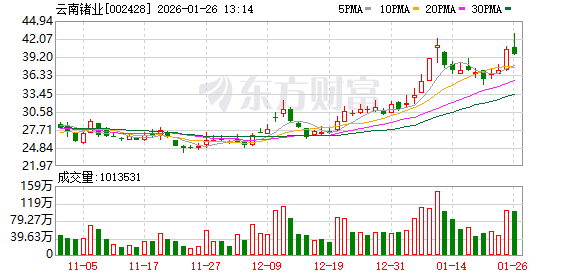
云南锗业:子公司生产的光伏级锗产品为太阳能电池用锗单晶片,主要运用于生产太阳能锗电池生产
Mei Ri Jing Ji Xin Wen· 2026-01-26 05:14
Group 1 - The company Yunnan Zhenye (002428.SZ) has products applicable in the space photovoltaic sector, specifically solar-grade germanium products used for solar cell production [2] - The solar germanium batteries produced by the company's subsidiary are characterized by high photoelectric conversion efficiency and stable performance, making them suitable for use in spacecraft such as satellites [2]


有色金属行业2026年投资策略:资源大周期,把握金属全面牛市
Southwest Securities· 2026-01-23 10:36
Core Insights - The report highlights a bullish outlook for the metals sector, driven by macroeconomic factors such as the Federal Reserve's interest rate cuts and a recovering global economy, particularly in China [3][44] - Key investment themes for 2026 include expanding demand for precious metals like gold and silver, improving fundamentals for aluminum and copper, strategic opportunities in rare earths, and supply-side disruptions due to overcapacity in certain sectors [3][4] Group 1: Precious Metals - The report suggests a long-term bullish view on gold, with expectations of price increases driven by anticipated interest rate cuts and geopolitical tensions, which enhance gold's appeal as a safe-haven asset [3][44] - Silver is also highlighted as a key investment opportunity due to its high price ratio to gold, indicating potential for significant price appreciation [3] - Specific companies to watch include Shandong Gold (600547.SH) and Zijin Mining (601899.SH), which are expected to benefit from increased production and operational efficiencies [4] Group 2: Industrial Metals - The report notes that aluminum and copper are set to see improved profitability due to lower production costs and increased demand, particularly in the context of infrastructure investments [3][4] - Companies such as Zhongfu Industrial (600595.SH) and Zijin Mining (601899.SH) are identified as having strong positions in the copper market, with expected profit growth [4] - The report emphasizes the importance of monitoring supply chain dynamics, particularly in copper, where inventory levels are shifting significantly [18][58] Group 3: Rare Earths and Strategic Metals - The report identifies rare earth elements as a critical area for investment, particularly in light of geopolitical tensions between the US and China, which may create opportunities for companies involved in rare earth mining and processing [3][4] - Companies like Northern Rare Earth (600111.SH) and China Rare Earth (000831.SZ) are highlighted for their potential to benefit from price increases in rare earth materials [4] Group 4: Energy Metals - The report discusses the rebound in lithium and nickel prices, driven by strong demand from the battery sector, with specific mention of companies like Tianqi Lithium (002466.SZ) and Ganfeng Lithium (002460.SZ) [4][27] - The expected growth in energy storage solutions is also noted as a significant driver for demand in these metals [4] Group 5: Overall Market Performance - The overall performance of the non-ferrous metals sector is noted to have outperformed the broader market, with a cumulative increase of 96.46% in 2025 compared to a 21.65% increase in the Shanghai Composite Index [33][35] - The report indicates that while the sector has seen significant gains, valuations are currently at historical averages, suggesting potential for further growth [35]



数据复盘丨钙钛矿电池、商业航天等概念走强 191股获主力资金净流入超1亿元



Zheng Quan Shi Bao Wang· 2026-01-23 09:56
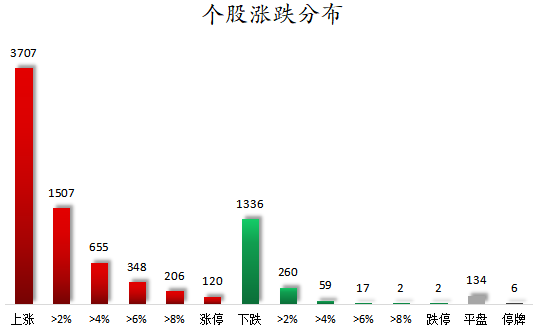
Market Overview - The Shanghai Composite Index closed at 4136.16 points, up 0.33%, with a trading volume of 1.3369 trillion yuan. The Shenzhen Component Index rose 0.79% to 14439.66 points, with a trading volume of 1.7484 trillion yuan. The ChiNext Index increased by 0.63% to 3349.50 points, with a trading volume of 822.63 billion yuan. The STAR Market 50 Index closed at 1553.71 points, up 0.78%, with a trading volume of 110.8 billion yuan. The total trading volume of both markets was 3.0853 trillion yuan, an increase of 393.5 billion yuan compared to the previous trading day [1]. Sector Performance - The market saw more sectors gaining than losing, with notable increases in power equipment, non-ferrous metals, precious metals, defense and military, steel, media, computer, environmental protection, and textile and apparel sectors. Concepts such as perovskite batteries, commercial aerospace, satellite internet, sapphire, lithium mining, cultivated diamonds, small metals, gold, and interactive short dramas were particularly active. In contrast, sectors like communication, insurance, banking, coal, and home appliances experienced declines [1]. Individual Stock Performance - A total of 3707 stocks rose, while 1336 stocks fell, with 134 stocks remaining flat and 6 stocks suspended. Excluding newly listed stocks, there were 120 stocks hitting the daily limit up and 2 stocks hitting the limit down [2]. - Among the stocks that hit the daily limit up, 23 stocks had consecutive limit-up days of 2 or more, with Fenglong Co., Ltd. leading with 18 consecutive limit-ups [3]. Capital Flow - The net capital outflow from the two markets was 4.167 billion yuan, with the ChiNext seeing a net inflow of 1.515 billion yuan. The CSI 300 index experienced a net outflow of 1.005 billion yuan, while the STAR Market saw a net outflow of 3.171 billion yuan. Out of 31 sectors, 13 sectors had net capital inflows, with the power equipment sector leading with a net inflow of 8.977 billion yuan [4][6]. - The top sectors with net inflows included non-ferrous metals (4.552 billion yuan), media (2.173 billion yuan), and defense and military (2.157 billion yuan). Conversely, the communication sector had the highest net outflow of 7.992 billion yuan, followed by electronics (6.350 billion yuan) and machinery (5.077 billion yuan) [4][6]. Notable Stocks - 191 stocks had net capital inflows exceeding 1 billion yuan, with Jin Feng Technology receiving the highest net inflow of 1.861 billion yuan. Other notable stocks included Lens Technology (1.594 billion yuan), Qian Zhao Optoelectronics (1.267 billion yuan), and Xian Dao Intelligent (1.217 billion yuan) [7][8]. - Conversely, 116 stocks experienced net capital outflows exceeding 1 billion yuan, with Xin Yi Sheng leading with a net outflow of 3.471 billion yuan, followed by Zhong Ji Xu Chuang (3.103 billion yuan) and Li Ou Shares (2.604 billion yuan) [10][11]. Institutional Activity - Institutional investors had a net selling of approximately 1.02 billion yuan, with 22 stocks seeing net purchases and 14 stocks net sales. Jin Feng Technology was the most purchased stock by institutions, with a net purchase amount of approximately 266 million yuan [13][14].
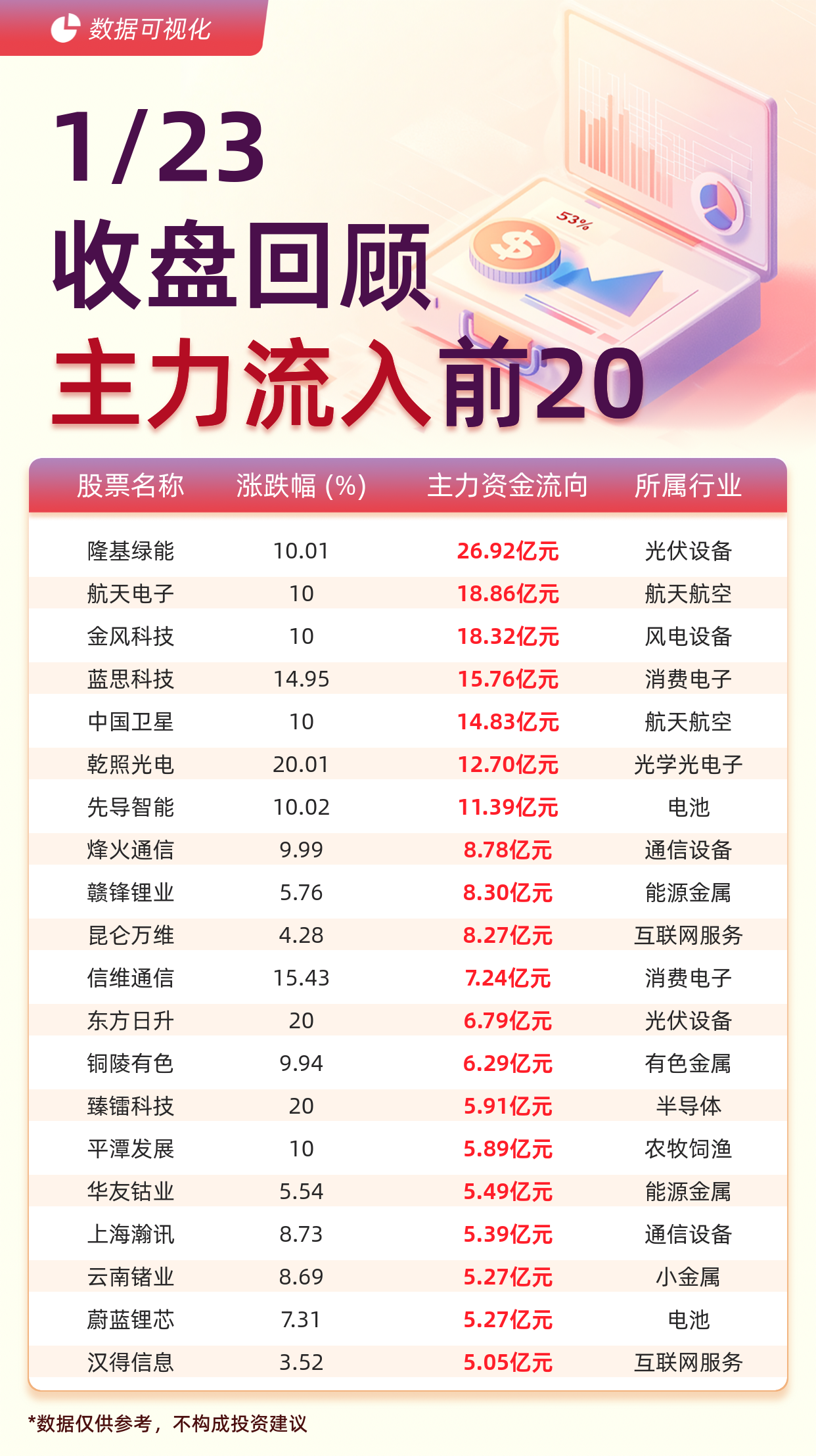
主力资金流入前20:隆基绿能流入26.92亿元、航天电子流入18.86亿元
Jin Rong Jie· 2026-01-23 07:34
Group 1 - The main stocks with significant capital inflow as of January 23 include Longi Green Energy (2.692 billion), Aerospace Electronics (1.886 billion), and Goldwind Technology (1.832 billion) [1] - Longi Green Energy experienced a price increase of 10.01% with a capital inflow of 2.692 billion [2] - Aerospace Electronics and China Satellite both saw a price increase of 10% with capital inflows of 1.886 billion and 1.483 billion respectively [2][3] Group 2 - Jin Feng Technology had a price increase of 10% and a capital inflow of 1.832 billion, indicating strong investor interest in wind energy equipment [2] - The stock of 乾照光电 (Qianzhao Optoelectronics) surged by 20.01% with a capital inflow of 1.270 billion, highlighting its performance in the optical and optoelectronic sector [2] - Other notable stocks include Yunnan Zhiye (5.27 billion) and Han's Information (5.05 billion), both showing positive capital inflows and price increases [3]



磷化铟,火了
3 6 Ke· 2026-01-23 03:28
Core Insights - The future of computing power will be determined by optical transmission efficiency, highlighting the critical role of optical interconnect technology and the growing market enthusiasm for indium phosphide (InP) materials [1][2] - The global AI infrastructure spending is expected to exceed $1 trillion by 2026, driving the rapid iteration of data center optical modules to 800G/1.6T and beyond [1] - The demand for InP materials is surging due to their unique properties, with a significant supply-demand gap projected to persist until 2026 [1][9] Group 1: InP Material Advantages - InP exhibits over ten times the electron mobility of silicon, making it suitable for high-frequency and high-speed applications, particularly in optical communication at critical wavelengths [3][4] - InP's high thermal resistance and radiation tolerance are essential for AI servers and data centers operating in high-temperature environments [3] - InP is positioned as the core material for high-end long-distance communication, outperforming silicon and gallium arsenide in efficiency and adaptability [4] Group 2: Market Demand Drivers - The explosive growth of AI data centers is the primary driver for the increasing demand for InP, with 800G optical modules becoming standard [6] - The introduction of Co-Packaged Optics (CPO) technology is expected to significantly increase the demand density for InP substrates, with a projected market growth of 166 times by 2030 [7] - In addition to data centers, InP is penetrating advanced fields such as LiDAR, 5G/6G mobile communications, low Earth orbit satellite communications, and quantum computing [8] Group 3: Global Market Dynamics - The global InP industry is characterized by a high degree of oligopoly, with major players like Sumitomo Electric and AXT dominating over 95% of the market [9] - A significant supply-demand gap is anticipated, with a projected need for 2 million InP devices by 2025 against a production capacity of only 600,000 [9] - Major manufacturers are ramping up production capacity to address this gap, with AXT planning to double its capacity by 2026 [9][10] Group 4: Domestic Industry Developments - Chinese companies are accelerating efforts to break the foreign monopoly in the InP market, with several firms achieving significant milestones in production capacity and technology [10][11] - The domestic market is witnessing a collaborative push towards a full-chain upgrade in the InP industry, enhancing quality and efficiency [12] - Government policies are supporting the development of InP materials, including tax reductions and funding for research in high-purity indium production [12] Group 5: Future Outlook and Challenges - The InP industry is on the brink of a significant scale-up, driven by the urgent need for high-performance materials in AI and optical communication [18] - Despite the promising outlook, challenges such as low crystal growth yield and high costs remain, necessitating technological advancements and cost reductions [14][15] - Geopolitical factors and export controls are creating uncertainties in the global supply chain, impacting the InP industry's growth trajectory [16]



磷化铟,火了!
半导体行业观察· 2026-01-23 01:37
Core Viewpoint - The article emphasizes the critical role of indium phosphide (InP) in the future of computing power, particularly in the context of AI and high-speed optical communication, highlighting its unique properties that make it essential for advanced applications [1][19]. Group 1: Indium Phosphide's Unique Properties - InP exhibits over ten times the electron mobility of silicon, with a maximum of 1.2×10^4 cm²/V·s, making it suitable for high-frequency applications [2]. - It is particularly advantageous in the 1310nm and 1550nm wavelengths, which are optimal for fiber optic communication, due to its direct bandgap properties [2]. - InP's high thermal resistance and radiation tolerance are crucial for AI servers and data centers operating in high-temperature environments [2]. Group 2: Market Demand and Growth Drivers - The demand for InP is driven by the explosive growth of AI data centers, with the global AI infrastructure spending expected to exceed $1 trillion by 2026 [1]. - The need for 800G and 1.6T optical modules in AI data centers is creating a rigid demand for InP, as each 800G module requires 4-8 InP laser chips [5]. - AXT predicts that the demand for optical modules connecting server racks will nearly double by 2026, with the InP industry expected to maintain an annual growth rate of over 25% [6]. Group 3: Competitive Landscape and Supply Challenges - The global InP market is dominated by a few key players, with Sumitomo Electric holding a 60% market share and AXT capturing about 35% [10]. - By 2025, the demand for InP devices is projected to reach 2 million units, while production capacity is only 600,000 units, resulting in a 70% supply-demand gap [11]. - Major companies are expanding production capacity, with AXT planning to double its capacity by 2026 and Sumitomo Electric aiming for a 40% increase [11]. Group 4: Emerging Applications and Future Prospects - InP is penetrating various advanced fields, including lidar, 5G/6G mobile communications, low Earth orbit satellite communications, and quantum computing [8]. - The global market for CPO technology is expected to grow approximately 166 times by 2030, significantly boosting the demand for InP [7]. - The InP substrate market is projected to grow from $3 billion in 2022 to $6.4 billion by 2028, with a compound annual growth rate of 13.5% [8]. Group 5: Domestic Developments and Challenges - Domestic companies in China are accelerating efforts to break the foreign monopoly in the InP market, with several firms achieving significant advancements in production technology [12]. - The Chinese government is supporting the InP industry through policy initiatives, including lowering tariffs on key materials and promoting domestic production [12]. - Despite the rapid growth, the InP industry faces challenges related to production costs and technological complexities, particularly in crystal growth processes [15][16].

上市公司TOP5济安评估 (1月12日至1月16日)|上市公司观察
Xin Lang Cai Jing· 2026-01-22 05:49
Group 1 - Institutional research activity decreased this week, with a reduction in the number of companies being surveyed, but top stocks received increased attention [1] - Xiangyu Medical (688626) was favored by 208 institutions, focusing on rehabilitation medical devices, with strong growth potential driven by aging population and health awareness [1] - The company has a solid capital structure rated BBB, indicating better financial stability compared to most listed companies, but faces challenges in operational efficiency and asset quality [1] Group 2 - SWOT analysis for Xiangyu Medical shows strengths in capital structure, but weaknesses in operational efficiency and scale, with significant room for improvement in multiple dimensions [2][3] - Opportunities exist for Xiangyu Medical to enhance operational efficiency and scale, with potential growth in market channels and cost control [2] - Threats include a notable decline in core capabilities, particularly in operational efficiency and profitability, indicating increased operational pressure [3] Group 3 - Lio Group (002131) was surveyed by 40 institutions, focusing on its dual business model of mechanical manufacturing and digital marketing, with strong interest in its growth potential in emerging sectors [5] - The company has strong scale strength rated AA, indicating significant competitive advantages, but faces challenges in cash flow and debt repayment capabilities [6] - SWOT analysis reveals Lio Group's strengths in asset quality and scale, but weaknesses in cash flow and development capabilities, with opportunities for improvement in emerging markets [7][8] Group 4 - Weichuang Electric (688698) was the subject of a survey by 35 institutions, focusing on its core products in industrial automation and its competitive advantages in the market [10] - The company has strong profitability and asset quality ratings, but faces challenges in cash flow and debt repayment capabilities [11] - SWOT analysis indicates strengths in profitability and operational efficiency, but weaknesses in cash flow and capital structure, with opportunities for growth in high-demand sectors [12][13] Group 5 - Light Optoelectronics (688150) was surveyed by 34 institutions, focusing on its core products in OLED materials and its competitive position in the market [15] - The company has strong debt repayment capabilities and a solid capital structure, but faces challenges in scale and operational efficiency [16] - SWOT analysis shows strengths in financial stability and profitability, but weaknesses in scale and operational efficiency, with significant opportunities for growth in emerging markets [17][18] Group 6 - Yunnan Ge Industry (002428) was surveyed by 32 institutions, focusing on its complete germanium industry chain and its strategic position in the market [20] - The company has a strong development capability rating, but faces significant challenges in cash flow, profitability, and operational efficiency [21] - SWOT analysis indicates strengths in development capability, but weaknesses in scale and financial stability, with opportunities for growth in commercial aerospace and semiconductor sectors [22][23]



商业航天深度报告:太空光伏大有可为,卫星太阳翼市场持续扩容
ZHONGTAI SECURITIES· 2026-01-21 00:25
Investment Rating - The report does not explicitly state an investment rating for the industry. Core Insights - The demand for satellite internet networking is urgent, and space computing opens new growth opportunities. The construction of satellite internet networks is driven by strong demand due to the advantages of wide coverage, strong disaster resistance, and rapid deployment. The International Telecommunication Union (ITU) has established principles for satellite frequency and orbit usage, leading to a competitive race for low Earth orbit resources. The construction and launch of satellite constellations in China are accelerating, with a significant gap compared to the US [4][16]. - Space computing is leading to increased demand for satellites. The traditional model of "ground computing" is evolving to "space computing," with satellites equipped with AI chips and edge computing modules to process data in orbit, significantly reducing transmission delays and processing times. Major companies are investing in space computing infrastructure, which is expected to drive the demand for satellites [17][19]. - Solar wings are the only efficient and long-term energy supply solution for near-Earth commercial space. Solar wings account for approximately 12%-24% of the satellite's value, and their area is continuously increasing, which enhances the overall power supply capacity of satellites. The transition from rigid to flexible solar wings is a key trend, with different technological routes being adopted in China and the US [4][28][38]. Summary by Sections Satellite Internet Networking - The urgent need for satellite internet networking is driven by the rapid release of rigid application demands in communication, navigation, and remote sensing. The construction of satellite internet networks is becoming increasingly critical due to limited low Earth orbit resources and the competitive landscape [11][16]. - The ITU's "first come, first served" principle has intensified the competition for satellite orbital resources, with China lagging in the completion rate of its satellite constellations compared to the US [16][18]. Space Computing - Space computing is transforming satellite demand by embedding AI capabilities into satellite systems, allowing for in-orbit data processing and reducing the need for ground-based data transmission. This shift is expected to significantly enhance the capabilities and applications of satellites [19][22]. Solar Wings - Solar wings are essential for providing continuous power to satellites, with their value accounting for a significant portion of the satellite's overall worth. The area of solar wings is increasing, which is expected to enhance the power supply capabilities of satellites [28][30]. - The transition from rigid to flexible solar wings allows for greater power generation efficiency and is particularly suited for high-power and multi-satellite launch scenarios. The flexible solar wings can achieve a higher power-to-weight ratio and better space utilization [38][45]. Technology Routes - There are notable differences in the solar wing battery technology routes between China and the US. The US primarily uses silicon solar cells due to their lower costs and established supply chains, while China is exploring gallium arsenide cells for their higher power-to-weight ratios and efficiency [51][62]. - Gallium arsenide cells are being actively explored for cost reduction, and perovskite cells are emerging as a potential next-generation solution for solar wings due to their low cost and high efficiency [65][69].


金属价格持续上行 16只个股业绩预喜
Xin Lang Cai Jing· 2026-01-20 23:56
Group 1 - The global precious metals market continues to show strength, with gold and silver prices reaching new historical records as of January 20 [1] - Since 2025, prices of various non-ferrous metals have surged, significantly enhancing the profitability of listed companies [1] - As of January 20, 16 non-ferrous metal stocks have released their 2025 annual performance data, with 12 stocks expected to report year-on-year growth in net profit attributable to shareholders [1] Group 2 - The average increase in stock prices for 13 companies expected to report profit growth or turnaround in 2026 is 16.39%, outperforming the industry index which rose by 12.73% [1] - Notably, companies like Xianglu Tungsten and China Uranium have seen cumulative increases of over 40% since the beginning of the year [1] - There has been significant institutional interest in the sector, with 17 non-ferrous metal stocks undergoing institutional research since 2026, and 8 of these stocks receiving attention from more than 10 institutions [1]