
RSPC(002493)

Search documents
炼化及贸易板块11月25日跌0.04%,和顺石油领跌,主力资金净流入1.54亿元
Zheng Xing Xing Ye Ri Bao· 2025-11-25 09:10
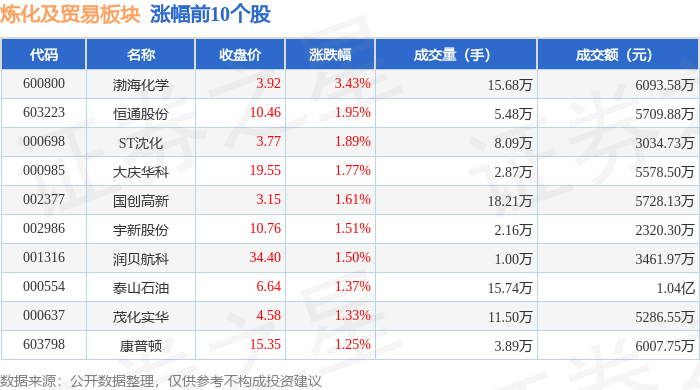
Core Viewpoint - The refining and trading sector experienced a slight decline of 0.04% on November 25, with Heshun Petroleum leading the losses, while the overall market indices showed positive movements, with the Shanghai Composite Index rising by 0.87% and the Shenzhen Component Index increasing by 1.53% [1][2]. Group 1: Market Performance - The Shanghai Composite Index closed at 3870.02, up 0.87% [1]. - The Shenzhen Component Index closed at 12777.31, up 1.53% [1]. - The refining and trading sector saw a net inflow of 154 million yuan from main funds, while retail investors experienced a net outflow of 239 million yuan [2][3]. Group 2: Individual Stock Performance - Heshun Petroleum (603353) closed at 28.44, down 1.96% with a trading volume of 92,100 shares and a transaction value of 26.9 million yuan [2]. - China Petroleum (600028) closed at 5.80, down 0.68%, with a trading volume of 1,513,500 shares and a transaction value of 875 million yuan [2]. - Bohai Chemical (600800) closed at 3.92, up 3.43%, with a trading volume of 156,800 shares and a transaction value of 60.94 million yuan [1]. Group 3: Fund Flow Analysis - Major funds showed a net inflow of 80.57 million yuan for China Petroleum, while retail investors had a net outflow of 39.5 million yuan [3]. - Rongsheng Petrochemical (002493) had a net inflow of 43.55 million yuan from major funds but a net outflow of 75.79 million yuan from retail investors [3]. - The overall trend indicates that while major funds are entering the market, retail investors are withdrawing, reflecting a cautious sentiment among smaller investors [2][3].





石油石化行业今日跌1.21%,主力资金净流出5.30亿元
Zheng Quan Shi Bao Wang· 2025-11-24 13:16
Market Overview - The Shanghai Composite Index rose by 0.05% on November 24, with 19 sectors experiencing gains, led by defense and military industry (up 4.31%) and media (up 3.49%) [1] - The oil and petrochemical sector saw the largest decline, down 1.21%, followed by coal, which fell by 1.09% [1] Capital Flow - The main capital outflow from both markets totaled 10.192 billion yuan, with 11 sectors seeing net inflows [1] - The defense and military sector had the highest net inflow of 5.466 billion yuan, while the media sector followed with 2.542 billion yuan [1] - The electronic sector experienced the largest net outflow, totaling 6.708 billion yuan, followed by the power equipment sector with 2.087 billion yuan [1] Oil and Petrochemical Sector Analysis - The oil and petrochemical sector experienced a decline of 1.21%, with a net capital outflow of 530 million yuan [2] - Out of 47 stocks in this sector, 24 rose, including one that hit the daily limit, while 20 fell [2] - The top net inflow stocks included Rongsheng Petrochemical (43.186 million yuan), Huibo Technology (31.2136 million yuan), and Bomaike (25.2525 million yuan) [2] Individual Stock Performance - Major stocks with significant net outflows included China Petroleum (-2.49%, -316.2775 million yuan), China National Offshore Oil Corporation (-3.15%, -157.0026 million yuan), and Guanghui Energy (-0.59%, -42.7184 million yuan) [3][4] - Stocks with notable gains included Bomaike (up 10.01%, 25.2525 million yuan) and Huibo Technology (up 2.65%, 31.2136 million yuan) [4]



俄炼厂遭袭 中国成品油出口与硫黄市场迎机遇
Zhong Guo Hua Gong Bao· 2025-11-24 12:06
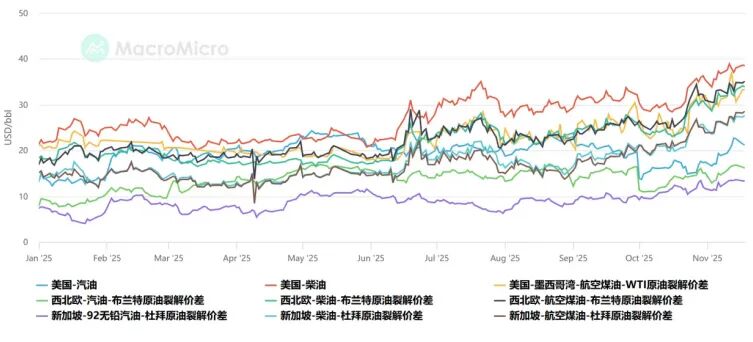
Core Viewpoint - The ongoing drone attacks by Ukraine on Russian energy infrastructure have significantly impacted Russia's refining capacity, leading to a surge in global oil product prices and creating new opportunities for China's oil product exports and sulfur industry [1][4][10]. Group 1: Impact on Russian Refining Capacity - Since November 2025, Ukraine has conducted multiple drone strikes targeting key Russian refineries, including Ryazan, Samara, and Volgograd, resulting in a 6% decrease in overall Russian refining output [1]. - The Ryazan refinery, one of Russia's four major refineries with an annual processing capacity of 13.1 million tons (340,000 barrels per day), suffered damage to its distillation units and fuel storage tanks [1]. - The Volgograd refinery, with an annual capacity of 15.7 million tons, has faced multiple shutdowns due to these attacks, further exacerbating the decline in Russian refining capacity [1]. Group 2: Global Oil Product Price Surge - The reduction in Russian refining capacity has led to a significant increase in overseas oil product crack spreads, with the 3-2-1 crack spread reaching $32.13 per barrel, the highest level since March 2024, reflecting a more than 30% increase from October's average [2]. - Diesel prices have seen the most substantial rise among oil products, indicating a high-profit cycle for the refining industry [2]. Group 3: Sulfur Market Dynamics - The attacks have also disrupted sulfur production, as Russia is the second-largest sulfur producer globally, accounting for 15%-20% of the world's supply [4]. - Domestic sulfur prices have surged, with the port spot index reaching 3,990 yuan per ton in late November, marking an increase of over 1,000 yuan per ton in just over a month and a rise of approximately 2,500 yuan per ton since the beginning of the year [4]. - Forecasts suggest that sulfur prices may exceed 5,000 yuan per ton in 2026 due to a tight supply-demand balance [4]. Group 4: Opportunities for Chinese Companies - The international supply gap has created a favorable window for China's oil product exports, with a total export quota of 40.195 million tons for 2025 [7]. - Major state-owned enterprises dominate China's oil product export market, with Sinopec and PetroChina holding significant shares [7]. - The sulfur industry in China is experiencing a dual benefit of rising prices and increasing demand, particularly due to the growth in the new energy sector and solid-state battery technology [7][8]. Group 5: Market Position of Leading Companies - China's total sulfur production capacity is approximately 16.8 million tons per year, with Sinopec, PetroChina, and Rongsheng Petrochemical being the top three producers, collectively holding over 70% of the market share [8][10]. - A price increase of 100 yuan in sulfur can lead to significant profit gains for leading companies, indicating a positive outlook for profitability in the current high-demand environment [8].
炼化及贸易板块11月24日跌2.15%,和顺石油领跌,主力资金净流出4.49亿元
Sou Hu Cai Jing· 2025-11-24 09:19
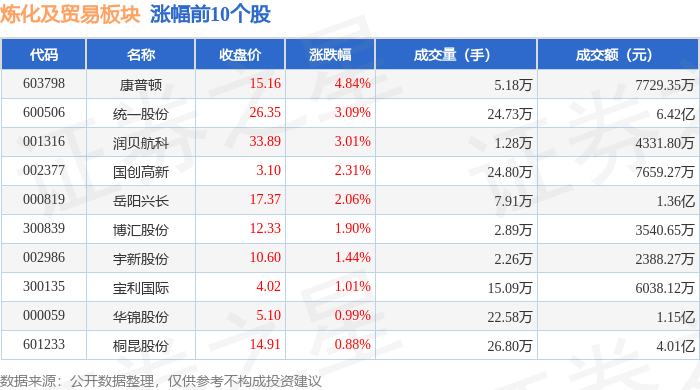
Market Overview - The refining and trading sector experienced a decline of 2.15% on November 24, with Heshun Petroleum leading the drop [1] - The Shanghai Composite Index closed at 3836.77, up 0.05%, while the Shenzhen Component Index closed at 12585.08, up 0.37% [1] Stock Performance - Notable gainers in the refining and trading sector included: - Compton (603798) with a closing price of 15.16, up 4.84% [1] - Unified Shares (600506) at 26.35, up 3.09% [1] - Runbei Aerospace (001316) at 33.89, up 3.01% [1] - Major decliners included: - Heshun Petroleum (603353) at 29.01, down 5.17% [2] - Rongsheng Petrochemical (002493) at 9.52, down 2.96% [2] - China Petroleum (601857) at 9.78, down 2.49% [2] Capital Flow - The refining and trading sector saw a net outflow of 449 million yuan from main funds, while retail funds had a net inflow of 262 million yuan [2] - The following stocks had significant capital flows: - Rongsheng Petrochemical had a main fund net inflow of 42.31 million yuan, but retail funds saw a net outflow of 22.34 million yuan [3] - Compton had a main fund net inflow of 7.05 million yuan, with retail funds experiencing a net outflow of 9.01 million yuan [3]


ETF盘中资讯 | 化工板块意外回调!热门板块领跌,是风险还是布局良机?细分化工指数年内涨幅仍超24%傲视大盘
Sou Hu Cai Jing· 2025-11-24 06:59
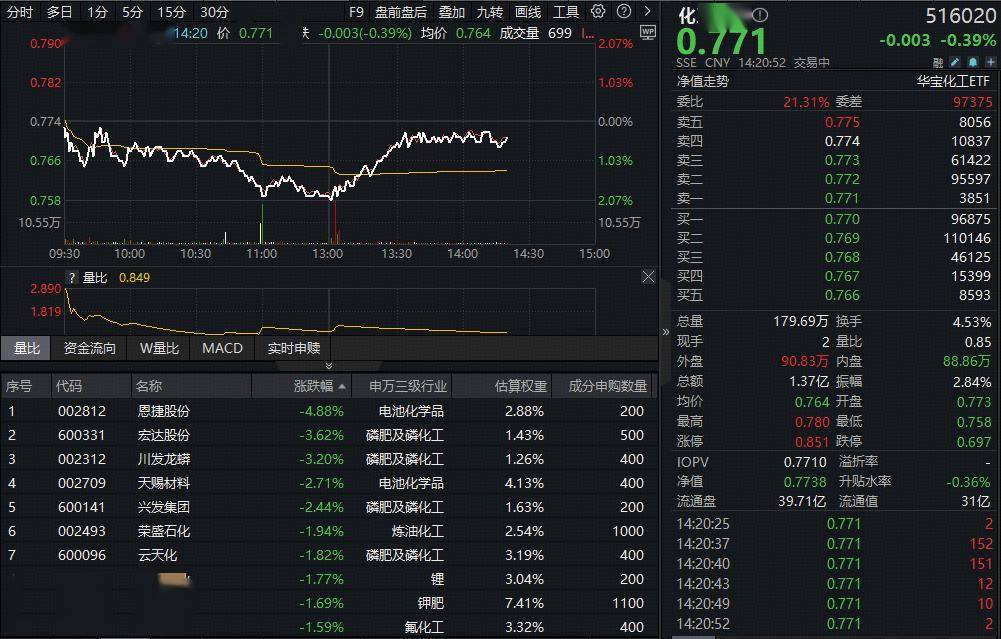
Group 1 - The chemical sector continues to experience a downward trend, with the Chemical ETF (516020) showing a decline of 0.39% as of the latest update, after a drop of over 2% during the day [1] - Key stocks in the lithium battery and phosphate chemical sectors have seen significant declines, with Enjie Co. down over 4%, and Hongda Co. and Chuanfa Longmang both down over 3% [1] - The Chemical ETF has shown a year-to-date increase of 24.89%, outperforming major A-share indices such as the Shanghai Composite Index (14.41%) and the CSI 300 Index (13.18%) [1][3] Group 2 - The basic chemical industry is expected to benefit from supply-side reforms driven by "anti-involution" policies, leading to an improved supply-demand balance and increased market share for leading companies [4] - The phosphoric and potash sectors are experiencing high demand, with stable prices for phosphate rock and steady growth in potash demand [4] - The valuation of the Chemical ETF is relatively low, with a price-to-book ratio of 2.28, indicating a favorable long-term investment opportunity [4] Group 3 - The Chemical ETF (516020) tracks the sub-sector chemical industry index, covering various segments of the chemical industry, with nearly 50% of its holdings in large-cap leading stocks [5] - Investors can also access the chemical sector through linked funds of the Chemical ETF, enhancing investment efficiency [5]



——基础化工行业周报:DMC、电解液、磷酸二胺价格上涨,关注反内卷和铬盐-20251123
Guohai Securities· 2025-11-23 11:02
Investment Rating - The report maintains a "Recommended" rating for the chemical industry [1] Core Views - The chemical industry is expected to benefit from the ongoing "anti-involution" measures, which may lead to a significant slowdown in global chemical capacity expansion. This shift is anticipated to enhance cash flow and dividend yields for companies in the sector, transforming them from cash-consuming entities to cash-generating ones [7][27] - The report highlights the potential for domestic substitutes for Japanese semiconductor materials due to rising tensions in Sino-Japanese relations, which could accelerate the domestic market's growth in this area [6] Summary by Sections Recent Trends - The chemical industry has shown a relative performance increase of 16.1% over the past 12 months, outperforming the CSI 300 index, which increased by 11.6% [4] Key Price Movements - DMC (Dimethyl Carbonate) prices rose to 4400 CNY/ton, up 14.29% week-on-week, driven by strong demand from the electrolyte sector [14] - Lithium battery electrolyte prices increased to 27000 CNY/ton, up 8.00% week-on-week, although profit margins for manufacturers are under pressure due to rising raw material costs [14] - Diammonium phosphate prices in East China reached 3850 CNY/ton, up 5.48% week-on-week, amid rising production costs [14] Investment Opportunities - The report identifies four key opportunities in the chemical sector: 1. Low-cost expansion, focusing on companies like Wanhua Chemical and Hualu Hengsheng [9] 2. Improved industry conditions, particularly in chromium salts and phosphate rock [10] 3. New materials with high growth potential, such as electronic chemicals and aerospace materials [11] 4. High dividend yields from state-owned enterprises in the chemical sector, including China Petroleum and China National Chemical [11] Company Tracking and Earnings Forecast - The report provides a detailed earnings forecast for key companies, indicating a positive outlook for several firms in the chemical sector, with many rated as "Buy" [28]



石油化工行业周报(2025/11/17—2025/11/23):IEA如何看待石油长期需求?-20251123
Shenwan Hongyuan Securities· 2025-11-23 09:35
Investment Rating - The report provides a positive investment outlook for the petrochemical sector, highlighting specific companies for investment opportunities [10]. Core Insights - The IEA projects that under the Current Policies Scenario (CPS), global oil demand will steadily increase, reaching 105 million barrels per day by 2035 and 113 million barrels per day by 2050, with an average annual growth of approximately 500,000 barrels per day [3][4]. - In the Established Policies Scenario (STEPS), oil demand is expected to peak around 2030, with a decline anticipated thereafter, primarily driven by the rapid growth of electric vehicles in China [6][10]. - Emerging markets, particularly India, Southeast Asia, and Africa, are expected to account for nearly all oil demand growth, while developed economies will see a decline in consumption [4][6]. Summary by Sections Oil Demand Projections - Under CPS, oil demand is projected to rise to 105 million barrels per day by 2035, with significant contributions from petrochemical, aviation, and industrial sectors [3][4]. - In STEPS, oil demand is expected to peak around 2030, with a subsequent decline influenced by the rise of electric vehicles, particularly in China [6]. Regional Demand Insights - India is projected to lead global oil demand growth, increasing from 5.5 million barrels per day in 2024 to 8 million barrels per day by 2035 [4]. - Africa's oil demand is expected to grow by one-third to approximately 6 million barrels per day by 2035, driven by road transport needs [4]. Investment Recommendations - The report recommends investing in high-quality companies in the polyester sector, such as Tongkun Co. and Wankai New Materials, due to tightening supply and improving market conditions [10]. - It also suggests focusing on major refining companies like Hengli Petrochemical and Rongsheng Petrochemical, which are expected to benefit from improved cost structures and competitive advantages [10]. Price Trends and Market Conditions - As of November 21, Brent crude oil prices were reported at $62.56 per barrel, reflecting a decrease of 2.84% from the previous week [15]. - The report notes that the overall oil price is expected to maintain a neutral level through 2026, with limited downside potential [10].

石油化工行业周报:IEA如何看待石油长期需求?-20251123
Shenwan Hongyuan Securities· 2025-11-23 08:14
Investment Rating - The report maintains a positive outlook on the oil and petrochemical industry, indicating a favorable investment environment [2][3]. Core Insights - The IEA projects that under the Current Policies Scenario (CPS), oil demand will steadily increase, reaching 105 million barrels per day by 2035 and 113 million barrels per day by 2050, with an average annual growth of approximately 500,000 barrels per day [2][3]. - In the Stated Policies Scenario (STEPS), oil demand is expected to peak around 2030, with a forecasted decline to 100 million barrels per day by 2035, averaging a decrease of about 200,000 barrels per day from 2035 to 2050 [2][7]. - The report highlights that the growth in oil demand will primarily occur in emerging markets and developing economies, with India leading the demand increase, projected to rise from 5.5 million barrels per day in 2024 to 8 million barrels per day by 2035 [4][7]. Summary by Sections Upstream Sector - As of November 21, Brent crude oil futures closed at $62.56 per barrel, a decrease of 2.84% from the previous week, while WTI futures fell by 3.38% to $58.06 per barrel [16]. - The report notes a trend of widening supply-demand dynamics in crude oil, with expectations of downward pressure on prices, although OPEC production cuts and shale oil cost support are likely to maintain prices at moderate to high levels [2][16]. Refining Sector - The report indicates that the Singapore refining margin for major products increased to $26.66 per barrel, up by $2.44 from the previous week [53]. - The domestic refining product price differentials have improved, suggesting a potential for enhanced profitability as economic recovery progresses [50][53]. Polyester Sector - The report observes a tightening supply-demand balance in the downstream polyester sector, with expectations for improved market conditions, particularly for high-quality companies in the polyester filament sector [11]. - The PTA price has shown an upward trend, with the average price in East China reaching 4626.8 yuan per ton, reflecting a 0.90% increase [11]. Investment Recommendations - The report recommends focusing on high-quality companies in the polyester filament sector, such as Tongkun Co., and bottle-grade companies like Wankai New Materials [11]. - It also suggests monitoring large refining companies like Hengli Petrochemical and Rongsheng Petrochemical due to expected improvements in cost structures and competitive advantages [11]. - For upstream exploration and development, companies like CNOOC and Haiyou Engineering are highlighted as having strong growth prospects [11].
大炼化周报:局部地区春季订单开始释放,长丝盈利仍在改善-20251123
Xinda Securities· 2025-11-23 07:03
Investment Rating - The report does not explicitly state an investment rating for the oil refining industry. Core Insights - The report highlights that spring orders are beginning to be released in certain regions, and the profitability of polyester filament continues to improve [1]. Summary by Sections Domestic and International Refining Project Price Differentials - As of November 21, 2025, the domestic key refining project price differential is 2389.69 CNY/ton, with a week-on-week increase of 52.43 CNY/ton (+2.24%). The international key refining project price differential is 1446.16 CNY/ton, with a week-on-week increase of 6.66 CNY/ton (+0.46%) [2][3]. Refining Sector - The report notes that the end of the U.S. government shutdown is expected to boost demand. Geopolitical tensions, particularly the attack on the Russian port of Novorossiysk, raise concerns about supply disruptions from Russia. The Brent and WTI crude oil prices as of November 21, 2025, are 62.56 USD/barrel and 58.06 USD/barrel, respectively, reflecting decreases of 1.83 USD and 2.03 USD from the previous week [2][15]. Chemical Sector - The chemical price differentials are showing a fluctuating trend. Polyethylene prices are stable, while polypropylene demand remains weak, leading to price declines. The report indicates that the price of pure benzene remains stable, with a slight increase in its price differential [2][57]. Polyester & Nylon Sector - Demand for polyester filament is gradually being released, with product prices and profits showing slight increases. The report mentions that two new production facilities have been commissioned, although they have not yet started production. The prices of nylon fiber products have slightly increased, while the price differential has significantly decreased [2][57]. Stock Performance of Major Refining Companies - As of November 21, 2025, the stock price changes for six major private refining companies over the past week are as follows: Rongsheng Petrochemical (-9.17%), Hengli Petrochemical (-5.29%), Dongfang Shenghong (-3.44%), Hengyi Petrochemical (-3.01%), Tongkun Co. (-6.04%), and Xin Fengming (-9.63%). Over the past month, stock price changes are: Rongsheng Petrochemical (+4.58%), Hengli Petrochemical (+14.38%), Dongfang Shenghong (+7.91%), Hengyi Petrochemical (+10.44%), Tongkun Co. (+11.55%), and Xin Fengming (+7.98%) [2].
荣盛石化跌2.07%,成交额1.72亿元,主力资金净流出2043.11万元
Xin Lang Cai Jing· 2025-11-20 03:27
Core Viewpoint - Rongsheng Petrochemical's stock price has experienced fluctuations, with a recent decline of 2.07% and a year-to-date increase of 16.02% [1] Financial Performance - For the period from January to September 2025, Rongsheng Petrochemical reported a revenue of 227.81 billion yuan, a year-on-year decrease of 7.09%, while the net profit attributable to shareholders was 0.888 billion yuan, reflecting a year-on-year growth of 1.34% [2] - Cumulative cash dividends since the company's A-share listing amount to 9.4 billion yuan, with 3.391 billion yuan distributed over the past three years [3] Shareholder Information - As of September 30, 2025, the number of shareholders for Rongsheng Petrochemical was 73,700, a decrease of 14.14% from the previous period, while the average circulating shares per person increased by 14.80% to 126,986 shares [2] - The top ten circulating shareholders include Hong Kong Central Clearing Limited, which holds 191 million shares, an increase of 17.06 million shares from the previous period [3] Market Activity - As of November 20, 2025, the stock price was 10.39 yuan per share, with a trading volume of 1.72 billion yuan and a turnover rate of 0.17% [1] - The net outflow of main funds was 20.43 million yuan, with significant selling pressure observed [1] Business Overview - Rongsheng Petrochemical, established on September 15, 1995, and listed on November 2, 2010, is primarily engaged in the research, production, and sales of various chemical products, oil products, and polyester products [1] - The company's revenue composition includes chemicals (40.87%), refining (35.26%), PTA (10.60%), polyester film (7.49%), and trade and others (5.79%) [1] Industry Classification - Rongsheng Petrochemical is classified under the Shenwan industry as part of the petroleum and petrochemical sector, specifically in refining and chemical trade [1] - The company is associated with several concept sectors, including oil and gas reform, solar energy, photovoltaic glass, and the Belt and Road Initiative [1]