Guangdong Xinbao Electrical Appliances (002705)

Search documents
新宝股份:公司出口美国的产品主要采用FOB交易模式
Zheng Quan Ri Bao Wang· 2025-10-16 11:10
Core Viewpoint - The company, Xinbao Co., Ltd. (002705), primarily utilizes the FOB trading model for its products exported to the United States, where the buyer is responsible for customs clearance and tax payments [1] Group 1 - The company answered investor inquiries on October 16 regarding its export practices [1] - The FOB trading model indicates that the responsibility for customs clearance lies with the buyer [1] - This trading model may impact the company's pricing strategy and competitiveness in the U.S. market [1]

小家电板块10月16日跌1.29%,比依股份领跌,主力资金净流出1.21亿元
Zheng Xing Xing Ye Ri Bao· 2025-10-16 08:20
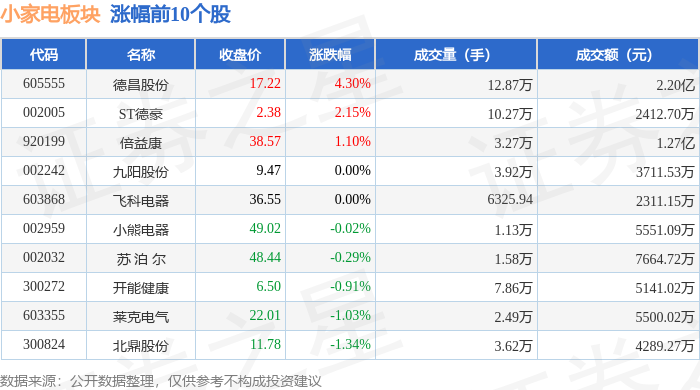
Market Overview - The small home appliance sector experienced a decline of 1.29% on October 16, with Biyi Co., Ltd. leading the losses [1] - The Shanghai Composite Index closed at 3916.23, up 0.1%, while the Shenzhen Component Index closed at 13086.41, down 0.25% [1] Stock Performance - Notable gainers in the small home appliance sector included: - Dechang Co., Ltd. (605555) with a closing price of 17.22, up 4.30% and a trading volume of 128,700 shares [1] - ST Dehao (002005) closed at 2.38, up 2.15% with a trading volume of 102,700 shares [1] - Key decliners included: - Biyi Co., Ltd. (603215) closed at 20.70, down 4.43% with a trading volume of 82,200 shares [2] - Stone Technology (688169) closed at 179.00, down 2.92% with a trading volume of 40,900 shares [2] Capital Flow - The small home appliance sector saw a net outflow of 121 million yuan from main funds, while retail investors contributed a net inflow of 106 million yuan [2] - The detailed capital flow for selected stocks showed: - Dechang Co., Ltd. had a main fund net inflow of 23.91 million yuan, while retail investors had a net outflow of 20.03 million yuan [3] - Leike Electric (603355) experienced a main fund net inflow of 6.84 million yuan, with retail investors also seeing a net outflow of 10.12 million yuan [3]


“中国第一展”广交会开幕
Shen Zhen Shang Bao· 2025-10-15 22:59
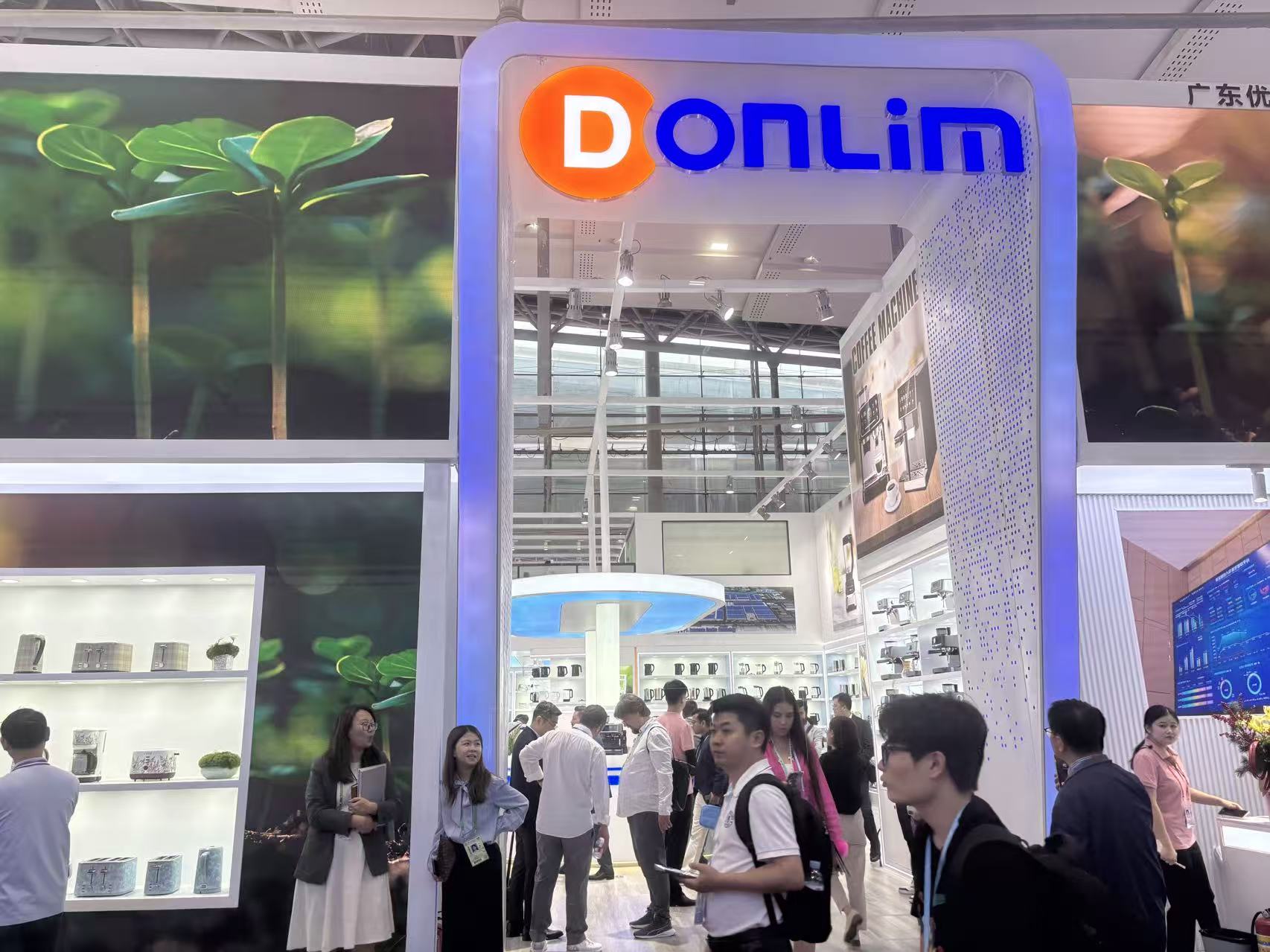
Group 1 - The 138th Canton Fair has gathered 32,000 enterprises showcasing cutting-edge products across 155,000 square meters with 74,600 booths, attracting buyers from 217 countries and regions [1] - Chinese exhibitors have adapted to changing trade dynamics, enhancing their capabilities in overseas manufacturing, brand export, and high-end product innovation, demonstrating increased confidence in global markets [1] - Ningbo Daye Garden Equipment Co., Ltd. has transformed from OEM to a brand leader, with 98% of its business in exports, particularly in North America and Europe, where it holds a significant market share [1] Group 2 - Xinbao Co., Ltd. has seen a strong turnout at its booth, with a 2.49% year-on-year increase in overseas market revenue, reaching over 6.07 billion yuan in the first half of the year, particularly thriving in emerging markets like the Middle East, Africa, and Latin America [2] - The company is transitioning from a small appliance manufacturer to a globally recognized electrical enterprise, expanding its product range and enhancing its overseas production capacity, particularly in Indonesia [2] - Xinbao's strategy includes establishing research institutes in Shenzhen to support its growth and innovation in the electrical manufacturing sector [2]
小家电板块10月15日涨0.44%,倍益康领涨,主力资金净流出1.15亿元
Zheng Xing Xing Ye Ri Bao· 2025-10-15 08:29
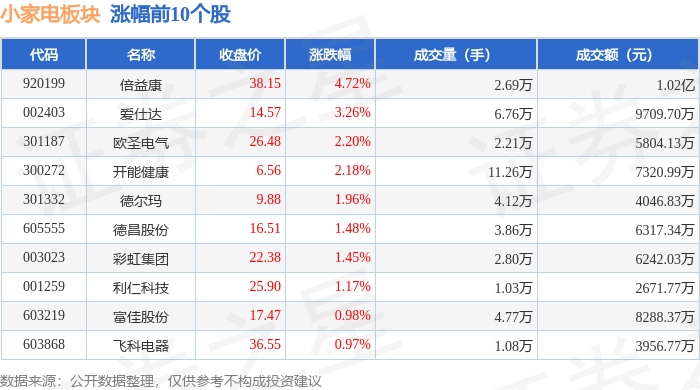
Market Overview - The small home appliance sector increased by 0.44% on October 15, with BeiYikang leading the gains [1] - The Shanghai Composite Index closed at 3912.21, up 1.22%, while the Shenzhen Component Index closed at 13118.75, up 1.73% [1] Stock Performance - BeiYikang (code: 6610Z6) closed at 38.15, rising by 4.72% with a trading volume of 26,900 lots and a transaction value of 102 million yuan [1] - Other notable performers include: - Aishida (code: 002403) at 14.57, up 3.26% [1] - Ousheng Electric (code: 301187) at 26.48, up 2.20% [1] - Kaineng Health (code: 300272) at 6.56, up 2.18% [1] - Delma (code: 301332) at 9.88, up 1.96% [1] Capital Flow - The small home appliance sector experienced a net outflow of 115 million yuan from institutional investors, while retail investors saw a net inflow of 94.22 million yuan [2] - The capital flow for specific stocks includes: - Xinbao (code: 002705) with a net inflow of 12.21% from institutional investors [3] - Feike Electric (code: 603868) with a net inflow of 18.64% from retail investors [3] - Kaineng Health (code: 300272) with a net outflow of 1.35% from retail investors [3]


小家电板块10月13日跌3.15%,比依股份领跌,主力资金净流出1.39亿元
Zheng Xing Xing Ye Ri Bao· 2025-10-13 12:38
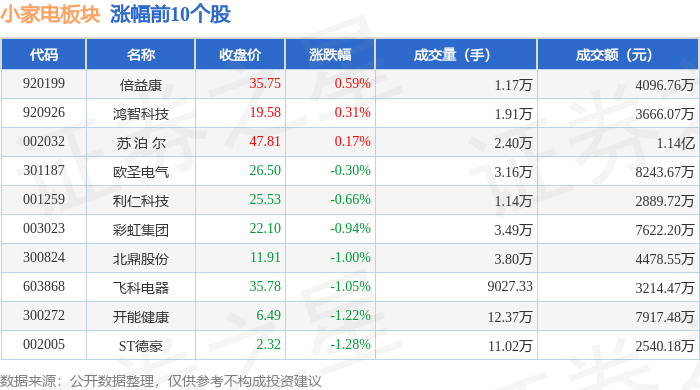
Market Overview - The small home appliance sector experienced a decline of 3.15% on October 13, with Bei Yi Co. leading the drop [1] - The Shanghai Composite Index closed at 3889.5, down 0.19%, while the Shenzhen Component Index closed at 13231.47, down 0.93% [1] Stock Performance - Key stocks in the small home appliance sector showed varied performance, with Bei Yi Co. closing at 22.88, down 5.26%, and Kewo Si at 97.49, also down 5.26% [2] - Other notable declines included Stone Technology at 187.50, down 5.20%, and Xin Bao Co. at 15.42, down 3.81% [2] Trading Volume and Capital Flow - The small home appliance sector saw a net outflow of 139 million yuan from main funds, while retail investors contributed a net inflow of 97.90 million yuan [2] - The trading volume for key stocks included 136,200 shares for Bei Yi Co. and 51,400 shares for Kewo Si, indicating significant trading activity despite the overall decline [2] Individual Stock Capital Flow - Among individual stocks, Jiu Yang Co. had a main fund net inflow of 3.68 million yuan, while Fu Jia Co. experienced a net outflow of 1.32 million yuan from main funds [3] - Retail investors showed a preference for stocks like Su Po Er, which had a net inflow of 4.19 million yuan from retail investors, despite a net outflow from main funds [3]


家电行业2025年三季报业绩前瞻:内销将面临以旧换新高基数,关税扰动下出口不改长期增长趋势
Shenwan Hongyuan Securities· 2025-10-13 10:15
Investment Rating - The report maintains a positive outlook on the home appliance industry, particularly for the white goods sector, indicating a "Buy" recommendation for key players like Midea, Haier, and Gree [4][8]. Core Insights - The home appliance sector is benefiting from real estate policies and the "trade-in" program, leading to a sustained growth trend in domestic sales [6][14]. - The report highlights three main investment themes: white goods, export opportunities, and core components, with a focus on companies that are expected to outperform in these areas [8][17]. Summary by Sections 1. Domestic Sales Growth - From January to August 2025, the air conditioning industry produced 149.32 million units, a 6% year-on-year increase, with sales reaching 152.57 million units, up 7%, and domestic sales growing by 9% [6][14]. - The refrigerator and washing machine sectors also saw domestic sales growth of 4% and 6%, respectively, during the same period [6][14]. 2. White Goods and Components - The report notes that the average price of white goods is increasing due to the trade-in program, with air conditioning prices expected to rise further [27]. - Key companies are projected to show varied performance in Q3 2025, with Midea expected to see a 3% revenue increase and an 8% rise in profits, while Gree anticipates flat revenue and profit [28][29]. 3. Kitchen Appliances - The kitchen appliance sector is experiencing a recovery driven by real estate and trade-in policies, with significant growth in online sales for range hoods and gas stoves [6][14]. - Major players like Robam and Vatti are expected to see mixed results, with Robam projecting a 2% revenue increase but a 7% decline in profits [6][14]. 4. Small Appliances - The small appliance sector is benefiting from domestic trade-in policies, with companies like Supor and Joyoung expected to see revenue growth of 3% and a profit turnaround, respectively [6][14]. - The report highlights significant growth for companies like Stone Technology, which anticipates an 80% revenue increase [6][14]. 5. New Displays and Lighting - The emerging display sector is at a turning point, with companies like Hisense and Xiaomi expected to report revenue growth of 8% and 15%, respectively [6][14]. - The lighting industry is anticipated to see gradual improvements as market conditions stabilize [6][14]. 6. Investment Highlights - The report emphasizes the attractiveness of the white goods sector due to its low valuation, high dividends, and stable growth potential, recommending a combination of leading companies [8][17]. - Export opportunities are highlighted for companies like Ousheng Electric and Dechang, which are expected to benefit from increased orders and stable profitability [8][17]. 7. Trade-in Policy Impact - The trade-in policy has been expanded to include 12 categories of appliances, significantly boosting sales and consumer interest [17][18]. - The report notes that the trade-in program has already led to over 62 million units sold in 2024, generating nearly 270 billion yuan in consumption [17][18].





关税税率频繁变化下,中国依旧是全球最具竞争力的小家电生产基地
Di Yi Cai Jing· 2025-10-13 01:13
Core Insights - Despite fluctuating tariff rates in the US over the past six months, Chinese small appliance exporters are seeking ways to adapt and remain competitive, with many concluding that China remains the most competitive production base globally [1][4] Group 1: Company Strategies - Some small appliance companies, like Letu Electric, have paused plans to establish factories in Southeast Asia due to rising costs and insufficient local infrastructure [1] - Letu Electric's general manager noted that labor costs in Malaysia have increased by 7%-8% over the past six months, making manufacturing costs approximately 15% higher than in China [1] - Companies that do not heavily rely on the US market are less inclined to set up overseas factories, with many preferring to explore alternative markets instead [3] Group 2: Industry Trends - Leading companies in the appliance sector, such as Xinbao, have already established overseas operations to mitigate external uncertainties, with Xinbao's Indonesian factory showing growth in exports [4] - Data indicates a decline in exports of various small appliances from China to the US, highlighting the impact of changing tariffs on kitchen appliance exports [4] - Industry experts suggest that in a complex trade environment, appliance exporters should focus on innovation and diversifying markets, especially for small enterprises facing challenges in global expansion [4]
关税变数下,中国仍是全球最具竞争力的小家电生产基地
Di Yi Cai Jing· 2025-10-12 10:12
Core Insights - Despite fluctuating tariff rates in the US over the past six months, Chinese small appliance exporters are actively seeking ways to adapt to the situation [2][3][4] - Many small and medium-sized enterprises (SMEs) are reconsidering plans to establish factories overseas, particularly in Southeast Asia, due to rising costs and insufficient local infrastructure [2][4] - Leading companies in the appliance industry have already established overseas operations to mitigate external uncertainties [5] Group 1: Company Strategies - Companies like Letu Electric have paused plans to set up factories in Southeast Asia, citing concerns over labor costs and energy reliability [2] - The monthly salary for workers in Malaysia has increased by 7%-8% in the past six months, making manufacturing costs there approximately 15% higher than in China [2] - New Bao, a leading small appliance exporter, has successfully established a factory in Indonesia, reporting significant export growth [5] Group 2: Market Dynamics - The proportion of US customers for many SMEs is relatively low, leading to a cautious approach towards overseas factory establishment [4] - In Ningbo, only about 20 out of over 3,000 appliance companies are considering overseas factories as a response to tariff impacts [4] - The overall export value of various small appliances from China has seen a decline, particularly in kitchen appliances to the US market [5] Group 3: Industry Trends - There is a growing trend among upstream component suppliers in China to follow their clients abroad, although local supply chains in regions like Mexico are not yet fully developed [3] - Industry experts suggest that innovation and market diversification are crucial for SMEs to navigate the complex trade environment [5]
家用电器:假期消费专题:出境游、线下演出高景气——25W40周观点-20251012
Huafu Securities· 2025-10-12 10:11
Investment Rating - The report maintains an "Outperform" rating for the industry [7] Core Insights - The report highlights a significant increase in holiday travel and consumption, with an average of 3.04 billion people traveling daily from October 1 to 8, a year-on-year increase of 6.3% [3][11] - Domestic consumption is showing steady improvement, with average daily sales in related sectors increasing by 4.5% during the holiday period, driven by strong performance in digital products, jewelry, and cultural services [3][15] - The offline performance of the entertainment sector is robust, with a 39.5% year-on-year increase in audience numbers for live performances during the holiday [3][20] Summary by Sections Holiday Consumption Trends - The report notes a rise in domestic travel, with 8.88 billion domestic trips taken during the holiday, an increase of 1.23 billion trips compared to the previous year [11][12] - The average spending per person decreased by 13% despite the increase in total expenditure, which reached 809 billion yuan [11][12] Retail and E-commerce Performance - Key retail and catering enterprises saw a 2.7% year-on-year increase in sales during the holiday [19] - E-commerce platforms experienced a surge in sales of green organic foods (up 27.9%), smart home products (up 14.3%), and domestic fashion brands (up 14.1%) [19][20] Investment Recommendations - The report suggests focusing on several sectors for potential investment, including: 1. Major appliances benefiting from trade-in programs, recommending companies like Midea Group, Haier Smart Home, and Gree Electric [4][23] 2. The pet industry, which is expected to remain resilient, with recommendations for companies like Guai Bao Pet and Zhongchong Co [4][23] 3. Small appliances and branded apparel, which may see a rebound in demand, with recommendations for companies like Bear Electric and Anta Sports [4][23] 4. Electric two-wheelers, with a strong outlook for domestic sales improvement, recommending companies like Ninebot and Yadea [4][23] Global Market Opportunities - The report emphasizes the long-term theme of international expansion, recommending companies like Ecovacs and Roborock in the cleaning appliance sector, and Midea and Haier in the major appliance sector [5][24] - It also highlights the potential for motorcycle brands to increase their market share overseas, suggesting companies like Chunfeng Power and Longxin General [5][24] Market Data - The home appliance sector saw a slight decline of 0.4% this week, with specific segments showing varied performance: white goods up 0.8%, black goods down 0.3%, and kitchen appliances down 1.0% [25]




2025年上海市搅拌机产品质量监督抽查结果公布
Zhong Guo Zhi Liang Xin Wen Wang· 2025-10-11 09:41
Core Insights - The Shanghai Municipal Market Supervision Administration conducted a quality inspection of blender products, revealing that out of 20 batches tested, 1 batch was found to be non-compliant [2] - The inspection included products from 6 provinces and cities, with 5 batches from Shanghai showing no non-compliance, while 1 out of 15 batches from other provinces was non-compliant [2] Group 1: Inspection Results - 20 batches of blender products were tested, with 1 batch failing quality standards [2] - The non-compliant product was identified as a food processor (meat grinder) from 廊坊峻畅家居有限公司, sold through a local store [2] - The inspection was based on the SHSSXZ0054-2025 guidelines for electric food processing machinery quality supervision [2] Group 2: Compliance Details - Several products passed the quality inspection, including brands like Joyoung, Midea, and Philips, with certifications from recognized institutions [2][3] - The compliant products included various types of food processors and blenders, indicating a generally high compliance rate among tested items [2][3] - The inspection results will be communicated to the respective market supervision departments for further action on non-compliant products [2]