Drinda(002865)

Search documents
耀看光伏第13期:太空光伏:万亿蓝海市场,产业趋势明确
Changjiang Securities· 2026-01-23 02:33
Investment Rating - The report maintains a "Positive" investment rating for the space photovoltaic industry [3]. Core Insights - The space photovoltaic market is projected to reach a trillion-dollar scale, driven by the increasing demand from low Earth orbit (LEO) satellites and advancements in photovoltaic technology [8][41]. - The report highlights the transition from traditional gallium arsenide (GaAs) solar cells to silicon and perovskite technologies, indicating a shift towards cost-effective solutions in space applications [55][64]. Summary by Sections 1. Growth Drivers - The demand for space photovoltaics is significantly driven by communication and computing satellites, with LEO satellites becoming the mainstream development direction due to their lower costs and shorter development cycles [12]. - The Starlink project is expected to generate substantial revenue, with predictions of over 9 million customers by 2025, covering more than 155 countries [17]. 2. Technology Trends - GaAs multi-junction solar cells are currently the mainstream technology for space applications, achieving efficiencies over 30% [45]. - The report anticipates that silicon will become the next-generation technology, while perovskite is expected to emerge as the ultimate solution due to its high power-to-weight ratio and lower production costs [64]. 3. Material Innovations - The satellite power system consists of three main components: power generation units (solar wings), energy storage units (lithium-ion batteries), and control units [71]. - Flexible solar wings are gaining traction, with advancements in materials leading to the development of ultra-thin glass (UTG) and polyimide (PI) films for better performance in harsh space environments [81][84]. 4. Market Potential - The report estimates that the market space for low Earth orbit satellite photovoltaic systems could reach 275 billion yuan, while the market for space computing could exceed 1 trillion yuan by 2030 [41]. - The anticipated peak in satellite launches from 2030 to 2035 is expected to further drive the demand for space photovoltaics, with projections indicating over 18,000 satellites launched annually [23]. 5. Competitive Landscape - The report outlines the competitive landscape, highlighting key players in the space photovoltaic sector and their respective advancements in technology and materials [88].






光伏产业链延续强势,迈为股份等多只个股涨停
Mei Ri Jing Ji Xin Wen· 2026-01-23 02:25
Group 1 - The photovoltaic industry chain continues to show strong performance, with Maiwei Co., Ltd. (300751) hitting a 20% limit up [1] - JunDa Co., Ltd. (002865), Aisxu Co., Ltd. (600732), and Foster (603806) also reached a 10% limit up [1] - Jiejia Weichuang (300724) increased by over 17%, while Jingsheng Mechanical and Electrical (300316) rose by over 13% [1]


未知机构:长江电新太空光伏三问三答太空光伏的市场空间有多大-20260123
未知机构· 2026-01-23 02:25
此外,数据中心迁移到太空是 【长江电新】太空光伏三问三答 【长江电新】太空光伏三问三答 太空光伏的市场空间有多大: 低轨卫星+太空算力双轮驱动,太空光伏远期市场可观。 低轨卫星已成为太空博弈的新赛道,各国纷纷推出星座计划,比如美国的星链、中国的国网和千帆、欧盟的IRIS2 等,预计2030年发射量在1.5万颗左右,若单颗卫星10kW,发电功率总额达到150MW,按照100元/W测算,对应市 场空间150亿。 晶硅技术成本低廉适合大规模部署,采用p型硅片提升抗辐射性能,通过降低硅片厚度提升比功率,HJT技术具有 天然优势,中期看渗透率有望提升。 钙钛矿或许是远期选择之一,转换效率有望突破30.6824%,比功率远高于晶硅和砷化镓,可实现太阳翼的柔性 化,而且抗辐射性能优异(如金属卤化物钙钛矿)。 哪些企业布局太空光伏领域: 1、迈为股份已与北美客户对接HJT设备,而且在当前银价高位背景下,HJT成本优势逐步显现。 太空光伏的市场空间有多大: 低轨卫星+太空算力双轮驱动,太空光伏远期市场可观。 低轨卫星已成为太空博弈的新赛道,各国纷纷推出星座计划,比如美国的星链、中国的国网和千帆、欧盟的IRIS2 等,预计203 ...


港股钧达股份涨幅扩大至35%
Mei Ri Jing Ji Xin Wen· 2026-01-23 02:17
(文章来源:每日经济新闻) 每经AI快讯,1月23日,港股钧达股份涨幅扩大至35%,现报35.4港元。 ...
港股商业航天股多数上涨 钧达股份涨超27%


Xin Lang Cai Jing· 2026-01-23 01:59
截至发稿,钧达股份(02865.HK)涨27.02%、金风科技(02208.HK)涨7.01%、亚太卫星(01045.HK)涨 6.01%、大陆航空科技控制(00232.HK)涨2.38%。 ...
光伏概念反复走强 钧达股份等多股涨停
Xin Lang Cai Jing· 2026-01-23 01:48
【光伏概念反复走强 钧达股份等多股涨停】智通财经1月23日电,光伏概念反复走强,太空光伏方向领 涨,钧达股份2连板,协鑫集成、金辰股份、明阳智能、拓日新能等多股涨停,连城数控、迈为股份、 东方日升等涨超10%。消息面上,申万宏源研报称,我国提交超20万颗卫星星座申请,标志着商业航天 进入规模化部署新阶段,将直接带动太空光伏长期需求。太空光伏面临从高效砷化镓到规模化硅基 HJT,再到远期钙钛矿叠层的技术迭代路径。 转自:智通财经 ...
光伏设备板块高开,钧达股份、双良节能涨停
2 1 Shi Ji Jing Ji Bao Dao· 2026-01-23 01:43
南方财经1月23日电,光伏设备板块高开,钧达股份、双良节能涨停,迈为股份涨超10%,奥特维、连 城数控、高测股份、琏升科技、拉普拉斯跟涨。 ...



光伏龙头企业“亏损潮”延续,专家:2026年三四月份有望迎来拐点
Hua Xia Shi Bao· 2026-01-22 09:35
Core Viewpoint - The photovoltaic industry is experiencing significant losses across all major segments, with a call for recovery and improvement in profitability by 2026, focusing on asset management and pricing power [2][11]. Group 1: Industry Performance - The photovoltaic sector is in a "dark moment," with all major segments, including silicon materials, wafers, cells, and modules, reporting losses [2]. - The overall performance of the industry is characterized by high inventory and weak demand, despite some signs of recovery in silicon material prices [3]. - The integrated companies face significant pressure, with a notable decline in profitability due to rising costs of key materials like silver paste [3][6]. Group 2: Company-Specific Insights - Daqo New Energy forecasts a net loss of 1 to 1.3 billion yuan for 2025, but with a reduced loss margin of 52.17% to 63.21% year-on-year due to improved operational efficiency [3]. - Longi Green Energy expects a net loss of 6 to 6.5 billion yuan, a reduction of over 2 billion yuan compared to the previous year, driven by increased production efficiency [5]. - Junda Co. anticipates a net loss of 1.5 to 1.2 billion yuan, significantly higher than the previous year's loss of 590 million yuan, citing supply-demand imbalance and price transmission issues [4]. Group 3: Component and Equipment Sector - Companies focusing on Bifacial (BC) modules, such as Aiko Solar, are seeing a significant reduction in losses, with expected losses narrowing from 5.319 billion yuan to between 1.9 billion and 1.2 billion yuan [5]. - The equipment sector, represented by Aotai Technology, is also facing declines, with expected revenue dropping by 26.71% to 30.50% year-on-year [8]. - Silver paste manufacturer Dike Co. is projected to shift from profit to loss, with expected losses of 200 to 300 million yuan due to rising silver prices [9]. Group 4: Future Outlook - The industry is still in a phase of "deleveraging and capacity reduction," but there are signs of recovery in upstream segments, with discussions about potential profitability improvements in 2026 [11][12]. - Aiko Solar reports that its ABC module sales volume is expected to double, indicating a positive trend despite overall losses [12]. - Analysts predict that the industry may see a shift from supply-demand pricing to cost-based pricing by early 2026, potentially improving profit margins significantly [12].


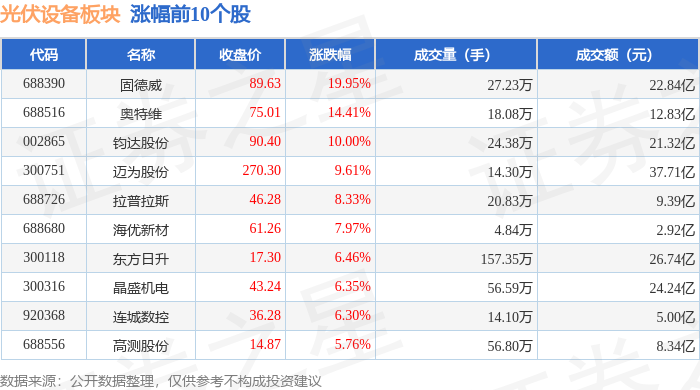
光伏设备板块1月22日涨2.41%,固德威领涨,主力资金净流入15.09亿元
Zheng Xing Xing Ye Ri Bao· 2026-01-22 09:01
Core Viewpoint - The photovoltaic equipment sector experienced a significant increase, with a 2.41% rise on January 22, led by GCL-Poly Energy Holdings [1] Group 1: Market Performance - The Shanghai Composite Index closed at 4122.58, up 0.14%, while the Shenzhen Component Index closed at 14327.05, up 0.5% [1] - GCL-Poly Energy Holdings (688390) saw a remarkable increase of 19.95%, closing at 89.63, with a trading volume of 272,300 shares and a transaction value of 2.284 billion [1] - Other notable performers included: - Yuantai Technology (688516) up 14.41% to 75.01 with a transaction value of 1.283 billion - Junda Co., Ltd. (002865) up 10.00% to 90.40 with a transaction value of 2.132 billion - Maiwei Co., Ltd. (300751) up 9.61% to 270.30 with a transaction value of 3.771 billion [1] Group 2: Fund Flow Analysis - The photovoltaic equipment sector saw a net inflow of 1.509 billion from institutional investors, while retail investors experienced a net outflow of 1.002 billion [2] - Key stocks with significant fund flow included: - Longi Green Energy (601012) with a net inflow of 355 million from institutional investors [3] - Junda Co., Ltd. (002865) with a net inflow of 313 million from institutional investors [3] - Maiwei Co., Ltd. (300751) with a net inflow of 305 million from institutional investors [3]


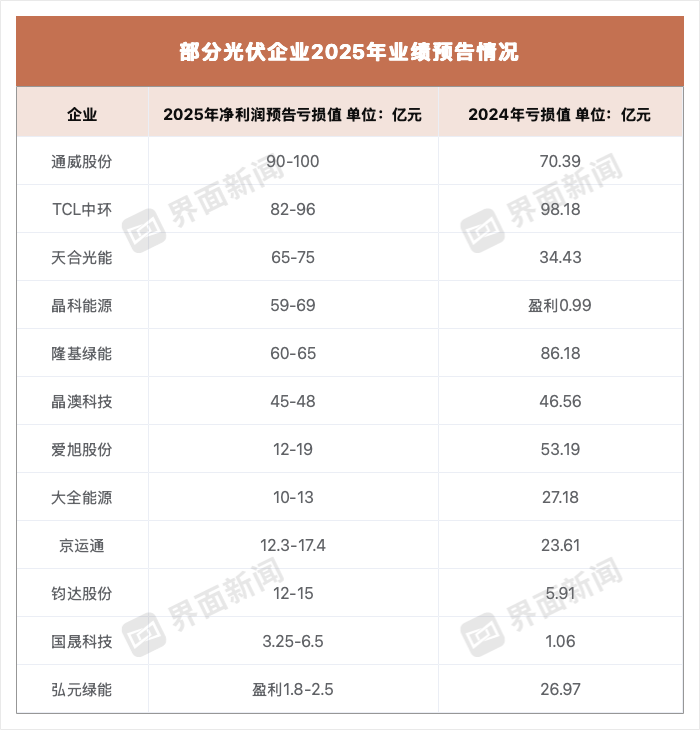
行业寒冬叠加银价暴击,12家光伏龙头集体“失血”超500亿
Xin Lang Cai Jing· 2026-01-22 08:03
Core Viewpoint - The photovoltaic industry continues to face significant challenges, with major companies reporting substantial losses, totaling over 500 billion yuan, except for Hongyuan Green Energy, which is the only profitable entity among the analyzed firms [1][2]. Group 1: Financial Performance - Among 12 major photovoltaic companies, only Hongyuan Green Energy reported a profit, while the others collectively faced losses exceeding 500 billion yuan [1]. - Tongwei Co. is projected to incur the largest loss in 2025, estimated between 90-100 billion yuan, followed by TCL Zhonghuan and Trina Solar, with losses of 82-96 billion yuan and 65-75 billion yuan, respectively [2]. - JinkoSolar is expected to report a loss of 59-69 billion yuan for the previous year, while it anticipates a slight profit in 2024 [6][8]. Group 2: Cost Pressures - The rising prices of silver and silicon materials have significantly increased production costs for photovoltaic companies, with silver paste becoming a major cost component, accounting for approximately 17% of module costs [3][5]. - Silver prices have surged over 230% since the beginning of 2025, contributing to the financial strain on companies like Longi Green Energy and Trina Solar [5]. Group 3: Company Strategies and Developments - Longi Green Energy and TCL Zhonghuan have shown the most significant reduction in losses among leading firms, with Longi reducing its losses by nearly 20 billion yuan due to improved production yields and the development of alternative materials [10]. - Hongyuan Green Energy has successfully turned a profit, projecting a net profit of 1.8-2.5 billion yuan for 2025, attributed to its vertically integrated supply chain strategy [14][15]. - JinkoSolar and Trina Solar have both highlighted advancements in their energy storage businesses, indicating a potential area for growth despite current losses [8].