
Nsfocus(300369)

Search documents
一图看懂 | AI内容审核概念股
市值风云· 2026-02-13 10:13
AI时代的信息传播合规性不容忽视。 作者 | 小鑫 编辑 | 小白 大优列1月7日 (思想) · 阿瓦可门 三九八1小六日J亚FX 合成信息,已处置账号1.3万余个、清理信息54.3万余 条。未来将保持高压严管,呼吁创作者主动添加Al标识, 共同营造风清气正的网络环境。 一、Al内容审核 / 二、数字水印 (技术核心) 网信安全(政策驱动核心) 人民网 新华网 汉邦高科 数码视讯 北信源 拓尔思 新媒股份 亚信安全 恒信东方 视觉中国 华数传媒 国安股份 科大讯飞 ST汇洲 吉大正元 绿盟科技 电科网安 四、数字水印延伸应用 三、AI反诈 / 数据湖源 / 合作企业 合兴包装 浩瀚深度 安妮股份 金运激光 平治信息 科蓝软件 高凌信息 证通电子 大胜达 鸡博股份 东方国信 数据来源:上市公司财报、互联网公开信息 该内容仅供参考,不构成任何投资建议 免责声明: 本报告(文章)是基于上市公司的公众公司属性、以上市公司根据其法定义务公开披露的信息(包括但 不限于临时公告、定期报告和官方互动平台等)为核心依据的独立第三方研究;市值风云力求报告(文章)所载内 容及观点客观公正,但不保证其准确性、完整性、及时性等;本报告 ...





绿盟科技取得网络资产识别方法专利
Sou Hu Cai Jing· 2026-02-13 06:33
国家知识产权局信息显示,绿盟科技集团股份有限公司取得一项名为"一种网络资产识别的方法、装置 及电子设备"的专利,授权公告号CN114004961B,申请日期为2021年10月。 声明:市场有风险,投资需谨慎。本文为AI基于第三方数据生成,仅供参考,不构成个人投资建议。 来源:市场资讯 天眼查资料显示,绿盟科技集团股份有限公司,成立于2000年,位于北京市,是一家以从事软件和信息 技术服务业为主的企业。企业注册资本79930.8527万人民币。通过天眼查大数据分析,绿盟科技集团股 份有限公司共对外投资了6家企业,参与招投标项目334次,财产线索方面有商标信息205条,专利信息 839条,此外企业还拥有行政许可7个。 北京神州绿盟科技有限公司,成立于2003年,位于北京市,是一家以从事科技推广和应用服务业为主的 企业。企业注册资本100000万人民币。通过天眼查大数据分析,北京神州绿盟科技有限公司共对外投资 了1家企业,参与招投标项目5000次,专利信息735条,此外企业还拥有行政许可6个。 ...

暴力拉升!300369,20cm涨停
Zhong Guo Ji Jin Bao· 2026-02-13 03:16
【导读】航天军工板块快速拉升,网络安全概念股表现活跃 春节前的最后一个交易日,一起来看下最新的市场情况及资讯。 2月13日早盘,A股市场低开后震荡拉升,截至发稿,沪指跌0.36%,深成指跌0.42%,创业板指跌0.7%,科创综指涨0.37%。 从板块上看,航天军工板块快速拉升,网络安全、半导体服务、餐饮旅游等板块表现活跃;海运、石油天然气、CPO板块震荡调整。 港股方面,恒生指数、恒生科技指数均跌超1%,腾讯音乐、百度集团、哔哩哔哩等跌幅居前。 网络安全概念股早盘表现活跃,绿盟科技(300369)20%涨停,国投智能(300188)、中新赛克(002912)、亚信安全等涨幅居前。 | 名称 | 现价 | 涨跌幅 ▼ | 成交量 | 换手率 | 市智率 | 总市值 | 年初至今 | | --- | --- | --- | --- | --- | --- | --- | --- | | 绿盟科技 | 11.90 | 19.96% | 1.13亿 | 13.98% | -41.1 | 96亿 | 59.09% | | 国投智能 | 17.58 | 10.15% | 6665万 | 7.79% | -28.0 | 1 ...


大数据指数盘中拉升,成分股普涨
Mei Ri Jing Ji Xin Wen· 2026-02-13 02:13
(文章来源:每日经济新闻) 每经AI快讯,2月13日,大数据指数盘中强势拉升,成分股呈现普涨格局。绿盟科技、华胜天成涨停, 国投智能、博汇科技、安恒信息等个股跟涨。 ...


绿盟科技2026年2月13日涨停分析:业绩减亏+治理优化+AI安全
Xin Lang Cai Jing· 2026-02-13 02:08
登录新浪财经APP 搜索【信披】查看更多考评等级 责任编辑:小浪快报 根据喜娜AI异动分析,绿盟科技涨停原因可能如下,业绩减亏+治理优化+AI安全: 1、绿盟科技2025年 业绩预告显示亏损大幅收窄83.55%-91.78%,亏损额从3.6亿元缩减至3000 - 6000万元,经营改善明显。 同时公司密集修订23项治理制度,包括董事会各专门委员会工作规则、信息披露、关联交易管理等,治 理透明度显著提高,取消监事会改设审计委员会,治理结构全面优化。 2、公司AI安全产品获得行业认 证和奖项,技术实力得到验证,获得市场认可。并且开发支出增长956.70%,显示技术储备增强。当前 市场对AI相关概念关注度较高,网络安全与AI结合的领域发展前景被市场看好,相关题材股票容易受 到资金青睐。 3、从行业来看,网络安全行业是国家重点关注和支持的领域,随着数字化进程的加快, 对网络安全的需求不断增加。东方财富数据显示,2月13日网络安全板块多只个股表现活跃,形成板块 联动效应。 4、技术面上,若该股MACD指标形成金叉,或突破重要压力位等技术形态,也会吸引技术 派投资者的关注。同花顺资金监控显示,当日超大单资金可能呈现净流入 ...
网络安全指数盘中涨超3%,绿盟科技涨停
Mei Ri Jing Ji Xin Wen· 2026-02-13 02:07
(文章来源:每日经济新闻) 每经AI快讯,2月13日,网络安全指数盘中涨超3%。成分股中,绿盟科技20%涨停,国投智能触及涨 停,中新赛克、奇安信-U涨超6%,吉大正元涨超4%。 ...
字节又一新模型Seedream 5.0上线,信创ETF(562570)近6天获得连续资金净流入
Mei Ri Jing Ji Xin Wen· 2026-02-10 06:45
Group 1 - The core viewpoint is that the AI application market is experiencing significant growth, particularly during the Spring Festival period, which is seen as a pivotal moment for competition in this space [2] - The performance of the 信创 ETF (562570) indicates strong market interest, with a recent increase in scale to 5.22 billion yuan, marking a three-month high and leading among its peers [1] - The ETF has seen continuous net inflows over the past six days, totaling 95.35 million yuan, with a peak single-day inflow of 35.75 million yuan [1] Group 2 - The introduction of ByteDance's Seedream 5.0 model in various applications highlights the rapid advancement and accessibility of AI technologies, with free trial experiences available [1] - 华西证券 emphasizes that high subsidies are an effective strategy for rapidly educating the market and cultivating user habits in AI applications [2] - The 信创 ETF closely tracks the 中证信创指数, focusing on domestic full-stack replacements across critical sectors such as storage, CPU, and AIPC, while integrating with the DeepSeek ecosystem and AI applications [2]


防火墙行业报告:市场集中度较高,市场稳步发展,定制化防火墙产品将不断涌现
Xin Lang Cai Jing· 2026-02-05 12:18
Core Insights - The firewall market in China is steadily growing, with the market size expected to increase from $1.17 billion in 2016 to $3.02 billion by 2025, and projected to reach $3.156 billion in 2026 [2][7][20] - The growth is driven by policy support, increasing market demand, and technological advancements, particularly with the deployment of 5G, private networks, and industrial internet [2][15] - The rise of edge computing is increasing the demand for lightweight firewalls, and customized firewall products for scenarios like IoT and smart cities are expected to emerge [2][15] Firewall Industry Definition and Classification - A firewall is an access control product that creates barriers between internal networks and insecure external networks, preventing unauthorized access and attacks [3][16] - Firewalls can be categorized based on technology into traditional firewalls, Unified Threat Management (UTM) firewalls, Next-Generation Firewalls (NGFW), and AI firewalls [5][18] - They can also be classified by form into software firewalls, hardware firewalls, and chip-level firewalls [5][18] Current Development Status - The firewall industry is characterized as a critical component of IT infrastructure, acting as a gatekeeper for network security [7][20] - The market is experiencing steady growth due to supportive policies and increasing technological advancements [7][20] Industry Value Chain - The upstream of the firewall industry includes basic hardware (chips, hard drives, network cards, etc.) and basic software (BIOS, operating systems, encryption) [9][22] - The midstream consists of firewall products, while the downstream applications span various sectors including government, finance, telecommunications, energy, education, healthcare, transportation, and aerospace [9][22] Key Companies - Notable listed companies in the firewall sector include Sangfor Technologies (300454.SZ), Tianrongxin (002212.SZ), Hillstone Networks (688030.SH), Deepin Technology (300768.SZ), Ruijie Networks (301165.SZ), Venustech (002439.SZ), Qihoo 360 (688561.SH), and NSFOCUS (300369.SZ) [2][15]





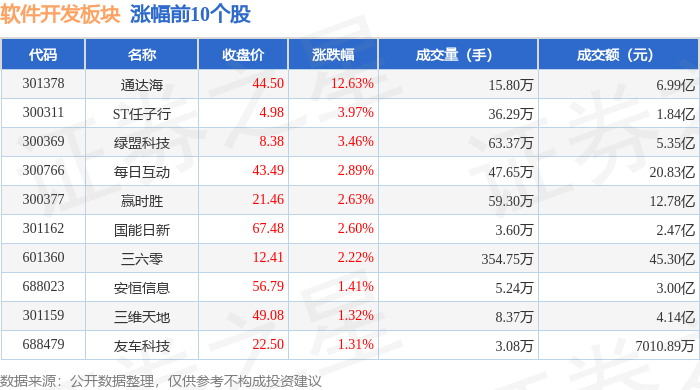
软件开发板块2月2日跌2.76%,星环科技领跌,主力资金净流出29.75亿元
Zheng Xing Xing Ye Ri Bao· 2026-02-02 09:15
Market Overview - On February 2, the software development sector declined by 2.76%, with Xinghuan Technology leading the drop [1] - The Shanghai Composite Index closed at 4015.75, down 2.48%, while the Shenzhen Component Index closed at 13824.35, down 2.69% [1] Stock Performance - Notable gainers in the software development sector included: - Tongda Hai (301378) with a closing price of 44.50, up 12.63% [1] - ST Renzihang (300311) at 4.98, up 3.97% [1] - Green Alliance Technology (300369) at 8.38, up 3.46% [1] - Significant decliners included: - Xingbei Technology (688031) at 182.41, down 13.11% [2] - Deepin Technology (300454) at 144.22, down 10.24% [2] - Keda Guochuang (300520) at 40.94, down 9.56% [2] Capital Flow - The software development sector experienced a net outflow of 2.975 billion yuan from institutional investors, while retail investors saw a net inflow of 2.357 billion yuan [2][3] - Key stocks with notable capital flows included: - Daily Interaction (300766) with a net inflow of 1.21 billion yuan from institutional investors [3] - Tongda Hai (301378) with a net inflow of 608.17 million yuan from institutional investors [3] - Green Alliance Technology (300369) with a net inflow of 288.85 million yuan from institutional investors [3]


2026网络安全趋势报告-绿盟科技
Sou Hu Cai Jing· 2026-02-02 08:03
Core Insights - The "2026 Cybersecurity Trends Report" by NSFOCUS highlights four core areas: AI security, data security, network security, and critical scenario security, identifying ten key trends to guide industry development [1]. Group 1: AI Security - AI-related security has become a focal point, with generative AI and autonomous agents pushing network defense into an "intelligent confrontation" phase, necessitating a shift from traditional defense systems to dynamic intelligent defenses [1]. - The security risks associated with AI are shifting to system behavior and decision-making levels, with potential misuse of intelligent agent permissions leading to severe data breaches, making the construction of a comprehensive AI security perimeter essential [1]. - In security operations, by 2026, a framework of "trusted limited autonomy" will be implemented, achieving controllable automation through confidence grading and interpretability optimization [2]. Group 2: Threat Landscape and Defense Systems - The rise of proxy-based botnets poses challenges to traditional threat intelligence systems, requiring a shift in defensive thinking from "blocking nodes" to "insight into links" [2]. - AI empowerment enhances threat intelligence capabilities, transitioning from "information piling" to intelligent decision-making engines [2]. - The proliferation of deep synthesis technology has led to a "crisis of authenticity," with "AI detecting AI" becoming a core preventive paradigm by 2026, driving demand for deep forgery detection [2]. Group 3: Cloud and Data Security - The migration of AI applications to the cloud and the introduction of open-source components have increased risks related to configuration flaws and vulnerabilities, making the exposure of AI assets on the internet a primary defense line for cloud data security [2]. - By 2025, the establishment of trusted data spaces will accelerate, leveraging cryptography and trusted hardware to ensure secure and controllable data "external circulation," evolving towards an ecological and intelligent direction [2]. Group 4: Emerging Scenario Security - The scaling of the low-altitude economy presents dual challenges of physical and data security, with a new security system based on "endogenous immunity + data protection" being constructed to ensure sustainable industry operations by 2026 [2]. - The cybersecurity industry will focus on the application of intelligent technologies and the expansion of emerging scenarios, continuously enhancing risk prevention, technological innovation, and compliance construction to build a more resilient security defense system [2].
