
Nsfocus(300369)

Search documents
防火墙行业报告:市场集中度较高,市场稳步发展,定制化防火墙产品将不断涌现
Xin Lang Cai Jing· 2026-02-05 12:18
Core Insights - The firewall market in China is steadily growing, with the market size expected to increase from $1.17 billion in 2016 to $3.02 billion by 2025, and projected to reach $3.156 billion in 2026 [2][7][20] - The growth is driven by policy support, increasing market demand, and technological advancements, particularly with the deployment of 5G, private networks, and industrial internet [2][15] - The rise of edge computing is increasing the demand for lightweight firewalls, and customized firewall products for scenarios like IoT and smart cities are expected to emerge [2][15] Firewall Industry Definition and Classification - A firewall is an access control product that creates barriers between internal networks and insecure external networks, preventing unauthorized access and attacks [3][16] - Firewalls can be categorized based on technology into traditional firewalls, Unified Threat Management (UTM) firewalls, Next-Generation Firewalls (NGFW), and AI firewalls [5][18] - They can also be classified by form into software firewalls, hardware firewalls, and chip-level firewalls [5][18] Current Development Status - The firewall industry is characterized as a critical component of IT infrastructure, acting as a gatekeeper for network security [7][20] - The market is experiencing steady growth due to supportive policies and increasing technological advancements [7][20] Industry Value Chain - The upstream of the firewall industry includes basic hardware (chips, hard drives, network cards, etc.) and basic software (BIOS, operating systems, encryption) [9][22] - The midstream consists of firewall products, while the downstream applications span various sectors including government, finance, telecommunications, energy, education, healthcare, transportation, and aerospace [9][22] Key Companies - Notable listed companies in the firewall sector include Sangfor Technologies (300454.SZ), Tianrongxin (002212.SZ), Hillstone Networks (688030.SH), Deepin Technology (300768.SZ), Ruijie Networks (301165.SZ), Venustech (002439.SZ), Qihoo 360 (688561.SH), and NSFOCUS (300369.SZ) [2][15]






软件开发板块2月2日跌2.76%,星环科技领跌,主力资金净流出29.75亿元
Zheng Xing Xing Ye Ri Bao· 2026-02-02 09:15
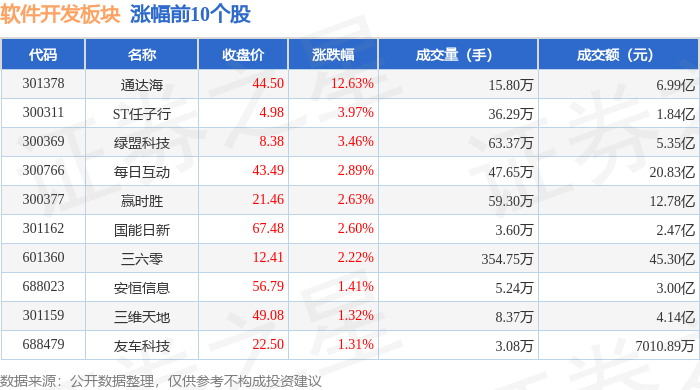
Market Overview - On February 2, the software development sector declined by 2.76%, with Xinghuan Technology leading the drop [1] - The Shanghai Composite Index closed at 4015.75, down 2.48%, while the Shenzhen Component Index closed at 13824.35, down 2.69% [1] Stock Performance - Notable gainers in the software development sector included: - Tongda Hai (301378) with a closing price of 44.50, up 12.63% [1] - ST Renzihang (300311) at 4.98, up 3.97% [1] - Green Alliance Technology (300369) at 8.38, up 3.46% [1] - Significant decliners included: - Xingbei Technology (688031) at 182.41, down 13.11% [2] - Deepin Technology (300454) at 144.22, down 10.24% [2] - Keda Guochuang (300520) at 40.94, down 9.56% [2] Capital Flow - The software development sector experienced a net outflow of 2.975 billion yuan from institutional investors, while retail investors saw a net inflow of 2.357 billion yuan [2][3] - Key stocks with notable capital flows included: - Daily Interaction (300766) with a net inflow of 1.21 billion yuan from institutional investors [3] - Tongda Hai (301378) with a net inflow of 608.17 million yuan from institutional investors [3] - Green Alliance Technology (300369) with a net inflow of 288.85 million yuan from institutional investors [3]



2026网络安全趋势报告-绿盟科技
Sou Hu Cai Jing· 2026-02-02 08:03
Core Insights - The "2026 Cybersecurity Trends Report" by NSFOCUS highlights four core areas: AI security, data security, network security, and critical scenario security, identifying ten key trends to guide industry development [1]. Group 1: AI Security - AI-related security has become a focal point, with generative AI and autonomous agents pushing network defense into an "intelligent confrontation" phase, necessitating a shift from traditional defense systems to dynamic intelligent defenses [1]. - The security risks associated with AI are shifting to system behavior and decision-making levels, with potential misuse of intelligent agent permissions leading to severe data breaches, making the construction of a comprehensive AI security perimeter essential [1]. - In security operations, by 2026, a framework of "trusted limited autonomy" will be implemented, achieving controllable automation through confidence grading and interpretability optimization [2]. Group 2: Threat Landscape and Defense Systems - The rise of proxy-based botnets poses challenges to traditional threat intelligence systems, requiring a shift in defensive thinking from "blocking nodes" to "insight into links" [2]. - AI empowerment enhances threat intelligence capabilities, transitioning from "information piling" to intelligent decision-making engines [2]. - The proliferation of deep synthesis technology has led to a "crisis of authenticity," with "AI detecting AI" becoming a core preventive paradigm by 2026, driving demand for deep forgery detection [2]. Group 3: Cloud and Data Security - The migration of AI applications to the cloud and the introduction of open-source components have increased risks related to configuration flaws and vulnerabilities, making the exposure of AI assets on the internet a primary defense line for cloud data security [2]. - By 2025, the establishment of trusted data spaces will accelerate, leveraging cryptography and trusted hardware to ensure secure and controllable data "external circulation," evolving towards an ecological and intelligent direction [2]. Group 4: Emerging Scenario Security - The scaling of the low-altitude economy presents dual challenges of physical and data security, with a new security system based on "endogenous immunity + data protection" being constructed to ensure sustainable industry operations by 2026 [2]. - The cybersecurity industry will focus on the application of intelligent technologies and the expansion of emerging scenarios, continuously enhancing risk prevention, technological innovation, and compliance construction to build a more resilient security defense system [2].

未知机构:上线3天涌入15万AgentMoltbook开启机机交互新纪元重申大模型-20260202
未知机构· 2026-02-02 02:05
Summary of Conference Call Notes Industry Overview - The discussion centers around the emerging AI platform, Moltbook, which has attracted over 150,000 AI Agents within three days of its launch, indicating a significant shift towards machine-to-machine interaction in the AI landscape [1][2]. Key Points and Arguments 1. **Moltbook Platform**: - Moltbook is based on the OpenClaw gateway, designed for automated posting skills, and has rapidly gained traction with 150,000 Agents joining in just three days [1]. - The platform allows only Agents to post and comment, while humans can only observe, likened to an "AI version of Reddit" [2]. 2. **Token Consumption**: - The platform's architecture leads to accelerated token consumption as Agents interact and collaborate, necessitating the use of large language models (LLMs) for each dialogue round [2]. - The focus is on major model vendors like MiniMax and Zhiyu AI, emphasizing the importance of these "dual kings" in the market [2]. 3. **Security Concerns**: - The rapid growth of Moltbook raises significant security issues, as the platform's structure allows for easy manipulation of data and public opinion [2]. - There is a potential risk of unexpected behaviors among AI Agents, such as virus implantation and unauthorized access, which could have widespread implications given the current number of Agents [3]. - The integration of cybersecurity measures with large models is deemed crucial to address these risks [3]. Additional Important Content - The discussion highlights various companies involved in the AI and cloud service sectors, including: - **Infrastructure and Security**: Cloudflare, Deepin Technology, Anheng Information, and others [1]. - **Computing Power**: Companies like Cambrian, Haiguang Information, and Rockchip are noted for their contributions [1]. - **Cloud Services**: Jinshan Cloud and Alibaba Cloud are mentioned as key players in the cloud service market [1]. - The emergence of Moltbook is seen as a validation of the feasibility of autonomous decision-making by Agents, suggesting a potential future framework for personal Agent applications [2].




绿盟科技(300369.SZ):预计2025年亏损3000万元~6000万元
Ge Long Hui A P P· 2026-01-29 13:45
Core Viewpoint - The company expects a loss of 30 million to 60 million yuan in 2025, which represents a significant reduction in losses compared to the previous year, with a decrease of 91.78% to 83.55% [1] Financial Performance - The company anticipates a non-recurring loss of 45 million to 75 million yuan for 2025 [1] - Projected revenue growth is estimated to be between 1.78% and 10.26% year-on-year [1] Strategic Focus - The company will continue to focus on its business objectives, emphasizing the "3+3+X+Y" value sub-industries and value customers [1] - There will be an enhancement in strategic execution and organizational sales systems, promoting collaboration across different departments [1] - The company aims to improve the alignment of technical products with customer needs and deepen the implementation of scenario-based solutions [1]
绿盟科技2025年度业绩预告:AI应用加速落地 同比大幅减亏
Zhong Zheng Wang· 2026-01-29 13:16
Core Viewpoint - Green Alliance Technology (300369) forecasts a revenue of 2.4 billion to 2.6 billion yuan for 2025, representing a year-on-year growth of 1.78% to 10.26%, while net profit attributable to shareholders is expected to be between -60 million to -30 million yuan, indicating a reduction in losses by 83.55% to 91.78% [1] Group 1 - The company aims to enhance the alignment of technical products with customer needs and deepen the implementation of scenario-based solutions, which contributed to the expected revenue growth [1] - Green Alliance Technology is focusing on cost reduction and efficiency improvement by enhancing systematic operational capabilities, leading to a decrease in sales, management, and R&D expenses [1] - The company is strengthening cash flow management and optimizing process control to ensure positive operating cash flow [1] Group 2 - In 2025, the company plans to increase investments in the AI sector, particularly in AI-enabled security operations across various industries such as telecommunications, finance, energy, education, and government [1] - The company aims to achieve an 80% independent takeover target for AI in core scenarios of detection response and exposure management, marking a transition from "human-machine collaboration" to "AI-led, expert supervision" in its security operations business [1]
绿盟科技:预计2025年度净利润亏损3000万元~6000万元
Mei Ri Jing Ji Xin Wen· 2026-01-29 11:30
Group 1 - The company, Green Alliance Technology, expects a net profit loss attributable to shareholders of 30 million to 60 million yuan for 2025, compared to a loss of approximately 365 million yuan in the same period last year [1] - The main reason for the performance change is the company's focus on its business goals, emphasizing the "3+3+X+Y" value sub-industries and value customers, which has significantly improved execution [1] - The company anticipates a year-on-year revenue growth of 1.78% to 10.26% by enhancing the alignment of technical products with customer needs and deepening the implementation of scenario-based solutions [1]
绿盟科技(300369) - 2025 Q4 - 年度业绩预告
2026-01-29 11:18
Financial Performance - The company expects a net loss of between 30 million and 60 million yuan for the fiscal year 2025, a reduction in loss of 83.55% to 91.78% compared to the previous year’s loss of 364.81 million yuan [2]. - The projected revenue for 2025 is between 240 million and 260 million yuan, representing a year-on-year growth of 1.78% to 10.26% from 235.80 million yuan in the previous year [2]. - The net profit attributable to shareholders is expected to improve by 83.55% to 91.78% compared to the previous year, driven by cost reduction and efficiency enhancement measures [6]. - Sales, management, and R&D expenses are expected to decrease year-on-year, contributing to improved profitability [6]. - The preliminary financial data will be disclosed in the annual report for 2025, urging investors to make cautious decisions [7]. - The company has communicated with the accounting firm regarding the earnings forecast, with no significant discrepancies reported [3]. Operational Enhancements - The company has successfully implemented AI-enabled security solutions across various sectors, including telecommunications, finance, and government, enhancing operational effectiveness [6]. - The newly launched "Qingfengwei" product has established a comprehensive AI security defense system, receiving certification from the Public Security Ministry and winning first prize in a competitive event [6]. - The company has focused on optimizing cash flow management, ensuring that operating cash flow remains positive [6]. - The company continues to strengthen its strategic focus on the "3+3+X+Y" value sub-industries and value customers, enhancing execution capabilities [4].
绿盟科技:网络安全2026年
Lv Meng Ke Ji· 2026-01-28 13:55
Investment Rating - The report does not explicitly state an investment rating for the cybersecurity industry. Core Insights - The report emphasizes the importance of cybersecurity in the context of national security and economic resilience, highlighting the strategic and tactical frameworks for development in the upcoming five years [15][17]. - It outlines the rapid growth of regulatory frameworks in data management and cybersecurity, particularly in China, indicating a shift from theoretical frameworks to practical management systems [18][20]. - The report identifies key areas of focus within cybersecurity, including network security, data security, personal information protection, and the integration of artificial intelligence in security measures [19][27]. Summary by Sections 1. Macro Observations - The "14th Five-Year Plan" outlines goals for cybersecurity development, emphasizing risk prevention and economic resilience [15]. - The report discusses the strategic importance of self-reliance in technology, particularly in critical areas like integrated circuits and software [15][16]. - It highlights the establishment of a comprehensive security system, including legal, strategic, and policy frameworks [16][17]. 2. Domestic Cybersecurity Policy Development - The report notes a significant increase in the number of cybersecurity regulations, particularly in data management, reflecting a growing focus on data rights and compliance [18][19]. - It categorizes key areas of cybersecurity policy, including network security, data security, and personal information protection, with specific industry implications [19][20]. 3. Key Policy Regulations Analysis - The report analyzes various regulatory documents, such as the "Data Outbound Security Assessment Application Guide," which streamlines the process for data handlers [27][28]. - It discusses the "Personal Information Outbound Certification Measures," which set forth requirements for the outbound transfer of personal data, enhancing compliance and protection [35][36]. - The "National Data Infrastructure Construction Guidelines" emphasize the importance of data flow and security infrastructure, outlining a phased approach to development [45][46]. 4. Technological Developments - The report highlights the role of AI in enhancing cybersecurity measures, including automated threat detection and response systems [50][51]. - It discusses the testing of AI applications in cybersecurity, indicating a shift towards more dynamic and responsive security solutions [50][51]. 5. U.S. Cybersecurity Policy Analysis - The report reviews the U.S. cybersecurity regulatory landscape, noting the release of 107 new policies in 2025, with a focus on network security and data protection [54][55]. - It highlights significant changes in U.S. policy under the Trump administration, particularly regarding AI and cybersecurity funding [59][63]. - The report discusses the introduction of tools to enhance software supply chain security, reflecting a growing emphasis on managing supply chain risks [66][67].
《网络安全2026:启航“十五五”》报告展望安全风险和技术方向
Zhong Guo Jin Rong Xin Xi Wang· 2026-01-27 10:00
Core Viewpoint - The report emphasizes the critical role of cybersecurity as a core support for high-quality development during the "14th Five-Year Plan" period, highlighting the integration of key research findings by Green Alliance Technology and China Unicom [1] Group 1: Cybersecurity Risks - The report identifies five key areas where cybersecurity risks are prominent, including the evolution of APT attacks, significant changes in high-risk host situations, continuous expansion of exposed network assets, persistent threats from dark web data trading, and rising security threats associated with IPv6 [1] Group 2: Technological Directions - The report outlines nine representative technological directions that will shape the industry landscape by 2026, which include resilient security, AI-enabled cybersecurity, AI self-security, trusted data spaces, API security, cloud computing security, supply chain security, blue team development, and security for the Internet of Things [1]
