SNIBE(300832)

Search documents
加快人工智能创新应用融合 建用并举更好守护群众健康
Xin Hua Ri Bao· 2026-01-08 21:33
Group 1 - The provincial government emphasizes the integration of artificial intelligence with healthcare to meet the growing health service demands of the public [1] - The healthcare insurance information system is highlighted for its vast data capacity, which enhances service efficiency and ensures the safety of insurance funds [1] - The government aims to strengthen insurance fund supervision using AI technology to create a closed-loop system for risk prevention and control [1] Group 2 - The focus is on exploring AI-assisted medical classification standards and accelerating the development of intelligent systems for innovative applications [2] - Collaboration among industry, academia, and healthcare is encouraged to enhance the integration of AI with medical practices and improve the AI literacy of healthcare professionals [2] - The provincial government supports the growth of companies specializing in medical AI technologies, aiming to establish a stronghold for AI industry development in the region [2]


战新产业与未来产业领航,央企开辟增长“第二曲线”
Hua Xia Shi Bao· 2026-01-08 12:16
Core Insights - The article emphasizes the importance of the "14th Five-Year Plan" implementation period starting in 2026, focusing on enhancing core functions and competitiveness of state-owned enterprises (SOEs) to achieve world-class status [2] - The central government aims to accelerate industrial upgrades and foster new growth drivers through strategic investments in emerging industries such as artificial intelligence, biomedicine, and digital economy [2][3] Group 1: Industrial Upgrades and Strategic Focus - The State-owned Assets Supervision and Administration Commission (SASAC) is promoting a dual-track development model for SOEs, focusing on both traditional industry enhancement and the cultivation of new growth drivers [3] - Central enterprises are expected to invest in strategic emerging industries, with an annual investment growth rate exceeding 20% over the past five years, reaching 3.3 trillion yuan in fixed asset investments (excluding real estate) from January to November 2025 [3] Group 2: Technological Advancements and R&D Investment - Central enterprises have significantly increased R&D investment, amounting to 890.16 billion yuan from January to November 2025, with an R&D intensity of 2.62% [5] - Breakthroughs in key technologies have been achieved, such as the development of a world-first megawatt-level CO₂ thermal energy storage system and a 700-megawatt ultra-supercritical circulating fluidized bed boiler [5][6] Group 3: Collaborative Ecosystem and Mechanism Reforms - SOEs are moving away from isolated operations by forming innovation alliances and promoting collaborative development across the industrial chain, with 24 innovation alliances involving over 800 enterprises and institutions [7] - The SASAC plans to advance strategic and specialized mergers and acquisitions in 2026, focusing on sectors like new energy, integrated circuits, and biotechnology to enhance competitive advantages [8]


智谱豪华阵容港交所上市,“十五五”新产业趁早布局
Sou Hu Cai Jing· 2026-01-08 11:35
Core Insights - The listing of Zhipu on the Hong Kong Stock Exchange marks the dawn of a new industry centered around large models, coinciding with the upcoming 2026 China Real Estate Asset Management Summit and the Fourth Smart Low-Carbon Industry-Finance Summit [2] - Zhipu's IPO was oversubscribed by 1159.46 times, attracting 11 cornerstone investors, including national capital and leading financial institutions, indicating strong market confidence [3] - Zhipu's flagship model, GLM-4.7, has achieved significant recognition, outperforming competitors in various global assessments, showcasing the competitiveness of Chinese large models [3] Financial Performance - Zhipu's revenue surged from 57.4 million yuan in 2022 to 312.4 million yuan in 2024, reflecting a compound annual growth rate of 130%, with a staggering 325% year-on-year increase in the first half of 2025 [3] - The company's MaaS platform has attracted over 2.7 million enterprises and developers, including nine of the top ten internet companies in China, highlighting its market penetration [3] Industry Transformation - Zhipu's successful listing signifies a pivotal moment for Chinese AGI companies, transitioning from a "technology follower" to a "global competitor" in the large model industry [4] - The upcoming summit aims to explore the entire lifecycle value of new industries, focusing on the integration of technology, scenarios, and capital to foster growth [4]
新产业:公司在国内和海外免疫诊断市场领域的市占率仍处于相对较低水平
Zheng Quan Ri Bao Zhi Sheng· 2026-01-07 13:49
Core Insights - The company is focusing on expanding its presence in tertiary hospitals, which account for over half of hospital visits and are key end-users of in vitro diagnostic products [1] - The company plans to enhance its product offerings with cost-effective solutions like MAGLUMI X3 and MAGLUMI X6 to cater to secondary and lower-tier medical markets [1] - The company aims to increase its market share in both domestic and international immunodiagnostic markets, which currently remain relatively low, indicating significant growth potential [1] Domestic Market Strategy - The company is increasing efforts to penetrate tertiary hospitals with its high-speed luminescent instruments MAGLUMI X8, MAGLUMI X10, and SATLARS T8 [1] - The focus is on improving single-machine output while also addressing the needs of smaller medical facilities through affordable product development [1] International Market Strategy - The company is witnessing a rise in sales of mid-to-large machines in overseas markets, with the proportion increasing from 57% in 2023 to 76% in the first three quarters of 2025 [1] - The strategy includes a stronger emphasis on expanding large machines and production lines in high-end global markets to drive growth from large sample volume clients [1]
新产业大宗交易成交1192.00万元
Zheng Quan Shi Bao Wang· 2026-01-07 09:51
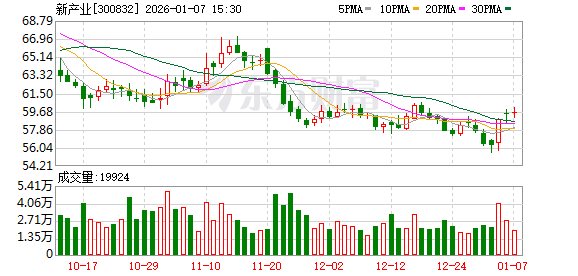
Core Viewpoint - The recent large transaction of New Industry on January 7 involved 200,000 shares with a transaction value of 11.92 million yuan, executed at a price of 59.60 yuan per share, indicating institutional trading activity [2] Trading Activity Summary - A total of 2 large transactions occurred in the last three months for New Industry, with a cumulative transaction value of 85.67 million yuan [2] - On January 7, the closing price for New Industry was 59.60 yuan, reflecting a slight increase of 0.17% for the day, with a turnover rate of 0.29% and a total trading volume of 119 million yuan [2] - The net inflow of main funds for the day was 6.14 million yuan, while the stock experienced a cumulative increase of 3.27% over the past five days, with a total net outflow of 39.60 million yuan during the same period [2] Margin Financing Data - The latest margin financing balance for New Industry stands at 803 million yuan, having increased by 5.95 million yuan, which represents a growth rate of 0.75% over the past five days [2]
新产业:国内外免疫诊断市场占率仍存广阔增长空间
Sou Hu Cai Jing· 2026-01-07 08:21
Core Insights - The company is focusing on expanding its market presence in both domestic and international healthcare sectors, particularly targeting large hospitals while also developing cost-effective products for smaller healthcare facilities [1] Group 1: Domestic Market Strategy - The company recognizes that tertiary hospitals account for over half of the hospital diagnosis visits in China, making them key users of in vitro diagnostic products [1] - The company plans to enhance its penetration in large hospitals with its high-speed luminescence instruments, MAGLUMI X8, MAGLUMI X10, and SATLARS T8, which have gained recognition in the market [1] - To address the needs of secondary and lower-tier medical facilities, the company is developing more cost-effective products, such as MAGLUMI X3 and MAGLUMI X6, to meet the demand for high-quality and affordable diagnostic solutions [1] Group 2: International Market Strategy - The company is experiencing an increase in sales of large machines in overseas markets, with the proportion rising from 57% in 2023 to 67% in 2024, and further to 76% in the first three quarters of 2025 [1] - The company aims to focus on expanding its high-end terminal offerings globally, particularly for large sample volume clients, which are expected to drive sustained growth [1] - The company's market share in both domestic and international immunodiagnostic sectors remains relatively low, indicating significant growth potential in these markets [1]
脑机接口迎政策技术双催化,三博脑科、美好医疗20CM两连板!全市场规模最大医疗ETF(512170)20日新高!
Xin Lang Cai Jing· 2026-01-06 02:01
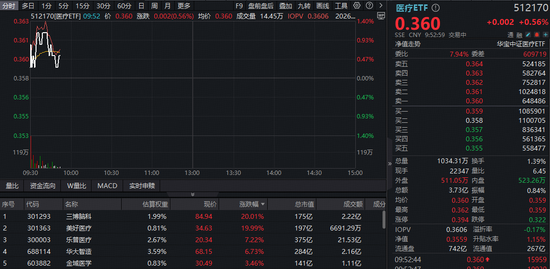
Group 1 - The medical ETF (512170) opened high on January 6, rising over 1% and reaching a 20-day high, with real-time transaction volume exceeding 350 million yuan. The ETF recorded a daily increase of over 5%, marking five consecutive days of gains [1][5] - Brain-computer interface stocks, including Sanbo Brain Science and Meihua Medical, both hit the 20% daily limit up, achieving two consecutive boards. Conversely, the CXO sector saw a pullback, with Tigermed falling over 1% [1][5] Group 2 - On January 5, 2026, Elon Musk announced that Neuralink plans to start large-scale production of brain-computer interface devices, advancing the commercialization of the technology. Concurrently, the National Medical Products Administration held a meeting to expedite the review and approval of related medical devices [3][6] - According to CITIC Securities, China's brain-computer interface technology is relatively advanced globally, with potential to cultivate leading companies in the sector. This could enhance the valuations of related listed companies in the secondary market and stimulate financing in the primary market, creating a synergy between capital and industry development [7] - Zhongtai Securities noted that the pharmaceutical sector is expected to rebound in 2025 after four consecutive years of decline, driven by the realization of innovative drug export logic and industry recovery post-policy reform. Certain areas of the medical device sector may also see a reversal of difficulties [7]




基层治理有创新产业发展有活力
Xin Lang Cai Jing· 2026-01-05 18:44
Core Insights - The article highlights the transformation of Shibadong Village through grassroots governance led by the local party branch, focusing on agricultural development and community engagement [1][2] Group 1: Community Development - The village has 205 households and 771 residents, previously facing challenges such as weak collective economy and inadequate infrastructure [1] - The local party branch implemented a mechanism called "One Core, Three Links, Four Promotions," with 28 party members acting as liaisons to support local farmers [1] - The village has improved irrigation and road conditions, with quick responses to community needs, exemplified by the rapid repair of irrigation channels [1] Group 2: Economic Growth - The village's collective economic income is projected to reach an average of 122,000 yuan by 2025, driven by the development of specialty industries [2] - Initiatives include the establishment of cooperatives for broadening the scale of fava bean cultivation and livestock farming, creating a dual-driven model of "planting + breeding" [1][2] - The introduction of online training and practical agricultural skills has empowered villagers to enhance their marketing capabilities, leading to increased sales of local products [2] Group 3: Infrastructure Improvement - The village has successfully transformed muddy roads into cement paths, addressing previous transportation issues [1][2] - The local party branch has organized partnerships with six collective economic investment enterprises to tackle land transfer and labor challenges [2] - The overall development has led to a more interconnected village, facilitating better access to markets and resources [2]
新产业(300832) - 关于获得医疗器械注册证的公告
2026-01-05 10:22
证券代码:300832 证券简称:新产业 公告编号:2026-001 深圳市新产业生物医学工程股份有限公司 关于获得医疗器械注册证的公告 可溶性 fms 样酪氨酸激酶-1(sFlt-1)是一种内源性抗血管生成蛋白,由胎盘 产生,通过中和血管生成蛋白血管内皮生长因子(VEGF)和胎盘生长因子(PlGF) 而起作用。中华医学会妇产科学分会妊娠期高血压疾病学组发布的《子痫前期预 测与预防指南(2025)》指出妊娠期 PlGF 水平降低、sFlt-1 水平升高或 sFlt‑ 1/PlGF 比值升高预示子痫前期的发生风险升高。在医疗资源充分的情况下,建议采用其 结合孕妇风险因素、平均动脉压和超声参数,综合评估孕妇子痫前期的发生风险。 (二)反三碘甲状腺原氨酸测定试剂盒(磁微粒化学发光法) 本公司及董事会全体成员保证信息披露的内容真实、准确和完整,没有虚假 记载、误导性陈述或重大遗漏。 近日,深圳市新产业生物医学工程股份有限公司(以下简称"公司")收到 了广东省药品监督管理局颁发的 2 项《医疗器械注册证》。具体情况如下: | 序 | 注册 | 注册证编号 | | | 注册证有效期 | | 产品名称 | | | | 适用 ...
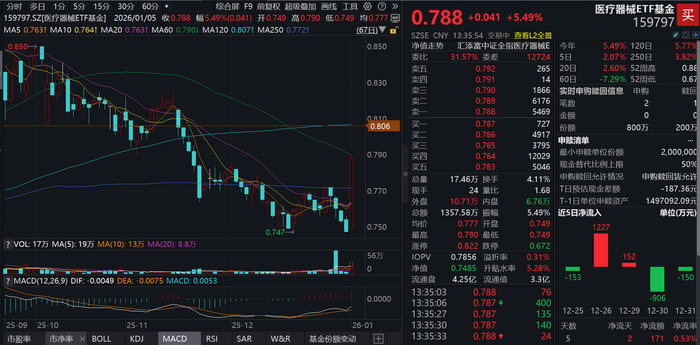
马斯克宏图的下一个篇章,2026年将大规模生产脑机接口!医疗器械ETF基金(159797)暴涨超5%,再获资金青睐!
Xin Lang Cai Jing· 2026-01-05 05:56
Group 1: Market Performance - The medical device ETF fund (159797) surged over 5% after four consecutive days of decline, indicating a significant rebound in the market [1] - The fund saw a net subscription of 6 million shares during the trading session, with a total inflow of over 30 million yuan in the past 10 days, including 7 days of net inflow [1] - Most component stocks of the medical device ETF fund performed positively, with notable gains including Lepu Medical reaching a 20% limit up, and other companies like United Imaging and Huatai Medical rising over 4% [1] Group 2: Neuralink and Brain-Computer Interface Developments - Neuralink is expected to enter large-scale production by January 1, 2026, with nearly automated surgical operations, enhancing safety by allowing guide wires to pass through the dura mater without opening it [4] - The advancement of Neuralink's technology is anticipated to facilitate collaboration with Tesla's Optimus humanoid robot, aiming to create a "human brain + robot" ecosystem [5] - The technology is transitioning from clinical trials to commercial viability, marking a significant step in making brain-computer interfaces widely accessible [3] Group 3: Policy and Industry Trends - The National Medical Products Administration (NMPA) emphasized the strategic importance of brain-computer interfaces in a meeting held on December 18, 2025, focusing on safety, innovation in regulatory methods, and collaboration across sectors [6] - Recent clinical trials have shown promising results for brain-computer interface systems, with successful implantations and significant improvements in patients' hand functions [6] - The rapid iteration and upgrade of brain-computer interface technology are driven by advancements in signal acquisition, materials science, and multi-modal integration, paving the way for broader applications beyond medical use [7]