Adobe(ADBE)

Search documents
Has AI Killed Adobe For Good?
Yahoo Finance· 2026-01-20 16:33
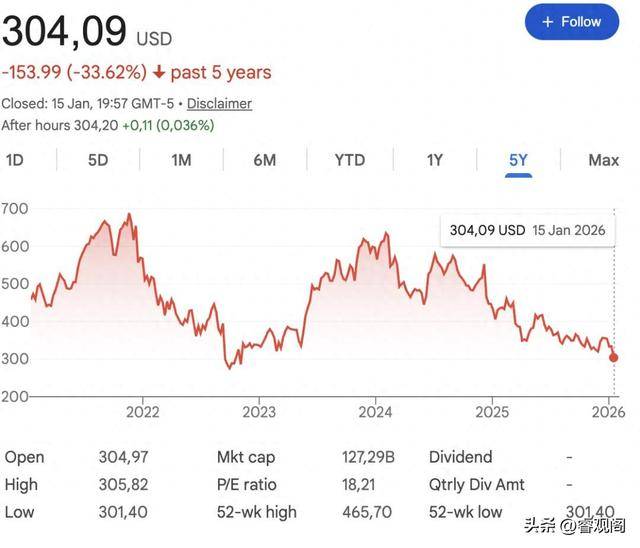
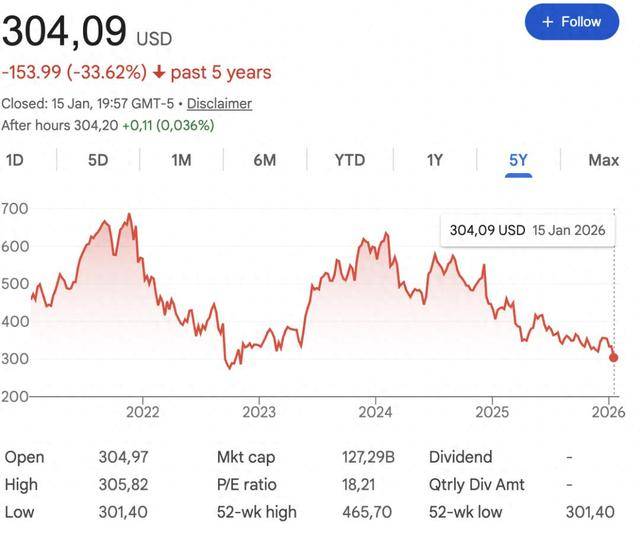
Its stock has struggled, down 17% year-to-date (YTD), underperforming the S&P 500's 0.25% gain, and also 38% below its 52-week high of $465.70, reflecting the market's pessimism. Valuation metrics show Adobe trading at a trailing price-to-earnings (PE) ratio of 17.7, well below its three-year historical average of 38.2 and the technology sector average of 32. This suggests the market sees less growth potential.Adobe is a leading software company specializing in creative and digital experience tools, includi ...

Jim Cramer Discusses Adobe (ADBE) & Apple Suite
Yahoo Finance· 2026-01-20 11:01
Core Viewpoint - Adobe Inc. (NASDAQ:ADBE) is facing significant challenges in the competitive landscape of productivity software, particularly due to the rise of AI technologies, which has led to a 32% decline in its stock price over the past year [2]. Group 1: Company Performance - Adobe's shares have decreased by 32% over the last year, indicating struggles in maintaining its market position [2]. - The company's software-as-a-service model is under threat from AI advancements, which has raised concerns about its growth potential [2]. - Goldman Sachs set a price target of $290 for Adobe shares and issued a Sell rating, highlighting competition as a major concern for high-end user growth [2]. Group 2: Analyst Opinions - Oppenheimer downgraded Adobe's rating from Outperform to Market Perform, citing the impact of AI on software stock valuations [2]. - Jim Cramer discussed insights from Ben Reitzes and Mellius Research regarding Adobe's challenges and competition in the market [3]. - There is a belief among some analysts that other AI stocks may offer better investment opportunities with higher returns and lower risks compared to Adobe [3].
Claude抢生意,美国软件股暴跌
3 6 Ke· 2026-01-20 07:22
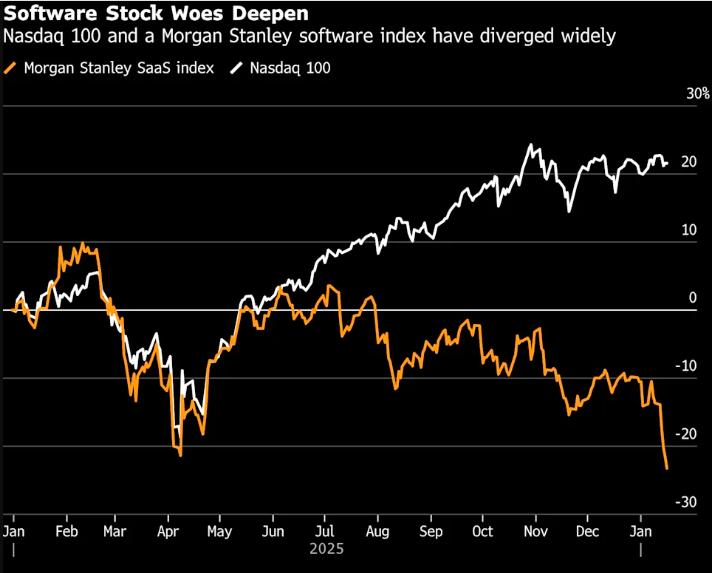
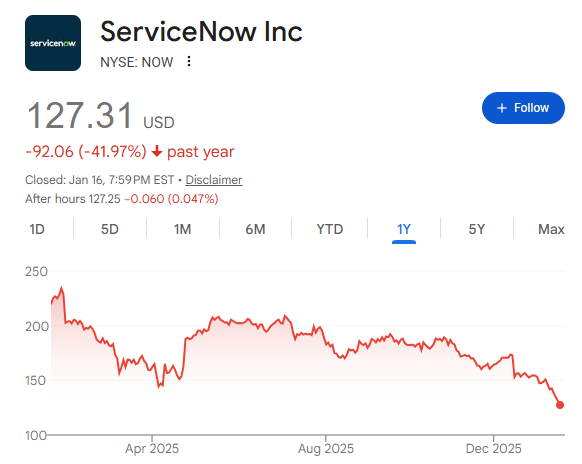
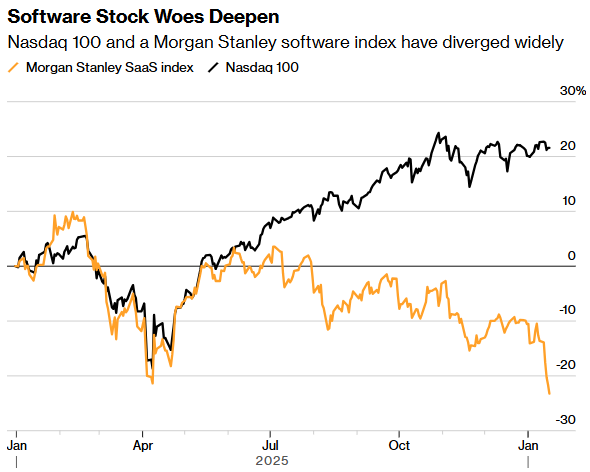
Core Viewpoint - The software sector is experiencing its worst start to the year since 2022, with a 15% decline following an 11% drop last year, raising concerns about future growth prospects due to emerging AI competition [1][3]. Group 1: Market Performance - A group of Software as a Service (SaaS) stocks tracked by Morgan Stanley has seen a significant downturn, marking the worst annual opening since 2022 [1]. - Intuit Inc., the parent company of TurboTax, experienced a 16% drop, while Adobe and Salesforce saw declines exceeding 11% [3]. - The Nasdaq 100 index is nearing historical highs, yet companies like ServiceNow Inc. are at multi-year lows, highlighting a widening gap in performance within the tech sector [9]. Group 2: AI Competition - The launch of Anthropic's AI collaboration tool "Claude Cowork" has intensified fears of disruptive competition in the software market, reminiscent of concerns from 2025 [3][8]. - Claude Cowork allows users to automate tasks such as creating spreadsheets and generating reports, significantly enhancing productivity for both programmers and non-programmers [4][6]. - The tool's rapid adoption has led to a notable increase in its user base, with a 12% rise in global daily active users since last month [7]. Group 3: Investor Sentiment - Many investors are losing confidence in holding software stocks, believing there are no catalysts for valuation recovery despite lower price multiples [8]. - Concerns about the attractiveness of AI products from established software companies are growing, as many have not demonstrated significant revenue impact from their AI offerings [9]. - The expected profit growth for software and services companies in the S&P 500 is projected to slow to 14% in 2026, down from an estimated 19% in 2025 [9]. Group 4: Valuation Trends - Software companies are seeing their valuations decline, with a forward price-to-earnings ratio of 18 times, the lowest in history compared to an average of over 55 times in the past decade [10]. - The traditional high valuation of software companies, based on subscription models and recurring revenue, is being challenged by the emergence of AI agents capable of performing tasks more efficiently [13].


10 Undervalued Stocks to Invest in According to Goldman Sachs
Insider Monkey· 2026-01-20 06:12
Economic Outlook - Goldman Sachs released its 2026 Economic and Financial Market Outlook report, indicating strong economic momentum at the start of the year and dismissing widespread recession concerns [1] - The bank acknowledged policy shocks in 2025 that impacted real wages and labor supply but described the slowdown as orderly rather than disruptive [2] - Consumer spending, which constitutes nearly 70% of U.S. GDP, is aligned with long-term growth trends due to rising equity and home prices [2] Inflation and Monetary Policy - Goldman Sachs views last year's challenges as temporary and policy-driven, with inflationary impacts from tariffs considered a one-time price-level shift [3] - Core PCE inflation is projected to decrease from 2.9% at the beginning of the year to approximately 2.3% by year-end, with two Federal Reserve rate cuts anticipated [3] Growth and Investment Trends - The bank favors artificial intelligence (AI) as a key growth area, expecting sustained technology investment to support demand and contribute significantly to GDP without excessive borrowing [4] - Corporate balance sheets are reported to be healthy, with non-financial business debt declining as a share of GDP [4] Recession Probability - Goldman Sachs assigns a 25% probability of a recession in 2026, which is lower than the 33% consensus, indicating strong expected earnings growth despite high index-level valuations [5] Undervalued Stocks - The article discusses 10 undervalued stocks identified by Goldman Sachs, based on their 13-F filings and forward price-to-earnings multiples [7] - The methodology involved filtering stocks with the lowest forward price-to-earnings multiples and ranking them by the number of hedge funds holding stakes [7][8] Company-Specific Insights - **T-Mobile US, Inc. (NASDAQ:TMUS)**: Forward P/E multiple of 15.72x, with 81 hedge fund holders. Bernstein lowered its price target from $265 to $245, citing increased competition in the telecom sector [9][10] - **AT&T Inc. (NYSE:T)**: Forward P/E multiple of 10.63x, with 84 hedge fund holders. Bernstein reduced its price target from $31.00 to $30.00, highlighting heightened competition and challenges in the sector [13][14] - **Adobe Inc. (NASDAQ:ADBE)**: Forward P/E multiple of 12.58x, with 88 hedge fund holders. Investor sentiment is cautiously constructive, with a consensus price target of $417.50, indicating a potential upside of 37.30% [17][18]
开年最惨!美国软件股崩了,因为Claude Code太火了
华尔街见闻· 2026-01-19 09:46
Core Viewpoint - The release of Claude Code has reignited concerns about the disruption of the software industry by AI, leading to the worst annual start for U.S. software stocks in years, with a 15% decline in a basket of SaaS stocks tracked by Morgan Stanley since the beginning of the year [1][4]. Group 1: Market Performance - Software stocks have experienced a significant downturn, with a 15% drop since the start of the year, following an 11% decline in 2025, marking the worst opening performance since 2022 [1]. - Current valuations for software stocks are at a record low, trading at 18 times expected earnings for the next 12 months, significantly below the average of over 55 times in the past decade [1]. Group 2: Impact of AI Developments - The panic in the market was triggered by Anthropic's release of "Claude Cowork," which showcased capabilities that alarmed investors about the future of software companies [5][6]. - Users reported completing complex projects in a week that would typically take a year, highlighting the disruptive potential of AI tools [2]. Group 3: Analyst Perspectives - Many buy-side institutions believe there is currently "no reason to hold" software stocks due to the uncertainty brought by AI, with no catalysts for valuation recovery in the short term [4][6]. - Analysts note that existing software companies have not demonstrated significant appeal in their AI products, with Salesforce and Adobe showing limited revenue impact from their AI initiatives [8]. Group 4: Comparative Sector Performance - The earnings growth forecast for software and services companies in the S&P 500 is expected to slow from approximately 19% in 2025 to 14% in 2026, contrasting with the semiconductor sector, which is projected to see profit growth of nearly 45% in 2025 and accelerate to 59% in 2026 [8][9]. - Major tech companies like Microsoft, Amazon, Alphabet, and Meta Platforms are expected to invest heavily in AI infrastructure, providing clearer visibility for revenue growth compared to software firms [8]. Group 5: Valuation Discrepancies - Despite low valuations, there is a divide in market sentiment regarding the future of software stocks, with some analysts optimistic about a rebound by 2026 due to stable customer spending and attractive valuations [10][11]. - Concerns remain about how software companies will compete against AI agents capable of completing tasks rapidly, complicating the assessment of appropriate valuation multiples [11].

Three Reasons To Own Adobe In 2026 (NASDAQ:ADBE)
Seeking Alpha· 2026-01-19 04:19
Core Viewpoint - The article emphasizes the importance of understanding that past performance does not guarantee future results, highlighting the need for careful analysis before making investment decisions [2][3]. Group 1: Company Insights - The article does not provide specific insights or data regarding any particular company or its performance [1][2][3]. Group 2: Industry Analysis - The article does not include any detailed analysis or commentary on industry trends or dynamics [1][2][3].

开年最惨!美国软件股崩了,因为Claude Code太火了
Hua Er Jie Jian Wen· 2026-01-19 00:23
Core Viewpoint - The release of Claude Code has reignited concerns about the disruption of the software industry by AI, leading to a significant decline in U.S. software stocks, marking one of the worst starts to the year in recent history [1][5]. Group 1: Market Performance - Since the beginning of the year, a basket of SaaS stocks tracked by Morgan Stanley has dropped by 15%, following an 11% decline in 2025, marking the worst opening performance since 2022 [1]. - Software stocks are currently trading at a record low valuation of 18 times expected earnings for the next 12 months, significantly below the past decade's average of over 55 times [1]. - Companies like ServiceNow Inc. have seen their stock prices fall to multi-year lows, while Intuit Inc. experienced a 16% drop, the largest weekly decline since 2022 [2]. Group 2: Investor Sentiment - Many buy-side institutions believe there is "no reason to hold" software stocks amid the disruptive uncertainty brought by AI, with no visible catalysts for valuation recovery in the short term [4][6]. - The release of the "Claude Cowork" service by Anthropic has intensified fears among investors regarding the future growth prospects of software companies [5][6]. Group 3: AI Integration Challenges - Most software manufacturers have not demonstrated significant appeal in their AI products, with Salesforce and Adobe struggling to show revenue impact from their AI initiatives [7]. - Existing software companies need to exhibit accelerated growth to drive stock price rebounds, which appears unlikely in the short term [7]. - In contrast, other tech sectors, particularly semiconductor companies, are expected to see substantial profit growth, with projections of nearly 45% profit growth in 2025 and 59% in 2026 [7][8]. Group 4: Valuation Discrepancies - Despite low valuations, there remains a divide in market sentiment regarding the future of software stocks, with some analysts optimistic about a rebound by 2026 due to stable customer spending and attractive valuations [8]. - Barclays and Goldman Sachs predict that rising AI adoption will expand the total addressable market for software companies, potentially benefiting them in the long run [8]. - Wealthspire's chief market strategist notes that while the sector is not yet a clear buy opportunity, it is approaching a more attractive point for investment [9].
机构称“没有理由持有”!美股软件股陷入“AI焦虑”,板块估值跌至多年低位
智通财经网· 2026-01-19 00:04
Core Viewpoint - The software sector in the U.S. stock market is experiencing its worst start in years, with a 15% decline in software-as-a-service stocks tracked by Morgan Stanley, contrary to earlier expectations of a 11% drop by 2025 [1][4]. Group 1: Market Performance - The stock prices of major software companies like Intuit, Adobe, and Salesforce have seen significant declines, with Intuit dropping 16%, Adobe and Salesforce both falling over 11% [1]. - Despite the Nasdaq 100 index nearing historical highs, companies like ServiceNow have reached multi-year lows, indicating a disconnect between overall market performance and software stock valuations [5]. Group 2: AI Innovations and Concerns - Anthropic's launch of the Claude Cowork service has raised concerns about disruptive innovations in AI, which could further impact software manufacturers' growth prospects [4]. - The rapid development of AI tools has created unprecedented uncertainty regarding future growth, as highlighted by investment managers [4]. Group 3: Earnings and Valuation Trends - Earnings growth for software and service companies in the S&P 500 is expected to slow to 14% in 2026, down from an anticipated 19% in 2025, contrasting with more optimistic fundamentals in other tech sectors [6]. - The price-to-earnings ratio for Morgan Stanley's software company portfolio has dropped to 18 times expected earnings, a historical low compared to an average of over 55 times in the past decade [6][7]. Group 4: Future Outlook - Some analysts believe that the current low valuations of software stocks could lead to a rebound by 2026, driven by stable customer spending and the potential benefits of AI [7][8]. - There is a cautious optimism about the software sector's attractiveness, although it is not yet deemed a definitive buy opportunity [8].
四大投行齐看空!Adobe股价狂跌45%,AI让专业设计门槛“大跳水”
Sou Hu Cai Jing· 2026-01-18 15:19
Core Viewpoint - Adobe is facing significant challenges as major investment banks have downgraded its ratings, leading to a nearly 8% drop in its stock price and a market value decline of almost 50% since the end of 2023, contrasting sharply with the rising Nasdaq index and software sector ETFs [1][3] Group 1: Market Reaction and Ratings Downgrade - Multiple investment banks, including Goldman Sachs and Oppenheimer, have downgraded Adobe's ratings, citing a slowdown in its growth engine primarily due to the impact of AI technology [3] - The consensus rating for Adobe has fallen to its lowest level in a decade, reminiscent of its previous crisis when it transitioned from selling software on discs to a subscription model [5] Group 2: AI Impact on Creative Workflows - The emergence of generative AI has drastically lowered the barriers to creating professional-quality content, allowing users to generate images and videos with simple language prompts, which undermines Adobe's traditional value proposition [7][8] - Competing tools like Midjourney and Runway, as well as established rivals like Canva and Figma, are integrating AI to offer user-friendly solutions at lower prices, further challenging Adobe's market position [10] Group 3: Adobe's Response and Challenges - Adobe is actively developing its own generative AI models, such as Firefly, and integrating them into its flagship products like Photoshop, but these efforts have not yet translated into significant revenue growth [12] - The shift in user habits towards simpler, cheaper AI tools poses a long-term threat to Adobe, as new creators may prefer these alternatives over Adobe's complex software suite [14] Group 4: Industry Implications - Adobe's situation illustrates a broader trend where technology is democratizing professional skills, challenging traditional business models based on the scarcity of specialized tools [16] - The company's future hinges on finding a balance between maintaining professional depth and embracing the accessibility brought by AI, as the industry adapts to these technological shifts [16]
昔日软件霸主遭腰斩!华尔街集体“叛变”,AI正让Adobe过时?
Sou Hu Cai Jing· 2026-01-18 08:19
Core Viewpoint - The article discusses the challenges Adobe faces due to the rise of AI tools that democratize design, potentially undermining its traditional business model and user base [3][5][18] Group 1: Market Performance - Adobe's stock price has dropped over 45% from the end of 2023, contrasting sharply with the Nasdaq 100 index, which has risen over 50% in the same period [3] - Analysts from Goldman Sachs express concerns that AI is limiting growth among Adobe's core professional user base, indicating a structural headwind for years to come [3] Group 2: Competitive Landscape - The emergence of AI-native tools like OpenAI's Sora and Midjourney is attracting casual users who prefer simplicity over traditional software complexity [8] - Traditional competitors like Canva and Figma are enhancing their offerings with AI features, posing a significant threat to Adobe's market position [8][10] Group 3: Business Model Challenges - Adobe's integration of AI into its products has led to a paradox where increased efficiency may reduce the need for multiple software licenses, threatening its subscription-based revenue model [13][15] - The traditional value of "skill scarcity" that Adobe relied on for success is being eroded by AI, which makes powerful tools more accessible [15][18] Group 4: Future Outlook - Despite the challenges, some analysts remain optimistic about Adobe's brand loyalty and the costs associated with switching for enterprise customers [16] - The management expresses hope for AI-driven growth, but skepticism is growing regarding a potential systemic re-evaluation of traditional software business values due to technological advancements [18]