Bristol-Myers Squibb(BMY)

Search documents
JPMMNC肿瘤进展梳理:IO和ADC为焦点,联用将迎突破-20260128
Orient Securities· 2026-01-28 05:14
Investment Rating - The report maintains a "Positive" outlook for the pharmaceutical and biotechnology industry in China [6] Core Insights - The focus remains on the combination of IO (Immuno-Oncology) and ADC (Antibody-Drug Conjugates), with significant advancements expected in their joint applications [10][11] - The year 2026 is identified as a critical year for the confirmation of IO combined with ADC, with expectations for increased demand for ADCs, particularly in the context of various cancer treatments [11][41] Summary by Sections Section 1: Focus on Second-Generation IO and ADC - Merck's sac-TMT is a strategic focus, with 16 ongoing Phase III clinical trials, particularly in gynecological tumors [14][15] - AstraZeneca has 8 ADCs in clinical stages, with significant data readouts expected in 2026 [19][20] - Pfizer is advancing 4 Phase III trials for its PD-1/VEGF dual antibody SSGJ-707, highlighting its strategic importance in oncology [26][27] - Johnson & Johnson aims to become the leading oncology company by 2030, focusing on multiple myeloma and other cancers [30] - Bristol-Myers Squibb (BMS) is advancing its PD-L1/VEGF dual antibody with multiple ongoing trials [32] Section 2: Confirming the Year of "IO+ADC" Combination - The combination of IO and ADC is seen as a key development direction, with various clinical trials underway [41] - The first-generation IO combined with ADC is competitive, with sac-TMT emerging as a significant player [42] - The second-generation IO combined with chemotherapy is led by AK112, with multiple milestones expected in the coming years [47] - The second-generation IO combined with ADC is still in early exploration, with AstraZeneca leading the way [49] Section 3: Investment Recommendations and Targets - The report identifies several investment targets, including Kangfang Biotech, 3SBio, and others, emphasizing their potential in the oncology sector [11][56]


中金 • 全球研究 | 特朗普政府药价改革背后的因与果
中金点睛· 2026-01-27 23:50
Core Viewpoint - The article discusses the ongoing efforts by the Trump administration to lower drug prices in the U.S., highlighting the strong pricing power of pharmaceutical companies and the complexities of the healthcare payment system, which includes private insurance and pharmacy benefit managers (PBMs) [2][35]. Summary by Sections U.S. Healthcare System Overview - The U.S. healthcare system is characterized by high medical service costs and low insurance coverage rates compared to other developed countries, with total healthcare spending reaching approximately $4.9 trillion in 2023, accounting for 17.6% of GDP [4][5]. - From 1960 to 2023, per capita national health expenditure in the U.S. increased from $146 to $14,570, a 99-fold increase with a compound annual growth rate of 7.6% [4]. Insurance Coverage and Efficiency - The U.S. insurance coverage rate is relatively low among developed nations, with 2023 coverage at 92.4%, lower than most OECD countries [9]. - The efficiency of healthcare services is also a concern, with the U.S. showing only an 8.8% decrease in all-cause mortality from 1999 to 2022, compared to a 25.9% decrease in the UK during the same period [7]. Medicare and Medicaid - Medicare, the primary public insurance program, covers approximately 65 million elderly and disabled individuals, while Medicaid covers about 91.7 million low-income individuals, with a compound annual growth rate of 7.0% in spending from 2013 to 2023 [18][19]. - Private insurance dominates the U.S. healthcare system, covering about 207 million people, or 62% of the population, with employer-sponsored plans being the most common [19]. PBM Role and Pricing Mechanisms - Pharmacy Benefit Managers (PBMs) play a crucial role in the drug supply chain, managing drug formularies and negotiating prices, but their profit mechanisms, including rebate retention and price differentials, contribute to high drug prices [26][28]. - The consolidation of PBMs has raised concerns about their influence on drug pricing and transparency, prompting regulatory scrutiny at both state and federal levels [30]. Drug Pricing Reforms - The Trump administration has initiated several measures to reduce drug prices, including the Inflation Reduction Act, which allows for direct price negotiations for Medicare-covered drugs [33][35]. - The administration's efforts include setting price caps on insulin and negotiating discounts with pharmaceutical companies, with significant reductions observed in negotiated drug prices [33][39]. Pharmaceutical Pricing Trends - According to ICER, the median list price of new drugs is projected to increase by 24% and the net price by 51% from 2022 to 2024, indicating the continued strong pricing power of pharmaceutical companies [2][40]. - The article concludes that the interplay of the healthcare payment system, PBM profit mechanisms, and pharmaceutical pricing power complicates the effectiveness of drug price reform initiatives [39][40].



Janux Therapeutics Partners With Bristol-Myers (BMY) on Solid Tumor Therapy
Yahoo Finance· 2026-01-27 23:09
Bristol-Myers Squibb Company (NYSE:BMY) is included among the Best Low Risk Stocks for a Retirement Stock Portfolio. Janux Therapeutics Partners With Bristol-Myers (BMY) on Solid Tumor Therapy Janux Therapeutics said on January 22 that it has partnered with Bristol-Myers Squibb Company (NYSE:BMY) to develop a new cancer treatment, according to Reuters. The announcement was well received by the market, with Janux shares jumping more than 12% in premarket trading. The therapy is aimed at solid tumors, canc ...
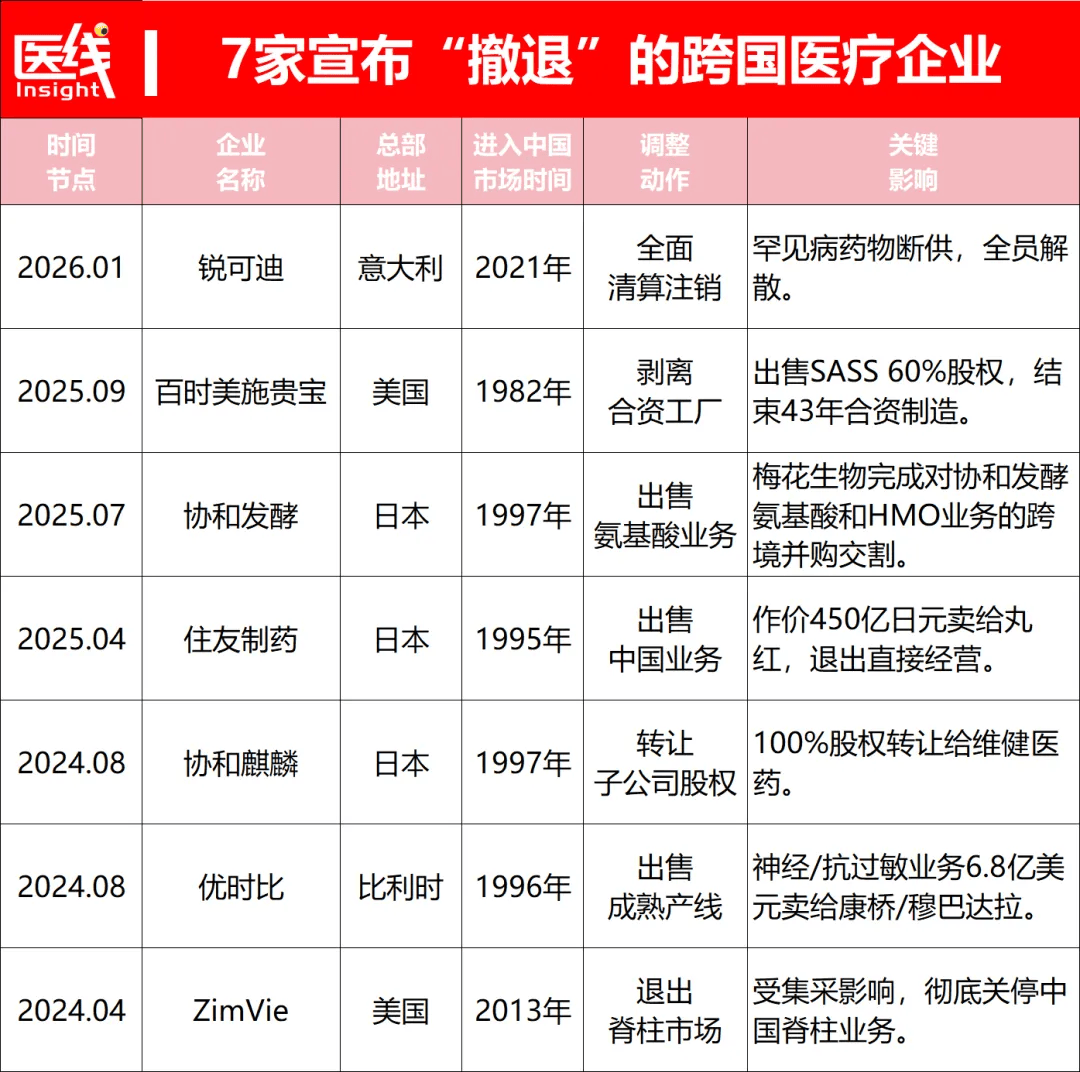
短短两年内,7家跨国医疗巨头退出中国市场
Sou Hu Cai Jing· 2026-01-27 02:13
如果我们把时间轴拉回至2024年初,俯瞰整个中国医疗市场,一份"撤退清单"已然浮现:短短两年间,至少7家曾经在中国市场长袖善舞的跨国医疗企 业,做出了令业界哗然的决绝选择——出售、剥离、裁撤,乃至清盘。 从住友制药将中国业务"打包卖身",到百时美施贵宝(BMS)挥泪斩断40年的合资情缘;从协和麒麟的全权转让,到ZimVie在脊柱市场的黯然离场。 | | | | | 7家宣布"撤退"的跨国医疗企业 | | | --- | --- | --- | --- | --- | --- | | EDITET | 1541 | 总部 | 进入中国 | 调整 | 美键 | | 节点 | 名称 | 地址 | 市场时间 | 动作 | 影响 | | 2026.01 | 锐可迪 | 意大利 | 2021年 | 毛圓 | 罕见病药物断供,全员解 | | | | | | 清算注销 | 散。 | | 2025.09 | 百时美施贵宝 | 美国 | 1982年 | 剥离 | 出售SASS 60%股权,结 | | | | | | 合资工厂 | 束43年合资制造。 | | 2025.07 | 协和发酵 | 日本 | 1997年 | 出售 | 梅 ...

What the Options Market Tells Us About Bristol-Myers Squibb - Bristol-Myers Squibb (NYSE:BMY)
Benzinga· 2026-01-26 19:00
Core Insights - Financial giants are showing a bullish sentiment towards Bristol-Myers Squibb, with 44% of traders being bullish and 33% bearish in recent options trading [1] - Significant investors are targeting a price range of $45.0 to $57.5 for Bristol-Myers Squibb over the past three months [2] - The trading volume for Bristol-Myers Squibb stands at 3,924,289, with the stock price at $54.99, reflecting a 0.63% increase [10] Options Trading Analysis - A total of 9 unusual trades were identified, with 3 puts valued at $105,215 and 6 calls valued at $249,315 [1] - The largest options trades include a bearish call sweep at a strike price of $57.50, valued at $76.7K, and a bearish put sweep at the same strike price, valued at $50.2K [6] - The volume and open interest metrics indicate liquidity and investor interest in options trading for Bristol-Myers Squibb, particularly within the strike price range of $45.0 to $57.5 over the last 30 days [3] Company Overview - Bristol-Myers Squibb focuses on discovering, developing, and marketing drugs for various therapeutic areas, with a strong emphasis on immuno-oncology [7] - Approximately 70% of Bristol-Myers Squibb's total sales are derived from the US market, indicating a higher dependence on the US compared to its peers [7] Analyst Ratings and Price Targets - Recent expert ratings suggest an average target price of $59.5 for Bristol-Myers Squibb, with individual targets ranging from $53 to $65 [9][10] - Analysts from various firms maintain differing ratings, with one upgrading to Buy and setting a price target of $65, while others maintain Neutral and Outperform ratings [10][11]

BMS开展5项PD-L1/VEGF-A双抗头对头研究,挑战4款PD-(L)1药物
Xin Lang Cai Jing· 2026-01-26 11:09
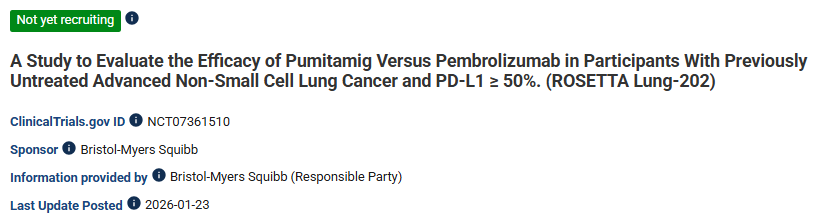
Core Viewpoint - Bristol-Myers Squibb (BMS) has initiated two new Phase III clinical trials (ROSETTA Lung-201 and ROSETTA Lung-202) for Pumitamig, a PD-L1/VEGF-A dual antibody, indicating a strong commitment to advancing its oncology pipeline [1][7]. Group 1: Clinical Trials - ROSETTA Lung-201 aims to enroll 850 patients with unresectable stage III non-small cell lung cancer (NSCLC) who have not experienced disease progression after platinum-based chemotherapy, evaluating the efficacy and safety of Pumitamig compared to durvalumab as a subsequent treatment [1][8]. - ROSETTA Lung-202 plans to include 750 previously untreated patients with advanced NSCLC and PD-L1 expression ≥50%, assessing the efficacy and safety of Pumitamig versus pembrolizumab as a first-line treatment [3][10]. Group 2: Development History - Pumitamig was initially discovered by Prometheus Biosciences, which granted global development, production, and commercialization rights outside of China to BioNTech in November 2023. Prometheus was subsequently acquired by BioNTech for a total of $950 million [1][8]. - In June 2025, BMS acquired global collaboration and commercialization rights for Pumitamig from BioNTech for $11.1 billion, highlighting the strategic value placed on this asset [1][8]. Group 3: Competitive Landscape - To date, Pumitamig has been involved in five head-to-head Phase II/III or III clinical trials against PD-(L)1 drugs, with positive control drugs including pembrolizumab, nivolumab, durvalumab, and atezolizumab [5][12]. - BMS is noted for its proactive approach in advancing clinical development for introduced products, particularly in the context of PD-(L)1 dual antibodies [5][12].
Bristol Myers Squibb: The Rerating Was Fast - The Proof Will Be Slow (Rating Downgrade)
Seeking Alpha· 2026-01-24 16:52
Core Insights - The article discusses Bristol Myers Squibb (BMY) and highlights concerns regarding the Eliquis patent cliff, legacy erosion, and execution risks, which were significant factors when the stock was near 5-year lows in October 2025 [1]. Company Analysis - Bristol Myers Squibb is facing challenges related to the expiration of the Eliquis patent, which could impact revenue streams significantly [1]. - The company has been under scrutiny for its legacy products and the potential erosion of market share as competition increases [1]. - Execution risks are noted as a critical factor that could affect the company's operational performance and overall market position [1]. Investment Perspective - The article emphasizes the importance of evaluating valuations and dividend offerings as part of the investment analysis for Bristol Myers Squibb [1]. - The author suggests that despite the challenges, there may be potential investment opportunities if the company can navigate these risks effectively [1].

AI Bubble or Sustainable Growth? Here Are 2 Healthcare Companies Harnessing AI for the Long Term.
Yahoo Finance· 2026-01-23 23:50
Key Points Bristol Myers Squibb just announced an important partnership with Microsoft that involves AI. Intuitive Surgical has integrated AI real-time processing into its surgical robots, but that could be just the start. 10 stocks we like better than Bristol Myers Squibb › Artificial intelligence chip giant Nvidia has grown to be the largest component of the S&P 500, as Wall Street jumps on the AI bandwagon. There's no question that AI is going to be a world-changing technology. However, it isn't ...

Bristol-Myers Squibb: Solid Tumor Collaboration With Janux And Camzyos Expansion
Seeking Alpha· 2026-01-23 20:52
Core Insights - The article emphasizes the value of in-depth analysis in the Biotech sector, highlighting the offerings of the Biotech Analysis Central service, which includes a library of over 600 articles and a model portfolio of small and mid-cap stocks [1][2]. Group 1 - The Biotech Analysis Central service is available for $49 per month, with a discounted annual plan at $399, representing a 33.50% savings [1]. - The service aims to assist healthcare investors in making informed decisions through comprehensive analysis and news reports [2]. - The author has a background in Applied Science, which is leveraged to generate long-term value in the healthcare sector [2].

JANX Enters Global Oncology Collaboration With BMY, Stock Rises
ZACKS· 2026-01-23 13:20
Core Insights - Janux Therapeutics (JANX) has entered a strategic collaboration and exclusive global license agreement with Bristol Myers Squibb (BMY) to develop tumor-activated therapies for solid tumors [2][4] - The partnership validates Janux's proprietary tumor-activated immunotherapy platforms and enhances its presence in the oncology sector [2][12] Financial Aspects - Janux is eligible for up to $50 million in upfront and near-term milestone payments, with potential additional milestones totaling approximately $800 million [5][9] - The deal allows Janux to leverage its platform expertise while transferring later-stage development risks to BMY, a large pharmaceutical partner [10] Development and Commercialization - Janux will lead preclinical development until the IND submission, after which BMY will assume responsibility for clinical development and global commercialization [6][10] - Janux will remain involved through the completion of the first phase I study, ensuring continuity in the development process [6] Clinical Pipeline - Janux currently has two tumor-activated T cell engagers in clinical development targeting prostate-specific membrane antigen (PSMA) and epidermal growth factor receptor (EGFR) across various solid tumors [11] - The collaboration with BMY serves as a validation of Janux's tumor-activated approach and enhances the credibility of its broader pipeline strategy [12]