
HP(HPQ)

Search documents
第3届链博会美国参展商增长15%
Bei Jing Wan Bao· 2025-12-29 15:06
Core Viewpoint - The business community in China and the U.S. aims to make economic and trade relations a stabilizing force in bilateral relations rather than a hindrance [1] Group 1: Economic and Trade Relations - The China Council for the Promotion of International Trade (CCPIT) organized a visit for Chinese enterprises to the U.S., emphasizing the importance of implementing the consensus reached by the leaders of both countries [1] - During the visit, over 20 business matching activities were held, involving 25 key Chinese enterprises engaging in discussions with more than 170 U.S. companies and organizations, including Apple, HP, and Micron [1] - The CCPIT noted that despite the winter season, the exchanges between the two countries' business communities were warm, reflecting a strong foundation for cooperation and mutual benefits [1] Group 2: Participation in Trade Events - At the third Chain Expo, the number of U.S. exhibitors increased by 15% compared to the previous edition, maintaining the highest number of foreign exhibitors [1] - U.S. companies showed strong enthusiasm for participating in the event, indicating a positive trend in bilateral trade engagement [1]


Lenovo names Amit Luthra as One Lenovo commercial leader for India
BusinessLine· 2025-12-29 12:40
Leadership Appointments - Lenovo has announced key leadership appointments in India, with Amit Luthra becoming the One Lenovo Commercial Leader effective March 1, 2026, to drive integrated enterprise growth [1] - Srinivas Rao has been appointed as Managing Director of the Infrastructure Solutions Group (ISG) in India, expanding his leadership role [3] - Kaman Chawla has been appointed as Director of Consumer Business, responsible for leading the consumer business across PCs and smart devices [3] Financial Performance - In Q2 FY25/26, Lenovo India recorded a 23% year-on-year growth, reaching $1.2 billion, with expectations that leadership changes will further strengthen this momentum [2] Leadership Experience - Amit Luthra has over three and a half years of leadership experience at Lenovo India, significantly contributing to the scaling of the ISG business [2] - Kaman Chawla brings over 25 years of leadership experience from various sectors, including his recent role at HP Inc. [4] Strategic Focus - Lenovo aims to sharpen its focus on solution-led growth, with Amit's understanding of enterprise needs being critical for this strategy [5] - The company emphasizes the importance of infrastructure in enterprise transformation, with Srinivas's leadership expected to enhance infrastructure capabilities amid increasing AI adoption [5]



现在,哪些芯片厂商已经开始涨价了?(附最新涨价汇总)
芯世相· 2025-12-29 07:48
Price Increases in the Chip Industry - The chip industry is experiencing a significant price increase trend, with various manufacturers announcing price hikes due to rising raw material costs and supply chain pressures [3][4] - Major companies such as TSMC, SMIC, Samsung, and Micron have implemented or are expected to implement price increases across their product lines [12][13][14][19] Raw Material and PCB Price Increases - Jiantek announced a second price increase in December, raising prices for its copper-clad laminates by 5% to 10% due to escalating raw material costs [9] - Nanya Plastics raised prices for all CCL products and PP by 8% starting November 20, citing increases in copper prices and other raw materials [10] Semiconductor Price Adjustments - TSMC has informed clients of a price increase for advanced technology nodes (5nm to 2nm) over the next four years, with expected increases of 8% to 10% for 5nm and up to 50% for 2nm wafers [12] - SMIC has raised prices for some of its production capacity by approximately 10% [13] Memory Chip Price Surge - Samsung has notified clients of a price increase for DRAM and NAND Flash products, with increases of 15% to 30% for certain DRAM types and 5% to 10% for NAND products [14] - Micron has announced a price increase of 20% to 30% for its storage products, effective from September 12 [16] Passive Component Price Increases - Multiple passive component manufacturers have joined the price increase trend, with companies like KEMET and Yageo announcing price hikes of 20% to 30% due to raw material cost pressures [30][33] - Panasonic has raised prices for certain tantalum capacitor models by 15% to 30% [35] Power Device Price Adjustments - China Resources Microelectronics confirmed a price increase for some IGBT products, driven by rising raw material costs and strong order performance [45] - Jingdao Microelectronics has raised prices for certain product series by 10% to 15% due to the increase in raw material prices [46] End-User Impact - Major PC manufacturers like Lenovo, Dell, and HP are planning to raise prices by up to 20% due to ongoing storage price increases [66] - Several smartphone manufacturers have paused procurement of storage chips, facing challenges with rising prices from suppliers [68]




集邦咨询预测 DDR5 内存价格再涨 45%!2026 年电脑恐迎“史上最贵”的一年
Xin Lang Cai Jing· 2025-12-27 10:24
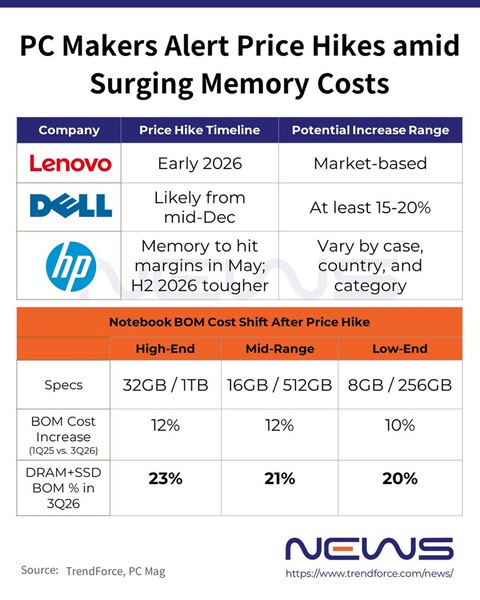
Core Insights - Major laptop manufacturers like Lenovo and HP are likely to delay their new product launches in 2026 due to a historic memory shortage impacting their product roadmaps [1] - The cost of core components is rising significantly, leading brands to reassess their release plans to avoid inventory buildup and high pricing risks [1] - The SSD prices are increasing due to AI monopolizing NAND flash supply, with DDR5 memory prices expected to rise by 45% by the end of 2026, making storage components account for 23% of total laptop material costs [1] Group 1: Price Hikes and Cost Implications - Lenovo plans to increase prices by at least 15-20% starting from mid-December 2025, with high-end models potentially seeing price hikes of up to 30% to maintain profit margins [2] - The BOM (Bill of Materials) cost for high-end laptops is expected to increase by 12% from Q1 2025 to Q3 2026, with DRAM and SSD components making up 23% of the BOM in 2026 [2] Group 2: Manufacturer Strategies - Dell and Framework have announced upcoming price increases, while ASUS considered producing DDR5 memory in-house but later denied this rumor [3] - Custom PC brand Maingear is encouraging customers to send in their own memory modules for assembly, although this unconventional method may not yield significant cost savings [3] Group 3: Market Outlook - The PC market, after a strong growth in 2025 driven by Windows 11 upgrade demands, is expected to face a sharp decline in 2026 due to the exhaustion of upgrade incentives and delayed new product launches [5] - Analysts predict a decrease in laptop sales in 2026 as consumer purchasing power declines and new product availability diminishes [5]
HP Inc. Stock: Severely Mispriced Cash Flow Powerhouse (NYSE:HPQ)
Seeking Alpha· 2025-12-27 08:53
分组1 - The analyst has over 10 years of experience researching more than 1000 companies across various sectors including commodities and technology [1] - The focus of the research includes metals and mining stocks, as well as consumer discretionary, staples, REITs, and utilities [1] 分组2 - The analyst has transitioned from writing a blog to creating a value investing-focused YouTube channel, where extensive research on hundreds of companies has been conducted [1]
存储芯片猛烈涨价,一家PC高管密会三星电子、SK海力士
第一财经· 2025-12-22 10:35
Core Viewpoint - The article discusses the significant price increase in the global memory chip market, which has prompted a leading PC manufacturer to secure supply agreements with major memory chip suppliers like Samsung, SK Hynix, and Micron to mitigate rising costs [3]. Group 1: Market Dynamics - The memory chip market is experiencing its most severe price surge in five years, with DRAM spot prices rising over 260% in just two months and NAND flash prices increasing by over 50% since the beginning of 2025 [3]. - Memory components account for 15%-20% of the bill of materials (BOM) cost for laptops, and the recent price hikes are expected to significantly impact PC manufacturing costs in 2026 [3]. Group 2: Industry Response - Major PC manufacturers, including Lenovo, Dell, HP, Acer, and Asus, are issuing warnings about potential price increases of 15%-20% for end-user PCs due to rising memory costs [4]. - Lenovo's CFO indicated that the company has increased its component inventory by approximately 50% due to the tight supply and rising prices of memory chips [4]. Group 3: Competitive Landscape - The ability to secure stable memory chip supplies is becoming a critical factor for PC manufacturers, with larger firms benefiting from scale advantages and long-term procurement agreements, while smaller firms face challenges in obtaining supplies even with available funds [4]. - IDC forecasts a 4.9% decline in global PC shipments next year, with the potential for a more significant drop if memory supply issues worsen, suggesting that larger OEMs may capture more market share at the expense of smaller local manufacturers [4].
Inside HP’s AI bet to rebuild itself for the ‘work intelligence’ age
Yahoo Finance· 2025-12-22 10:00
Core Insights - HP is transforming from a traditional hardware company into a work-intelligence platform, integrating AI as a fundamental component rather than a mere feature [1][2] - The company aims to address the challenges faced by knowledge workers, as only 20% report a healthy relationship with work, indicating a need for more cohesive and intelligent systems [1][3] - HP's strategy focuses on leveraging its extensive global reach across various endpoints and services to enhance margins and create recurring revenue streams [2][3] Financial Performance - In Q4 of fiscal 2025, HP reported a 4% year-over-year revenue growth, primarily driven by the Personal Systems segment [3] - AI PCs constituted over 30% of shipments in the quarter, with expectations to reach nearly 50% in the following year [3] - The subscription and services segment is generating billions in annual recurring revenue, indicating a shift towards a more sustainable business model [3] Industry Trends - The shift towards intelligent, AI-driven enterprise computing is seen as essential for competitiveness, with industry experts emphasizing the need for embedded intelligence in system design [4][5] - HP's approach to AI PCs includes local processing capabilities, which provide advantages in cost, performance, and privacy, distinguishing it from competitors [6][8] - The transition from device-driven revenue to software and services is viewed as inevitable, with longer device lifecycles and pricing pressures impacting traditional hardware profits [10][11] Competitive Landscape - HP is integrating AI across various product categories, including PCs, workstations, and printing, to streamline workflows and enhance productivity [8][9] - The company's expansion into digital employee experience tools and managed device lifecycle services reflects the evolving competitive landscape [11] - The future of work may be characterized by a quiet reinvention of systems that adapt to actual work processes, rather than through flashy technological showcases [12]
应对存储芯片涨价 一家PC高管密集拜访三星、SK海力士敲定供货
Di Yi Cai Jing· 2025-12-22 08:16
Group 1 - A leading global PC manufacturer has been visiting major memory chip suppliers like Samsung, SK Hynix, and Micron to secure supply agreements amid a significant price surge in the memory chip market, the most severe in five years [1] - The two most likely candidates for this leading PC manufacturer are Lenovo Group and HP, with market shares of 25.5% and 19.8% respectively in the latest quarter [1] - Morgan Stanley reported that DRAM spot prices have surged over 260% in just two months, while NAND flash prices have increased by over 50% since early 2025, leading to potential cost pressures for PCs in 2026 [1] Group 2 - The PC industry is facing a price surge across the entire supply chain due to a "super cycle" in memory supply, with major manufacturers like Lenovo, Dell, HP, Acer, and Asus warning of price increases of 15%-20% for end-user PCs [2] - Companies are preparing to renegotiate contracts, with Dell's COO noting the unprecedented speed of memory chip cost increases, and HP's CEO indicating readiness to raise prices if necessary [2] - IDC forecasts a 4.9% decline in global PC shipments next year, with the potential for further declines if memory supply worsens, favoring large OEMs over smaller manufacturers [2]


美国科技行业-第三季度业绩摘要:人工智能波动未改变软件投资逻辑-US Technology_ Q3 results summary_ AI volatility doesn‘t change the software playbook
2025-12-20 09:54
Summary of Key Points from the Conference Call Industry Overview - The conference call focuses on the **US Technology Equities** sector, particularly the **software and AI** landscape, highlighting the transition towards AI productization expected by **2026** [1][2]. Core Insights - **AI Productization Timeline**: 2026 is projected as the pivotal year for AI productization within enterprise software, moving from early-stage deployment to widespread enterprise integration [1][2]. - **Current AI Deployment Challenges**: Companies are still in the early stages of AI experimentation, facing challenges in hiring skilled talent and achieving meaningful results from initial projects [1][2]. - **Shift in Investment Focus**: There is a notable shift from hardware to software investments as companies begin embedding AI into their existing workflows, with significant advancements seen in companies like **Oracle, Microsoft, Salesforce, and ServiceNow** [1][2][5]. - **Monetization Visibility**: Vendors controlling structured enterprise processes are expected to have improved monetization visibility as AI becomes a value-added feature in their product suites [2]. Financial Performance Highlights - **Q3 Earnings Performance**: Most companies reported modest revenue beats but significant improvements in non-GAAP operating income and EPS, indicating early economic benefits from AI deployments [7][9]. - **Revenue Growth Constraints**: Despite increased interest in AI, enterprise budget expansions remain modest, limiting revenue growth [9]. - **Profitability Boost from AI**: AI-driven efficiencies are enhancing unit economics, leading to higher non-GAAP operating income and EPS, even without substantial revenue increases [9]. Company-Specific Insights - **Preferred AI Stocks**: The report identifies **Oracle (ORCL), Microsoft (MSFT), ServiceNow (NOW), and Salesforce (CRM)** as preferred stocks likely to benefit from their strategic positioning in the AI landscape by 2026 [2][5]. - **Earnings Revisions**: Companies like **Microsoft** and **Palantir** have seen significant upward revisions in revenue and EPS forecasts, reflecting strong AI-related demand [13][14]. - **CoreWeave's Performance**: CoreWeave reported revenue of **USD 1,365 million** for Q3, exceeding consensus but below estimates, with concerns about asset turnover and future guidance indicating potential revenue decline [18][19]. Market Dynamics - **AI Infrastructure Demand**: The demand for AI infrastructure and data workloads is solid, with companies like **Oracle and CoreWeave** aggressively scaling capacity [15]. - **Investor Sentiment**: There is a growing investor focus on how companies will deploy AI to solve business problems, with many still not fully recognizing the link between AI deployment and enterprise software [2]. Conclusion - The technology sector is on the brink of a significant transformation driven by AI, with 2026 expected to be a critical year for monetization and integration into enterprise workflows. Companies that are well-positioned in the software space are likely to capitalize on this trend, while challenges remain in the broader economic environment and enterprise budget constraints.


HPQ Stock Price Prediction: Where HP Could Be by 2025, 2026, and 2030
Yahoo Finance· 2025-12-19 10:25
Core Viewpoint - HP Inc. is experiencing a modest rebound in PC demand, but faces significant challenges including liquidity issues, intense competition, and low margins, which may hinder long-term growth potential [2][4][8]. Financial Performance - Personal computers account for over 70% of HP's quarterly revenue, with the Personal Systems segment showing a 6% year-over-year increase in Q3 FY25 [2]. - HP's current assets are $20.6 billion, while current liabilities stand at $27.9 billion, indicating potential liquidity risks [2][9]. - The company has built up an inventory of $8 billion, further stressing its balance sheet and liquidity [9]. Market Position - HP's stock trades around $28, within a 12-month range of $22 to $35, appealing more to income-driven investors due to its low valuation and high dividend yield [3]. - Analysts have a consensus price target of $29.83 for HPQ, with estimates ranging from $25 to $39, suggesting limited upside potential from current levels [1]. Growth Prospects - HP has recorded five consecutive quarters of revenue growth, with the potential for AI-enabled PCs to drive future revenue expansion and improve margins [7]. - However, long-term forecasts indicate a decline in HP's market position by 2030 due to anticipated market-share loss and ongoing margin pressure [12][13]. Competitive Landscape - HP faces intense competition from companies like Dell, Lenovo, and Apple, which have stronger positions in premium product categories [8]. - The company's reliance on a limited set of business lines makes it vulnerable to cyclical declines in PC demand [8][14]. Investment Considerations - The success of HP's turnaround is contingent on the adoption of AI PCs and the stabilization of its balance sheet [14]. - While the high dividend yield may attract income investors, growth investors may be deterred by HP's limited diversification and low-margin structure [14][15].