
LPL Financial(LPLA)

Search documents
LPL Financial: AI Selloff Is Your Opportunity
Seeking Alpha· 2026-02-16 04:49
Core Insights - LPL Financial (LPLA) is the leading independent broker-dealer in the United States, serving approximately 32,200 financial advisors and managing around $2.4 trillion in assets under custody [1] Company Overview - The core value proposition of LPL Financial is to provide a comprehensive suite of solutions across the front, middle, and back office [1]



LPL Financial Holdings Inc. (LPLA) Delivers Growth and Analyst Support
Insider Monkey· 2026-02-15 09:09
Core Insights - Generative AI is viewed as a transformative technology by Amazon's CEO Andy Jassy, indicating its potential to reinvent customer experiences across the company [1] - Elon Musk predicts that humanoid robots could create a market worth $250 trillion by 2040, representing a significant shift in the global economy driven by AI innovation [2][3] - Major firms like PwC and McKinsey acknowledge the multi-trillion-dollar potential of AI, suggesting a broad consensus on its economic impact [3] Company and Industry Analysis - A breakthrough in AI technology is redefining work, learning, and creativity, leading to increased interest from hedge funds and top investors [4] - There is speculation about an under-owned company that may play a crucial role in the AI revolution, with its technology posing a threat to competitors [4][6] - Prominent figures in technology and investment, including Bill Gates and Warren Buffett, recognize AI as a significant technological advancement with the potential for substantial social benefits [8] Market Dynamics - The AI ecosystem is expected to reshape how businesses, governments, and consumers operate, indicating a broad and deep impact across various sectors [2] - The investment landscape is becoming increasingly competitive, with major players like Oracle investing heavily in AI technologies [8]


AI Shockwave: SCHW, LPLA & Others Slide on Disruption Fear
ZACKS· 2026-02-12 18:16
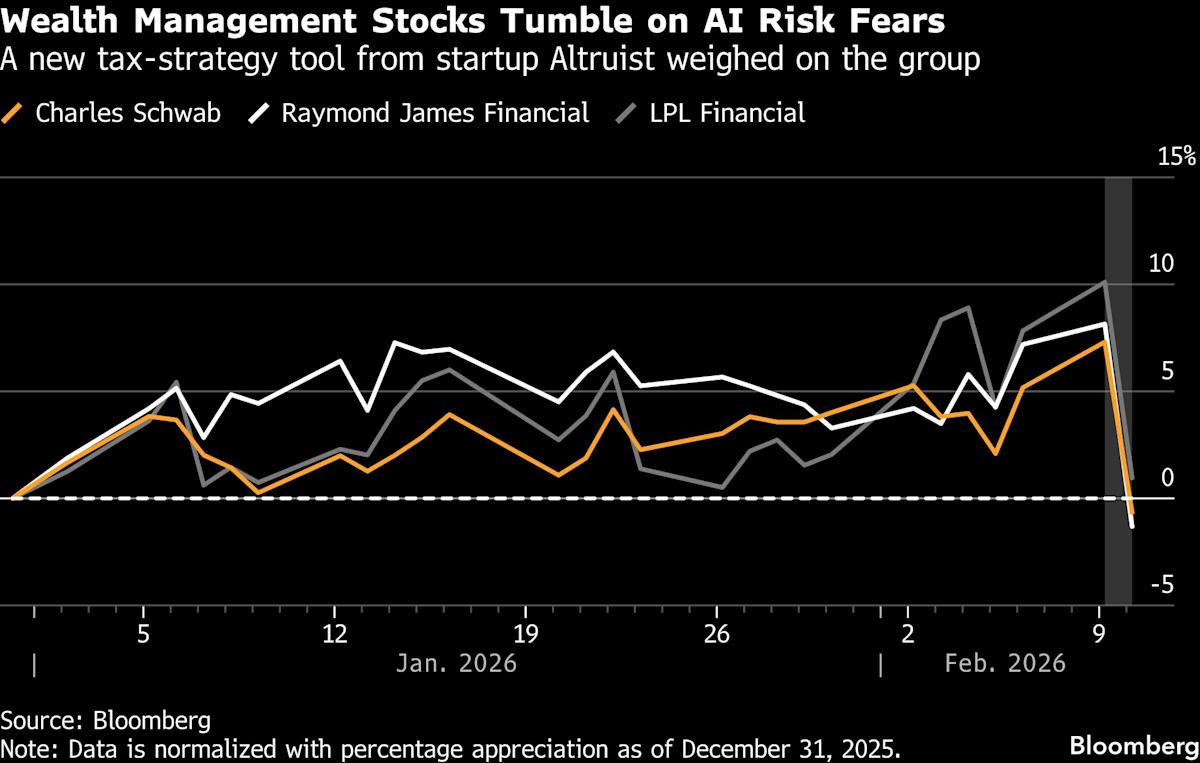
Core Insights - Artificial intelligence (AI) is transitioning from a growth driver for technology stocks to a disruptor in traditional financial services, impacting market expectations for wealth management firms globally [1] - Major wealth management and brokerage stocks have experienced significant declines as investors assess the implications of new AI tools that automate tasks previously performed by human advisors [1] Stock Performance - The Charles Schwab Corp. (SCHW) has decreased by 10.9%, LPL Financial Holdings Inc. (LPLA) by 13.8%, and Raymond James Financial Inc. (RJF) by 8.8% in recent trading days [2] - Other firms such as Lazard and Stifel Financial have also seen declines of nearly 4% and 4.9%, respectively, while banks with substantial wealth management exposure, including JPMorgan Chase (JPM), Bank of America (BAC), and Wells Fargo, have dropped more than 4% [2] Trigger for Stock Selloff - The stock market reaction was initiated by the launch of an AI-powered tax planning tool by U.S. fintech startup Altruist, which is integrated into its Hazel platform [3] - This tool can process client data to generate personalized tax strategies and financial insights that previously required extensive manual work from advisors [3] Investor Concerns - Investors view the AI tool as a potential threat to traditional revenue streams in wealth advisory, particularly in fee-based services like tax planning and portfolio strategy [4] - The ability to commoditize and scale complex financial advice rapidly raises concerns about the erosion of fee margins and business models for existing firms [4] Shift in Market Focus - The market's focus has shifted from beneficiaries of the AI boom to those who might be displaced by it, affecting asset management and private capital firms [5][6] - Executives from firms like Blackstone and Apollo Global Management have attempted to reassure stakeholders that AI is unlikely to undermine their businesses, but skepticism remains prevalent [6] Reassessment of Risks - The initial optimism surrounding AI is evolving into a reassessment of risks, as investors consider the potential for AI to compress margins and alter business models [7] - The recent selloff in wealth management stocks signifies a turning point in how investors perceive AI risk within financial services [8] Implications for Wealth Management - The declines in shares of firms like Schwab, LPL Financial, and Raymond James reflect fears that AI could diminish advisory fees and disrupt established operating models [8][9] - While it is too early to label AI as an existential threat to human-led wealth advice, the rapid advancement of tools like Altruist's Hazel platform necessitates a reevaluation of defensible areas within the value chain [10] - Success for incumbents will likely hinge on the effective integration of AI into client service, compliance, and portfolio construction, where trust and judgment remain essential [10]



LPL Financial Welcomes Sound Wealth
Globenewswire· 2026-02-12 13:55
Core Insights - LPL Financial LLC has welcomed financial advisors Curt Pederson and Britt Saylor from Sound Wealth, who manage approximately $420 million in advisory, brokerage, and retirement plan assets [1][2] Group 1: Company Overview - LPL Financial Holdings Inc. is one of the fastest-growing wealth management firms in the U.S., supporting over 32,000 financial advisors and approximately 1,200 financial institutions [6] - The firm services and custodies around $2.4 trillion in brokerage and advisory assets for approximately 8 million Americans [6] - LPL offers a variety of advisor affiliation models, investment solutions, fintech tools, and practice management services, allowing advisors to choose the business model and technology resources they need [6] Group 2: Advisor Background - Pederson and Saylor have a combined experience of 40 years and are based in Seattle and Phoenix [2] - The team specializes in serving high-net-worth individuals, families, and multigenerational households with complex financial planning needs, including inheritance planning and advanced executive compensation planning [2] Group 3: Reasons for Transition - Sound Wealth chose LPL for its support of a highly customized service model, open architecture, and commitment to innovation, including advancements in AI and expanded investment solutions [3][4] - The advisors were impressed by LPL's leadership in technology and the flexibility to tailor strategies uniquely for each client [4]

Why Altruist’s New AI Tax Tool Spooked Investors in Schwab, LPL, Raymond James
Yahoo Finance· 2026-02-12 05:01
Core Insights - The launch of Altruist's AI-powered tool, Hazel, has negatively impacted the stock prices of major wealth management firms, indicating market sensitivity to AI developments [2][6] - Experts suggest that the market reaction may be an overreaction, and the true impact of AI tools on wealth management firms will depend on their adoption rates [2][5] Group 1: AI Tool Launch and Market Reaction - Altruist introduced Hazel, an AI tool that creates tax strategies based on client documents, leading to stock declines for firms like LPL Financial and Charles Schwab [2][6] - The stock prices of LPL Financial and Charles Schwab fell by 5.7% and 4%, respectively, with other firms like Stifel Financial and Piper Sandler also experiencing declines [6] Group 2: Industry Expert Opinions - Bill Harris, CEO of Evergreen Wealth, emphasized that Hazel is part of a broader trend of AI tools that will transform the wealth management industry [3][4] - Kyle Mostransky, CEO of Mostransky & Associates, argued that while AI can optimize financial calculations, the human element remains crucial for interpreting financial decisions [5] - Harris noted that the introduction of AI tools could lead to a reduction in fees for human financial advisors, which currently average around 1% of assets [5]


Wall Street’s New Trade Is Dumping Stocks in AI’s Crosshairs
Yahoo Finance· 2026-02-11 16:09
Core Viewpoint - Rising fears about artificial intelligence (AI) are negatively impacting shares of companies perceived to be at risk, leading to significant sell-offs across various sectors, particularly in software and wealth management [1][2][3]. Group 1: Market Reactions - The latest selloff was triggered by a tax-strategy tool from Altruist Corp, causing shares of Charles Schwab Corp., Raymond James Financial Inc., and LPL Financial Holdings Inc. to drop by 9% or more over two days [2]. - This decline represents the deepest slide for some stocks since the trade-war meltdown in April, reflecting a sell-first, ask-questions-later mentality among investors [3]. - The software industry has been particularly affected, with new AI tools from companies like Anthropic PBC leading to a rout in stocks across various sectors, including financial services and legal services [8]. Group 2: Investor Sentiment - Investors are shifting from identifying potential winners in the AI space to avoiding companies that may be displaced by AI advancements [6]. - The narrative has changed from believing in AI and searching for use cases to recognizing the disruptive potential of newly discovered applications [7]. - Concerns about AI's impact have spread beyond the software industry, affecting US insurance brokers and wealth-management stocks due to new applications that leverage AI technology [9].
美股下一个“AI受害者”已经出现,市场正在提前定价!
美股研究社· 2026-02-11 11:06
Core Viewpoint - The article discusses the recent internal rotation in the U.S. stock market, highlighting a shift from a few large-cap stocks leading the market to a broader participation across various sectors, while also addressing the impact of AI on traditional business models and the resulting market volatility [5][7][8]. Market Performance - On Tuesday, the S&P 500 fell by approximately 0.3%, while the Dow Jones Industrial Average rose by about 0.1%, reaching a new historical high [5]. - The equal-weighted S&P index also reached a record high, indicating a shift in market dynamics with around 300 stocks in the S&P 500 rising [7]. Retail Sales Data - The U.S. Commerce Department reported that December retail sales were flat month-over-month, significantly below the expected 0.4% growth, indicating a slowdown in consumer spending [9]. - Core retail sales, excluding autos and gas, even showed a decline, reflecting weakened consumer spending momentum during the holiday season [9]. Interest Rate Expectations - The weak retail data led to a rise in U.S. Treasury prices and a decline in yields, with the futures market increasing the probability of three rate cuts within the year, with two already priced in [9]. - Historical trends suggest that rate cut expectations typically support risk assets, but the current market shows a divergence where rates are falling but stocks are not rising, particularly in the tech sector [11]. AI Impact on Market Sentiment - Market participants are shifting their interpretation of AI's impact from a growth narrative to concerns about short-term disruptions, leading to a "sell first, think later" mentality [12]. - Investors are moving from an "AI is a panacea" mindset to a more pragmatic "performance realization" phase, anticipating greater differentiation between winners and losers in the market [12]. Institutional Perspectives - There is a noticeable divergence in institutional views on the tech sector, with Goldman Sachs warning about the risks of overestimating AI's growth potential and emphasizing the need for actual earnings and cash flow improvements to support tech valuations [13]. - UBS downgraded its rating on the U.S. tech sector from "overweight" to "neutral," citing key risks while still acknowledging the long-term potential of AI [14]. Wealth Management Sector - The wealth management sector has come under scrutiny following the launch of an AI tool by Altruist Corp., which automates tasks traditionally reliant on human expertise, raising concerns about the core revenue models of wealth management firms [17][18]. - The market reacted sharply, with significant declines in stocks of major wealth management firms, indicating fears about the long-term competitive structure of the industry under AI pressure [19][21]. Broader Market Reactions - The sell-off in the market has been attributed to fears that AI tools could undermine the intermediary value of insurance brokers, leading to a significant drop in the insurance brokerage sector [22]. - The recent downturn in the software sector has seen substantial market capitalization losses, with estimates indicating a combined loss of approximately $611 billion across software, financial services, and asset management sectors [26]. Conclusion - The current market environment reflects a transition from viewing AI as a beneficiary narrative to recognizing potential victims, with traditional software companies facing heightened scrutiny and volatility [27]. - The article suggests that this phase serves as a valuation and business model stress test, prompting a reevaluation of which revenue models are based on irreplaceable value versus those reliant on information asymmetry [34].




AI淘金热变成AI恐慌潮!华尔街新共识:躲开一切可能被颠覆的公司
华尔街见闻· 2026-02-11 09:15
Core Viewpoint - The investment logic on Wall Street is undergoing a significant transformation, with investors rapidly selling stocks of companies that may be disrupted by AI, rather than focusing on identifying AI winners [3][4]. Group 1: Market Reactions - A recent sell-off was triggered by the launch of Altruist Corp.'s tax strategy tool, Hazel, which caused major wealth management companies like Charles Schwab and Raymond James Financial to see stock declines of over 7%, marking the largest drop since the market crash in April [4]. - The panic began when Anthropic introduced a new tool, leading to a deep correction across software, financial services, asset management, and legal services sectors [5][7]. - The insurance brokerage industry was also affected, with stocks plummeting after Insurify launched a ChatGPT-based application for comparing auto insurance rates [7]. Group 2: Industry Impact - Altruist's Hazel tool highlights the market's deep anxiety regarding AI's potential to disrupt traditional financial services, as it can perform tasks that typically require an entire team for just $100 a month [6][7]. - The fear of AI disruption has spread from the software industry to broader sectors, indicating a significant shift in market sentiment [5][7]. Group 3: Diverging Opinions - Despite the prevailing panic, some market participants question the speed and extent of AI disruption, suggesting that technological upheaval often takes longer than anticipated [10][11]. - Concerns about AI's impact on various industries may be premature, as the market is still in the early stages of understanding AI's long-term implications [12]. Group 4: Market Sensitivity - The current sell-off reflects a general anxiety over high valuations in the market, which have been driven by a surge in AI spending and unexpected economic resilience [13]. - In a highly sensitive market environment, even minor negative signals can lead to significant stock declines, as investors prefer to err on the side of caution regarding potential AI disruptions [13].

AI淘金热变成AI恐慌潮!华尔街新共识:躲开一切可能被颠覆的公司
硬AI· 2026-02-11 08:40
Core Viewpoint - Investors are shifting from seeking AI winners to rapidly selling stocks of companies that may be disrupted by AI, leading to a panic selling mentality across various sectors, including software, financial services, wealth management, insurance brokerage, and legal services [2][3]. Group 1: Market Reaction to AI Disruption - The latest wave of selling was triggered by the launch of a tax strategy tool, Hazel, by Altruist Corp., which caused significant stock price drops of over 7% for wealth management firms like Charles Schwab, Raymond James Financial Inc., and LPL Financial Holdings Inc., marking the largest decline since the market crash in April [3][5]. - The panic began when Anthropic introduced a new tool that led to a deep correction in software, financial services, asset management, and legal services sectors, indicating a turning point in market sentiment [6][8]. - The insurance brokerage sector was also heavily impacted after Insurify launched a new application using ChatGPT to compare auto insurance rates, resulting in substantial stock losses for U.S. insurance brokers [6][8]. Group 2: Concerns Over AI's Impact - The introduction of AI tools like Hazel highlights deep-seated anxieties about AI disrupting traditional financial services, as these tools can perform tasks that typically require entire teams, with costs as low as $100 per month [5][6]. - Market participants are increasingly concerned that any intermediary services that could be replaced by AI face existential threats, leading to widespread selling [6][8]. Group 3: Diverging Market Opinions - Despite the prevailing panic, some market analysts express skepticism about the speed and extent of AI disruption, suggesting that technological upheaval often takes longer to materialize than anticipated [8]. - Historical context indicates that industries like banking have faced challenges from emerging technologies, such as cryptocurrencies and electronic services, but these have not significantly undermined their dominance [8]. Group 4: Market Sensitivity and Valuation Concerns - The current sell-off reflects broader anxieties regarding elevated stock valuations, which have been pushed up by a surge in AI spending and unexpected economic resilience in the U.S., making investors highly sensitive to negative signals [10]. - In a tense market environment, even minor product launches from small startups can lead to significant volatility in large public companies, as investors prefer to err on the side of caution regarding potential AI disruptions [10].

US stock market | Wall Street’s new trade is dumping any stock in AI’s crosshairs
The Economic Times· 2026-02-11 07:53
Core Viewpoint - The recent selloff in the stock market, particularly affecting companies at risk of disruption from AI technologies, reflects a growing anxiety among investors about the potential impact of AI on various industries [1][14]. Group 1: Market Reaction - The selloff was triggered by the launch of a tax-strategy tool by Altruist Corp., which caused shares of major firms like Charles Schwab Corp. to drop by 7% or more, marking the deepest decline since the trade-war meltdown in April [1][14]. - Investors are adopting a "sell-first, ask-questions-later" mentality, leading to indiscriminate selling of companies perceived to have any disruption risk [2][14]. - The stock market's reaction has wiped billions of dollars off the market values of several investment firms, indicating a strong signal about the competitive threat posed by new AI products [8][14]. Group 2: Industry Impact - The software industry has been particularly affected, with fears spreading to sectors such as financial services, asset management, and legal services following the introduction of new AI tools [6][14]. - The launch of Insurify's application using ChatGPT to compare auto-insurance rates also negatively impacted shares of US insurance brokers [7][14]. - Altruist's product, Hazel, which personalizes strategies for financial advisers, exemplifies how AI can potentially replace entire teams in wealth management for a fraction of the cost [9][14]. Group 3: Investor Sentiment - Investors are now more focused on avoiding companies that could be displaced by AI rather than identifying potential winners in the market [5][14]. - There is skepticism about the speed at which AI will disrupt industries, with some experts suggesting that tech disruption often takes longer to materialize than anticipated [10][11]. - The recent pullbacks in stock prices may also reflect broader concerns about high valuations following a rally driven by AI spending and a resilient US economy [11][12].
