
LPL Financial(LPLA)

Search documents
US stock market | Wall Street’s new trade is dumping any stock in AI’s crosshairs
The Economic Times· 2026-02-11 07:53
Core Viewpoint - The recent selloff in the stock market, particularly affecting companies at risk of disruption from AI technologies, reflects a growing anxiety among investors about the potential impact of AI on various industries [1][14]. Group 1: Market Reaction - The selloff was triggered by the launch of a tax-strategy tool by Altruist Corp., which caused shares of major firms like Charles Schwab Corp. to drop by 7% or more, marking the deepest decline since the trade-war meltdown in April [1][14]. - Investors are adopting a "sell-first, ask-questions-later" mentality, leading to indiscriminate selling of companies perceived to have any disruption risk [2][14]. - The stock market's reaction has wiped billions of dollars off the market values of several investment firms, indicating a strong signal about the competitive threat posed by new AI products [8][14]. Group 2: Industry Impact - The software industry has been particularly affected, with fears spreading to sectors such as financial services, asset management, and legal services following the introduction of new AI tools [6][14]. - The launch of Insurify's application using ChatGPT to compare auto-insurance rates also negatively impacted shares of US insurance brokers [7][14]. - Altruist's product, Hazel, which personalizes strategies for financial advisers, exemplifies how AI can potentially replace entire teams in wealth management for a fraction of the cost [9][14]. Group 3: Investor Sentiment - Investors are now more focused on avoiding companies that could be displaced by AI rather than identifying potential winners in the market [5][14]. - There is skepticism about the speed at which AI will disrupt industries, with some experts suggesting that tech disruption often takes longer to materialize than anticipated [10][11]. - The recent pullbacks in stock prices may also reflect broader concerns about high valuations following a rally driven by AI spending and a resilient US economy [11][12].



周一保险经纪崩了、周二财富管理崩了,美股遍寻“下一个AI受害者”
华尔街见闻· 2026-02-11 03:38
Core Viewpoint - The launch of Altruist Corp.'s AI tool for tax strategy planning has raised concerns about the future of traditional wealth management firms, indicating a potential disruption in their core business model [1][2][4]. Group 1: Market Reaction - Following the announcement of Altruist's AI tool, shares of major wealth management firms experienced significant declines, with Charles Schwab (SCHW) dropping 9.5% intraday and closing down 7.4%, while Raymond James Financial Inc. (RJF) and LPL Financial Holdings Inc. (LPLA) saw declines of over 9% and 11% respectively [2]. - The sell-off in wealth management stocks reflects broader market anxieties regarding AI's potential to disrupt financial advisory and wealth management services, leading to fears of efficiency gains being eroded by competition and long-term fee compression [4][6]. Group 2: Broader Industry Impact - The threat posed by AI to traditional business models is spreading across various sectors, with wealth management stocks being the latest to feel the impact [5]. - Prior to the wealth management stock declines, insurance brokerage stocks had already faced significant losses, with the S&P 500 Insurance Index dropping 3.9%, marking its largest single-day decline since October 2025 [7]. - The introduction of new AI tools by companies like Insurify has raised concerns about the potential threat to the consulting business of insurance brokers, although some analysts view these tools as efficiency enhancers rather than existential threats [9]. Group 3: Market Trends and Analyst Insights - The recent sell-off in stocks across software, financial services, and asset management sectors resulted in a combined market value loss of $611 billion [10]. - Since the launch of OpenAI's ChatGPT, the potential for AI disruption has been a hot topic, with investors previously focusing on beneficiaries of AI advancements, such as semiconductor and network equipment companies [12]. - Despite the current market turmoil, analysts project a 19% growth in earnings for S&P 500 software and services constituents by 2026, indicating a potential recovery in the sector [14].


AI“淘汰焦虑”愈演愈烈!华尔街如今的交易逻辑:只要怕被AI替代,先抛了再说
智通财经网· 2026-02-11 02:49
Core Viewpoint - The market is experiencing heightened fear regarding the potential disruption caused by artificial intelligence (AI), leading to significant stock price declines across various sectors, particularly in wealth management and software companies [1][3]. Group 1: Market Reaction - A recent sell-off was triggered by the launch of a tax strategy tool by Altruist Corp, resulting in stock price drops of over 7% for major firms like Charles Schwab, Raymond James, and LPL Financial [1]. - This sell-off reflects a broader market sentiment of "sell first, ask questions later," as concerns grow over the potential for AI to disrupt entire industries [1][3]. - The stock market has seen significant volatility, with companies facing indiscriminate selling if they are perceived to have any risk of being replaced by AI [3][4]. Group 2: Industry Impact - The introduction of AI products has shifted investor focus from identifying AI winners to quickly exiting any companies that may face replacement risks [3]. - The software industry is particularly affected, with stock prices plummeting across various sectors, including financial services and legal services, following the launch of new AI tools [3][4]. - Altruist's CEO highlighted that the technology used in their product could potentially replace many roles in wealth management, emphasizing the competitive threat posed by AI [4]. Group 3: Market Sentiment and Future Outlook - There is skepticism among analysts regarding the rapid shift from concern over an AI bubble to fear of its disruptive potential, with some suggesting that technological disruption often takes longer to materialize than anticipated [4][5]. - The current market reaction indicates a heightened sensitivity to any negative signals, with stock prices dropping significantly on minor adverse news [5]. - Experts caution against making premature conclusions about the long-term impact of AI, noting that the AI revolution is still in its early stages [5].
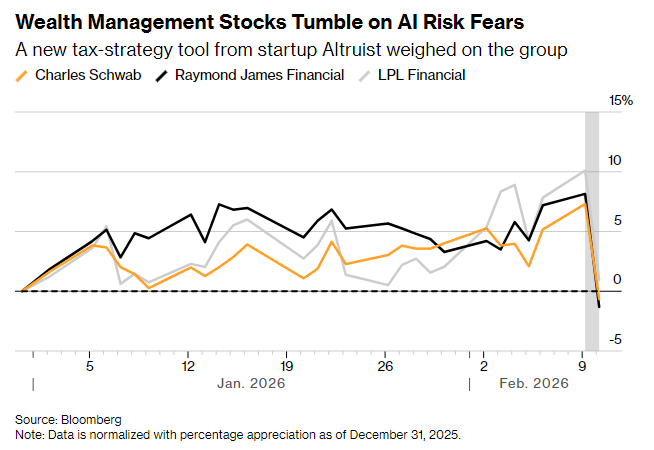
Wall Street’s mood swing turns AI disruption into a sell signal
BusinessLine· 2026-02-11 01:41
Core Viewpoint - Rising fears about artificial intelligence (AI) are negatively impacting the stock prices of companies perceived to be at risk, including both small software firms and large wealth-management companies [1][2]. Market Reaction - A recent selloff was triggered by a tax-strategy tool from Altruist Corp., causing shares of Charles Schwab Corp., Raymond James Financial Inc., and LPL Financial Holdings Inc. to drop by 7% or more [1]. - This decline represents the most significant drop for these stocks since the trade-war market meltdown in April [2]. Investor Sentiment - Investors are shifting from identifying potential winners in the AI space to avoiding companies that may be displaced by AI advancements [5]. - The mood among investors has changed dramatically, with a focus on potential disruption rather than growth opportunities [4][5]. Industry Impact - The software industry has been particularly affected, with fears of AI disruption spreading to financial services, asset management, and legal services [6]. - New AI tools have led to significant stock declines across various sectors, including a notable impact on US insurance brokers following the launch of an application by Insurify [7]. Competitive Threats - Altruist's CEO noted the unexpected scale of the market's reaction, indicating a strong signal regarding the competitive threat posed by AI in wealth management [8]. - The architecture used to build Altruist's product, Hazel, is seen as capable of replacing traditional jobs in wealth management, which typically require entire teams [9]. Broader AI Adoption - Companies like OpenAI and Anthropic are making strides in software engineering and are beginning to penetrate other industries [9]. - There are ongoing questions about how quickly and effectively AI technology will be adopted across various sectors, including banking [10]. Valuation Concerns - The recent pullbacks in stock prices may reflect broader anxieties about inflated valuations resulting from the AI spending boom and a resilient US economy [11]. - Investors are becoming increasingly sensitive to negative market signals, leading to significant sell-offs in response to perceived risks [12]. Future Outlook - Some industry experts believe that concerns about AI's disruptive potential may be premature, as the market is still in the early stages of understanding AI's long-term implications [13].

3分钟生成税务策略!Altruist发布税务新工具,财富管理板块应声惨跌
Zhi Tong Cai Jing· 2026-02-11 01:25
Core Insights - The launch of Altruist's AI-assisted tax planning tool, Hazel, has caused significant turmoil in the wealth management sector on Wall Street, raising fears about the disruption of traditional investment advisory business models [1] - Hazel utilizes deep learning algorithms to analyze complex financial documents in approximately three minutes, offering tailored tax-saving strategies for a monthly fee of $60, which threatens to drastically reduce the costs associated with traditional tax planning [1] - The market reacted negatively, with wealth management and brokerage stocks experiencing a sharp decline, reaching their lowest valuations since April of the previous year [1] Company Performance - LPL Financial (LPLA.US) saw its stock price drop by 8.3%, reflecting investor concerns over service commoditization [1][2] - Charles Schwab (SCHW.US) recorded a significant decline of 7.4%, becoming a highly traded stock on that day [1] - Raymond James (RJF.US) faced its largest single-day drop since the onset of the pandemic, falling by approximately 8.8% [2] - Other established firms like Ameriprise Financial (AMP.US) and Stifel Financial (SF.US) also experienced declines ranging from 4% to 7% [2] Analyst Perspectives - Some industry analysts believe the market's reaction to the "AI panic" may be an overreaction, as the core barriers in wealth management, such as the need for complex behavioral coaching and deep trust with high-net-worth clients, are not easily replicable by automation [2] - Morningstar's research indicates that if traditional firms fail to integrate similar AI capabilities quickly, their customer acquisition costs will continue to rise amid the digital asset transfer wave, leading to fundamental changes in future revenue structures [2]

Broader Market Falls Ahead of Wednesday’s US Jobs Report
Yahoo Finance· 2026-02-10 21:32
Economic Indicators - Nonfarm payrolls are expected to increase by +68,000 in January, with the unemployment rate remaining unchanged at 4.4% [1] - Average hourly earnings are projected to rise by +0.3% month-over-month and +3.7% year-over-year in January [1] - Initial weekly unemployment claims are anticipated to decrease by -7,000 to 224,000 [1] - Existing home sales in January are expected to decline by -4.3% month-over-month to 4.16 million [1] - January CPI is expected to rise by +2.5% year-over-year, with core CPI also expected to increase by +2.5% year-over-year [1] Retail Sales and Employment Costs - US December retail sales were unchanged month-over-month, falling short of expectations of +0.4% [2] - The employment cost index for Q4 rose by +0.7% quarter-over-quarter, which is the smallest increase in 4.5 years and below the expected +0.8% [2] Stock Market Performance - Stock indexes experienced mixed trading, with the Dow Jones reaching a new all-time high while the S&P 500 closed down -0.33% and the Nasdaq down -0.56% [6][5] - The broader market initially found support from weaker-than-expected retail sales and employment cost index reports, which lowered bond yields [5] Earnings Season Insights - Over half of the S&P 500 companies have reported earnings, with 78% beating expectations [7] - S&P earnings growth is expected to rise by +8.4% in Q4, marking the tenth consecutive quarter of year-over-year growth [7] - Excluding the Magnificent Seven tech stocks, Q4 earnings are projected to increase by +4.6% [7] Interest Rates and Bond Market - The markets are pricing in a 23% chance of a -25 basis point rate cut at the next Federal Reserve meeting [8] - The 10-year T-note yield fell to a 3.5-week low of 4.13%, supported by weaker-than-expected economic reports [9] Sector Performance - AI-infrastructure stocks faced pressure, with Western Digital down more than -7% and other tech stocks also declining [12] - Wealth-management stocks dropped significantly, with Raymond James Financial down more than -8% due to concerns over AI disruption [13] - Homebuilding stocks rose after the drop in mortgage rates, with Toll Brothers up more than +6% [14] Company-Specific Developments - Goodyear Tire & Rubber Co reported Q4 adjusted EPS of 39 cents, below the consensus of 49 cents, leading to a decline of more than -14% [15] - Incyte forecasted dull-year total net product revenue of $4.77 billion to $4.94 billion, causing a drop of more than -8% [16] - Spotify reported a record 38 million monthly active users in Q4, leading to a rise of more than +17% [17]




Wealth Manager Stocks Sink as Traders Flee Next AI Casualty
Yahoo Finance· 2026-02-10 21:12
An artificial intelligence tool aimed at creating tax strategies sparked a selloff in wealth-management stocks Tuesday as investors fear the business could be at risk from automated advice. The innovation puts the wealth-management industry in the crosshairs of AI competition, the way it did for software stocks and private credit firms last week and insurance brokerage shares on Monday. Investors responded precisely the way they did before — by unloading the stocks. Raymond James Financial Inc. dropped 8. ...
$730M Wisconsin Team Joins Raymond James From Commonwealth
Yahoo Finance· 2026-02-10 20:19
You can find original article here WealthManagement. Subscribe to our free daily WealthManagement newsletters. A Wisconsin-based five-advisor team from Commonwealth is joining Raymond James’ independent advisor channel, marking the latest departure from the LPL Financial-acquired firm. The team operated as Financial Consulting Services, and included Russell Olson, Christopher Lamal, Raymond Krusic and daughter Nicole Krusic, Ryan Spiering and Brian Craig. Together, the team managed about $730 million from ...
The AI threat wrecked software stocks. Now broker stocks look next with LPL down 11%
CNBC· 2026-02-10 19:10
Core Viewpoint - The launch of a new AI-powered tax planning tool has led to significant declines in shares of financial services firms, indicating potential disruption in the industry. Group 1: Market Reaction - Shares of financial services firms experienced a sharp decline, with LPL Financial falling nearly 11% and both Charles Schwab and Raymond James Financial dropping over 9% [1] - Morgan Stanley's shares also decreased by 4%, reflecting widespread concern about the impact of AI on the financial services sector [1] Group 2: AI Tool Overview - Altruist introduced an AI platform named Hazel, which assists advisors in creating personalized tax strategies by analyzing various client data sources, including 1040s, paystubs, and account statements [2] - The tool applies deep tax logic to its analysis, enhancing the efficiency and effectiveness of tax planning for financial advisors [2]

Court Allows Advisors’ Attempt to Pause LPL/Ameriprise Suit
Yahoo Finance· 2026-02-09 19:39
Core Viewpoint - The ongoing legal dispute between Ameriprise and LPL Financial involves advisors seeking to pause the case while FINRA arbitration proceedings are underway, following a court ruling that allows them to request a halt to the litigation and digital searches [1][2]. Group 1: Legal Proceedings - District Court Judge Jinsook Ohta issued a ruling allowing advisors to request a pause in the case and the digital searches for confidential client information [2]. - The advisors had previously been ordered to allow searches of their personal devices as part of the litigation, but a federal appeals court overruled this decision, enabling the advisors to intervene [2][6]. - Ameriprise filed a lawsuit against LPL Financial in summer 2024, alleging that LPL directed recruits to obtain confidential information, leading to potential regulatory and criminal exposure [3]. Group 2: Advisor Involvement - Advisors who left Ameriprise are required to undergo a review of their retention of client information on personal devices, as argued by Ameriprise [4]. - A third-party forensic examiner was agreed upon by both companies to investigate the claims, but some advisors objected and sought to stop the forensic search [4]. - The advisors claimed they were not parties to the agreement allowing searches of their devices and expressed concerns about privacy invasion and rights violations [5]. Group 3: Corporate Responses - LPL Financial accused Ameriprise of hypocrisy while asserting its support for advisors' rights [3]. - Ameriprise alleged that the advisors were coordinating with LPL to disrupt the agreement regarding the data searches [5]. - The Ninth Circuit Court of Appeals ruled in favor of the advisors, vacating the previous decisions that denied their intervention and mandated the searches [6].