L'Oreal(LRLCY)

Search documents
欧莱雅加仓高德美股权至20%,这场跨界融合玩得多大?
Sou Hu Cai Jing· 2025-12-19 07:42
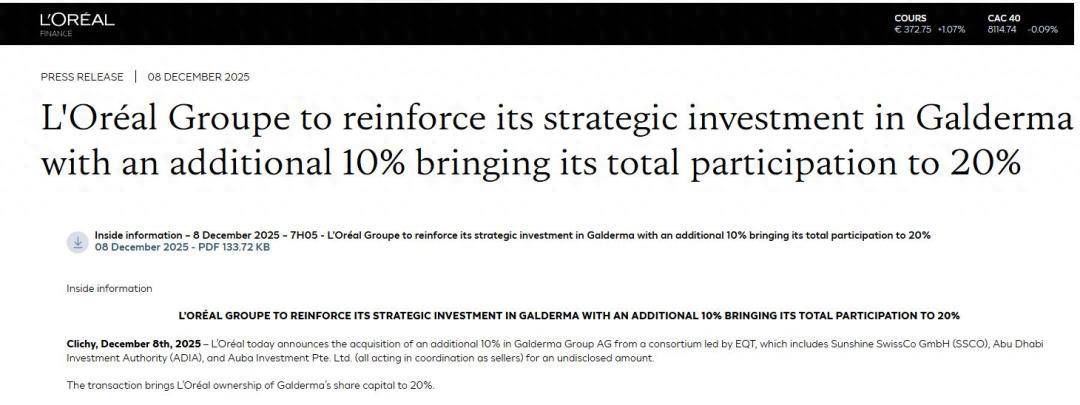
Core Viewpoint - The boundary between beauty and medical aesthetics is increasingly blurred, with major beauty companies like L'Oréal investing in medical aesthetics firms, reflecting a strategic shift in the industry towards a more integrated approach to consumer beauty needs [1][5]. Group 1: Company Actions - L'Oréal announced the acquisition of an additional 10% stake in Galderma, increasing its ownership from 10% to 20%, marking a significant move into the medical aesthetics sector [1][3]. - The transaction involves Sunshine SwissCo GmbH, backed by EQT, Abu Dhabi Investment Authority (ADIA), and Auba Investment Pte. Ltd., and is expected to finalize in Q1 2026 [3]. - L'Oréal plans to nominate two non-independent directors with L'Oréal backgrounds to Galderma's board, enhancing its influence over strategic decisions [4]. Group 2: Industry Trends - The integration of beauty and medical aesthetics is becoming a necessity, with companies like Estée Lauder and Shiseido also making moves into the medical aesthetics space, indicating a broader industry trend [7]. - The driving force behind this trend is the demand for a comprehensive ecosystem that combines daily skincare, medical devices, and professional medical aesthetics [7]. - The Chinese medical aesthetics market is seen as a key growth area for beauty companies, as consumer demand for "scientific beauty" continues to rise [7]. Group 3: Challenges and Opportunities - The fusion of beauty and medical aesthetics presents challenges due to differing business models and channel logic, with beauty companies focusing on mass production and marketing, while medical aesthetics emphasize personalized services and compliance [9]. - The entry of beauty companies into the medical aesthetics field is expected to enhance consumer education and push for safer, more convenient medical technologies [9]. - Successful integration of technology transfer, channel adaptation, and compliance operations will be crucial for capturing opportunities in the rapidly growing medical aesthetics market [10].


欧莱雅“科技女生赋能计划”的西部回响与“兰州模式”成型
Xin Lang Cai Jing· 2025-12-19 07:25
来源:美通社 兰州2025年12月18日 /美通社/ -- 近日,一场科技女生提问女科学家的主题活动在兰州市第五十九中学展 开,让"让她问,助她行"化为一场真实的科学对话,成为欧莱雅"科技女生赋能计划"系列活动在陇原大 地持续深化的生动注脚。学生们将好奇写进明信片,寄往科学家手中,由第十九届"中国青年女科学家 奖"获奖者中国科学院上海药物研究所黄敏研究员、中国科学院动物研究所曲静研究员写下饱含鼓励与 专业知识的回信,为充满好奇的科技女生搭建与科学思维直接对话的桥梁。同时,一批曾参与过上海临 港、兰州大学赋能营的女生也化身"科学信使",在校园内与更多学生分享活动见闻与心得。 "一代耀一代"欧莱雅科技女生赋能计划——兰州市第五十九中学科技赋能活动 本次活动的成功开展,也是对《兰州市全民科学素质行动规划纲要(2022-2025年)》所倡导的"激发青少 年科学兴趣、培育创新精神、弘扬科学家精神"目标的生动实践与积极回应。欧莱雅"科技女生赋能计 划"催化了学校由校外活动"联动者"自主转型为校内科教活动"创造者",形成了"项目引领、学校支持、 社会协同"的良性循环,为西部青少年的科学梦想搭建了坚实的阶梯。 缘与联:欧莱雅 ...

欧莱雅在中国市场遭遇“滑铁卢”,反应慢了?
Xi Niu Cai Jing· 2025-12-16 01:24
Core Insights - 2024 is expected to be a challenging year for L'Oréal, particularly in the Chinese market, which has become a significant concern for the company [2] Group 1: Financial Performance - L'Oréal achieved a record sales figure of €43.48 billion in 2024, representing a year-on-year growth of 5.1% [2] - The operating profit reached €8.688 billion, with a year-on-year increase of 6.7%, resulting in an operating margin of 20% [2] - The North Asia market, which includes China, reported a sales decline of €10.3 billion, down 3.2% year-on-year, making it the only region with negative growth among L'Oréal's five major markets [2] Group 2: Market Dynamics - The growth rate of L'Oréal in the Chinese market has been declining, with previous growth rates exceeding 20% from 2019 to 2021, but dropping to low single-digit growth from 2022 onwards [2] - The first quarter of 2024 showed decent performance, but the second quarter experienced negative growth, which continued into the third and fourth quarters [2] - Factors contributing to the negative growth in the North Asia market include weak selective channels and pressure on travel retail sales [2] Group 3: Competitive Landscape - L'Oréal's revenue in China is primarily driven by mass-market and premium cosmetics, with brands like L'Oréal Paris and Lancôme being significant contributors [3] - The mass-market segment faces intense competition from local skincare brands that are gaining popularity due to the "national trend" and high cost-performance ratios [3] - In the premium segment, consumers are becoming more discerning, often opting for "alternative" products instead of high-end offerings, which diminishes L'Oréal's previous pricing advantages [3][4] Group 4: Adaptability Challenges - Local brands are quicker to respond to market changes and consumer demands due to their advantages in channels and supply chains, putting L'Oréal at a disadvantage [4] - The beauty market's dynamics have shifted, requiring brands to adopt more agile and flexible strategies to keep pace with rapid changes [4] Group 5: Future Outlook - In the first three quarters of 2025, the North Asia market reported sales of €7.35 billion, with a slight year-on-year growth of 0.5%, indicating a low growth state [5] - The Chinese market remains a crucial revenue source for L'Oréal, necessitating a focus on market trends and consumer demand changes to potentially restore high growth in the future [5]
研发在静安、生产在奉贤 破解美妆产业“研发难转换慢量产贵”痛点 静安奉贤双向赋能“美美与共”
Jie Fang Ri Bao· 2025-12-14 01:57
Core Insights - Shanghai is recognized as a major beauty city in China, with leading cosmetic brands and nearly one-third of the national retail sales of cosmetics coming from the city [1] - The two key districts in Shanghai's cosmetic industry are Fengxian, known for its production capabilities, and Jing'an, which serves as a hub for global cosmetic headquarters and innovation [2][4] Group 1: Industry Overview - Fengxian has established itself as a significant production base, housing nearly 40% of the city's cosmetic companies and is projected to account for 50% of the city's cosmetic output value by 2024 [2] - Jing'an is home to numerous high-profile beauty and skincare companies, including L'Oréal and Perfect Diary, and has launched the "Beauty Innovation Zone" initiative to create a comprehensive beauty economy ecosystem [2][5] Group 2: Collaborative Advantages - The collaboration between Fengxian and Jing'an aims to leverage their respective strengths: Jing'an's innovation and research capabilities with Fengxian's manufacturing prowess [4][7] - Fengxian's production facilities include a range of enterprises from major OEMs to flexible custom manufacturers, while Jing'an boasts top-tier medical resources and innovation centers [4][5] Group 3: Strategic Initiatives - The recent meeting between the two districts focused on developing a coordinated approach to enhance the beauty economy, emphasizing the importance of matching resources and capabilities [3][9] - The proposed model includes a closed-loop mechanism for innovation incubation and industrial transformation, aiming to create a nurturing environment for both emerging and established brands [7][9] Group 4: Market Dynamics - The synergy between the two districts is expected to reduce costs and enhance value across the entire supply chain, allowing companies to focus on core competencies while benefiting from established production capabilities [9][10] - This collaborative approach reflects a broader shift in Shanghai's industrial strategy, moving from competition to cooperation among districts to optimize resource allocation [9][10]

“香水经济”拯救美妆品牌企业?
Xi Niu Cai Jing· 2025-12-12 08:31
Core Insights - The beauty industry is increasingly focusing on the fragrance business as a key growth area, with major brands like Estée Lauder and L'Oréal ramping up investments in this sector [2][3][7] - The fragrance market is seen as a new opportunity for beauty brands to break through current market challenges, with the "fragrance economy" emerging as a significant trend [2][5] Investment and Strategic Moves - L'Oréal announced a €60 million investment to double the production capacity at its historic Gossy factory in France, which serves luxury brands [3] - Kering Group has entered a long-term strategic partnership with L'Oréal, allowing L'Oréal to acquire the high-end fragrance brand Creed and gain 50-year licenses for several iconic brands [3] - Estée Lauder made a minority investment in the Mexican high-end fragrance brand XINÚ through its New Incubation Ventures [3][4] Market Trends and Consumer Behavior - The fragrance category is evolving from a secondary role in beauty to a primary emotional driver for consumers, with a growing willingness to spend on emotional value [5][6] - According to a report, the primary reasons for purchasing fragrances include self-pleasure and enhancing emotional value, with social gifting being secondary [5][6] Market Potential and Growth - The fragrance market in China is still in a "blue ocean" phase, with low penetration rates compared to mature international markets, presenting significant growth opportunities [6][7] - Data shows that fragrance imports in China surpassed body care products for the first time in Q1 2025, with a 20.5% year-on-year growth in the first half of 2025, reaching $600 million [6][7] Financial Performance - L'Oréal's fragrance business now accounts for 40% of its luxury division's revenue, with a compound annual growth rate of 20% over the past five years, projected to exceed €6 billion by 2025 [7] - Estée Lauder reported a 14% year-on-year increase in fragrance revenue, reaching $721 million in Q1 of the 2026 fiscal year [7][8] Competitive Landscape - The fragrance category offers high margins and a longer product lifecycle compared to other beauty products, making it an attractive segment for brands [8] - As the market becomes more competitive, brands must find unique positioning and storytelling to connect emotionally with consumers, whether through high-end or niche fragrances [8]
两大美妆巨头同时出手,一边狂买一边狂卖
2 1 Shi Ji Jing Ji Bao Dao· 2025-12-10 12:25
Group 1 - L'Oréal Group announced the acquisition of an additional 10% stake in Galderma, increasing its ownership from 10% to 20%, indicating a strategic focus on the aesthetic and medical beauty market [1][2] - The acquisition is expected to be completed in the first quarter of 2026, with plans to nominate two non-independent directors from L'Oréal to Galderma's board [2] - L'Oréal's recent investments include a €4 billion acquisition of luxury beauty licenses from Kering Group, reflecting a strong recovery in its performance, particularly in the North Asia region [3] Group 2 - Unilever is undergoing a restructuring process, focusing on core businesses by divesting non-core brands, including the planned spin-off of its ice cream business [4][5] - Unilever's CEO emphasized that the spin-off aims to create a more streamlined company, concentrating on beauty and personal care sectors for higher profit margins [5] - The contrasting strategies of L'Oréal's acquisitions and Unilever's divestitures reflect a broader industry trend of resource concentration on core business areas [5][6] Group 3 - Estee Lauder is also considering divesting its Korean beauty brand Dr. Jart+ and has previously planned to sell Too Faced and Smashbox, indicating a trend of brand portfolio optimization among major beauty companies [6] - Domestic brands are also pursuing acquisitions to build their brand portfolios, as seen with Perfect Diary's parent company acquiring high-end skincare brands [6] - An ideal brand matrix in the beauty industry should exhibit strategic synergy, growth gradient, and profit orientation to withstand market fluctuations [7]

两大美妆巨头同时出手,一边狂买一边狂卖
21世纪经济报道· 2025-12-10 12:19
Core Views - The article discusses the contrasting strategies of two major beauty groups, L'Oréal and Unilever, highlighting L'Oréal's aggressive acquisition approach and Unilever's focus on divesting non-core assets [2][8]. Group 1: L'Oréal's Acquisition Strategy - L'Oréal announced the acquisition of an additional 10% stake in Galderma, increasing its ownership from 10% to 20%, with plans to explore further scientific research collaborations [1][6]. - The acquisition is part of L'Oréal's ambition to penetrate the rapidly growing medical aesthetics market, alongside its investments in high-end and clean beauty segments [6][8]. - In October, L'Oréal made a significant investment of €4 billion to acquire beauty licenses from Kering Group, indicating a strong recovery in its performance, particularly in the North Asia region [6][7]. Group 2: Unilever's Divestment Strategy - Unilever is undergoing a restructuring process, focusing on core businesses by divesting over 20 non-core beauty and personal care brands, including the planned spin-off of its ice cream business [1][7]. - The CEO of Unilever emphasized that the spin-off aims to create a more streamlined company focused on higher profit margins in beauty and personal care sectors [7][8]. - Unilever's recent quarterly results showed improvement in sales growth after excluding the ice cream business, indicating a positive trend in its core operations [7][8]. Group 3: Industry Trends and Brand Matrix - The contrasting strategies of L'Oréal and Unilever reflect a broader industry trend where companies are either expanding their brand portfolios or optimizing them by shedding non-core assets [8][9]. - The ideal brand matrix should exhibit strategic synergy, growth gradient, and profit orientation, allowing companies to withstand market fluctuations [10]. - Other beauty brands, including Estée Lauder, are also reviewing their brand portfolios, indicating a shift towards optimizing brand performance and profitability [9].
“买买买”vs“断舍离”:欧莱雅、联合利华再变阵?丨美妆变局
2 1 Shi Ji Jing Ji Bao Dao· 2025-12-10 09:25
Core Insights - The two major beauty groups, L'Oréal and Unilever, are pursuing different strategies, with L'Oréal focusing on acquisitions while Unilever is divesting non-core assets [2][4]. Group 1: L'Oréal's Acquisition Strategy - L'Oréal announced the acquisition of an additional 10% stake in Galderma, increasing its ownership from 10% to 20%, with plans to explore further scientific research projects together [1][2]. - The acquisition is part of L'Oréal's ambition to enter the rapidly growing medical aesthetics market, alongside its investments in high-end and clean beauty segments [2][3]. - In October, L'Oréal spent €4 billion to acquire beauty licenses from Kering Group, indicating a strong partnership and capability to enhance luxury brands [3]. - L'Oréal's investments in China include a stake in Naturgy and further investments in local skincare brands, reflecting its strategy to accelerate brand innovation and consumer attraction [3]. Group 2: Unilever's Divestment Strategy - Unilever is undergoing a restructuring process to focus on core businesses, highlighted by the planned spin-off of its ice cream division, expected to be completed by Q4 2025 [1][5]. - The CEO of Unilever emphasized that the spin-off will create a more streamlined company, concentrating on beauty, health, and personal care sectors for higher profit margins [5]. - Unilever's recent quarterly performance showed improvement after excluding the ice cream business, indicating a positive trend in its core operations [5]. Group 3: Industry Trends and Brand Matrix - The contrasting strategies of L'Oréal and Unilever reflect a broader industry trend where companies are either expanding their brand portfolios or optimizing them by shedding non-core assets [6][7]. - The ideal brand matrix should exhibit strategic synergy, growth gradient, and profit orientation, allowing companies to withstand market fluctuations [7].
长曜创新完成A轮融资;Meta收购Limitless;太古收购新沁园
Sou Hu Cai Jing· 2025-12-10 03:17
Investment Dynamics - L'Oréal plans to increase its stake in Galderma to 20%, becoming a significant strategic shareholder and gaining a board seat for core strategic decision-making [3] - Changyao Innovation successfully completed a new round of A financing amounting to several tens of millions, with strategic investment from leading robotics company Hangzhou Shenhao Technology [5] - UK DTC children's outdoor clothing brand Roarsome raised £1.5 million, with nearly £1 million from lead investor Sustainable Wealth Group, focusing on sustainable materials [7] - Meta acquired wearable AI device company Limitless, shifting part of its metaverse resources towards AI wearable devices [8] - Swire Group reached a share transfer agreement for its bakery chain "New Qinyuan" with Yang Brothers Investment Company, with a total acquisition amount close to HKD 1.4 billion [9] - Anheuser-Busch InBev plans to acquire a majority stake in US ready-to-drink beverage brand BeatBox for approximately $490 million, as part of its strategy to explore markets beyond beer [12] Brand Dynamics - Hema acknowledged a production issue with strawberry cakes, affecting around 60 units sold across seven stores, and has initiated customer follow-ups and compensation [15] - COMME des GARÇONS announced a collaboration with G-DRAGON, featuring a collection inspired by his album "Übermensch," with a black baseball cap as a core item [18] - Burberry appointed Matteo Calonaci as COO and CCO, emphasizing supply chain acceleration and customer experience as key performance drivers [19][21] - Kering's Brioni brand ended its collaboration with creative director Norbert Stumpfl, potentially slowing down the introduction of new men's collections [23]




欧莱雅再增持高德美股权至20%,释放出哪些信号?
Xin Lang Cai Jing· 2025-12-10 02:19
Core Viewpoint - L'Oréal Group has acquired an additional 10% stake in Galderma from EQT-led consortium, increasing its ownership to 20%, marking a significant move in the medical aesthetics and skin health sector [1][5] Group 1: Acquisition Details - The acquisition allows L'Oréal to nominate two non-independent board members from its group starting from the 2026 annual shareholders' meeting, replacing representatives from EQT [1] - L'Oréal's historical connection with Galderma dates back to 1981 when it co-owned the company with Nestlé, which later sold its stake to EQT and Abu Dhabi Investment Authority in 2019 [3] Group 2: Financial Performance - Galderma's sales increased from $34.17 billion in 2021 to $44.1 billion in 2024, with a notable growth rate of 9.3% in 2024 and 15% in the first three quarters of 2025, significantly outpacing L'Oréal's growth [4][5] - The company has successfully restructured its business focus on aesthetic injectables, skin care, and dermatological treatments under EQT's leadership [4] Group 3: Strategic Importance - Galderma is viewed as a "strategic puzzle" by L'Oréal, which aims to leverage its expertise in medical aesthetics rather than treating it as a short-term investment [5] - The collaboration is expected to enhance R&D alignment between L'Oréal and Galderma, particularly in developing innovative products that combine medical aesthetics and skincare [12][14] Group 4: Market Positioning - Galderma has established a strong presence in over 100 countries, with significant achievements in the Chinese market, which is projected to exceed 300 billion yuan in the medical aesthetics sector by 2025 [14] - The partnership allows L'Oréal to utilize Galderma's existing capabilities and distribution channels to capture market share in the injectable aesthetics segment [14] Group 5: Industry Challenges - The medical aesthetics industry is entering a phase of compliance and competition, with various brands launching new products and services [15] - L'Oréal faces challenges in balancing its mass marketing approach with the specialized services required in the medical aesthetics field, necessitating a focus on localized product development [17][18] Group 6: Long-term Strategy - The success of the collaboration between L'Oréal and Galderma hinges on a commitment to long-term investment in R&D and the development of innovative products that meet consumer needs [18] - The evolving consumer demand from basic skincare to advanced aesthetic solutions indicates a trend towards deeper integration between beauty and medical sectors [18]