MEITUAN(MPNGY)

Search documents
美团收购叮咚对抗盒马
Di Yi Cai Jing· 2026-02-12 03:31
Core Viewpoint - Meituan's acquisition of Dingdong Maicai highlights the strategic need to enhance its supply chain capabilities in the fresh produce sector, addressing its limitations in self-operated product supply chains and brand recognition compared to Alibaba's Hema [1][2] Group 1: Acquisition Rationale - Dingdong Maicai possesses unique operational capabilities, allowing for precise monitoring and management of fresh produce sales, which helps minimize waste and achieve profitability [1][5] - The acquisition serves as a means for Meituan to quickly acquire a validated system that enhances unit economic efficiency (UE) in the fresh produce category, directly competing with Alibaba's Hema [2][5] Group 2: Industry Dynamics - Instant retail is fundamentally different from traditional e-commerce, governed by "shelf economics" rather than the "long tail theory," necessitating a focus on high-turnover, core products due to limited shelf space and associated costs [4][5] - The concept of UE is critical, determining the profitability of each order and product placement after accounting for all associated costs; Dingdong Maicai's digital system has successfully identified pathways to achieve positive UE in a high-waste category [5][6] Group 3: Competitive Landscape - Meituan and Alibaba represent contrasting business models: Meituan focuses on an "efficiency model" with stringent UE requirements, while Alibaba operates an "ecosystem model" that can absorb short-term losses for long-term market cultivation [7][8] - Meituan's strategy involves leveraging the acquisition to enhance its supply chain operations and brand assets in the fresh produce sector, transitioning from speed to precision and waste reduction [8][10] Group 4: Future Trends - The future of instant retail will shift towards low-frequency, high-value products, requiring advanced algorithms and intelligent systems to optimize every aspect of the supply chain [10][11] - The competition will evolve into a battle of AI-driven infrastructure, with Meituan aiming to integrate AI capabilities into its supply chain to enhance decision-making and operational efficiency [10][11]





美团升级“问小团”AI管家,为用户制定吃喝玩乐指南并自动领券
智通财经网· 2026-02-12 03:15
2月12日,美团升级"问小团"AI管家。即日起,至整个春节假期,用户只需在美团App使用该工具,提 出本地吃喝玩乐相关问题,"问小团"便能快速进行深度思考,搜集美团上准确及时的商户与服务信息, 并进行二次校验,结合真实用户评价,提供精准匹配需求且可交易的选择。同时,用户进入"问小团"春 节专区,还可一键领取多种春节消费券,获取最优惠下单方案,覆盖外卖、闪购、餐饮堂食等场景。 ...
美团收购叮咚:买下“零损耗”算法对抗盒马
Di Yi Cai Jing· 2026-02-12 03:08
Core Insights - Meituan's acquisition of Dingdong Maicai highlights the strategic need for Meituan to enhance its supply chain capabilities in the fresh produce sector, where Dingdong excels in operational efficiency and profitability [1][3] - Dingdong Maicai, despite being profitable, faces growth limitations due to its reliance on WeChat mini-programs for customer acquisition, lacking the traffic support from larger ecosystems like Alibaba [1][2] - The acquisition is seen as a way for Meituan to quickly gain a proven system that enhances unit economics (UE) in the fresh produce category, allowing it to compete more effectively against Alibaba's Hema [3][4] Industry Dynamics - The competition between Meituan and Alibaba represents a clash between "efficiency models" and "ecosystem models," with each having distinct resource endowments and challenges [5][6] - Meituan's focus on efficiency requires strict control over UE, limiting its ability to make large-scale strategic investments compared to Alibaba, which can afford temporary UE losses for long-term market cultivation [5][6] - The future of instant retail is shifting towards high-value, low-frequency products, necessitating advanced supply chain management and AI-driven infrastructure to optimize operations and enhance UE [7][8] Strategic Implications - Meituan aims to leverage Dingdong's supply chain expertise to transition from a fast delivery model to one that emphasizes accurate selection and low waste, thereby building a comprehensive efficiency model [6][7] - Alibaba is exploring AI-driven solutions to enhance user interaction and streamline service delivery within its ecosystem, aiming to break down barriers and improve collaborative value [8] - The ultimate competitive edge will depend on which company can effectively transition from consumer internet to industrial internet, utilizing AI to redefine cost, efficiency, and user experience in the UE competition [8]
携程、去哪儿、飞猪、同程、美团、京东、航旅纵横、滴滴、高德地图、百度地图等平台,被约谈
Bei Jing Qing Nian Bao· 2026-02-12 02:52
Group 1 - The Beijing Municipal Market Supervision Administration held an administrative interview with 12 major platforms involved in online train ticket sales, including Ctrip, Qunar, Fliggy, Tongcheng, Meituan, JD.com, and others, to address prominent issues reported by the public [1] - The administration plans to intensify regulatory enforcement and crack down on illegal activities such as false ticket grabbing, inducement transactions, and price fraud [1] - The public is encouraged to supervise the services of third-party online train ticket sales platforms to promote the healthy development of the industry and maintain fair market competition [1]


携程、去哪儿、飞猪、同程、美团、京东、航旅纵横、高铁管家、滴滴、高德地图、百度地图、腾讯地图等被约谈
Bei Jing Shang Bao· 2026-02-12 02:24
北京市市场监督管理局方面表示,下一步,北京市市场监督管理局将持续加大监管执法力度,依法严厉 打击虚假抢票、诱导交易、价格欺诈等违法行为。同时,欢迎广大群众加强对第三方火车票网络销售平 台服务的监督,共同推动行业规范健康发展,维护公平竞争市场秩序。 约谈会上,北京市市场监督管理局向各平台明确提出四项合规经营要求。其中包括严格落实主体责任与 社会责任,树立正确经营理念,为旅客出行"多助力、少添堵";全面排查业务模式与服务流程,禁止明 示或者暗示消费者可通过付费服务获得优先购票特权,及时整改车票售罄后的"加速包""双通道""余票 监控"等误导性宣传,并自觉接受社会监督;全面排查整改平台页面,下架涉嫌误导性宣传的产品,调 整页面宣传内容,禁止采用12306图片、文字、商标等宣传,让消费者误以为平台与12306存在特定业务 合作;认真做好明码标价,显著提醒增值服务内容和价格,及时整改因增值服务提示不醒目导致火车票 展示价格和实际支付费用不一致问题,切实保障消费者的知情权。 北京商报讯(记者 吴其芸)2月12日,北京市市场监督管理局发布的消息显示,近日,北京市市场监督 管理局组织携程、去哪儿、飞猪、同程、美团、京东、航旅 ...
2026春节档前瞻:木鸟途家美团的博弈
3 6 Ke· 2026-02-12 00:08
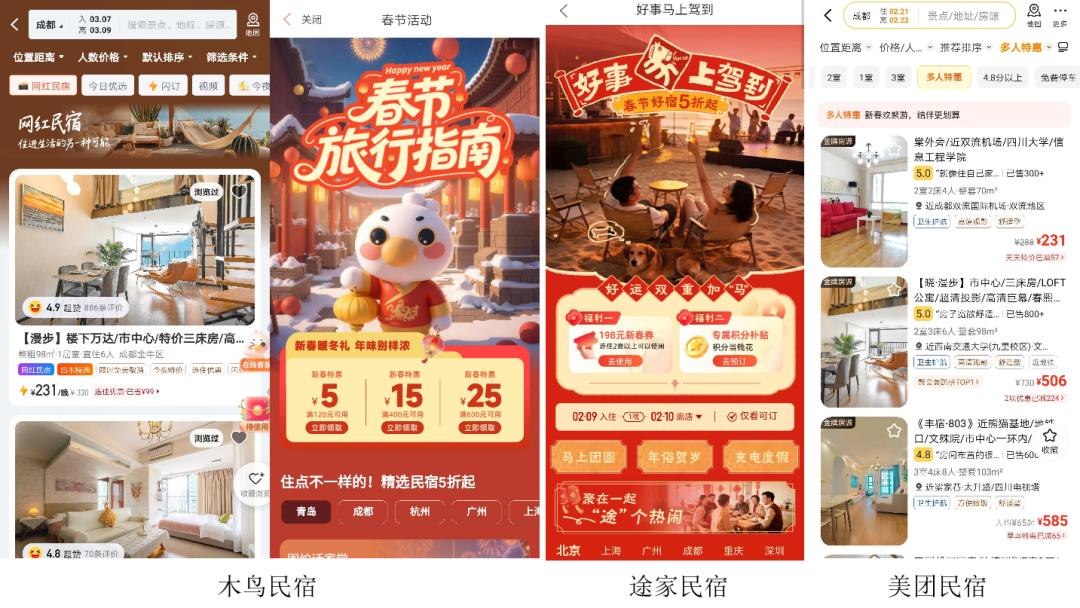
Core Insights - The 2026 Spring Festival holiday, lasting 9 days from February 15 to February 23, is expected to significantly boost the homestay market, with a projected 79.6% increase in orders compared to the previous year [1] - The competition among three major platforms—Muniu, Tujia, and Meituan—highlights differentiated strategies aimed at expanding the overall market [1][12] Muniu Homestay - Muniu is anticipated to be the most stable player during the 2026 Spring Festival, with a strong order growth forecast of nearly 80% [4] - The platform focuses on unique offerings such as "internet celebrity homestays" and "flash booking," catering to the quality demands of the 95s generation and family travelers [4] - Muniu's promotional strategy includes a dual discount system, offering a 110 yuan coupon for users, which is expected to support overall order growth [4] Tujia Homestay - Tujia's strategy revolves around "stay discounts" and "group rentals," targeting family and business travelers [5] - The platform's stay discount package offers competitive pricing, with a two-night stay in Beijing priced at 1,322 yuan after a 239 yuan discount [5] - Tujia faces challenges due to the scrutiny of its parent company, Ctrip, which may impact its order growth during the festival [6] Meituan Homestay - Meituan has integrated its hotel and homestay offerings into a unified travel platform, which may dilute its homestay identity [6] - The platform targets young people with group stay promotions, but its inventory primarily consists of budget accommodations, raising concerns about the diversity of its offerings [6] - Meituan's market share has declined amid competition with Taobao, affecting its overall traffic and promotional visibility [6] Market Trends - Family travel remains a key focus for the 2026 Spring Festival, with two-bedroom and larger accommodations accounting for 64% of orders, up 5% from last year [9] - The rise of quality family trips and long-stay guests aligns with the current market dynamics [10] - The competition among the three platforms reflects a broader trend of diversifying customer segments, with each platform targeting different demographics and needs [11][12]
美团发布原生“深度研究”Agent;阿里千问、飞猪宣布与全球超40家旅行品牌达成AI合作|未来商业早参
Mei Ri Jing Ji Xin Wen· 2026-02-11 23:08
Group 1 - Meituan launched a native "Deep Research" Agent, utilizing a unique three-layer intelligent agent architecture to address AI hallucination issues in real-world applications, enhancing its competitiveness in the AI market [1] - Alibaba's Qianwen and Fliggy announced AI collaborations with over 40 global travel brands, providing exclusive subsidies and value-added benefits to users, aiming to streamline travel services through AI technology [2] - Tencent and Tesla upgraded in-car experiences by launching "WeChat Connectivity" and "Destination Services," with the update set to cover over one million Model 3 and Model Y vehicles in China, enhancing Tencent's position in the smart cockpit market [3]

美团收购叮咚买菜中国业务,交易额约7.17亿美元
Jing Ji Guan Cha Wang· 2026-02-11 17:40
经济观察网美团集团宣布收购叮咚买菜中国业务,交易初始对价约7.17亿美元。叮咚买菜中国业务将成 为美团的间接全资子公司,其海外业务将在交割前剥离。 近期事件 业绩经营情况 叮咚买菜在收购前已实现稳健盈利。2025年第三季度,其营收达66.6亿元,GMV为72.7亿元,Non- GAAP标准下净利润1亿元,连续12个季度盈利。 未来发展 收购完成后,市场将关注业务整合进展、叮咚买菜品牌与团队的稳定性,以及其对美团即时零售格局的 影响。美团表示,双方将独立运营,但协同效应可能提升效率。 以上内容基于公开资料整理,不构成投资建议。 2026年2月5日,美团于香港联交所发布公告,计划收购叮咚买菜中国业务100%的股权。交易完成后, 叮咚买菜的财务数据将并入美团报表。 股票近期走势 交易消息公布后,叮咚买菜股价出现波动。2026年2月6日,其美股报收2.740美元,单日跌幅达 14.38%,市值降至约5.94亿美元。 ...
洲际酒店集团深化美团合作 旗下品牌进军东南亚市场
Jing Ji Guan Cha Wang· 2026-02-11 17:23
Brand Marketing Activities - InterContinental Hotels Group and Meituan Travel will jointly launch the "Accommodation + Cultural Celebrity New Year" event on December 30, 2025, and plan to deepen the "Accommodation +" cooperation in 2026, including new offerings like ethnic travel photography and cycling experiences to attract younger users [1] - The group will host the "Travel Fun Night" annual gala at the end of 2025 and strengthen brand heritage through the 50th anniversary celebration of its holiday hotel brand in the Greater China region [1] Business Progress - The group's Garner brand opened its first Southeast Asian store in Pattaya, Thailand, in December 2025, marking the brand's official entry into the Southeast Asian market, with over 72 hotels currently in operation globally and 80 projects under development [2]

美团50亿元收购叮咚,生鲜零售的出路到底在哪?
Sou Hu Cai Jing· 2026-02-11 13:50
Group 1 - The core viewpoint of the article highlights the unique development path of China's fresh food retail industry, which cannot simply replicate experiences from Japan and the West. The market for instant retail is expected to explode by 2025, reaching a scale of 1-2 trillion yuan, while traditional e-commerce and offline retail remain significantly larger at 15.2 trillion yuan and 44.3 trillion yuan respectively, indicating a rapid growth potential for instant retail [1] - The acquisition of Dingdong Maicai by Meituan is seen as a strategic adjustment reflecting profound changes in the fresh food retail industry, raising questions about quality versus scale, independent development versus reliance on larger platforms, and regional focus versus national expansion [1][3] - The acquisition is not merely about scale but focuses on quality positioning, as Meituan lacks a quality benchmark in the instant retail sector. Dingdong Maicai, known for its strict quality control and premium supply chain, fills this gap for Meituan, allowing it to leverage Dingdong's reputation to drive sales [4] Group 2 - The article outlines three potential paths for fresh food retail: instant retail, offline retail, and supply chain competition. Instant retail companies face a harsh reality with net profit margins around 1%, making acquisition or deep collaboration with larger platforms a rational choice to gain quality endorsement and supply chain capabilities [5] - Offline retail companies, while struggling with profitability (net profit margins of 1-3%), must focus on fine-tuned operations for sustained profitability or seek independent listings, as their value to larger platforms is limited [5] - Supply chain efficiency is identified as a critical competitive advantage, with logistics costs varying between 3% to 6%. The management of cold chain logistics and operational efficiency directly impacts product freshness and cost [6][7] Group 3 - The fresh food retail industry is shifting from blind expansion to rational contraction, with companies like Dingdong Maicai and Qian Dama focusing on core regional markets to establish competitive advantages. This strategic contraction is not a retreat but a focus on core strengths [8][10] - The construction of product strength through self-owned brands is emphasized as essential for meeting consumer demands for quality. Successful examples include Aldi and Hema, which have high self-brand product ratios [8] - Balancing service and efficiency is crucial for success in fresh food retail, as operational details in logistics, store operations, and product display can significantly affect competitiveness [9] Group 4 - China's fresh food retail model is distinct from Japan's vertical convenience stores and the West's pre-packaged goods, characterized by the rapid development of instant retail and innovative models like front warehouses [10] - The complexity of operations presents challenges but also opportunities for flexibility in meeting diverse consumer needs. The competition is shifting towards supply chain depth, product differentiation, and operational efficiency [11] - The ultimate battleground in fresh food retail lies in providing fresher, higher quality, and more convenient food options to consumers, determining the winners in this essential retail sector [11]