ServiceNow(NOW)

Search documents
These 5 Software Stocks Could Double in Price This Year, Says Morgan Stanley
Investopedia· 2026-02-11 20:40
Core Insights - Morgan Stanley analysts suggest that five software stocks could potentially double in value within the next 12 months if fears surrounding AI subsist and the stocks rebound to their fair value [1] Group 1: Market Overview - Software stocks have faced significant declines this year, with the iShares Expanded Tech-software Sector ETF (IGV) losing over 20% of its value since the beginning of the year, primarily driven by concerns regarding AI's impact on the industry [1] - Major companies like Intuit, ServiceNow, and Salesforce have seen substantial drops in their stock prices due to fears that AI-native startups will pressure profit margins and reduce corporate headcounts, limiting revenue growth [1] Group 2: Investment Opportunities - Morgan Stanley identifies that some software stocks are currently trading at more than a 50% discount to their fair value, creating potential buying opportunities for investors [1] - The five software stocks highlighted by Morgan Stanley include large caps Intuit and Salesforce, which have potential upsides of 101% and 109% respectively from their recent closing prices [1] - Mid-cap stocks such as ServiceTitan, CCC Intelligent Solutions, and Vertex are also expected to more than double in value according to the analysts [1] Group 3: Market Sentiment and Future Outlook - The uncertainty surrounding AI's development has led to volatility in the stock market, but historical trends show that investors have often rebounded from such concerns, driving stock prices higher [1] - Experts, including Nvidia's CEO, have expressed skepticism about the notion that AI will severely disrupt the software industry, suggesting that nimble software providers could leverage AI to their advantage [1] - The market for tech stocks is expected to remain turbulent as uncertainty continues to loom over the software sector, with Morgan Stanley indicating that disruption-related volatility is likely to persist [1]





The AI-fueled software meltdown is overblown
Yahoo Finance· 2026-02-11 19:54
Core Viewpoint - The software sector is experiencing significant declines due to fears that AI advancements will disrupt existing software companies, leading to a sell-off on Wall Street [1][2][6]. Group 1: Market Impact - ServiceNow (NOW) stock has decreased by over 22% since January 29, while Thomson Reuters (TRI) has fallen more than 26% as of Wednesday. Intuit (INTU) shares are down over 26%, and Snowflake (SNOW) has shed 18%. Salesforce (CRM) has dropped more than 20% [2]. - The release of new AI tools by Anthropic and OpenAI has intensified concerns that these companies will either create competing software or enable businesses to develop their own, posing a threat to traditional software firms [1][2]. Group 2: Analyst Perspectives - Some analysts believe the panic in the market is an overreaction, suggesting that AI will not replace existing software companies but rather enhance their services [3][4]. - William Blair analyst Jason Ader noted that the current market reaction resembles a "baby-with-the-bath-water" situation, indicating that not all software companies are equally at risk [4]. Group 3: AI Industry Developments - The AI industry has made significant advancements since the launch of ChatGPT in 2022, changing how tasks are performed but it is premature to declare AI companies as the new leaders in enterprise software [5]. - The uncertainty surrounding the potential impact of AI on the software industry has led to a broader sell-off, with investors seeking safer investments in sectors perceived as more stable [6][7].


Dan Ives Can’t Get Enough of These 2 Software Stocks Despite ‘Armageddon’ Worries
Yahoo Finance· 2026-02-11 19:52
The so-called "software Armageddon" has arrived, and it is not being subtle about it. AI disruption fears have triggered a broad and brutal retreat across the sector, with Anthropic's recent launch of an automation tool for lawyers sending data service and software names tumbling in a single session. Jefferies has gone as far as calling it a "SaaSapocalypse," as growing conviction that frontier AI models from OpenAI and Anthropic could eventually replace entire categories of enterprise software fuels an ...
ServiceNow's Product Expansion Gains Pace: More Growth Ahead?
ZACKS· 2026-02-11 19:45
Core Insights - ServiceNow's product expansion is accelerating, leading to measurable growth and reinforcing the case for continued upside [1] - Major fourth-quarter growth drivers include Now Assist, Workflow Data Fabric, Raptor, and CPQ, which have outperformed expectations and gained widespread adoption in large enterprise deals [1][2] Product Expansion and Adoption - Growing attach rates and multi-product adoption are enhancing ServiceNow's expansion, with Workflow Data Fabric included in most large deals and Raptor achieving triple-digit growth in new contract value [2] - Now Assist has surpassed $600 million in annual contract value, indicating strong AI monetization and faster multi-module deployments as customers scale AI for productivity and cost efficiency [2] Enterprise Deal Activity - The product-led momentum is translating into stronger enterprise deal activity, with major contract wins and a rising base of high-value customers [3] - The Zacks Consensus Estimate forecasts revenue growth of over 20% in 2026, supporting a favorable outlook for ServiceNow [3] Competitive Landscape - ServiceNow faces competition from Salesforce and Atlassian in its product expansion efforts [4] - Salesforce is extending its Agentforce into IT service and workflow automation, challenging traditional workflow tools with a unified data platform and embedded AI [5] - Atlassian is accelerating its product expansion with an AI-powered "system of work," integrating various tools and extending service capabilities into HR and finance [6] Financial Performance and Valuation - ServiceNow shares have declined 45.8% over the past year, underperforming the broader Zacks Computer and Technology sector, which returned 23.7% [7] - The forward 12-month price/sales ratio for ServiceNow is 6.84X, compared to the sector's 6.54X, indicating that the stock may be overvalued [11] - The Zacks Consensus Estimate for ServiceNow's 2026 earnings is $4.12 per share, reflecting a 17.38% year-over-year increase [14]

Goldman Sachs Likes ServiceNow’s (NOW) “Robust Expansion Opportunities in New Domains”
Yahoo Finance· 2026-02-11 16:57
Core Insights - ServiceNow Inc. has been added to Goldman Sachs' US Conviction List, with expectations of 20% YoY organic growth through 2029 due to robust expansion opportunities in new domains [1][8] - The company reported Q4-2025 results showing total revenue growth of 20.5% YoY to $3.6 billion, with subscription revenue growing 21.0% YoY to $3.5 billion [2] - Management anticipates subscription revenue growth of 20.5%-21.0% for 2026, driven by strategic partnerships [3] Financial Performance - Total revenue increased from $3.0 billion to $3.6 billion, marking a 20.5% YoY growth [2] - Subscription revenue rose from $2.9 billion to $3.5 billion, reflecting a 21.0% YoY increase [2] - Current remaining performance obligations grew from $10.3 billion to $12.9 billion, a 25.0% YoY increase, while remaining performance obligations increased from $22.3 billion to $28.2 billion, a 26.5% YoY growth [2] Strategic Initiatives - ServiceNow announced two strategic partnerships on January 28, one with Fiserv for AI-embedded solutions in financial services and IT service management, and another with Panasonic Avionics for AI-driven customer relationship management [3] - The company has two acquisitions planned, including Armis for AI cybersecurity and Veza for enhancing AI-driven workflow capabilities, both expected to close in the first half of 2026 [4] Company Overview - ServiceNow Inc. provides cloud-based and AI-embedded end-to-end workflow automation solutions for enterprises, founded in June 2004 and located in Santa Clara, California [5]
Better AI Software Stock: ServiceNow vs. Salesforce
Yahoo Finance· 2026-02-11 16:12
Group 1: Industry Overview - The technology industry is a significant investment area in 2026, driven by artificial intelligence (AI), but software stocks face challenges as some business models may be disrupted by AI [1] - Wall Street analysts predict that fears regarding AI could lead to declines in share prices across the software sector, creating potential buy opportunities for investors [2] Group 2: Salesforce Insights - Salesforce is a leader in customer relationship management (CRM) software, but the emergence of AI poses a threat to the relevance of CRM solutions [3] - In response to the AI threat, Salesforce launched its suite of AI agents under the Agentforce brand in 2024 and reported record results in its fiscal third quarter, with revenue increasing 9% year over year to $10.3 billion [4] - Agentforce's annual recurring revenue (ARR) grew 330% year over year in fiscal Q3, totaling half a billion dollars, although its revenue contribution is still in the early stages [5] Group 3: ServiceNow Insights - ServiceNow, like Salesforce, focuses on streamlining workflows and has performed well despite stock price declines, achieving $3.6 billion in sales for Q4, a 21% year-over-year increase [6] - The company has integrated AI into its platform and anticipates that AI agents will help expand its addressable market, contributing to revenue growth [6] - ServiceNow forecasts its 2026 subscription sales to reach at least $15.5 billion, up from $12.9 billion in 2025, with subscriptions making up 97% of 2025's revenue of $13.3 billion [7]
AI-Driven Platforms Strengthen IT Foundations, ISG Says
Businesswire· 2026-02-11 16:00
Core Insights - Integrated software platforms are increasingly vital for AI-enabled modernization of hybrid, multicloud enterprise IT environments, as per ISG's research [1][2] - Platform consolidation has shifted from being an efficiency measure to a structural necessity for enterprises [1] - Enterprises are replacing fragmented toolchains with platforms that integrate AI-assisted execution and robust governance [1] Group 1: Platform Evaluation and Rankings - The 2026 ISG Buyers Guides™ evaluated 97 software providers, focusing on integration, delivery speed, automation, and governance [1] - Microsoft emerged as the top Overall Leader in the Application Platforms category, followed by ServiceNow and Salesforce, all rated Exemplary [1][2] - In the AI-Driven Development Platforms category, Microsoft also led, with Appian and Pegasystems following, all rated Exemplary [2] Group 2: AI Integration in Platforms - AI functionality is now a core component across all platform categories, enhancing efficiency and visibility in application delivery [1] - Development platforms are incorporating AI for code generation, testing, documentation, and performance tuning [1] - Organizations with mature integration practices are better positioned to adopt unified, AI-enabled platforms [1] Group 3: Intelligent Automation Platforms - ISG evaluated 37 providers in the Intelligent Automation Platforms category, with Appian, Microsoft, and Automation Anywhere leading in Process Intelligence Platforms [2] - In Intelligent Document Processing Platforms, Appian ranked first, followed by Microsoft and ServiceNow, all rated Exemplary [2] - Microsoft also led in Automation and Orchestration Platforms, with Appian and Automation Anywhere following closely [2]



美股下一个“AI受害者”已经出现,市场正在提前定价!
美股研究社· 2026-02-11 11:06
Core Viewpoint - The article discusses the recent internal rotation in the U.S. stock market, highlighting a shift from a few large-cap stocks leading the market to a broader participation across various sectors, while also addressing the impact of AI on traditional business models and the resulting market volatility [5][7][8]. Market Performance - On Tuesday, the S&P 500 fell by approximately 0.3%, while the Dow Jones Industrial Average rose by about 0.1%, reaching a new historical high [5]. - The equal-weighted S&P index also reached a record high, indicating a shift in market dynamics with around 300 stocks in the S&P 500 rising [7]. Retail Sales Data - The U.S. Commerce Department reported that December retail sales were flat month-over-month, significantly below the expected 0.4% growth, indicating a slowdown in consumer spending [9]. - Core retail sales, excluding autos and gas, even showed a decline, reflecting weakened consumer spending momentum during the holiday season [9]. Interest Rate Expectations - The weak retail data led to a rise in U.S. Treasury prices and a decline in yields, with the futures market increasing the probability of three rate cuts within the year, with two already priced in [9]. - Historical trends suggest that rate cut expectations typically support risk assets, but the current market shows a divergence where rates are falling but stocks are not rising, particularly in the tech sector [11]. AI Impact on Market Sentiment - Market participants are shifting their interpretation of AI's impact from a growth narrative to concerns about short-term disruptions, leading to a "sell first, think later" mentality [12]. - Investors are moving from an "AI is a panacea" mindset to a more pragmatic "performance realization" phase, anticipating greater differentiation between winners and losers in the market [12]. Institutional Perspectives - There is a noticeable divergence in institutional views on the tech sector, with Goldman Sachs warning about the risks of overestimating AI's growth potential and emphasizing the need for actual earnings and cash flow improvements to support tech valuations [13]. - UBS downgraded its rating on the U.S. tech sector from "overweight" to "neutral," citing key risks while still acknowledging the long-term potential of AI [14]. Wealth Management Sector - The wealth management sector has come under scrutiny following the launch of an AI tool by Altruist Corp., which automates tasks traditionally reliant on human expertise, raising concerns about the core revenue models of wealth management firms [17][18]. - The market reacted sharply, with significant declines in stocks of major wealth management firms, indicating fears about the long-term competitive structure of the industry under AI pressure [19][21]. Broader Market Reactions - The sell-off in the market has been attributed to fears that AI tools could undermine the intermediary value of insurance brokers, leading to a significant drop in the insurance brokerage sector [22]. - The recent downturn in the software sector has seen substantial market capitalization losses, with estimates indicating a combined loss of approximately $611 billion across software, financial services, and asset management sectors [26]. Conclusion - The current market environment reflects a transition from viewing AI as a beneficiary narrative to recognizing potential victims, with traditional software companies facing heightened scrutiny and volatility [27]. - The article suggests that this phase serves as a valuation and business model stress test, prompting a reevaluation of which revenue models are based on irreplaceable value versus those reliant on information asymmetry [34].






This AI Stock's CEO Just Said It's a $1 Trillion Company in the Making
The Motley Fool· 2026-02-11 09:15
Core Viewpoint - ServiceNow is positioned as a potential $1 trillion company, currently valued at over $100 billion, driven by its advancements in AI and strategic acquisitions [2][10]. Company Overview - ServiceNow began as IT service management software and has expanded its offerings to include solutions for various enterprise departments, serving 85% of the Fortune 500 [4]. - The company has made significant acquisitions, including Moveworks for $2.85 billion and Armis for $7.75 billion, to enhance its cybersecurity capabilities [5]. AI Integration and Market Position - ServiceNow has integrated generative AI solutions into its services, with its Now Assist AI suite achieving an annual contract value of $600 million by the end of 2025, expected to reach $1 billion this year [6]. - The company aims to capture a significant share of the projected $1.3 trillion enterprises will spend on agentic AI-enabled applications by 2029 [9]. Financial Performance - In the fourth quarter, ServiceNow reported a subscription revenue growth of 19.5%, surpassing guidance and analyst expectations, with an adjusted operating margin increase to 31% from 29.5% [11]. - The company announced a $5 billion share repurchase authorization, indicating confidence in its stock valuation [10]. Future Outlook - Management's 2026 outlook projects subscription revenue growth of 20.5% to 21%, but concerns exist regarding the impact of acquisitions and currency fluctuations on this growth [12]. - Despite a recent decline in stock prices amid broader SaaS market sell-offs, ServiceNow's rapid adoption of AI positions it favorably in the market [13]. - The company's enterprise value is currently less than 6.5 times revenue estimates for 2026, suggesting it is undervalued relative to its growth potential [14].

AI冲击下,软件业走向“僵尸化”?
智通财经网· 2026-02-11 08:45
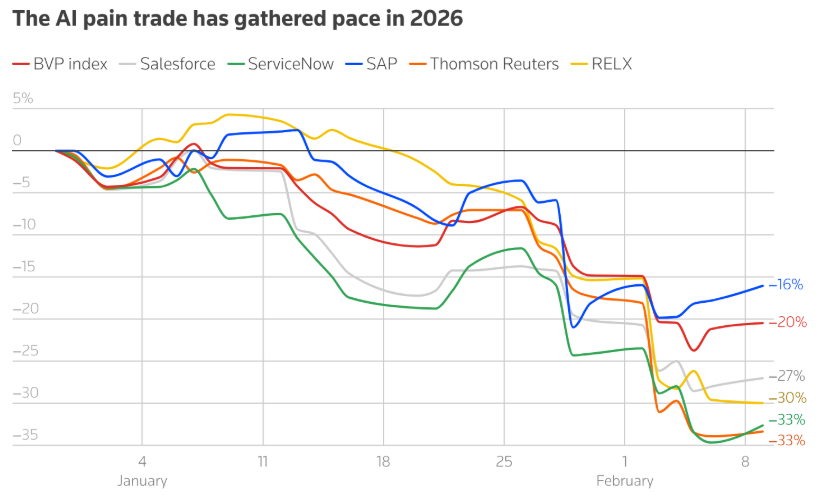
Group 1 - The core viewpoint is that artificial intelligence will impact existing software, data, and professional services companies, but it will not completely destroy them. Investors seem to share this perspective, as indicated by a Breakingviews analysis comparing valuation drops with recent analyst forecasts [1] - The BVP Nasdaq Emerging Cloud Index, a benchmark for software stocks, has declined by 20% year-to-date, raising concerns that AI chatbots like Claude from Anthropic could serve as flexible alternatives to existing company products [1] - Companies such as RELX and Thomson Reuters have seen their stock prices drop by approximately one-third since the end of 2025 due to this panic [1] Group 2 - ServiceNow's enterprise value is estimated at $105 billion, with free cash flow projected to grow from $5.8 billion this year to $10.3 billion by 2029. The implied value of recent cash flows, discounted at a 10% rate, is $27 billion [4] - After subtracting this amount from the enterprise value, ServiceNow's business value from 2030 onwards is approximately $78 billion, which translates to $114 billion in 2030 dollars using a 10% discount rate [5] - The long-term growth rate required to achieve this figure is only 0.9%, significantly lower than the previous year's growth rate of 5.7% [5] Group 3 - A study of 76 stocks, including BVP index components and some European software companies, shows a median long-term growth rate of 0.9%. About 60% of these companies are expected to grow from 2030, but only one-third will exceed a growth rate of 2% [6] - Companies like Monday.com, RingCentral, and Wix.com are exceptions that reflect expectations of significant declines in free cash flow starting in 2030 [6] Group 4 - Analysts caution that the analysis may be overly simplistic, as sell-side brokers might not have adjusted their forecasts for 2029, and a uniform 10% discount rate may not be appropriate across different industries [8] - The analysis suggests that AI is more likely to "zombify" existing companies rather than quickly eliminate them, raising questions about how CEOs should respond to this reality [8] - Stocks like SAP are trading close to what is termed "liquidation value," indicating a scenario where management accepts decline and cuts all growth-related spending to maximize cash extraction [8] Group 5 - Currently, no major data or software companies are pursuing a liquidation strategy, as many, like ServiceNow, continue to show strong growth. However, the market signals that many companies may soon stagnate or even face rapid decline [9] - If investors are pricing these companies as if they are zombie firms, it raises concerns about whether these companies will operate in a manner similar to actual zombie enterprises [9]