ServiceNow(NOW)

Search documents
Goldman issues a blunt warning to beat-up software stock investors
Yahoo Finance· 2026-02-09 14:13
Group 1 - The software stock downturn of 2026 may be indicative of a larger trend, similar to the impact of the internet on the newspaper industry in the early 2000s [1][2] - Historical examples show that share price stability in industries facing disruption requires stable earnings outlooks, as seen with newspapers which experienced a 95% decline in share prices from 2002 to 2009 [2] - The decline in newspaper stocks ended when earnings estimates bottomed, and the uncertainty surrounding AI's impact on software companies suggests that near-term earnings will be critical indicators of business resilience [3] Group 2 - Major software companies like Salesforce, Workday, and SAP are perceived to have their terminal values threatened by advancements in AI [4] - The recent debut of AI developer Anthropic and its automation capabilities has contributed to a significant decline in shares of various software companies, with no clear positive catalysts emerging to attract investors [8] - Software stocks are underperforming the Nasdaq Composite by the largest margin this century, with notable declines including 27% for Oracle and Salesforce, and a 41% drop for Figma [9] Group 3 - The software sector typically outperforms the S&P once it finds a bottom, but the extent of the current downturn remains uncertain, with no immediate solutions to shift investor sentiment [10]


摩根士丹利建议买入这9只被AI冲击的折价软件股
美股IPO· 2026-02-09 12:27
Core Viewpoint - The report highlights that high uncertainty has significantly impacted software valuation multiples, which have declined by approximately 33% since October 2025 [2] Group 1: Software Valuation - The average software valuation multiple has returned to around 4.4 times enterprise value/sales, reflecting levels seen during previous periods of high uncertainty in the public cloud sector [3] - Investors are underestimating the ability of existing vendors to benefit from AI adoption [3] Group 2: Investment Opportunities - The report suggests that pessimistic views on generative AI have led to a lack of trust in the ability of existing software vendors to participate in this innovation cycle [4] - Morgan Stanley identifies Microsoft, ServiceNow, Salesforce, Atlassian, Snowflake, Cloudflare, Shopify, and Palo Alto Networks as attractive investment opportunities due to their strong product cycles, improved financial metrics, and discounted valuations [4] - Microsoft is noted as a key player in significant innovation cycles, while the valuation of ServiceNow is described as "very attractive" [4] - Salesforce's AI-related annual recurring revenue has increased by 114% year-over-year [4] - Shopify is viewed as highly capable of capturing a larger share of the expanding online commerce market [4] Group 3: Long-term Opportunities - Generative AI represents a significant long-term opportunity, with an estimated potential to add approximately $400 billion to the broader enterprise software total addressable market by 2028 [5] - The key issue is not whether software will ultimately monetize in this innovation cycle, but rather which companies will participate [6]




美股软件股盘前上涨,微软涨0.8%
Mei Ri Jing Ji Xin Wen· 2026-02-09 10:16
每经AI快讯,2月9日,美股软件股盘前上涨,微软涨0.8%,Datadog涨 1.2%,ServiceNow涨0.8%。 ...

3000亿美元因Agent一夜蒸发,纳德拉、MongoDB CEO等宣告:传统SaaS已走到拐点
3 6 Ke· 2026-02-09 05:19
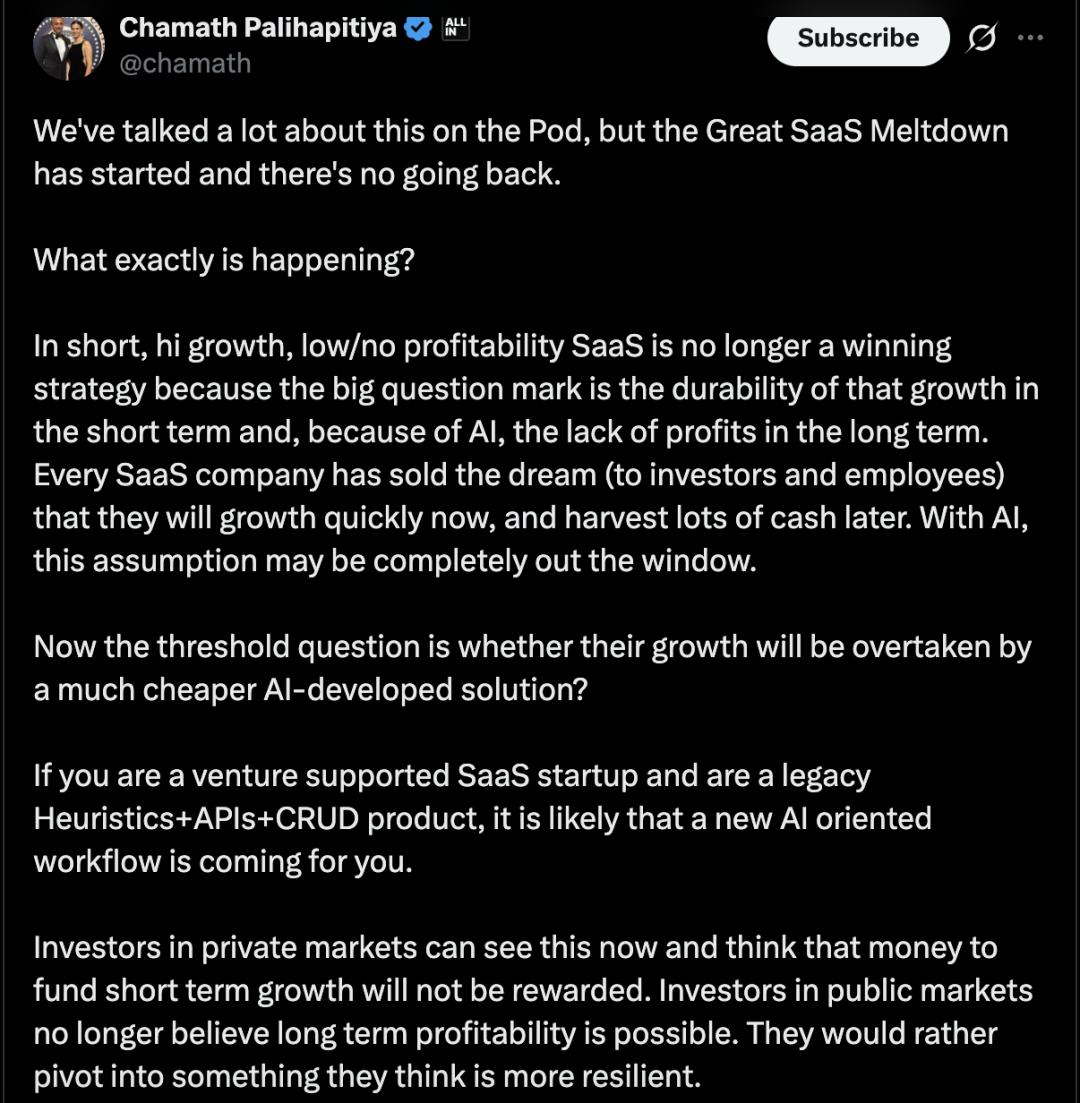
Core Insights - The market capitalization of SaaS, data, and software investment companies has evaporated by approximately $300 billion due to the release of an AI product, rather than disappointing earnings or macroeconomic shocks [1] - The IGV software index has dropped about 30% from its peak in late September, with significant declines in stock prices for major companies like Salesforce, ServiceNow, Adobe, and Workday, which fell around 7%, and Intuit, which plummeted nearly 11% [2] - The average expected price-to-earnings ratio for software companies has sharply decreased from about 39 times to approximately 21 times in just a few months [2] Group 1: Market Dynamics - The crisis in the SaaS sector has been ongoing for several months, with a recent acceleration in the speed of market reactions [2] - Short sellers have profited over $20 billion by betting against traditional SaaS businesses, indicating a significant loss of confidence in the sector [2] - The core assumption being challenged is the sustainability of traditional SaaS growth models, which have been supported by predictable recurring revenues and high switching costs [3][4] Group 2: AI Impact - AI is fundamentally testing the logic behind traditional SaaS models, as modern AI systems can replace many human workflows across various applications [6] - Investors are increasingly concerned that the growth of many SaaS companies may be rapidly supplanted by lower-cost, AI-driven solutions [8] - The emergence of AI-driven workflows is seen as a significant threat to the high-growth, low-profit SaaS development path, leading to a loss of market trust [7] Group 3: Future Outlook - High-profile figures like Chamath Palihapitiya and Microsoft CEO Satya Nadella have expressed that the SaaS model is becoming obsolete, predicting a shift towards AI-driven platforms [12][9] - Goldman Sachs predicts that by the end of the decade, AI agents will capture a disproportionate share of profits in the software market, with over 60% of software economic benefits potentially realized through agent systems rather than traditional SaaS services [15][18] - The transition from static applications to adaptive systems is expected to weaken the economic benefits of traditional software, although overall market growth is anticipated [18][19] Group 4: Investment Sentiment - The private equity and credit markets are reacting to the changing landscape, with investors recognizing that continued funding for short-term growth may not yield returns [8][20] - The prevailing investment logic in the software industry, based on predictable revenues and low customer churn, is being recalibrated in light of AI advancements [20] - MongoDB's CEO emphasizes that true platforms, rather than mere products, will endure in the evolving software landscape, highlighting the importance of adaptability and speed in technology transitions [21][26]

Down 45% Over the Past Year, Is It Time to Buy ServiceNow Stock?
The Motley Fool· 2026-02-09 04:30
Core Viewpoint - Investors are concerned about the impact of AI on software-as-a-service (SaaS) companies, leading to a decline in ServiceNow's stock despite strong fourth-quarter results [2][3][8] Group 1: Company Performance - ServiceNow reported a 20% year-over-year increase in sales and a 98% renewal rate [4] - The company has $12.85 billion in current remaining performance obligations and earnings per share of $0.92, reflecting a 26% year-over-year increase [4] - The stock has lost nearly 45% of its value over the past year, currently trading at a price-to-earnings (P/E) ratio of 32, which is considered reasonable for a company with double-digit growth [8] Group 2: Market Context - The decline in SaaS stock prices is attributed to market fears regarding AI potentially replacing many paid services, as companies may shift towards generative AI solutions [3][6] - ServiceNow positions itself as a "control tower" for businesses, with over 8,000 clients relying on its software, indicating a stable demand for its services [6][7] - The company is actively integrating AI into its offerings, including partnerships with OpenAI and Anthropic to enhance its software capabilities [7] Group 3: Investment Opportunity - Despite the current market sentiment, there are indications that the decline in ServiceNow's stock may present a buying opportunity as the company continues to show healthy growth prospects and a recurring revenue model [8]

2 Stocks to Buy for AI's Next Stage
Investor Place· 2026-02-08 17:00
Core Insights - The article discusses the shift in investment focus from hardware suppliers to experience-driven companies in the tech sector, particularly in the context of the iPhone and artificial intelligence [1][3][22] Group 1: iPhone Supplier Dynamics - Companies like Skyworks Solutions, Cirrus Logic, and Universal Display saw stock price surges when named as iPhone suppliers, but Apple often imposed low prices and high quality demands, leading to profitability challenges for these suppliers [2] - The real beneficiaries of the iPhone boom were companies providing services and experiences, such as Uber and ByteDance, which have outperformed traditional hardware suppliers [3] Group 2: Current AI Market Trends - A recent selloff in AI infrastructure companies, including chipmakers and data center developers, occurred due to concerns over profitability in a rapidly evolving industry [4] - Analyst Louis Navellier warns of a potential market dislocation for AI companies, suggesting that expectations for "Stage 1" infrastructure firms are overly optimistic [5] Group 3: Investment Opportunities in AI - A select group of "Stage 2" companies in the AI sector is believed to offer significant upside potential, with estimates of around 500% growth [6] - Thomson Reuters, with its established legal research platform, is expected to recover from a 60% selloff, as it combines AI with human expertise to maintain accuracy in legal research [9][14] - ServiceNow, which serves over 85% of Fortune 500 companies, is experiencing rapid growth with a 21% revenue increase in 2025 and projected 20% growth for the current year, driven by its AI capabilities [15][16] Group 4: Comparisons with 5G Technology - The article draws parallels between the 5G technology rollout and the current AI landscape, noting that the biggest winners are not the infrastructure providers but the companies leveraging these technologies for consumer experiences [20][21] - OpenAI's GPT-5 is highlighted as a significant advancement in AI, similar to the leap made by 5G, with the potential for "Stage 2" companies to dominate the market [22][23]

'This probably seems overdone': Wall Street strategists weigh in on software stock sell-off
Yahoo Finance· 2026-02-08 16:00
Group 1: Market Overview - A significant sell-off in the software sector occurred over the past week, particularly on Tuesday, Wednesday, and Thursday, as investors reacted to aggressive disruptions from AI advancements [1][2] - Despite a rebound on Friday, the tech-heavy Nasdaq experienced a weekly decline of over 2%, with major software companies like Salesforce and ServiceNow seeing their shares drop more than 9% [2] - Strategists are urging patience, suggesting that the recent market moves may have overshot the potential risks facing the software industry [2][3] Group 2: Company Performance - Notable declines in software stocks year-to-date include Oracle (-26.7%), Salesforce (-27.8%), and ServiceNow (-34.2%), among others [5] - Earnings reports from major tech companies revealed that capital expenditures related to AI from Amazon, Alphabet, Meta, and Microsoft are projected to exceed $650 billion [6] Group 3: Strategic Insights - Invesco's chief global market strategist indicated that the market's reaction may be overdone, with some software names significantly impacted [3] - JonesTrading's chief market strategist noted that larger software companies capable of adapting to AI advancements are likely to be fine, although new risks are emerging [4] - There is a shift in investor sentiment, with a more discerning approach to valuing companies as the industry transitions from capital-light to potentially more capital-intensive operations [7]
Truist Cut PT on ServiceNow (NOW) to $175 From $240 – Here’s Why
Yahoo Finance· 2026-02-08 08:48
ServiceNow, Inc. (NYSE:NOW) is one of the most promising future stocks to buy now. On February 5, Truist revised the price target on ServiceNow, Inc. (NYSE:NOW) to $175 from $240 and maintained a Buy rating on the shares, releasing the rating update as part of a broader research note on the Infrastructure Software names. It told investors that the sector pullback is primarily being driven by concerns associated with terminal value instead of near-term fundamentals, and this makes AI narratives highly criti ...
2 software stocks with at least 50% upside potential: Morningstar
Business Insider· 2026-02-07 10:15
Core Viewpoint - The software sector experienced a significant sell-off, with the iShares Expanded Tech-Software Sector ETF (IGV) dropping 19% from January 26 to February 5, but Morningstar believes the fears surrounding AI's impact on the industry are exaggerated and presents a buying opportunity [1][2]. Group 1: Market Performance and Analyst Insights - Morningstar's senior equity analyst, Dan Romanoff, stated that there is little evidence supporting the bear case for software stocks, as retention rates and other metrics remain solid [2]. - Despite the sell-off, software stocks showed signs of recovery, with IGV rising 3% and the Nasdaq increasing by over 2% on a recent Friday [3]. - Romanoff identified Microsoft (MSFT) and ServiceNow (NOW) as having substantial upside potential, with shares down 17% and 35% year to date, respectively [4]. Group 2: AI Impact and Revenue Generation - Concerns that AI will significantly disrupt the software industry may be overstated, as many firms still view AI with skepticism [5]. - AI products currently account for approximately 2% of revenue for software vendors, indicating that they are not generating substantial revenue [6]. - Historical instances of automation have not led to major disruptions in labor markets, suggesting that current fears may not materialize [6]. Group 3: Future Outlook and Employment Trends - While there may be future pressure on seat counts, there is no current evidence of this affecting sales representatives, as seen in the historical context of Salesforce's CRM approach [7]. - Headcount across functional areas continues to increase, indicating that fears of job losses due to automation are not currently reflected in the market [7].

Wall Street Roundup: Risk Off
Seeking Alpha· 2026-02-06 18:25
Group 1: Bitcoin Market Dynamics - Bitcoin has experienced a significant decline, down 13% this week and 27% over the past month, with its value dropping from a peak of over $126,000 to below $63,000 [4][5] - The selling pressure was exacerbated by leveraged positions being forced to liquidate, indicating Bitcoin's status as a risk asset rather than a stable currency [6] - The volatility in Bitcoin reflects broader market concerns about overvaluation and risk allocation in investment portfolios [3][6] Group 2: Software Stocks and AI Impact - Software stocks have seen substantial declines, with major players like Microsoft down 7%, Adobe down 10%, and Oracle down 16%, driven by fears that AI advancements may render many companies obsolete [10][15] - New AI tools announced by companies like Anthropic and Google have contributed to market anxiety, leading to a sell-off in related stocks [7][10] - The market is grappling with the dual concerns of high capital expenditures on AI that may not yield expected returns and the potential for AI to disrupt entire industries [16][18] Group 3: Earnings Reports and Market Reactions - Alphabet reported an 18% revenue increase and a 48% growth in cloud revenue, but its stock fell due to high capital expenditure predictions for 2026, which could consume a significant portion of its profits [12][13] - Amazon's projected capital expenditures for 2026 are also high, at $200 billion, representing 28% of its revenue and 256% of its net income, raising concerns about sustainability [14][15] - Hershey's stock rose 9% after beating earnings expectations and raising guidance, reflecting a shift towards more resilient consumer staples amid economic uncertainty [27][28] Group 4: Economic Indicators and Job Market Concerns - Recent job market data indicates rising initial jobless claims and the lowest job openings since September 2020, suggesting a weakening labor market [31][32] - Layoffs announced by major companies like Amazon and UPS contribute to a pessimistic outlook for upcoming job reports [32][33] - The defensive rotation in the market is evident as investors seek stability in traditional sectors like consumer staples and healthcare, moving away from riskier tech assets [26][31]