
Rivian Automotive(RIVN)

Search documents
Is Rivian Stock Yesterday's News?
Yahoo Finance· 2026-01-17 20:02
Core Insights - Rivian is preparing to launch its next vehicle platform, with its stock price increasing by approximately 36% over the past year, although it remains down about 90% from its peak in late 2021, raising questions about its profitability potential [1][2] Financial Performance - In Q3, Rivian's revenue increased by 78% year over year to around $1.56 billion, and it achieved a gross profit of $24 million, marking a significant improvement of $416 million from the previous year when it reported a gross loss [3] - Despite the positive gross profit, Rivian's automotive gross profits were still negative at $130 million, although this represented a reduction of $249 million compared to Q3 of the previous year, indicating that costs of goods sold remain higher than revenue [4] Vehicle Deliveries - The company delivered 13,201 vehicles in Q3 and reported 9,745 deliveries in Q4, resulting in fewer total deliveries in 2025 compared to 2023 and 2024, with the peak delivery of 15,564 units occurring in Q3 2023 [5][7] Future Prospects - Rivian is set to launch its R2 SUVs, which are expected to be more affordable than the R1 models, potentially increasing demand and allowing for economies of scale in manufacturing, although it may take time before the company achieves positive gross profits on its vehicles [6][7] - The path to profitability for Rivian is closely tied to its ability to scale production and deliveries, with hopes that the R2 vehicles will enhance gross margins and lower operating expenses per unit [7]

Rivian's 48% Stock Surge Jolted Wall Street — And The Next Big Catalyst May Hit Soon - Rivian Automotive (NASDAQ:RIVN)
Benzinga· 2026-01-16 16:42
Core Viewpoint - Rivian Automotive's stock outperformed the market in 2025 despite a decrease in electric vehicle deliveries, with CEO RJ Scaringe indicating that a significant catalyst for the stock is approaching soon [1] Group 1: R2 Electric SUV - The R2 electric SUV, unveiled in March 2024, is a crucial future catalyst for Rivian's stock, with manufacturing validation builds currently in progress [2] - Rivian has paused plans for a new factory in Georgia to focus on updating its existing Normal, Illinois factory, aiming for R2 deliveries in 2026 [3][4] - The R2 is priced starting at approximately $45,000, positioning it to compete with Tesla's Model Y, which starts at $41,630 and was the best-selling electric vehicle globally in 2025 [3] Group 2: Production and Market Strategy - Rivian aims for annual production capabilities exceeding 100,000 units from its Normal factory, with potential construction of the Georgia factory starting in 2026 [7] - The decision to prioritize R2 production at the existing facility rather than waiting for the Georgia factory could be advantageous for Rivian [7] - Rivian's R1S was the eighth best-selling electric vehicle in the U.S. with 24,852 deliveries, despite a 7.7% year-over-year decline, while total deliveries for 2025 were 42,247, down 18% year-over-year [8] Group 3: Stock Performance - Rivian's stock was trading at $16.87, with a 52-week range of $10.36 to $22.69, and shares increased by 48.2% in 2025, although they have started 2026 lower [10] - The upcoming R2 deliveries could significantly impact Rivian's stock direction in 2026 [10]


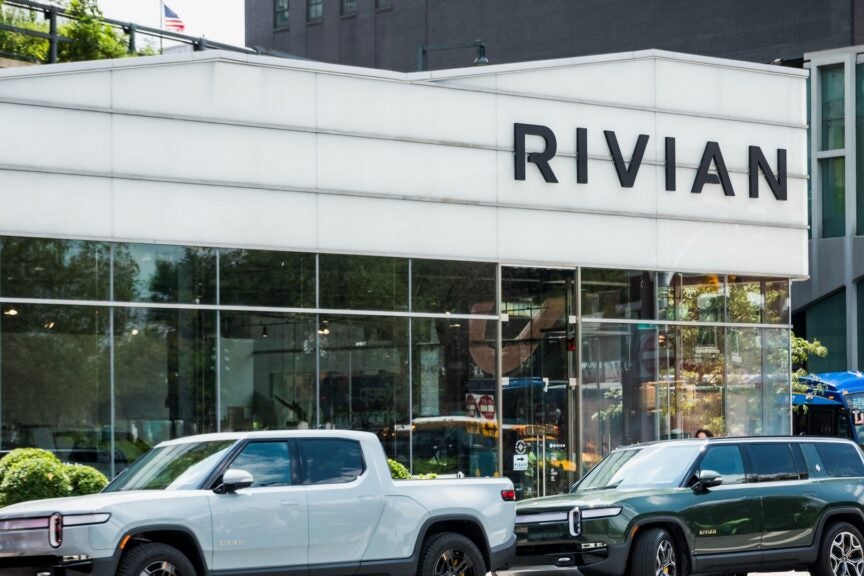
Is It Time To Buy The Dip In Rivian Automotive Stock?
Forbes· 2026-01-16 15:50
Core Viewpoint - Rivian Automotive (RIVN) stock has experienced a significant decline of 24.0% in less than a month, raising questions about whether this dip represents a buying opportunity [2]. Group 1: Stock Performance - RIVN stock fell from $22.45 on December 19, 2025, to $17.06 currently [2]. - Historically, the median return for the 12-month period following significant dips (defined as a drop of 30% or more within 30 days) has been -20%, with a median peak return of 21% [2][9]. - RIVN has met the dip threshold of -30% within 30 days five times since January 1, 2010 [5]. Group 2: Financial Quality Assessment - To assess the risk of a dip indicating a worsening business scenario, it is essential to evaluate revenue growth, profitability, cash flow, and the strength of the balance sheet [6]. - RIVN stock meets basic financial quality assessments, suggesting it may be a candidate for buying on dips [6]. Group 3: Portfolio Strategy - A well-diversified portfolio can mitigate risks associated with individual stock performance, enhancing overall market engagement and returns [7]. - The Trefis High Quality (HQ) Portfolio, consisting of 30 stocks, has consistently outperformed its benchmark, which includes the S&P 500, S&P mid-cap, and Russell 2000 [8]. - HQ Portfolio stocks have shown superior returns with lower risk and less volatility compared to the benchmark index [8].

Rivian Rises 31% in 3 Months: Should You Buy, Sell or Hold the Stock?
ZACKS· 2026-01-16 15:31
Core Insights - Rivian Automotive's shares have increased by 30.9% over the past three months, significantly outperforming the industry and sector growth of 2.7% and 3.4%, respectively [1] - Rivian's delivery numbers have declined, with 42,247 vehicles delivered in 2025, down from 51,579 in 2024, indicating challenges in maintaining growth [5] - The company faces pressures on cash flow due to heavy capital expenditures and inventory buildup for its R2 program, which could impact financial stability moving forward [9][10] Delivery and Production Performance - Rivian's production in 2025 totaled 42,284 units, a decrease from 49,476 units in 2024, with fourth-quarter production at 10,974 vehicles and deliveries at 9,745 units [5] - In contrast, Tesla delivered over 1,635,000 vehicles in 2025, down from more than 1,789,000 in 2024, while Lucid Group saw a 55% increase in deliveries to 15,841 units [6][7] Market Dynamics - The broader EV market is experiencing slowing demand, partly due to the expiration of a $7,500 U.S. tax credit, which has led to increased vehicle prices [8] - Rivian's premium-priced R1T and R1S models are under pressure as competition intensifies from both legacy automakers and new entrants [8] Financial Health - Rivian's cash balance decreased to $7.1 billion at the end of Q3 2025, down from $7.7 billion in 2024, indicating potential liquidity concerns [9] - The company is expected to continue facing cash flow pressures due to elevated capital spending and inventory buildup for the R2 program [10] Valuation and Broker Consensus - Rivian appears undervalued with a forward sales multiple of 3.05, lower than the industry's five-year average [12] - The Zacks Consensus Estimate for Rivian's 2025 sales and EPS indicates a year-over-year decline of 27.2% and 30.8%, respectively, with a neutral-to-cautious broker consensus reflected in an average recommendation of 2.78 [14][16] Conclusion - Despite recent stock performance, Rivian is contending with declining deliveries, softening EV demand, and increased competition, alongside significant capital expenditures and cash flow pressures [18] - External risks related to global trade and tariffs further complicate the outlook, suggesting limited near-term upside for the stock [19]

Why Investors Are Pumping the Brakes on Rivian Stock This Week
Yahoo Finance· 2026-01-15 22:25
Core Viewpoint - Rivian's stock has experienced a significant decline, with shares down 11.2% from the end of last Friday's trading session, reflecting a bearish outlook from analysts [1][3]. Analyst Downgrades - Wolfe Research downgraded Rivian stock from peer perform to underperform, setting a bearish price target of $16, citing ongoing losses on an EBITDA basis and concerns over reduced EV demand during the launch of the R2 model [3][4]. - UBS also downgraded Rivian stock from neutral to sell, although it raised its price target from $13 to $15, indicating a continued expectation of stock decline [4]. Mixed Analyst Opinions - Despite the negative sentiment from some analysts, Piper Sandler raised its price target for Rivian from $14 to $20, suggesting that not all analysts share a pessimistic view [5]. - There is potential for Rivian stock to increase in value not only in 2026 but in subsequent years, indicating a divided opinion on the stock's future trajectory [6]. Investment Considerations - Investors are advised to consider the recent analyst downgrades and the mixed opinions regarding Rivian's stock direction before making investment decisions [7]. - Rivian Automotive was not included in a list of the 10 best stocks identified by The Motley Fool Stock Advisor, which may influence investor sentiment [8].
Wolfe Downgrades Rivian (RIVN) on Cash Burn, Sees Delayed AI and Autonomy Catalysts
Yahoo Finance· 2026-01-15 20:33
Core Viewpoint - Rivian Automotive, Inc. has been downgraded by Wolfe Research from Peerperform to Underperform, with a price target set at $16.00 due to increasing cash burn, rising losses, and limited near-term catalysts for the stock [1] Group 1: Financial Performance - The firm estimates an EBITDA loss of $2.1 billion, which is wider than market expectations [3] - Free cash flow burn is projected to exceed $4 billion as capital, operating, and working capital challenges intensify [3] Group 2: Product and Market Outlook - There is excitement surrounding Rivian's Autonomy platform, which has contributed to a surge in shares, despite the overall deteriorating fundamental setup [2] - Demand for Rivian's R2 model is flagged, with expected volumes likely skewed to Q4 2026 [3] - Unlike Tesla, Rivian is not expected to have many Autonomy or AI-related catalysts, with key launches anticipated for late 2026 [3] Group 3: Investment Perspective - While Rivian has potential as an investment, certain AI stocks are viewed as offering greater upside potential and less downside risk [4]
Rivian stock: Wyckoff Theory points to rebound despite expert doubts
Invezz· 2026-01-15 13:08
Core Viewpoint - Rivian's stock has experienced a significant decline, with analysts expressing concerns over its financial health and the electric vehicle market's outlook [1][2][4]. Financial Performance - Rivian's revenue for Q3 increased by 74% year-over-year to $1.55 billion, driven by consumer purchases before the end of the EV tax credit [6]. - Despite the revenue growth, the company reported a net loss of over $1.16 billion for the quarter, accumulating a total loss of $2.8 billion in the first nine months of the year [6]. - Analysts project Q4 revenue to be $1.27 billion, a decrease of 25% compared to the same period last year, leading to an annual revenue estimate of $5.37 billion and a loss per share of $3.23 [7]. Analyst Ratings and Market Sentiment - Out of 29 analysts tracking Rivian, 8 have a sell rating, 12 a hold rating, and only 9 a buy rating, indicating a generally pessimistic outlook [2]. - Recent downgrades from analysts, including UBS and Wolfe Research, have contributed to the negative sentiment surrounding the stock [3]. Capital and Investment Concerns - Rivian ended the quarter with over $6 billion in cash and short-term investments, but there are concerns that these funds may be depleted due to ongoing losses [7]. - The CEO has indicated the possibility of raising additional capital this year, raising further concerns about potential dilution for investors [4]. Industry Context - The electric vehicle market is facing challenges, particularly after the expiration of the EV tax credit, which has led to significant charges from competitors like Ford and General Motors [4]. - Analysts are also worried about Rivian's autonomy technology lagging behind competitors such as Tesla and Waymo [5]. Future Projections - Analysts expect Rivian's revenue to rise to $6.8 billion this year, aided by the anticipated launch of the R2 model in the first half of the year, although the loss per share is projected to be substantial at $2.93 [8]. - The stock has been trading within a tight range and is currently at the 50-day and 100-day Exponential Moving Averages, suggesting a potential accumulation phase according to Wyckoff Theory, despite fundamental concerns [10][12].

2 EV Stocks That Could Be Heading for $0, and 1 With Multibagger Potential Left
The Motley Fool· 2026-01-15 03:00
Industry Overview - The electric vehicle (EV) industry in the U.S. has faced a downturn in 2025, with a 1% decline in sales, contrasting with a global increase of 21% [1] - The end of the $7,500 EV tax credit and tariffs have removed key incentives for American consumers, negatively impacting EV sales [2] Tesla - Despite challenges, Tesla's stock has increased by over 12% in the past year, indicating resilience [3] - For the first nine months of 2025, Tesla reported revenues of $69.9 billion and a net income of $2.99 billion, although both figures are down from 2024 [15] - Q3 2025 revenue reached $28 billion, an 11% increase from $25.1 billion in Q3 2024, and cash reserves grew from $16.1 billion to $18.2 billion during the year [17] Lucid Group - Lucid Group experienced a year-over-year production increase of 116% and a 68% rise in revenue, but still reported a net loss of $978.4 million for Q3 2025 [5][8] - The company started 2025 with $5 billion in cash but reduced its reserves to $3 billion by September [7] - Despite revenue growth, Lucid's financial health appears precarious, with only a slight reduction in losses [8] Rivian Automotive - Rivian's revenues increased by 78% to $1.55 billion in Q3 2025, but it still reported a net loss of $1.16 billion, slightly larger than the previous year's loss [9][11] - The company improved its cash flow loss from $4 billion in the first nine months of 2024 to $2.82 billion in the same period of 2025, holding $5.29 billion in cash as of September 30, 2025 [12] - Rivian's stock growth of 35% over the past year may be speculative, given its mixed performance [13]

ROLR, CRML, MDB, C, RIVN: 5 Trending Stocks Today - Rivian Automotive (NASDAQ:RIVN)
Benzinga· 2026-01-15 01:27
Market Overview - U.S. stock markets declined, with the Nasdaq dropping over 200 points, closing down 1% at 23,471.74. The S&P 500 fell 0.5% to 6,926.60, and the Dow Jones Industrial Average edged down 0.09% to 49,149.63 [1] High Roller Technologies, Inc. - High Roller Technologies' shares surged by 441.26%, closing at $18.89, with an intraday high of $33.68 and a low of $12.33. The stock's 52-week range is between $1.16 and $33.68. In after-hours trading, the stock declined 4.87% to $17.97 [1][2] - The surge in shares was attributed to a binding letter of intent signed with Crypto.com for an exclusive U.S. partnership to launch an event-based prediction markets product, with a targeted launch in Q1 2026 [2] Critical Metals Corp - Critical Metals' stock increased by 32.58%, closing at $17.93, with an intraday high of $19.05 and a low of $13.27. The 52-week high is $32.15 and the low is $1.23. In extended trading, shares fell 1.81% to $17.60 [3] - The increase followed strong assay results from its 2025 drilling campaign at the Tanbreez rare earths project in Greenland, showing near-surface grades of approximately 0.40%–0.47% total rare earth oxides plus yttrium, with heavy rare earths accounting for about 26%–27% [4] MongoDB - MongoDB shares fell 5.91%, closing at $386.89, with an intraday high of $410.36 and a low of $385.45. The 52-week range is between $140.94 and $444.72 [5] - Analysts remain broadly bullish on MongoDB, with an average price target of $496 from five recent ratings, including multiple Buy and Outperform calls clustered around $500 [6] Citigroup - Citigroup's stock dropped 3.34%, closing at $112.41, with an intraday high of $118.75 and a low of $110.46. The 52-week high is $124.17 and the low is $55.51 [7] - The company reported mixed fourth-quarter results, with adjusted earnings per share of $1.81 beating estimates, while revenue of $19.87 billion missed expectations. Net income fell 13% to $2.5 billion, impacted by a $1.1 billion after-tax loss related to its exit from Russia [7][8] Rivian Automotive Inc. - Rivian shares fell 7.16%, closing at $17.50, with an intraday high of $18.25 and a low of $17.06. The 52-week range is between $10.36 and $22.69 [9] - The decline was influenced by a recall of nearly 20,000 vehicles due to a potential crash risk, despite stable production and delivery figures in Q4, where the company produced about 11,000 vehicles and delivered roughly 10,000 [10]



TMTB 早间综述:Claude Code 引爆 AGI 预期,地缘政治扰动半导体与网安板块
2026-01-15 01:06
Summary of Key Points from Conference Call Records Industry Overview - **Technology and AI Sector**: The records highlight significant developments in the technology sector, particularly around AI and semiconductor industries, with a focus on companies like Nvidia and TSMC. The demand for AI-related technologies is driving capital expenditures and revenue growth expectations. Company-Specific Insights AppLovin (APP) - **Rating and Price Target**: ISI initiated coverage with an "Outperform" rating and a price target of $835, indicating a potential upside of approximately 25% [7][8] - **Growth Projections**: Expected sustained revenue and EBITDA CAGRs of over 30% from 2025 to 2028, with mobile gaming spend projected to grow at a ~23% CAGR through 2028 [7][8] Flex (FLEX) - **Upgrade and Price Target**: Raymond James upgraded Flex to "Outperform" with a price target of $75, citing strong growth in cloud and AI datacenter infrastructure [10] - **Revenue Expectations**: Anticipated FY26 datacenter revenue of $6.5 billion, representing a 35% year-over-year increase [10] TSMC (TSM) - **Capital Expenditure**: Morgan Stanley raised TSMC's capex forecast to $54 billion for 2027, noting it is still below market speculation of $60 billion but likely to increase due to strong AI demand [11] Infosys (INFY) - **Revenue Outlook**: Infosys raised its full-year revenue growth forecast to 3%-3.5% in constant currency, up from a previous estimate of 2%-3% [20] Nvidia (NVDA) - **Customs Restrictions**: Reports indicate that Chinese customs have prohibited Nvidia's H200 AI chips from entering China, impacting the company's market access [13][14] Okta (OKTA) - **Rating Upgrade**: Stephens upgraded Okta to "Overweight" with a price target increase to $120, citing improved growth outlook for 2026 [16] DoorDash (DASH) - **Operational Momentum**: BNP Paribas initiated coverage with an "Outperform" rating and a price target of $280, highlighting strong operational momentum and rising order frequency [17][18] Microsoft (MSFT) - **CIO Survey Insights**: Morgan Stanley reiterated an "Overweight" rating with a price target of $650, based on a CIO survey indicating modest acceleration in software spending growth to +3.8% in 2026 [36][38] Amazon (AMZN) - **Supplier Negotiations**: Amazon is reportedly pressuring suppliers for price cuts ahead of a Supreme Court ruling on tariffs, seeking discounts of up to 30% [39][40] Additional Insights - **Market Sentiment**: The overall market sentiment appears cautious, with investors showing little appetite for application software currently, despite some positive indicators from CIO surveys regarding software spending [4][36] - **AI and Semiconductor Demand**: The records emphasize the ongoing strength in AI semiconductor demand, which is expected to drive significant capital expenditures and revenue growth across the sector [2][11] Conclusion The conference call records provide a comprehensive overview of the current state of the technology sector, highlighting key companies and their growth prospects, as well as challenges posed by geopolitical factors and market dynamics. The emphasis on AI and cloud infrastructure indicates a strong growth trajectory for companies positioned in these areas.




