Toyota(TM)

Search documents
固态电池深度研究报告:电池变革重要赛点,材料设备全新颠覆
Huafu Securities· 2026-01-06 06:59
证券研究报告|行业深度报告 电力设备与新能源 行业评级 强于大市(维持) 2026年1月6日 电池变革重要赛点,材料设备全新颠覆 ——固态电池深度研究报告 证券分析师: 邓伟 执业证书编号:S0210522050005 游宝来 执业证书编号:S0210523030002 研究助理: 请务必阅读报告末页的重要声明 李宜琛 华福证券 华福证券 投资要点 2 华福证券 华福证券 Ø 发展固态电池已成为行业共识、全球竞争赛点:理论上能实现高比能、高安全性的固态电池体系,是全球公认的颠覆性 技术。减少液态电解质含量,提升固态电解质占比,逐步实现固态化,是行业发展共识。由此带来的对材料体系、装备 体系的颠覆,迫使全球企业、研究团队展开新一轮的创新竞争,避免在新技术方向上的掉队风险。2027年实现小批量生 产、工艺定型,基本上是国内外企业一致预期的重要时间节点。 Ø 材料端:固态电池颠覆材料环节,重视增量、升级、瓶颈环节。全固态电池颠覆现有体系,核心增量环节是硫化物/氧化 物/卤化物/聚合物固态电解质,其中降本、量产瓶颈在于硫化锂(成本高、工艺放大难)。此外,能量密度的提升依赖 高镍/富锂锰基正极、锂金属/硅碳负极的性能突 ...



Toyota Motor North America reports strong 2025 U.S. sales growth, led by EVs (NYSE:TM)
Seeking Alpha· 2026-01-05 17:04
Group 1 - The article does not provide any relevant content regarding company or industry insights [1]


Toyota Motor North America Reports 2025 U.S. Sales Results
Prnewswire· 2026-01-05 15:00
Core Insights - Toyota Motor North America (TMNA) reported a total of 2,518,071 vehicle sales in the U.S. for the year 2025, marking an increase of 8.0% on a volume basis and 8.3% on a daily selling rate (DSR) basis compared to 2024 [1][9] - Sales of electrified vehicles reached 1,183,248 units, up 17.6% on a volume basis, representing 47.0% of total sales volume [1][9] - The Lexus division achieved its best-ever full-year sales result, with a total of 370,260 vehicles sold, up 7.1% on a volume basis [5][8] Sales Performance - For the fourth quarter of 2025, TMNA reported sales of 652,195 vehicles, an increase of 8.1% on both volume and DSR basis compared to Q4 2024 [2][9] - December 2025 sales totaled 231,513 vehicles, up 10.3% on a volume basis and 6.0% on a DSR basis compared to December 2024 [3][9] - The Toyota division sold 2,147,811 vehicles in 2025, up 8.1% on a volume basis, while the Lexus division sold 99,685 vehicles in Q4, up 2.3% [4][5] Electrified Vehicle Sales - Sales of electrified vehicles in Q4 2025 totaled 290,840, down 1.9% on both volume and DSR basis, representing 44.6% of total sales volume for that quarter [2][9] - In December 2025, electrified vehicle sales reached 104,088 units, a slight increase of 0.2% on a volume basis but a decrease of 3.7% on a DSR basis [3][9] - The total number of electrified vehicle options available between Toyota and Lexus brands is currently 30 [8][9] Strategic Investments - In 2025, Toyota launched its first U.S. battery plant in North Carolina with a nearly $14 billion investment, creating up to 5,100 American jobs [9][10] - The company also invested $912 million across five manufacturing plants, adding 252 new jobs as part of its commitment to invest $10 billion in the U.S. over the next five years [9][10] Customer Engagement - Andrew Gilleland, senior vice president of Automotive Operations Group, emphasized the strong customer response in 2025, highlighting the importance of affordability and choice in their vehicle lineup [6][9] - The success of popular models like the Camry and Corolla, along with a diverse range of vehicles starting under $30,000, reflects customer preferences for accessible options [6][9]

Toyota's next-generation navigation system is built with Mapbox
Prnewswire· 2026-01-05 15:00
Core Insights - Toyota is enhancing its navigation application by bringing software development in-house and utilizing Mapbox's advanced mapping technologies, which include dynamic lighting and textures for the 2026 RAV4 [1][3] - The collaboration with Mapbox allows Toyota to create a customized map interface that aligns with each vehicle's digital cockpit design, improving the overall user experience [2] - The partnership accelerates the deployment of next-generation navigation features, including full-screen maps in the Digital Meter, providing drivers with dynamic maps and turn-by-turn directions [3][4] Company Developments - Toyota's navigation innovations are facilitated by Mapbox's SDKs, which support over-the-air updates, enabling rapid delivery of new features directly to vehicles [4] - The Chief Engineer of TMNA R&D emphasized the importance of partnering with Mapbox to achieve a new level of utility and performance in the 2026 RAV4 [5] - Mapbox's CEO highlighted the collaboration's goal to set a new standard for responsive and customizable driving experiences [5] Industry Context - Mapbox is recognized as a leading location platform, providing cloud-based APIs and SDKs for various applications, including navigation and geospatial solutions [7][8] - The company has established itself as a trusted partner for automakers and other industries, delivering scalable and customizable geospatial solutions that enhance user experiences [8]

全球车企市值“大洗牌”:特斯拉、丰田、小米、比亚迪分列前四
Xin Lang Cai Jing· 2026-01-05 14:20
转自:智通财经 【全球车企市值"大洗牌":特斯拉、丰田、小米、比亚迪分列前四】智通财经1月5日电,汽车产业深度 变革背景下,全球车企市值排名的更新既是中国、外资车企行业地位与竞争格局的直观体现,亦为市场 对汽车企业全产业链价值的综合判断。截至2025年12月31日收盘,在全球车企TOP10中,新势力车企与 传统车企、海外车企与中国车企之间的市值排名竞争呈现两种局面——特斯拉、丰田、小米、比亚迪分 列前四,排名较一年前无变化的同时各自市值有所增长,且全球十大市值车企中依旧有两家中国公司; 五至十名位次发生"巨变"——宝马、奔驰、大众等排名全面提升,保时捷掉出前十,马鲁蒂铃木印 度"入替"位列第十名。(智通财经记者 张屹鹏) ...


日本制造撤离中国?真相远比想象复杂
Xin Lang Cai Jing· 2026-01-04 11:30
Core Insights - The closure of the Canon factory in Zhongshan marks the end of an era, with the factory once considered a "golden rice bowl" employing over 10,000 people and generating an industrial output of nearly 3.2 billion yuan in 2022 [1][11] - This closure is part of a broader trend of Japanese companies retreating from the Chinese market, with significant examples including Nissan's Wuhan factory acquisition by Lantu Automotive for 732 million yuan, Mitsubishi's exit from Chinese automotive manufacturing, and Sony's withdrawal from the smartphone market in China [3][13] - Japanese companies are experiencing a "comprehensive collapse" in various sectors, with market shares plummeting, such as Japanese cars in China dropping from 25% to 11.2% [5][15] Industry Trends - The market share of domestic smart toilets has surpassed 60%, while Japanese companies like Sharp and Yakult have struggled to adapt to local consumer preferences, leading to significant losses [5][15] - Trust issues have arisen due to scandals involving Japanese companies, which have eroded consumer confidence and contributed to their decline in market share [5][15] - Japanese firms are now adopting a "K-shaped differentiation" strategy, withdrawing from low-end production while heavily investing in high-end sectors, such as Toyota's $2 billion investment in a wholly-owned electric vehicle company in Shanghai [7][17] Strategic Shifts - Japanese companies are transitioning from being seen as low-cost manufacturers to becoming sources of technological innovation and large-scale markets in China [7][17] - The appointment of local executives, such as Li Hui as the first Chinese general manager of Toyota China, signifies a shift towards localized decision-making [7][17] - Investments in high-tech sectors, including semiconductor packaging and medical aesthetics, indicate a strategic pivot to enhance competitiveness against domestic players [7][17]



特斯拉Model Y还是全球销冠?美媒质疑:很可能降至第三
Feng Huang Wang· 2026-01-01 01:47
Core Viewpoint - Tesla's Model Y has been claimed by CEO Elon Musk to be the best-selling car globally for the third consecutive year, but this assertion is being challenged by industry analysts who suggest it may drop to third place in 2024 [1][2]. Sales Performance - In 2023, Model Y achieved a historic milestone as the first electric vehicle to top global sales, earning the title of "Electrek Car of the Year" [1]. - However, data from JATO Dynamics indicates that Model Y narrowly lost to Toyota RAV4 by 2,000 units, raising doubts about its sales leadership in 2024 [2]. - Independent analysts predict that Model Y's global sales will decline significantly, with an expected year-on-year drop of 12% to 15% [3]. Global Sales Rankings - The projected global sales rankings for 2024 are as follows: - 1st: Toyota RAV4, with an estimated annual sales of approximately 1.2 million units, reflecting a year-on-year growth of about 0.6% [4]. - 2nd: Toyota Corolla, with an estimated annual sales of around 1.08 million units, showing a year-on-year decline of approximately 8.1% [5]. - 3rd: Tesla Model Y, with an estimated annual sales of about 1.03 million units, indicating a year-on-year decrease of approximately 12.7% [6]. Data Transparency Issues - Tesla's lack of transparency in reporting specific sales figures for Model Y and Model 3 complicates the verification of Musk's claims, as the company only provides combined delivery numbers [6]. - Analysts rely on registration data from various countries to estimate sales figures, which can lead to discrepancies with Tesla's public statements [6].

QS and 2 More Stocks to Watch in the EV Battery Space in 2026
ZACKS· 2025-12-31 13:30
Industry Overview - Electric vehicles (EVs) are increasingly integral to global transportation, driven by advancements in battery technology that enhance battery life, charging speed, and production costs, thereby narrowing the price gap with gas-powered vehicles [1] - The global EV battery market was valued at approximately $69 billion in 2024, with projections of $77 billion in 2025 and $115 billion by 2032, indicating a compound annual growth rate (CAGR) of 6% from 2025 to 2032 [2] Demand for Batteries - The rising number of electric vehicles on the road is expected to significantly increase demand for batteries, which are crucial for determining an EV's range, charging speed, performance, and overall cost [3] QuantumScape Corp. - QuantumScape is focused on developing solid-state lithium batteries for EVs, promising higher energy density, faster charging, and improved safety, with notable progress despite being pre-revenue [5] - The company announced a breakthrough in manufacturing with its Cobra process, which is 25 times faster and more compact than its previous system, facilitating scalable production [6] - QuantumScape has begun B1 sample deliveries, allowing automakers to evaluate its cells, and reported $12.8 million in customer billings for the first time, indicating early commercial traction [7] - The Zacks Consensus Estimate for QuantumScape's 2026 bottom line suggests a 15.5% improvement from projected 2025 levels [8] Toyota Motor - Toyota, one of the largest automakers, is investing heavily in battery manufacturing to catch up in the EV market, with a new battery plant in North Carolina capable of producing up to 30 GWh annually [9] - The facility will support production for hybrids and battery electric vehicles, with initial output powering models like the Camry HEV and RAV4 HEV, and plans for additional lines through 2030 [11] - Toyota is also enhancing its U.S. battery supply chain with a $1.5 billion agreement with LG Energy Solution and a $50 million investment in a battery development lab in Michigan, set to open in 2026 [12] - The Zacks Consensus Estimate for Toyota's EPS in the next fiscal year indicates a 20% year-over-year increase [13] Tesla Inc. - Tesla is a key player in battery design and production, focusing on its in-house 4680 lithium-ion battery program to reduce costs and reliance on external suppliers [14] - The company has produced 100 million 4680 cells and claims these in-house cells are now more cost-effective than those sourced externally [15] - Recent supply-chain adjustments suggest Tesla is pacing its 4680 production ramp more conservatively, balancing in-house production with sourcing from partners like CATL and Panasonic [16] - The Zacks Consensus Estimate for Tesla's 2026 EPS indicates a 42% improvement from projected 2025 levels [17]


崔东树:11月中国占世界汽车份额回升至40%
智通财经网· 2025-12-30 09:28
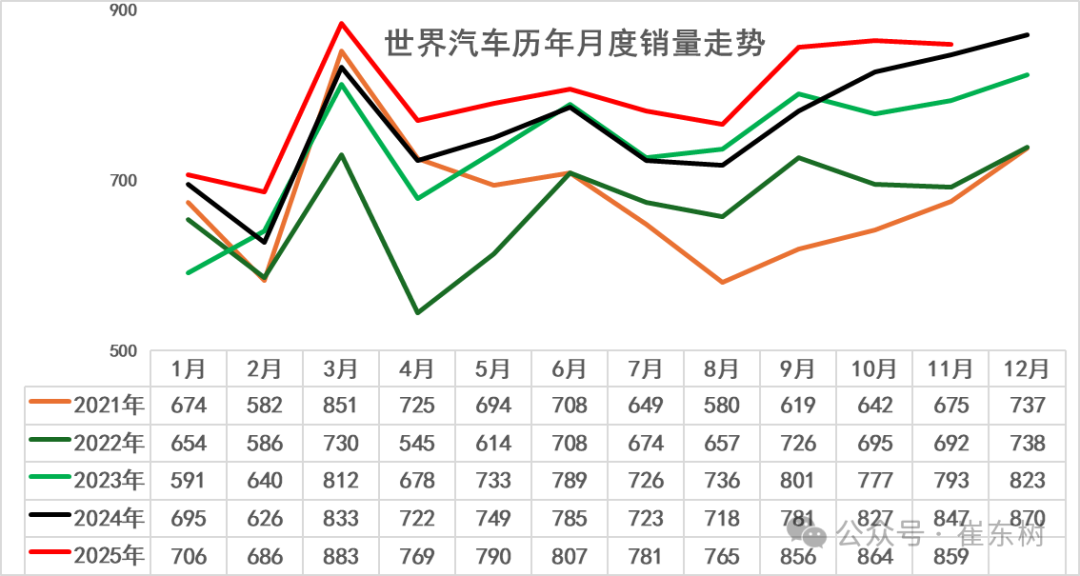
Core Insights - Global automotive sales reached 8.59 million units in November 2025, showing a year-on-year increase of 1% and a month-on-month increase of 1% [1][3] - The automotive market in China and the US is experiencing relative slowdowns, contributing to the overall deceleration in global sales growth [1][3] - For the period from January to November 2025, global sales totaled 87.66 million units, reflecting a year-on-year growth of 6% [1][3] Global Market Performance - In the first eleven months of 2025, global automotive sales grew by 6%, with China contributing 31.08 million units, an increase of 11% [1][12] - The US automotive market saw sales of 15.18 million units, up 2%, while India and Japan reported increases of 5% and 3%, respectively [1][12] - Germany's sales remained stable at 2.89 million units, showing no change from the previous year [1][12] China's Market Share - China's share of the global automotive market rose to 40% in November 2025, an increase of 1 percentage point from the previous year [1][11] - By the end of 2025, China's market share is projected to reach 35.4%, up 1.2 percentage points compared to the same period last year [1][11] - The Chinese automotive market is expected to maintain its leading position, with significant contributions to global sales growth [1][11] Company Performance - Among the top 10 global automotive companies, three are Chinese: BYD ranked 6th, Geely 8th, and Chery 10th, indicating strong performance and market share growth [1][21] - The electrification trend is causing some international automotive brands to decline, while Chinese companies are gaining market share [1][21] - The overall performance of Chinese automotive companies has exceeded expectations, leading to a significant increase in their global market presence [1][21]

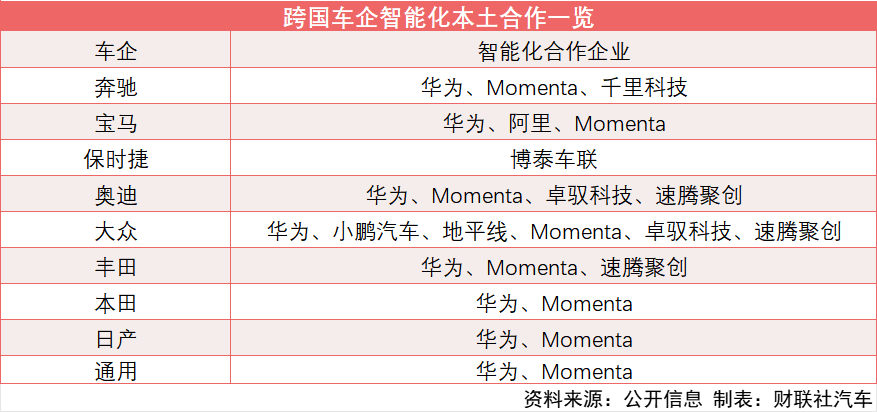
外资品牌深度链接本土“双智”供应商 华为、Momenta成赢家
Xin Lang Cai Jing· 2025-12-30 08:49
Core Viewpoint - The global automotive industry is undergoing significant transformation, presenting both challenges and opportunities for foreign car manufacturers in China. Collaborating with local intelligent suppliers is emerging as a major trend for the automotive industry by 2025 [1] Group 1: Collaborations and Partnerships - Major foreign car manufacturers, including Mercedes-Benz, BMW, and Audi, are forming strategic partnerships with local Chinese companies in the fields of intelligent driving and smart cockpits [2][3] - Mercedes-Benz has entered a long-term strategic cooperation agreement with Qianli Technology, focusing on artificial intelligence, intelligent driving, and smart cockpit technologies [2] - Other notable collaborations include partnerships between BMW and companies like Huawei and Momenta, as well as Audi's cooperation with multiple local suppliers [2][3] Group 2: Financial Performance and Market Trends - Foreign car manufacturers are experiencing declining profits, with BMW reporting a 16.2% year-on-year decrease in EBIT to €8.06 billion for the first nine months of the year, alongside a 5.6% drop in revenue to approximately €100 billion [3] - Sales figures for major brands in China from January to November show significant declines: BMW down 14.7% to 528,000 units, Mercedes-Benz down 18.7% to 518,000 units, and Audi down 13.3% to 518,000 units [4] - Industry experts suggest that the shift towards collaboration with local technology firms is a response to the pressures of profitability and the need for transformation in the automotive sector [3][4]