Wells Fargo(WFC)

Search documents
Why Analysts Are Closely Watching Wells Fargo & Company (WFC)
Yahoo Finance· 2026-01-26 15:13
Wells Fargo & Company (NYSE:WFC) is among the most profitable financial stocks to invest in. On January 15, TD Cowen slightly cut the price target on Wells Fargo & Company (NYSE:WFC) to $100 from $102 and reiterated a Hold rating. This follows the company’s fourth-quarter results, which reported a miss on the top line but impressive underlying organic growth. On the same day, Truist Securities also trimmed the price target on Wells Fargo & Company (NYSE:WFC) to $100 from $104 and maintained a Buy rating ...

【环球财经】华尔街大行密集发债 美国公司债潮涌背后风险需警惕
Xin Lang Cai Jing· 2026-01-25 14:09
Core Viewpoint - The article highlights a significant surge in bond issuance by major Wall Street banks, driven by the demand for financing related to artificial intelligence (AI) investments, with projections indicating that the U.S. corporate bond market could see issuance reach approximately $2.5 trillion in 2026, raising concerns about debt sustainability [2][3]. Group 1: Wall Street Bond Issuance - Major Wall Street banks, including JPMorgan Chase, Wells Fargo, Morgan Stanley, and Goldman Sachs, have recently launched extensive bond financing plans, with Goldman Sachs' issuance being the largest in history at $16 billion [3][4]. - In January alone, over $35 billion in new bonds are expected to enter the market from these banks, reflecting a broader trend of increased corporate bond issuance in the U.S. [3][4]. - Barclays predicts that the six major Wall Street banks will issue a total of $188 billion in high-rated bonds globally in 2026, marking a 7% increase year-over-year [3]. Group 2: Corporate Bond Market Trends - The overall issuance of U.S. corporate bonds is projected to reach $2.46 trillion in 2026, an 11.8% increase from $2.2 trillion in 2025, with a net issuance of $945 billion expected this year, up 30.2% from last year [5]. - The demand for high-quality dollar bonds has led to a decrease in borrowing costs, with the credit spread for U.S. investment-grade corporate bonds at its lowest level since June 1998 [5]. Group 3: Investor Sentiment and Risks - Investors are increasingly concerned about the high levels of debt being taken on by tech giants for AI infrastructure, with some turning to credit default swaps (CDS) to hedge against potential downturns related to AI investments [7]. - The bond issuance trend reflects not only domestic financial needs but also changes in global dollar liquidity, prompting calls for enhanced macroprudential management to mitigate financial volatility from cross-border capital flows [7].



华尔街大行密集发债,美国公司债潮涌背后风险需警惕
Xin Lang Cai Jing· 2026-01-25 14:08
Group 1 - The core viewpoint of the articles highlights a significant surge in bond issuance by major Wall Street banks, driven by declining borrowing costs and increased demand for financing related to artificial intelligence (AI) investments, with projections indicating a total issuance of approximately $2.5 trillion in the U.S. corporate bond market by 2026 [1][4][5] - Major Wall Street banks, including JPMorgan Chase, Wells Fargo, Morgan Stanley, and Goldman Sachs, have recently launched substantial bond financing plans, with Goldman Sachs' issuance being the largest in history for investment-grade bonds at $16 billion [1][2][3] - The overall corporate bond issuance in the U.S. is expected to reach $2.46 trillion in 2026, an 11.8% increase from $2.2 trillion in 2025, with a net issuance of $945 billion anticipated for this year, reflecting a 30.2% growth from last year [4][5] Group 2 - The surge in capital returns by the six major Wall Street banks, exceeding $140 billion in 2025 through dividends and stock buybacks, is attributed to soaring bank profits and relaxed regulatory policies, which enhance corporate financing confidence [2][3] - The demand for high-quality dollar-denominated bonds is driving down corporate financing costs, with the current credit spread for U.S. investment-grade corporate bonds being the lowest since June 1998, at just 0.73 percentage points above U.S. Treasury yields [4][5] - Concerns are rising among investors regarding the substantial debt incurred by tech giants for AI infrastructure, as there is skepticism about the profitability of such large-scale capital expenditures [6]


Bank Stocks: Another Quarter of Double-Digit S&P 500 Earnings Growth?
See It Market· 2026-01-22 22:45
Group 1 - The "Big Six" US banks (JPM, BAC, C, WFC, MS, GS) reported strong Q4 2025 profits, with half of them missing revenue expectations due to one-time charges [1] - Investment banking showed a resurgence, and loan demand remained strong despite falling interest rates and significant restructuring charges [2] - Most banks exceeded EPS estimates, but market reactions were muted or negative due to cautious 2026 guidance and rising operational costs related to AI investments [3] Group 2 - Bank of America reported a 12% profit increase driven by record net interest income, while JPMorgan and Citigroup managed one-time cleanup costs to signal a clearer path forward [4] - As of now, 7% of S&P 500 companies have reported results, with a blended EPS growth rate of 8.2% and revenue growth expectations rising to 7.8% [5] - The Late Earnings Report Index (LERI) indicates that CEOs are more confident than ever, with a record low reading of 46 for Q4 earnings season [6][8] Group 3 - The peak earnings season for Q4 is expected to run from January 26 to February 27, with over 1,000 reports anticipated each week [11] - Upcoming earnings releases include 35 S&P 500 companies and 577 companies in the global universe of 11,000 equities [9]

美国银行业正迎来史上最疯狂“抱团取暖”,谁能挑战摩根大通与美银?
Hua Er Jie Jian Wen· 2026-01-22 13:03
Core Insights - The U.S. banking industry is undergoing a historic wave of consolidation driven by a loose financial environment and relaxed regulatory policies, with regional banks aggressively pursuing mergers and acquisitions to expand their scale and enhance financial system stability [1][3] Group 1: Mergers and Acquisitions - PNC Financial Services Group has completed a $4.1 billion acquisition of FirstBank, while Fifth Third Bancorp is set to finalize a $10.9 billion acquisition of Dallas-based LegacyTexas [1] - The mergers are concentrated in fast-growing regions like Texas and Colorado, indicating a strategic intent by banks to capture high-growth markets [1] - Analysts from Jefferies highlight that regional lenders such as M&T Bank, Citizens Financial Group, and KeyCorp are seen as "ripe for acquisition" [2] Group 2: Regulatory Environment - The relaxation of regulatory scrutiny under the Trump administration has facilitated these mergers, with agencies like the OCC and FDIC easing restrictions on transactions [1][3] - The current financial environment, characterized by high interest rates and low credit losses, has left many U.S. banks with excess capital, making stock-based acquisitions more attractive [1][3] Group 3: Market Dynamics - The U.S. banking landscape is highly imbalanced, with JPMorgan Chase, Bank of America, and Wells Fargo controlling over 30% of household deposits, while many smaller banks hold only single-digit market shares [3] - Mergers are becoming essential for smaller banks to survive due to high technology investment and compliance costs, as larger banks can outspend them significantly [3] Group 4: Importance of Physical Branches - Acquiring deposits is a core challenge for banks, and significant market share growth from retail customers is nearly impossible without mergers [4] - The merger of BB&T and SunTrust to form Truist Financial exemplifies how combining resources can lead to a substantial increase in market share [4] - Physical branches remain crucial, as evidenced by JPMorgan Chase's expansion of 1,000 branches since 2018, which significantly boosts product sales per customer [4] Group 5: Financial Stability - The consolidation of banks into "super regional banks" may enhance financial stability by diversifying the banking landscape, reducing reliance on a few large institutions [6] - These super regional banks maintain simpler and more focused business models compared to global giants, potentially providing more stability in times of crisis [6] Group 6: Future Acquisition Targets - The market is focused on potential acquirers and targets, with PNC and Fifth Third leading recent transactions [7] - Wells Fargo, having recently lifted asset cap restrictions, may be a key player in future mergers, as its market share has declined to 7.7%, creating opportunities for strategic acquisitions [7]


Wells to Launch Revamped RIA Custody Platform in Late 2026
Yahoo Finance· 2026-01-21 19:59
Core Viewpoint - Wells Fargo Advisors is launching a newly designed fee-only RIA custody platform, which will initially be seeded by a few firms from its Financial Advisor Network, with a broader market launch planned for 2027 [1][2]. Group 1: RIA Platform Development - The fee-only RIA channel at Wells Fargo has expanded to several dozen firms over the years, with a new custodial tech stack being developed to onboard existing advisors seeking a fee-only model [2]. - The revamped RIA program will provide comprehensive services including due diligence, client transitions, operational support, relationship management, and technology integration, leveraging the full capabilities of the Wells platform [3]. Group 2: Leadership and Strategy - Erik Karanik, head of wealth and investment management independent solutions, emphasized the platform's role in cultivating the advisor lifecycle and maintaining an agnostic approach to advisor employment [3]. - The RIA solution was initially launched through the First Clearing division in 2019, and Leeann Markovitz has recently been promoted to lead First Clearing [4]. Group 3: Future Plans and Market Demand - The company plans to integrate some internal practices onto the new platform by the end of the year, with an aim to expand to external practices by 2027, indicating a strong demand for such services [6]. - Karanik noted the importance of testing the platform with existing advisors to ensure robustness before a wider market introduction [6].
Wells Fargo to Relocate Wealth Management Business to South Florida
Barrons· 2026-01-21 18:07
Core Viewpoint - Wells Fargo is relocating its wealth management unit's base of operations to South Florida, marking a significant shift in the banking industry as it becomes the first major bank to move wealth operations to this region [1] Group 1: Company Actions - The relocation will involve approximately 100 staff members, primarily senior executives [1] - The new complex is located in West Palm Beach, Florida [1] Group 2: Industry Impact - This move signifies a trend in the banking industry, as Wells Fargo is the first major bank to shift its wealth operations to Florida, potentially influencing other banks to consider similar relocations [1]
What Sparked Anteris Technologies (AVR) Stock Surge Over 52% After-Hours? - Anteris Technologies Glb (NASDAQ:AVR), Wells Fargo (NYSE:WFC)
Benzinga· 2026-01-21 06:38
Core Viewpoint - Anteris Technologies Global Corp. announced a significant capital raise, leading to a 52.17% increase in share price during after-hours trading, reaching $8.75, following a regular session close of $5.75, which was up 12.52% [1]. Group 1: Capital Raise Details - The company plans to conduct a $200 million underwritten public offering of common stock, with underwriters having a 30-day option to purchase an additional $30 million in shares at the offering price [2]. - Anteris has also agreed to sell up to $90 million in common stock to Medtronic plc through a private placement, with Medtronic set to acquire between 16% and 19.99% of shares outstanding after the public offering [3]. Group 2: Use of Proceeds - Proceeds from the capital raise will be utilized to support the DurAVR Transcatheter Heart Valve global pivotal trial for patients with severe aortic stenosis, as well as to expand manufacturing capacity and development for v2vmedtech, inc. [5]. Group 3: Trading Metrics and Analysis - Anteris has a market capitalization of $236.89 million, with its stock trading within a 52-week range of $2.34 to $8.79. Over the past 12 months, the stock has seen a decline of 2.21%, indicating ongoing challenges for the company [6]. - The stock is currently positioned at 52.9% of its 52-week range, nearing yearly highs, and has a Relative Strength Index (RSI) of 66.01, suggesting a positive price trend across all time frames [6][7].

美国股债汇三杀,纳指跌超2%,芯片股、中概股普跌,晶科能源跌超12%,黄金白银再创新高
2 1 Shi Ji Jing Ji Bao Dao· 2026-01-20 23:15
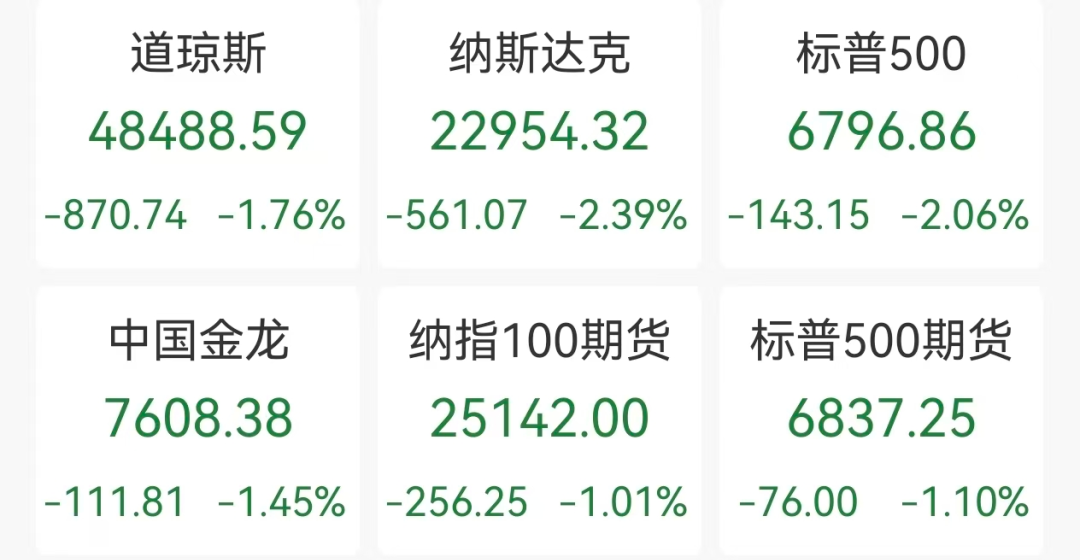
Market Overview - US stock indices experienced a significant decline, with the Dow Jones falling by 870 points (1.76%), the S&P 500 down by 143.15 points (2.06%), and the Nasdaq dropping by 561.07 points (2.39%) [1] - The Chicago Board Options Exchange Volatility Index (VIX), known as Wall Street's "fear index," surged above 20, reaching recent highs [1] Technology Sector - Major tech stocks saw substantial losses, with Nvidia and Tesla both dropping over 4%, while Apple and Amazon fell more than 3% [2][3] - Nvidia's stock price was reported at $178.07, down 4.38%, and Tesla at $419.25, down 4.17% [3] Streaming and Media - Netflix's post-market decline expanded to nearly 5% due to disappointing first-quarter earnings outlook and adjustments to its acquisition proposal for Warner Bros. assets to an all-cash offer totaling $82.7 billion [4] Semiconductor Industry - The semiconductor sector faced widespread declines, with Broadcom and Skyworks Solutions dropping over 5%, while TSMC fell more than 4% [4] Banking Sector - Bank stocks also fell across the board, with Citigroup down over 4% and JPMorgan and Morgan Stanley both declining more than 3% [4] Chinese Stocks - Chinese stocks mostly declined, with JinkoSolar down 12.5% and CenturyLink down over 10% [4][5] Bond Market - US Treasury yields rose to a four-month high, while the dollar index fell by 0.41%, marking its worst two-day performance in about a month [6] Precious Metals - Gold and silver prices reached new highs, with spot gold exceeding $4,763 per ounce and silver surpassing $94 per ounce [8][9] Cryptocurrency Market - The cryptocurrency market experienced a significant downturn, with Bitcoin dropping below $90,000 and Ethereum falling below $3,000, affecting approximately 163,000 traders [10][11]


Wells Fargo Moves Wealth Unit HQ to West Palm Beach
Wealth Management· 2026-01-20 18:57
Core Viewpoint - Wells Fargo & Co. is relocating its wealth-management headquarters to West Palm Beach, marking a significant move in response to the growing wealth boom in South Florida [1][2]. Company Strategy - The firm has signed a lease for 50,000 square feet at the One Flagler office building, with the wealth unit generating $16 billion in revenue last year, accounting for about 20% of the total revenue [1]. - Approximately 100 employees, primarily senior executives, will be relocated to the new office by the end of the year, including nearly half of the unit's operating committee [3]. Market Context - South Florida has attracted numerous billionaires and corporations due to tax advantages and a thriving finance and tech scene, with efforts to position Palm Beach County as a new hub for innovation [2]. - Competitors like JPMorgan Chase & Co. and Citizens Financial Group have also expanded in South Florida, drawn by wealth-management opportunities [6]. Future Plans - The relocation is seen as the beginning of an expansion in the South Florida market, with plans to hire experienced professionals and potentially rent more space in the future [7]. - The move is not intended to reduce operations in existing hubs like New York, St. Louis, and Charlotte, as some senior members will remain in those locations [9].