
中国石油天然气股份有限公司

Search documents
研判2026!中国原子灰行业分类、产业链及市场现状分析:行业增长动能重塑,高端制造与环保标准引领原子灰行业迈向高质量发展[图]
Chan Ye Xin Xi Wang· 2026-02-27 01:26
Industry Overview - The Chinese atom gray industry is transitioning from traditional "quantity increase" to modern "quality improvement" [1] - In 2024, the market size of the atom gray industry in China is expected to be approximately 1.201 billion yuan, representing a year-on-year growth of 5.81% [1][6] - The industry primarily serves sectors such as automotive, shipbuilding, furniture, construction, and high-end equipment manufacturing, with its performance closely linked to macro fixed asset investment and manufacturing activity [1][6] Market Dynamics - The growth of the atom gray industry is shifting from a broad-based increase to being driven by emerging high-end manufacturing sectors such as new energy vehicles, rail transit (e.g., high-speed rail), and new energy equipment (e.g., wind turbine blades) [1][6] - These sectors demand specialized properties from atom gray, including weather resistance, adhesion, and environmental friendliness, which are significantly higher than traditional applications [1] Industry Chain - The upstream of the atom gray industry includes raw materials such as unsaturated polyester resin, epoxy resin, polyurethane resin, and various fillers [3] - The midstream involves the production and manufacturing of atom gray, while the downstream applications span automotive, shipbuilding, furniture, construction engineering, and industrial equipment [3] Key Enterprises - The market concentration in the atom gray industry is relatively low, with companies like Hubei Huitian New Materials Co., Ltd. and Hebei Xindun Composite Materials Co., Ltd. leading in innovation and market share [7][9] - Huitian New Materials reported a revenue of 3.285 billion yuan in the first three quarters of 2025, a year-on-year increase of 8.49%, with a net profit of 216 million yuan, up 32.38% [9] Development Trends 1. Market demand is shifting from "general" to "high-end and customized," with the automotive manufacturing sector being the primary downstream market [10] 2. Environmental requirements are increasing, leading to a focus on "environmental and functional" product upgrades, with a shift towards low-VOC and water-based products [10] 3. Industry competition is evolving towards "deep service" and "industry chain integration," enhancing core competitiveness through timely technical support and broad service networks [11][12]


制储输用发力,开启能源“加氢减碳”之门
Zhong Guo Hua Gong Bao· 2026-01-13 06:26
Core Viewpoint - The hydrogen energy industry is seen as a key solution to energy issues, particularly in the context of expanding renewable energy capacity and addressing the challenges of wind and solar energy consumption [1]. Group 1: Green Hydrogen Development - Traditional hydrogen production mainly relies on fossil fuel reforming and industrial by-product gases, but there is significant demand for green hydrogen to replace gray hydrogen under carbon peak scenarios [2]. - By 2060, it is predicted that 30% of China's end-use thermal demand will come from non-fossil fuels, primarily through green electricity conversion, with a potential demand for 200 million tons of green hydrogen requiring approximately 10 trillion kilowatt-hours of green electricity [2]. - Water electrolysis is recognized as a crucial green hydrogen production technology, with advancements in equipment leading to cost reductions and broader applications [2]. Group 2: Hydrogen Storage Technologies - Efficient, safe, and low-cost hydrogen storage technologies are essential for energy peak shaving and valley filling [4]. - Current hydrogen storage methods include high-pressure, liquid, and solid-state storage, with liquid hydrogen being highlighted for its high storage efficiency and suitability for large-scale applications [4]. - Solid-state hydrogen storage, utilizing materials like carbon nanomaterials and metal hydrides, offers advantages such as higher storage density and longer cycle life compared to other methods [4]. Group 3: Hydrogen Transportation - Hydrogen transportation is critical for the industrial promotion of hydrogen energy, with pipeline transport being suitable for stable, continuous hydrogen demand in industrial clusters [5]. - Challenges in China's hydrogen pipeline transport include differences in hydrogen blending technology and a lack of unified national standards, which hinder industrialization [5]. - Non-metallic composite flexible pipelines are proposed as alternatives to metal pipelines, offering better corrosion resistance and lower costs [6]. Group 4: Market Opportunities in Hydrogen Energy - The hydrogen energy industry is entering a window of opportunity, with applications expanding in transportation, industry, and other energy sectors [7]. - Hydrogen energy has significant potential in the transportation sector, including hydrogen-powered heavy trucks and rail systems, which can replace diesel engines [7]. - In the industrial sector, hydrogen can replace coal in steel production, addressing carbon emissions at the source and enabling the production of high-quality steel [7].
研判2025!中国中间相碳微球行业产业链、市场规模、重点企业及未来趋势分析:工艺优化与表面改性技术突破,为下游应用提供了坚实的技术支撑[图]
Chan Ye Xin Xi Wang· 2026-01-07 01:26
Core Viewpoint - The Mesocarbon Microbeads (MCMB) industry in China is transitioning from rapid growth to high-quality development, with a projected market size of approximately 7.559 billion yuan in 2024, reflecting a year-on-year growth of 4.46% [1][6]. Industry Overview - MCMB is a key carbon material produced from heavy aromatic compounds like asphalt and coal tar through thermal treatment, characterized by its unique anisotropic liquid crystal structure [2]. - MCMB exhibits excellent electrical conductivity, thermal conductivity, chemical stability, thermal stability, and ease of graphitization, making it essential for applications in lithium-ion batteries, sodium-ion batteries, catalyst carriers, and composite materials [2]. Production Process - The production methods for MCMB are categorized into direct polymerization and indirect methods, with the latter further divided into suspension and emulsion methods. Direct polymerization is cost-effective but has inherent defects like low yield and high impurity content, while indirect methods yield higher quality products but are more complex and costly [4]. - The industry employs a gradient complementary structure of cost and performance, requiring companies to balance production methods based on market demands for yield, purity, and particle size precision [4]. Industry Chain - The upstream of the MCMB industry chain includes raw materials such as coal tar, petroleum pitch, and carbon black, while the midstream focuses on the production of MCMB. The downstream applications include lithium-ion batteries, high-strength composite materials, and chromatography column fillers [5]. - The "dual carbon" strategy and policies promoting new energy vehicles are driving the demand for power batteries, with a significant increase in lithium battery shipments, which reached 776 GWh in the first half of 2025, a year-on-year increase of 68% [5]. Market Size - The MCMB industry is at a critical turning point, with a market size projected at 7.559 billion yuan in 2024, growing by 4.46% year-on-year. Continuous optimization of production processes has improved particle size uniformity and enhanced performance in fast charging and low-temperature applications [6][7]. Key Companies' Performance - The MCMB industry is characterized by a concentration of leading companies like BETTERRY and Shanshan, which leverage technological advancements and scale advantages. BETTERRY leads in high-capacity products, while Shanshan dominates the mid-to-low-end market through cost control [8]. - BETTERRY has a production capacity of 16,500 tons of MCMB annually and holds over 70 national and international patents, achieving a particle size control precision of ±0.8 μm [8]. - Baotailong, another key player, has developed a unique business model integrating coal chemical processes with new materials, achieving over 90% self-sufficiency in raw materials [8]. Industry Development Trends 1. **Technological Innovation and Performance Breakthroughs**: The industry is advancing through continuous technological innovations, with traditional methods being optimized and new techniques like low-temperature plasma and microwave radiation showing promise [9]. 2. **Diversified Market Demand**: The demand for MCMB is growing due to the increasing sales of new energy vehicles and the explosive growth of the energy storage market, driven by policies and technological advancements [10]. 3. **Green Upgrading and Circular Economy**: The "dual carbon" goals are pushing the industry towards greener practices, with companies adopting closed-loop solvent recovery systems and focusing on waste reduction and recycling [10].


中国国有企业全球化:合作共赢与责任承担 | 跨越山海
Sou Hu Cai Jing· 2025-12-30 17:40
2025年,全球化发展进入一个新的时期。贸易保护主义加剧,一些国家更加强调"保护本国"的经贸政策,全球贸易摩擦升级,也促使关键产业回流本土。 与此同时,后疫情时代以来,在地缘政治局势紧张的背景下,主权国家与跨国企业对供应链安全重视度的提升,进一步加速了全球产业链、供应链的调整 优化。这些都给中国企业未来一段时间的全球化发展带来更多不确定性。 本文为报告第四章的内容。 中国企业全球化的外部环境持续变化。2025年年初以来,企业出海不断面临着新的挑战,无论是再次当选美国总统的特朗普反复对关税进行调整,还是美 国对来自中国大陆和中国香港的小额进口商品免税待遇取消,均迫使中国企业调整优化它们的全球化战略。 然而,在出海外部环境并不那么友好的"新常态"下,全球化依然是众多中国企业的发展方向。最新发布的《中共中央关于制定国民经济和社会发展第十五 个五年规划的建议》中提出,"坚持开放合作、互利共赢是中国式现代化的必然要求。稳步扩大制度型开放,维护多边贸易体制,拓展国际循环,以开放 促改革促发展,与世界各国共享机遇、共同发展"。海外市场的重要性不言而喻。公开数据显示,2024年中国出口规模突破了25万亿元。同时,近年来, 政 ...

阀门行业加速拥抱智能化
Zhong Guo Hua Gong Bao· 2025-12-17 02:55
Group 1 - The conference highlighted the shift in the petrochemical industry from "passive response" to "proactive warning" through the intelligent upgrade of valves, which are crucial for production safety and operational efficiency [1] - Approximately 40% of unplanned shutdowns in China's petroleum refining system are directly related to valve failures, indicating an urgent need for intelligent risk warning systems [1] - The implementation of predictive maintenance through intelligent controllers, such as Emerson's Fisher DVC7K, can automatically diagnose about 80% of common faults, effectively preventing unplanned downtime [1] Group 2 - The increasing regulatory requirements are driving the deeper application of intelligent self-diagnosis technology in safety-critical equipment like emergency shut-off valves, which is fundamental for achieving intelligent production in the petrochemical sector [2] - Challenges in the deployment of intelligent control valves include insufficient terminal computing power, complex and slow data transmission technologies, and the lack of supportive standards for intelligent instruments and network transmission [2] - The establishment of a unified design and quality standard through the formation of a domestic valve alliance is essential for promoting the intelligentization of valves, innovation in new materials, and upgrading green standards over the next five years [2] Group 3 - The role of higher education institutions in the intelligent and high-end transformation of the valve industry is emphasized, with a focus on deep collaboration among government, industry, academia, and research [3] - The establishment of training bases in collaboration with leading enterprises aims to support core technology breakthroughs and practical application in the industry [3] - The conference was organized by Jingyan (Beijing) Chemical Engineering Research Institute, with over 370 companies participating for exchange and collaboration [3]

摩根大通对中国石油股份的多头持仓比例降至5.43%
Xin Lang Cai Jing· 2025-10-30 09:32
据香港交易所披露,摩根大通对中国石油天然气股份有限公司 - H股的多头持仓比例于2025年10月24日 从5.44%降至5.43%。 ...

中石油上半年赚840亿元 预计国际油价在70美元左右波动
Nan Fang Du Shi Bao· 2025-08-28 13:45
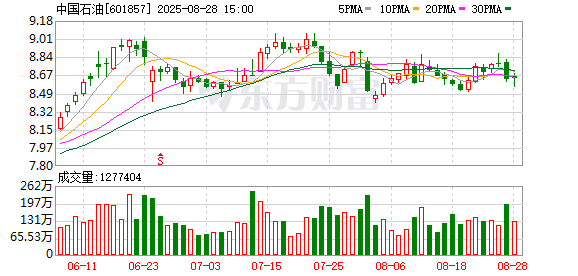
Core Viewpoint - China National Petroleum Corporation (CNPC) reported a solid performance in the first half of 2025, with significant increases in oil and gas production, alongside a strategic focus on green energy transition and market adaptability [1][2][3]. Production and Financial Performance - In the first half of 2025, CNPC's oil and gas equivalent production reached 924 million barrels, a year-on-year increase of 2%, with crude oil production at 476 million barrels, up 0.3% [1]. - The company achieved a natural gas production of 26.8 trillion cubic feet, marking a 3.8% increase, setting historical highs for both natural gas and oil equivalent production [1]. - CNPC's revenue for the first half of 2025 was RMB 1.5 trillion, with a net profit attributable to shareholders of RMB 84.01 billion, and a mid-year dividend of RMB 0.22 per share was declared [2]. Strategic Initiatives and Market Adaptation - CNPC optimized crude oil resource allocation and adjusted product structures dynamically to increase the production of high-margin refined and chemical products [3]. - The company is advancing its green low-carbon transition, with natural gas production's share of total output increasing, and is actively developing renewable energy projects [3]. - The management outlined a three-step plan for renewable energy, targeting 7% of total energy capacity from renewables by 2025, with a long-term goal of equal shares for oil, gas, and renewables by 2050 [3]. Market Outlook and Demand Trends - Despite a general decline in refined oil demand in the first half of the year, CNPC's domestic refined oil sales grew by 0.3%, increasing its market share by 1.5 percentage points [3]. - The company anticipates that domestic economic recovery will support energy consumption, particularly in residential travel and industrial oil use, although gasoline and diesel consumption may face downward pressure [3]. - Aviation fuel consumption is expected to continue growing at a rapid pace [3]. Oil Price and Risk Management - CNPC's management emphasized the importance of integrated supply chain management and cost control in responding to market changes [4]. - The company is closely monitoring international oil prices, which are influenced by OPEC+ production levels, geopolitical factors, and monetary policy [4][6]. - The management expects international oil prices to fluctuate around $70 per barrel in the third quarter, citing the company's robust risk management capabilities due to its comprehensive industry chain [6].
中石油上半年赚840亿元,预计国际油价在70美元左右波动
Sou Hu Cai Jing· 2025-08-28 12:29
Core Viewpoint - China National Petroleum Corporation (CNPC) reported strong mid-year performance for 2025, with significant revenue and profit growth, alongside a commitment to dividend distribution [1][3]. Financial Performance - CNPC's revenue for the first half of 2025 reached RMB 1.5 trillion, with a net profit attributable to shareholders of RMB 84.01 billion [1]. - The board declared an interim dividend of RMB 0.22 per share [1]. Production and Operations - Oil and gas equivalent production reached 924 million barrels, a year-on-year increase of 2%, with crude oil production at 476 million barrels (up 0.3%) and marketable natural gas production at 2.68 trillion cubic feet (up 3.8%) [1][3]. - The company optimized crude oil resource allocation and adjusted product structure to increase high-margin refined and chemical products [3]. Green Transition and Future Plans - CNPC is advancing its green low-carbon transition, with a focus on increasing natural gas production's share in total output and developing renewable energy [3]. - The company aims for renewable energy to account for 7% of total oil and gas equivalent production by the end of 2025, with a long-term goal of equal shares for oil, gas, and renewable energy by 2050 [3]. Market Dynamics - Despite a decline in overall refined oil demand, CNPC's domestic refined oil sales grew by 0.3%, increasing its market share by 1.5 percentage points [3]. - The company anticipates that domestic economic recovery will support energy consumption, particularly in residential travel and industrial oil use, although gasoline and diesel consumption may face downward pressure [3]. International Oil Price Outlook - CNPC's management highlighted the influence of OPEC+ production decisions and geopolitical factors on international oil prices, predicting a fluctuation around $70 per barrel in Q3 [4]. - The company emphasized its integrated supply chain management and cost control as key strengths in navigating market changes [4].
中国石油上半年归属于母公司股东净利润超840亿元
Xin Hua Cai Jing· 2025-08-26 10:49
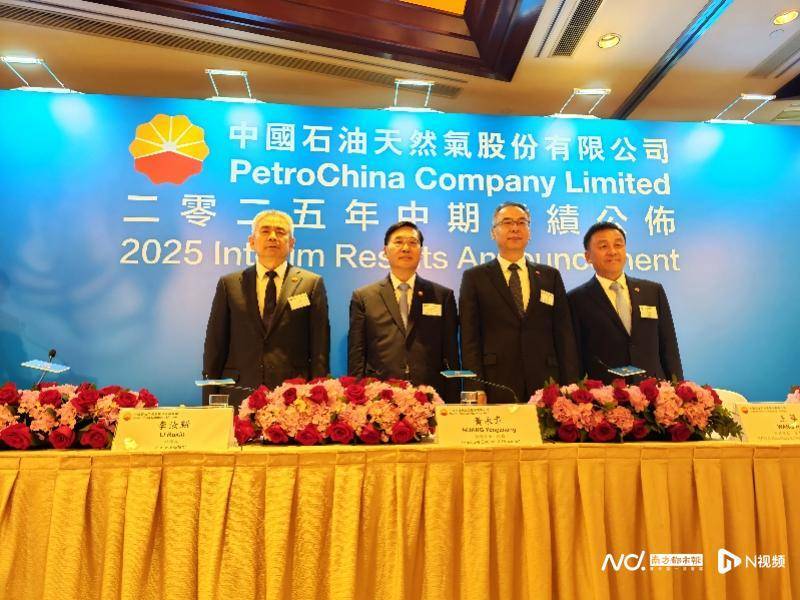
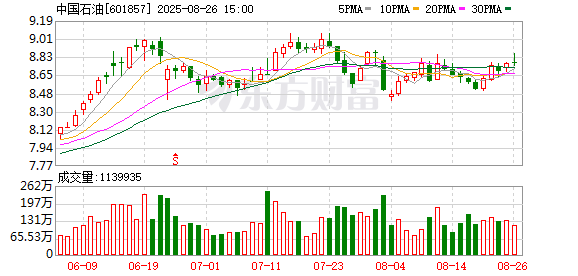
Core Viewpoint - China National Petroleum Corporation (CNPC) reported strong mid-year performance for 2025, with significant revenue and profit growth, alongside a commitment to shareholder returns through dividends [2][10]. Financial Performance - The company achieved a revenue of 1.5 trillion yuan and a net profit of 84.01 billion yuan in the first half of 2025 [2][10]. - A mid-year dividend of 0.22 yuan per share was declared, totaling 40.26 billion yuan, maintaining a historically high level [2][10]. Operational Highlights - Oil and gas production continued to grow, with a total output of 924 million barrels, a year-on-year increase of 2.0% [3][11]. - Natural gas production reached 2.68 trillion cubic feet, up 3.8%, marking record levels for the period [3][12]. - Renewable energy initiatives saw a 70.0% increase in wind and solar power generation [3][12]. Refining and Chemical Business - The company made significant progress in refining transformation and upgrading, with a focus on high-end, green, and intelligent directions [4][13]. - Crude oil processed was 690 million barrels, producing 59.57 million tons of refined oil, and chemical product sales increased by 4.9% to 1.997 million tons [4][14]. - New materials production surged by 54.9%, continuing a trend of over 50% growth for three consecutive years [4][14]. Sales and Market Expansion - Domestic refined oil sales grew by 0.3%, with market share increasing by 1.5 percentage points [5][16]. - Sales of vehicle LNG rose by 58.9%, and charging and battery swap services increased by 213% [5][16]. - Natural gas sales reached 151.5 billion cubic meters, a 2.9% increase, with domestic sales hitting 119.77 billion cubic meters, up 4.2% [5][17]. Innovation and Future Outlook - The company emphasized innovation as a key development strategy, focusing on enhancing core competitiveness in oil and gas operations [6][18]. - Plans for the second half of 2025 include closely monitoring market changes and driving high-quality business development to meet annual operational goals [7][19].
中油资本总资产连续三年超1万亿 拟6.55亿投资可控核聚变项目
Chang Jiang Shang Bao· 2025-06-23 00:50
Core Viewpoint - China Oil Capital (中油资本) is actively integrating support for the national "dual carbon" goals into its business layout and daily management, with recent investments aimed at strategic emerging industries, particularly in controllable nuclear fusion projects [1][8]. Financial Performance - As of the end of 2024, China Oil Capital's total assets reached 1,084.172 billion yuan, a 1.01% increase from the beginning of the year, maintaining a scale above one trillion yuan for three consecutive years [2][5]. - The company achieved an annual operating revenue of 39.024 billion yuan, reflecting a year-on-year growth of 0.08%, and a net profit of 9.9 billion yuan [1][5]. Investment Activities - The company plans to invest 655 million yuan in Kunlun Capital, a subsidiary, to support the controllable nuclear fusion project, maintaining its 20% ownership stake post-investment [3][4]. - The investment is part of a broader strategy to optimize business layout and explore growth opportunities in the energy and chemical industries [4]. Business Segments - By the end of 2024, the banking business of China Oil Capital had total assets of 455.56 billion yuan, a 5.84% increase, with an operating revenue of 16.74 billion yuan and a net profit of 1.705 billion yuan [7]. - The financial company segment reported total assets of 515.73 billion yuan, with an operating revenue of 16.335 billion yuan and a net profit of 6.04 billion yuan [7]. - The financial leasing business achieved a total asset of 72.617 billion yuan, with an operating revenue of 2.842 billion yuan and a net profit of 733 million yuan [7]. Green Finance Initiatives - China Oil Capital's green finance scale exceeded 100 billion yuan in 2024, with various business segments actively promoting green financial products [9]. - The company established green credit channels and prioritized green credit clients, with a total green credit balance exceeding 60.3 billion yuan [9].
