
海尔

Search documents
春节消费观察: 从“换机热”看上海智能终端产业“千亿突围”
Zhong Guo Zheng Quan Bao· 2026-02-26 21:03
但需要关注的是,消费端的"换机热",恰逢当前供给端存储芯片的"涨价潮",市场也在冷热交织中寻找 着平衡点。而在上海,政策牵引下,一个由人工智能(AI)技术革命做内核、千亿产业集群做底牌的智能 终端产业创新生态正在形成,以期通过确定的产业升级来应对波动。 ● 本报记者黄一灵乔翔 "国补"政策发力显效 "今年'国补'期间线上抢了很多次都没成功,线下改成即时摇号后,一次就摇到了,赶紧趁着春节前给 自己换了一部手机当新年礼物。"在上海工作的李女士手持刚激活的新手机,难掩兴奋地向记者分享自 己的换机经历。她的亲身感受,正是上海线下"国补"即时摇号政策落地见效的缩影。 为进一步优化补贴申领体验、激活线下消费活力,2月4日,上海市商务委等部门联合发布《上海市2026 年落实国家家电以旧换新、数码和智能产品购新补贴政策实施细则》,其中一个亮点便是新增"线下即 时摇号"参与方式,个人消费者可于每日8时至22时实时参与摇号,实现"即摇即知结果",大幅提升了补 贴申领的便捷度。 据悉,此次线下"国补"新政不仅简化了申领流程,更实现了优惠权益的多重叠加。消费者在线下参与摇 号并中签后,可即时使用"国补",部分门店同时还能叠加门店自主 ...
“马”蹄奋进 躬身实干 新年企业发展一线见闻
Jin Rong Shi Bao· 2026-02-25 04:22
新年开新篇,奋进启新程。 在"十五五"开局之年,全国各地涌动实干热潮,各行各业抢抓开局、聚力攻坚,从科技创新研发到企业 生产一线,从项目建设现场到消费市场前沿,发展的活力持续迸发,为2026年经济发展筑好基、开好 局。 在服务新产业中发展新产业 浙江杭州,在算力与新材料赛道,传化集团旗下新安股份(600596)交出了硅基液冷领域技术与商用双 突破的新年答卷。 "我们依托60年有机硅材料研发与工程化经验,成功开发出具备高绝缘性、极低挥发性、优异热稳定性 及环境友好特性的硅基冷却液,完美适配浸没式液冷的严苛要求。"新安股份硅基新材料研究院院长刘 继指着浸没在透明冷却液中的服务器,详细讲解硅基液冷解决方案的细节。 针对数据中心、储能安全、超快充电等不同高热场景,新安股份已形成系列化产品矩阵,覆盖从材料到 系统的全链条,首个硅基浸没液冷商用项目在杭州稳定运行,其在新技术、新场景、新产业(300832) 领域的探索步伐还在继续。 眼下,液冷成为算力刚需,硅基材料凭借性能、成本与环保三重优势,成为液冷产业化的核心支撑,市 场空间加速打开,2026年有望迎来液冷产业化放量的关键节点。 "应用场景越多样、需求越细分,发展潜力 ...


新时达纳入海尔卡奥斯生态,2025年业绩扭亏为盈
Jing Ji Guan Cha Wang· 2026-02-12 04:46
近7天,新时达股价波动明显。2月6日股价大涨3.42%至16.62元,但2月11日收盘价报16.52元,单日下 跌1.14%,区间振幅达15.73%。资金流向方面,2月10日主力资金净流入241.7万元,但最新数据显示2月 11日主力资金净流出981.38万元,散户资金净流入710.54万元。换手率在1.82%至4.39%之间,成交活跃 度较高。 以上内容基于公开资料整理,不构成投资建议。 经济观察网新时达(002527)正式被纳入海尔卡奥斯工业互联网生态体系,双方形成"平台与硬件"互 补,海尔控股后从供应链、技术、市场、运营四大维度推进整合。协同效应已逐步释放,2025年业绩预 告显示,新时达预计2025年净利润为500万元至750万元,同比扭亏为盈,扣非净利润增长80.84%至 84.52%。这一战略整合被视为长期利好,可能提升公司生态竞争力。 股票近期走势 ...

申万宏源证券晨会报告-20260212
Shenwan Hongyuan Securities· 2026-02-12 02:58
Core Insights - The report highlights the emergence of "high prosperity spillover" in the AI sector, suggesting that while the fundamental elasticity may not match the high prosperity itself, there is still potential for elasticity in spillover markets [2][11] - It emphasizes the importance of basic bottom-line requirements for spillover markets, indicating that the prosperity cycle needs to confirm a clear bottom [11] - The report suggests that the valuation structure of high prosperity can break through historical averages, but the spillover structure may face challenges [11] Industry Summaries AI Sector - The report identifies specific industries benefiting from AI price spillover, recommending attention to fiberglass and optical fiber due to their favorable valuations and visible price increases [2][11] - Fiberglass is noted for its strong bargaining power in the global supply chain, with a valuation slightly above historical averages, indicating a favorable risk-reward profile [11] - The optical fiber sector is experiencing a recovery in traditional segments alongside expectations for AI business advancements, presenting a high short-term success rate [11] Real Estate - The report indicates that the most challenging period for the real estate sector may be over, with signs of marginal improvement in supply and demand dynamics [11] - Data shows a narrowing decline in key indicators, with a significant reduction in the year-on-year decline of second-hand housing transactions [11] - Policy measures are being implemented to stabilize the real estate market, focusing on risk management and ensuring the protection of livelihoods [11] Consumer Electronics - The report discusses the impact of the "old-for-new" policy on the home appliance market, noting significant sales volumes and revenue generated from this initiative [15][18] - It highlights the performance of various appliance categories, with a focus on the kitchen appliance sector, which is experiencing varied performance amid high base pressures [18] - The report anticipates that the 2026 "old-for-new" policy will continue to benefit leading brands with superior product efficiency and performance [18] Tourism and Hospitality - The report outlines the expected surge in domestic tourism during the extended Spring Festival holiday, predicting a significant increase in passenger transport volumes [21] - It notes a shift in consumer preferences towards high-quality accommodations and diverse travel experiences, driven by family and senior travelers [21] - The report suggests that the tourism market is experiencing a multi-faceted explosion, with emerging destinations gaining popularity [21]

国补淘宝天猫春节不打烊,江苏浙江券量加码,全国220个城市正常送货
Yang Zi Wan Bao Wang· 2026-02-10 05:39
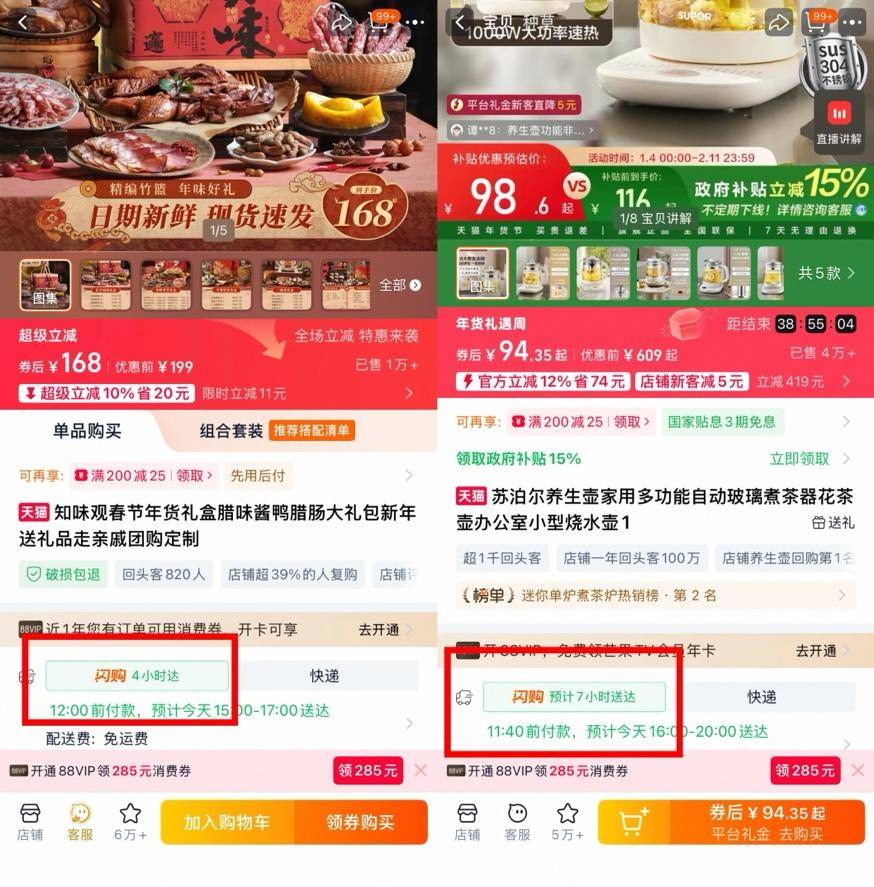
春节期间,天猫超市全国100个重点城市支持正常配送。与去年平均"次日达"的配送效率相比,今年能够至少提前"半天"送到。全国新增34个城市支持天 猫超市闪购,其中,杭州、上海、广州、北京、深圳等13个核心城市,消费者在天猫超市下单后,能够最快4小时送到家。 史上最长春节假期即将到来,淘宝天猫宣布,春节不打烊,闪购快递不放假。 2月12日,淘宝天猫"春节不打烊"活动将正式启动,覆盖整个春节假期。淘宝天猫官方立减商品9折起,全国220个城市正常送货。 值得一提的是,品牌官方旗舰店入驻淘宝闪购,安踏、乔丹、联想、苏泊尔(002032)、倍轻松、良品铺子(603719)、知味观等品牌全力保障应急年货 即时送达,让P人过年也不慌。良品铺子相关负责人介绍,良品铺子全国2000家线下门店均接入了淘宝闪购,春节期间所有门店照常营业,消费者下单 后,最快半个小时就能送货上门。 为点燃春节消费热潮,浙江、江苏、山东等地国补券量加码,消费者购买家电数码等品类,叠加平台大促优惠低至5折,美的、海信、海尔、格力、西门 子、华为、小米等千余品牌参与。此外,天猫送装服务开启"春节不打烊"模式,官方物流、上门安装、售后保障照常运行,确保消费者 ...

传统空调需求承压,格力、美的切入AI数据中心制冷领域
第一财经· 2026-02-04 09:46
Core Viewpoint - The central air conditioning industry is undergoing an adjustment period due to declining traditional engineering demand, prompting companies like Gree Electric and Midea Group to invest more resources in AI data center cooling and high-performance infrastructure to seek structural growth opportunities [5][6]. Group 1: Market Dynamics - Air conditioning still accounts for about 70% of Gree Electric's revenue, with central air conditioning being a core segment. However, the industry faces pressure from a downturn in real estate, weak traditional engineering demand, and intensified price competition [7]. - In 2025, the sales scale of China's central air conditioning industry is projected to be 138.68 billion yuan, with a 7.4% year-on-year decline in the domestic market, while the export market is expected to grow by 12.7%. The growth in exports is significantly driven by ongoing investments in overseas data centers and computing infrastructure [7]. Group 2: Technological Trends - As AI computing power increases, the power density of server cabinets is rising rapidly, revealing limitations in traditional air cooling solutions in terms of efficiency and heat dissipation. Liquid cooling is gradually becoming an important technology route for high-performance data centers [8]. - Liquid cooling is not merely an equipment upgrade but involves comprehensive changes in system architecture, core components, and operational modes. It is seen as a supplementary solution in high-performance scenarios, often coexisting with air cooling solutions, requiring higher system integration and project experience [8]. Group 3: Competitive Landscape - The data center cooling market is primarily dominated by two types of companies: specialized manufacturers with extensive experience in data center temperature control, such as Vertiv, Ingersoll Rand, and others, and foreign brands like Johnson Controls and Carrier, alongside domestic central air conditioning manufacturers like Gree and Midea [10]. - Domestic central air conditioning companies face significant challenges in the data center market, including the maturity of technology in high-performance scenarios, the ability to deliver complex projects, and the long verification cycles required by leading clients [10]. Group 4: Future Outlook - Overall, AI data center cooling presents a rare structural growth opportunity for the central air conditioning industry, but its scale, pace, and profit model differ significantly from traditional engineering markets. In the short term, data center business serves more as a buffer against the decline of traditional business rather than a decisive replacement [11]. - The ability of companies like Gree and Midea to establish stable engineering capabilities and long-term customer relationships in high-barrier technology paths like liquid cooling will be crucial in determining their position in the computing infrastructure cycle [11].


传统空调需求承压,格力、美的切入AI数据中心制冷领域
Di Yi Cai Jing· 2026-02-04 08:50
Core Insights - The data center cooling business is a significant growth point for the central air conditioning industry during its consolidation phase, but competition is intensifying, presenting both opportunities and challenges [1] Industry Overview - The central air conditioning industry is currently in an adjustment period due to weakening traditional engineering demand. Companies like Gree Electric Appliances (000651.SZ) and Midea Group (000333.SZ) are reallocating resources towards AI data center cooling and high-computing infrastructure to seek structural growth [3] - The data center temperature control market has high requirements for system design capabilities, project experience, and long-term operation and maintenance, posing challenges for traditional HVAC companies [3] Market Dynamics - Air conditioning still accounts for approximately 70% of Gree's revenue, with central air conditioning being a core segment. However, the industry faces pressure from a downturn in real estate, weak traditional engineering demand, and intensified price competition [4] - The Chinese central air conditioning market is projected to reach a sales scale of 138.68 billion yuan by 2025, with a year-on-year decline of 7.4% in the domestic market, while the export market is expected to grow by 12.7% [4] - Data centers are viewed as one of the few remaining sources of certain demand in the central air conditioning industry, although their contribution to Gree and Midea's central air conditioning revenue remains limited [4] Technological Trends - As AI computing power increases, the power density of server cabinets is rising rapidly, revealing limitations in traditional air-cooled solutions regarding efficiency and heat dissipation. Liquid cooling is becoming an important technology route for high-computing data centers [4] - Liquid cooling is not merely an equipment upgrade but involves comprehensive changes in system architecture, core components, and operational modes, requiring higher system integration and project experience [4] Competitive Landscape - The data center cooling market is primarily dominated by two types of companies: specialized temperature control manufacturers and foreign brands. Specialized firms have accumulated substantial project experience and customer loyalty, while central air conditioning manufacturers like Gree and Midea have advantages in manufacturing and global service networks but face competition in specialized cooling solutions [6] - Domestic central air conditioning companies see opportunities in the data center market due to incremental space and localization trends, but they also face challenges such as technology maturity and complex project delivery capabilities [6] Strategic Outlook - Overall, AI data center cooling presents a rare structural growth opportunity for the central air conditioning industry, but its scale, pace, and profit model differ significantly from traditional engineering markets. In the short term, data center business acts more as a buffer against the decline of traditional business rather than a decisive replacement [7] - The ability of Gree and Midea to establish stable engineering capabilities and long-term customer relationships in high-barrier technologies like liquid cooling will be crucial for their positioning in the computing infrastructure cycle [7]
与澳网“碰杯” 中国品牌“借赛出海”尚需三重角色转变
Mei Ri Jing Ji Xin Wen· 2026-02-03 14:29
Group 1 - The core viewpoint of the articles emphasizes the importance of Chinese brands leveraging international sports events to enhance their global presence and brand recognition [1][2][4] - The Australian Open serves as a significant platform for brand exposure, reaching over 2 billion viewers globally and allowing brands like "Guojiao 1573" to align with high-end international brands [1] - The trend of Chinese brands "borrowing events to go global" is gaining momentum, with examples including Haier at the French Open and Wuliangye at the FIFA World Cup, showcasing a shift towards participating in global brand competition [2] Group 2 - Chinese brands need to transition from being "traffic harvesters" to "cultural narrators," focusing on deeper brand storytelling that resonates with the core values of the events they sponsor [3][4] - There is a need for brands to evolve from "resource purchasers" to "ecosystem builders," actively engaging with the event's ecosystem to create mutual value rather than merely purchasing sponsorship rights [3] - The shift from "contract partners" to "value cultivators" is essential, as brands must adopt a long-term perspective to build sustainable brand assets through ongoing event collaborations [3][4]

“十四五”山东外贸规模年均增长9.8%,累计进出口规模16.21万亿元
Zhong Guo Fa Zhan Wang· 2026-01-21 01:25
Core Insights - During the "14th Five-Year Plan" period, Shandong Province has significantly expanded its high-level openness, achieving a cumulative import and export scale of 16.21 trillion yuan, a 70.1% increase compared to the "13th Five-Year Plan" period, contributing 10.3% to the national foreign trade growth [1] Group 1: Trade Growth and Performance - Shandong's foreign trade scale has reached new heights, with an average annual growth rate of 9.8%, surpassing 3 trillion yuan in 2022 and projected to reach 3.53 trillion yuan by 2025 [1] - The province's share of national foreign trade has increased by 1.2 percentage points to 7.7%, while its global share has risen by 0.2 percentage points to 1% [1] - Both exports and imports have maintained rapid growth, with average annual growth rates of 10.6% and 8.5% respectively, indicating balanced development [1] Group 2: Business Vitality and Structure - Shandong has optimized its business environment, leading to an increase in the number of enterprises with import and export records, expected to exceed 80,000 by 2025, an increase of 24,000 from 2020 [1] - Private enterprises have played a crucial role in stabilizing foreign trade, contributing 90.4% of the province's foreign trade growth [1] Group 3: Market Diversification and Export Structure - The "Ten Thousand Enterprises Going Global" initiative has resulted in Shandong establishing trade partnerships with over 250 countries and regions, with 80% of these partners experiencing growth in trade [2] - The province's exports have shifted towards high-quality products, with machinery and electronics exports growing at an average annual rate of 13.6%, projected to exceed 1 trillion yuan by 2025 [2] - Shandong's self-branded products have gained prominence, with their exports growing at an average annual rate of 13%, accounting for 24.3% of the province's total exports [2] Group 4: Domestic Demand and Import Trends - Shandong's economy has shown a steady recovery, with industrial added value growing rapidly and imports of key industrial commodities like metal ores and crude oil increasing significantly [3] - The import of high-tech products has also seen an average annual growth of 8.9%, with specific components like computer parts and integrated circuits growing by 31.7% and 12.3% respectively [3] - The consumer market remains stable, with annual imports of consumer goods exceeding 100 billion yuan, including high-quality fresh agricultural products [3]
青岛启动科创大走廊建设
Zhong Guo Jing Ji Wang· 2026-01-16 08:09
Core Viewpoint - The Qingdao Science and Technology Innovation Corridor aims to enhance original innovation and key core technology breakthroughs, integrating technological and industrial innovation while promoting the development of education, technology, and talent [1] Group 1: Corridor Overview - The Qingdao Science and Technology Innovation Corridor officially launched on November 7, 2025, and spans 53 kilometers along the coastal road, covering an area of approximately 190 square kilometers [1] - The corridor connects major districts such as Laoshan District, Licang District, and Qingdao Blue Valley, featuring a well-developed transportation network and showcasing unique natural landscapes [1] - It is home to leading enterprises like Haier, Hisense, and GoerTek, with 20 listed companies, 998 high-tech enterprises, and 25 specialized "little giant" companies [1] Group 2: Future Development Goals - By 2027, the corridor aims to achieve significant breakthroughs in innovation platforms, talent, and enterprises, with key laboratories and new research institutions accounting for over 45% of the city's resources [2] - The number of effective invention patents per ten thousand people, total innovation talent, and high-tech enterprises is expected to grow by over 15% [2] - By 2035, the corridor is projected to lead in transformative technology results, attract world-class leading enterprises, and establish itself as a national leader in technological innovation and a global marine technology innovator [2] Group 3: Organizational and Policy Support - A collaborative mechanism will be established to enhance communication and resource integration across departments, regions, and industries [3] - Policies will be implemented to support the development of the Youth Innovation City, Smart Industry City, and Marine Technology City, creating a synergistic effect [3] - The corridor will serve as a testing ground for technology transfer, leveraging educational resources and promoting innovation ecosystems [4]