腾讯公司

Search documents
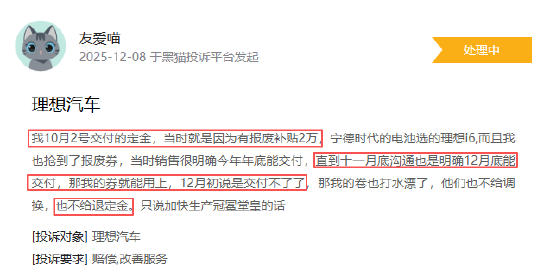
12月黑猫投诉汽车行业红黑榜:理想汽车无法按约定时间交车20000元报废补贴作废
Xin Lang Cai Jing· 2026-01-15 07:07
Core Insights - The article discusses the December complaint handling red and black list released by the Black Cat Complaint platform, highlighting the effectiveness of companies in addressing consumer complaints [1][10] - As of December 2025, the platform has received nearly 31.95 million valid consumer complaints, with approximately 24.75 million responses from companies and around 20.99 million complaints resolved [1][10] Group 1: Complaint Statistics - The Black Cat Complaint platform has accumulated nearly 31.95 million valid consumer complaints by the end of December 2025 [1][10] - Companies have responded to approximately 24.75 million complaints, with about 20.99 million complaints resolved [1][10] - In December alone, there were nearly 790,000 valid complaints [1][10] Group 2: Industry Red and Black Lists - In the shared services sector, the black list includes companies such as Guangyu Koste, Wisdom Xiaolian, and Yunma Technology, while the red list features companies like Hello and Monster Charging [5][14] - In the shopping platform category, the black list includes major platforms like Taobao Mall and JD.com, while the red list includes Heart Joy Mall and Tmall Supermarket [5][15] - The travel and accommodation sector's black list includes airlines such as Shenzhen Airlines and All Nippon Airways, while the red list features travel services like Ctrip and Shenzhou Car Rental [5][15] - In the entertainment sector, the black list includes WeChat and Tencent, while the red list features iQIYI and Guangdong Fuzhi Smart Technology [5][15] - The education and training sector's black list includes Duolingo and Zhonggong Education, while the red list features companies like Helian Tang and Yuan Tutor [5][15]


12月黑猫投诉企业红黑榜:金铲铲之战抽奖bug珍稀角色变白菜价
Xin Lang Cai Jing· 2026-01-15 05:26
Core Insights - The article presents the December complaint handling red and black list by the Black Cat Complaint platform, reflecting the complaint resolution status of various companies [1][13] - As of December 2025, the platform received nearly 31.95 million valid consumer complaints, with approximately 24.75 million responses from companies and around 20.99 million complaints resolved [1][13] - The red and black lists categorize companies by industry and highlight recent consumer concerns, providing valuable references for consumers [1][13] Group 1: Complaint Trends - In December, there were nearly 790,000 valid complaints, indicating a significant volume of consumer grievances [1][13] - The complaints cover various sectors, including e-commerce, travel, and entertainment, showcasing widespread issues across industries [1][13] Group 2: Notable Complaints - Consumers reported delays and fraudulent activities related to silver bars purchased on Taobao, with ineffective customer service responses [2][14] - New Balance faced complaints regarding unjustified refusal of returns, with a reported complaint volume of 76 and a response rate of 0% [3][15] - Li Auto was criticized for failing to deliver vehicles as promised, resulting in the forfeiture of a 20,000 yuan vehicle scrapping subsidy for consumers [4][16] - Shenzhen Airlines received complaints about flight cancellations and changes without compensation, accumulating 4,916 complaints with a response rate of only 9.24% [5][17] - The game "Gold Shovel Battle" experienced a pricing loophole, allowing players to acquire high-value items at a fraction of the cost, leading to 191 complaints with a 0% response rate [6][18] - Agoda faced backlash for misleading room descriptions, with 39 complaints and a refusal to refund despite meeting conditions for a full refund [7][19] Group 3: Industry Red and Black Lists - The red and black lists for December highlight companies with the most complaints and commendable service across various sectors, including shared services, shopping platforms, travel, entertainment, and education [8][20][22] - Notable companies on the black list include Taobao, Shenzhen Airlines, and New Balance, while the red list features companies like Haier and Chengdu Ocean Travel [20][22]

港股午评|恒生指数早盘涨1.41% 百度集团大涨超15%
智通财经网· 2025-09-17 04:14
Group 1: Market Performance - The Hang Seng Index rose by 1.41%, gaining 373 points to close at 26,812 points, while the Hang Seng Tech Index increased by 3.49% [1] - The early trading volume in the Hong Kong stock market reached HKD 192.4 billion [1] Group 2: Company Highlights - Baidu Group-SW (09888) surged by 15.9%, leading the gains among Hang Seng Tech Index constituents [1] - Alibaba-W (09988) saw a rise of 5% [1] - NIO-SW (09866) increased by over 8%, reaching a nearly one-year high ahead of the new ES8 launch [3] - China Tobacco Hong Kong (06055) rose by over 7%, achieving a new high after signing exclusive agency agreements for global markets [4] - Shandong High-Tech Holdings (00412) jumped by 14% following the announcement of a USD 100 million stock buyback plan [5] - Lens Technology (06613) increased by 6.8%, attributed to strong pre-order demand for the iPhone 17 [6] - China Education Holdings (00839) surged by over 16%, with expectations of significant valuation recovery in the private higher education sector [7] - Youzan (08083) rose by over 14%, as the company announced it is exploring the possibility of transferring to the main board for listing [8] Group 3: Industry Insights - The AI large model security assessment results indicated that major products from Tencent, Baidu, Alibaba, and Zhiyuan Huazhang exhibited fewer vulnerabilities, reflecting a high level of security protection [1] - CATL (宁德时代) shares rose over 5%, with the stock price surpassing HKD 500, marking a new high since its listing, while the company highlighted five major challenges in the energy storage industry [2]


金融科技出海浪潮正劲:如何在监管与发展之间寻路全球化
Zheng Quan Shi Bao· 2025-06-22 08:30
Core Viewpoint - The demand for Chinese fintech companies to expand internationally is increasing, driven by the consensus that "going abroad is essential for survival" in the context of global economic adjustments and digital transformation [1][2]. Group 1: Industry Trends - The globalization wave among domestic enterprises is strong, with leading companies, cross-border e-commerce, and financial services acting as significant enablers for international expansion [2]. - As of now, nearly 12,000 fintech companies exist in China, primarily located in major cities like Beijing, Shanghai, Shenzhen, and Hangzhou, accounting for over 60% of the market [3]. - China's fintech market is projected to reach $5 trillion, representing over 40% of the global total, making it the fastest-growing and largest market worldwide [3]. Group 2: Opportunities and Challenges - Despite the growing demand for international expansion, companies face significant challenges, particularly in cross-border regulation and localization [5][6]. - The complexity of regulatory compliance across different countries increases operational costs for Chinese fintech firms looking to enter foreign markets [5]. - Local data protection laws and the need for localized teams and products further complicate the internationalization process, raising costs for companies [6]. Group 3: Strategic Recommendations - Companies are encouraged to adopt a long-term strategy for international expansion, focusing on local market needs and regulatory compliance [8][9]. - Building local development teams and understanding regional demands are crucial for successful market entry [8]. - Collaboration and synergy within the industry can enhance competitive advantages in international markets [9]. Group 4: Role of Hong Kong - Hong Kong serves as a vital hub for mainland companies looking to expand internationally, offering standardized services, capital market access, and talent support [9]. - The city can assist in various areas, including international standards, fundraising, and talent acquisition, which are essential for successful international operations [9].
中国芯片,未雨绸缪
半导体芯闻· 2025-05-30 10:08
Core Viewpoint - The article discusses how Chinese tech companies are shifting towards domestic chip alternatives in response to tightening U.S. export controls on advanced chips, particularly from Nvidia, to support their AI development efforts [1][2][4]. Group 1: U.S. Export Controls and Chinese Response - The U.S. has tightened export controls on advanced chips to China, requiring companies like Nvidia to obtain government licenses for sales of customized chips [1]. - Chinese tech firms are accelerating their emergency plans to replace Nvidia chips with domestic alternatives due to limited existing inventory and long lead times for new orders [1][2]. - Companies like Baidu and Tencent are exploring various chip options and emphasizing the development of their own AI processors to meet growing demands [2][4]. Group 2: Domestic Chip Development - The export restrictions have sparked a wave of innovation in China's AI chip sector, with companies like Huawei promoting their Ascend chips as viable alternatives [2][4]. - Despite U.S. bans on Huawei's chips, demand for domestic alternatives is expected to rise, with more Chinese tech firms testing chips from local manufacturers like Haiguang and Cambricon [2][4]. - The shift to domestic chips may involve significant time and labor costs, leading many companies to adopt a hybrid approach, using existing Nvidia chips for training while relying on domestic processors for inference [4]. Group 3: U.S. Chip Manufacturers' Strategies - U.S. chip manufacturers like Nvidia and AMD are reportedly developing simplified AI chips that comply with U.S. export regulations for the Chinese market, with Nvidia's new chip codenamed "B20" [4][5]. - Nvidia's CEO acknowledged the challenges of launching new products in China under strict export controls, indicating that the company may be sidelined from the Chinese market [5]. - The competition between U.S. and Chinese chip manufacturers is intensifying, with the performance gap narrowing as Chinese firms ramp up production capabilities [5].


【太平洋科技-每日观点&资讯】(2025-03-13)
远峰电子· 2025-03-12 11:42
Market Performance - The main board led the gains with notable increases from Guangxi Guangdian (+10.08%), Tianwei Vision (+10.05%), and Hubei Guangdian (+10.03) [1] - The ChiNext board saw significant growth with Langke Technology (+20.01%) and Hanbang High-tech (+20.00%) [1] - The Sci-Tech Innovation board was led by Hongquan Wulian (+14.26%) and Tianyue Advanced (+11.42%) [1] - Active sub-industries included SW Other Communication Equipment (+2.39%) and SW Communication Engineering and Services (+2.14%) [1] Domestic News - Zhongdian Electric has integrated with DeepSeek large model, marking a significant step towards intelligent and technological development [1] - Hesai Technology announced a long-term exclusive partnership with a top European OEM, reportedly Mercedes-Benz, to provide high-performance lidar for next-gen automotive platforms [1] - SensorTower reported that the mobile game "Whiteout Survival" by Diandian Interactive achieved a global revenue of $2.07 billion by the end of February, with significant growth from other titles [1] - Daguo Media, authorized by multiple government bodies, has launched a comprehensive internet + traffic + content ecosystem service to enhance content promotion and reach [1] Company Announcements - Shenzhen South Circuit announced a 2024 revenue of 17.907 billion yuan (+32.39%), with significant contributions from PCB, electronic assembly, and packaging substrate [3] - Gehua Cable reported a 2024 revenue of 2.314 billion yuan, a decrease of 4.92% year-on-year, with a net profit of -72.55 million yuan [3] - Pengding Holdings achieved a 2024 revenue of 35.140 billion yuan (+9.59%) and a net profit of 3.620 billion yuan (+10.14%) [3] - Yunzhu Technology announced a share reduction plan for its directors and supervisors [3] International News - Anson Semiconductor launched its first real-time indirect time-of-flight sensor, Hyperlux™ID, capable of high-precision measurements and 3D imaging [4] - Amazon Web Services and Pearson Group expanded their long-term partnership to enhance AI-powered personalized learning experiences [4] - Samsung's foundry has commenced mass production of fourth-generation 4nm chips, improving performance and reducing manufacturing costs [4]