TCL ELECTRONICS(01070)

Search documents
TCL电子(01070):2025年预告业绩点评:股权激励超额完成,合作索尼高端化提速
GUOTAI HAITONG SECURITIES· 2026-01-23 12:38
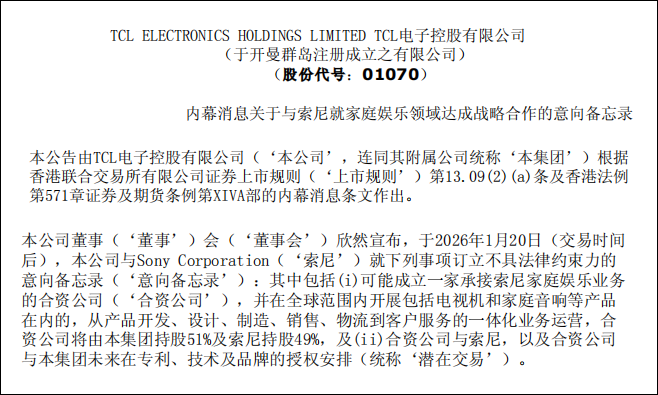
Investment Rating - The investment rating for TCL Electronics is "Buy" [5]. Core Insights - The company has exceeded its equity incentive targets for 2025, with a strategic cooperation memorandum signed with Sony, accelerating its high-end and global strategies [2]. - The forecasted adjusted net profit for 2025 is between HKD 23.3 billion and HKD 25.7 billion, representing a year-on-year increase of 45% to 60% [9]. - The company maintains a leading position in the television market, with a projected global shipment of 30.41 million units in 2025, a 5.4% increase year-on-year [9]. Financial Summary - **Revenue Forecast (in thousand HKD)**: - 2023A: 78,986 - 2024A: 99,322 (+26%) - 2025E: 115,807 (+17%) - 2026E: 131,717 (+14%) - 2027E: 147,177 (+12%) [4] - **Net Profit Forecast (in million HKD)**: - 2023A: 744 - 2024A: 1,759 (+137%) - 2025E: 2,448 (+39%) - 2026E: 2,849 (+16%) - 2027E: 3,279 (+15%) [4] - **Valuation Ratios**: - PE: 2025E at 12.59, 2026E at 10.82, 2027E at 9.40 [4]. - PB: 2025E at 1.65, 2026E at 1.50, 2027E at 1.36 [4]. Strategic Developments - TCL Electronics has signed a strategic cooperation memorandum with Sony to establish a joint venture for home entertainment business, with TCL holding 51% and Sony 49% [9]. - The new company will operate under the "Sony" and "BRAVIA" brands, expected to start operations by April 2027 [9].
突发!又一日企巨头爆雷
商业洞察· 2026-01-23 09:35
Core Viewpoint - Sony's decision to divest its television business to TCL marks the end of an era for Japanese brands in the global TV market, highlighting the rise of Chinese brands and the challenges faced by traditional players [12][14][26]. Group 1: Sony's Business Restructuring - Sony announced a major restructuring on October 20, 2023, to divest its television business, transferring it to a joint venture with TCL, where TCL will hold a 51% stake [12][14]. - This move signifies the end of Japanese dominance in global TV hardware manufacturing, as Sony relinquishes control over a once-proud segment of its business [14][26]. - The joint venture will continue to use the Sony and BRAVIA brands, ensuring brand recognition and customer loyalty while allowing Sony to focus on higher-margin areas like gaming and content [15][18]. Group 2: Market Dynamics and Competition - Chinese brands have captured over 50% of the Japanese TV market, with TCL holding a 13.8% global market share, positioning it as the second-largest TV brand worldwide [7][26][40]. - By 2024, foreign brands, including Sony, will collectively hold less than 5% of the Chinese market, indicating a significant decline in their competitive position [27]. - The partnership between TCL and Sony is seen as a strategic move to enhance TCL's brand prestige and global influence while allowing Sony to reduce operational pressures in a highly competitive market [17][18][44]. Group 3: Challenges Faced by Sony - Sony's television division has seen its global market share drop to 1.9%, reflecting a broader trend of declining Japanese brands in the consumer electronics space [26][34]. - Issues such as poor software adaptation, service delays, and customer dissatisfaction have contributed to a loss of trust among consumers, leading to a significant decline in brand loyalty [30][33]. - The overall decline of Japanese TV brands is evident, with significant drops in OLED TV shipments and a general retreat from the high-end market [34][35]. Group 4: TCL's Growth and Future Prospects - TCL has experienced substantial growth, with a 14.8% increase in global TV shipments in 2024, and is projected to surpass 30 million units in 2025 [40][41]. - The acquisition of Sony's TV business is expected to enhance TCL's capabilities in high-end markets, leveraging Sony's technology and brand reputation [44]. - The competitive landscape in the TV industry is shifting, with TCL's partnership with Sony potentially creating a formidable entity that could reshape market dynamics [45].


索尼委身TCL,日企时代终落幕了
阿尔法工场研究院· 2026-01-23 04:09
Core Viewpoint - The collaboration between Sony and TCL marks a significant shift in the consumer electronics industry, highlighting the transition from traditional Japanese brands to Chinese manufacturers as key players in the market [5][24]. Group 1: Sony and TCL Collaboration - TCL announced a memorandum of understanding with Sony to establish a joint venture for Sony's home entertainment business, with TCL holding 51% and Sony 49% of the shares [5][7]. - The joint venture will focus on an integrated model for operating television and home audio businesses globally, indicating a shift in control from Sony to TCL [7][22]. - This partnership aims to combine Sony's high-quality audio-visual technology and brand value with TCL's advanced display technology and cost efficiency [20][22]. Group 2: Historical Context of Sony - Sony was once a dominant player in the television market, with its Trinitron technology setting the standard for picture quality in the 1980s and 1990s [9][10]. - The company enjoyed a long period of brand loyalty in China, despite higher prices compared to local brands [12]. - However, the rise of Chinese brands like TCL and Hisense, which offered lower prices and competitive technology, began to erode Sony's market share starting in the early 2000s [12][17]. Group 3: Challenges Faced by Sony - Sony's television business has faced significant challenges, including complaints about product reliability and a decline in brand trust among consumers [17]. - By 2025, Sony's television shipments had dropped to 2.6 million units, ranking it tenth in the market, far behind Chinese competitors [22][24]. - The company has been shifting its focus away from hardware to more profitable sectors like gaming, music, and image sensors, indicating a strategic realignment [24]. Group 4: Rise of Chinese Brands - Chinese brands have transitioned from being price competitors to leaders in technological innovation, with TCL and Hisense achieving significant market shares globally [31][33]. - By 2025, TCL's global television shipments reached 20.8 million units, marking a 4.1% increase year-on-year, while Hisense led the Chinese market in shipments [31][33]. - The collaboration between Sony and TCL symbolizes a broader trend of power shifting in the consumer electronics industry, with Chinese companies increasingly defining market standards [22][24].

海通国际:维持TCL电子“优于大市”评级 合作Sony加强全球品牌竞争力
Zhi Tong Cai Jing· 2026-01-23 03:22
Group 1 - The core viewpoint of the report is that TCL Electronics maintains an "outperform" rating with a target price of HKD 15.60, supported by a well-structured global organization and a clear growth target through its equity incentive plan [1] - The company is focusing on high-end display technology, achieving quality expansion in the global market, with Mini LED products enhancing its product structure and overall profitability [1] - TCL Electronics expects adjusted net profit for 2025 to reach HKD 2.33 billion to HKD 2.57 billion, representing a year-on-year growth of 45% to 60% compared to 2024 [2] Group 2 - TCL Electronics has entered into a strategic cooperation with Sony in the home entertainment sector, planning to establish a joint venture with a 51% stake for TCL and 49% for Sony [3] - The joint venture aims to leverage TCL's advanced display technology and global scale, enhancing business operations in television and home audio products [3] - In 2025, global TV shipments are projected to reach 220 million units, with TCL's shipments expected to grow by 5.4% to 30.4 million units, increasing its market share to 13.8% [3]
海通国际:维持TCL电子(01070)“优于大市”评级 合作Sony加强全球品牌竞争力
智通财经网· 2026-01-23 03:19
Group 1 - The core viewpoint of the report is that TCL Electronics maintains an "outperform" rating with a target price of HKD 15.60, supported by a well-structured global operation and a clear growth target through its stock incentive plan [1] - The company expects adjusted net profit for 2025 to reach HKD 2.33 billion to HKD 2.57 billion, representing a year-on-year growth of 45% to 60% compared to 2024, driven by a strong global business growth and enhanced profitability [1] - TCL's focus on high-end display technology and Mini LED products is contributing to its revenue and profit growth, optimizing its product structure and overall profitability [1] Group 2 - TCL has entered into a strategic cooperation with Sony in the home entertainment sector, planning to establish a joint venture with TCL holding 51% and Sony 49%, aimed at expanding their business operations globally [2] - In 2025, global TV shipments are projected to reach 220 million units, with TCL's shipments expected to be 30.4 million units, a 5.4% increase, capturing a market share of 13.8%, up 0.8 percentage points, ranking second globally [2] - The report anticipates that global TV shipments may stabilize or grow in 2026, driven by major sporting events and increasing penetration of large-size and Mini LED products, with TCL and other leading brands expected to expand their market share [2]
大行评级|海通国际:维持TCL电子“优于大市”评级,上调2025至27年盈测
Ge Long Hui· 2026-01-23 02:42
Group 1 - The core viewpoint of the article highlights TCL Electronics' continuous improvement in its global operational structure and the clarity of its equity incentive plan aimed at growth targets, alongside collaboration with Sony to advance its globalization strategy [1] - TCL Electronics is maintaining high-quality expansion in global markets, supported by its Mini LED products, which not only drive overall scale expansion but also effectively optimize product structure and enhance overall profitability [1] - The earnings per share forecast for TCL Electronics has been raised for the years 2025 to 2027 to HKD 0.98, HKD 1.20, and HKD 1.43, respectively, from previous estimates of HKD 0.90, HKD 1.13, and HKD 1.34, while maintaining an "outperform the market" rating with a target price of HKD 15.6 [1]
TCL电子:联手索尼,迎来全球化高端化发展里程碑-20260123
First Shanghai Securities· 2026-01-23 02:20
Investment Rating - The report assigns a "Buy" rating to the company with a target price of HKD 15.00, representing a potential upside of 37.7% from the current price of HKD 10.89 [6]. Core Insights - The company is expected to achieve a net profit of HKD 2.53 billion to HKD 2.57 billion in 2025, reflecting a growth of 45% to 60% compared to 2024, which aligns with the company's equity incentive targets [8]. - The TV segment has shown significant improvement, with a 5.3% increase in TV shipments to 21.08 million units in the first three quarters of 2025, and a remarkable 153% growth in global shipments of TCL MiniLED TVs [8]. - A joint venture with Sony is set to enhance global and high-end development, with TCL holding a 51% stake. This partnership is expected to leverage TCL's supply chain and cost control advantages alongside Sony's advanced imaging technology and brand value [8]. - The report anticipates that the collaboration will allow TCL to transition from "scale expansion" to "brand globalization," enhancing its market share in high-end segments [8]. Financial Summary - Revenue is projected to grow from HKD 78.99 billion in 2023 to HKD 153.96 billion by 2027, with a compound annual growth rate (CAGR) of 13.5% [4]. - The gross profit margin is expected to stabilize around 15.7% by 2027, with net profit increasing from HKD 744 million in 2023 to HKD 3.51 billion in 2027 [4][9]. - Earnings per share (EPS) is forecasted to rise from HKD 0.33 in 2023 to HKD 1.39 in 2027, indicating a strong growth trajectory [4][9]. - The company’s price-to-earnings (P/E) ratio is projected to decrease from 32.9x in 2023 to 7.8x by 2027, suggesting an attractive valuation as earnings grow [4].
索尼把电视交给了TCL
36氪· 2026-01-23 00:00
Core Viewpoint - The collaboration between Sony and TCL is expected to reshape the global television market, with TCL taking a leading role in the joint venture, which may significantly enhance both companies' market shares and competitiveness [5][9]. Group 1: Joint Venture Details - Sony and TCL have signed a memorandum of understanding to potentially establish a joint venture focused on Sony's home entertainment business, including television and audio products [6]. - TCL will hold a 51% stake in the joint venture, while Sony will hold 49%, allowing TCL to take the lead in operations [7]. - The joint venture aims to leverage Sony's advanced technology and brand value alongside TCL's global scale and cost efficiency, potentially increasing the market share of both Sony and BRAVIA brands [7]. Group 2: Market Position and Competition - Samsung has maintained its position as the global television market leader for 20 consecutive years, while TCL is rapidly closing the gap as the second-largest player [10][12]. - By 2025, market share projections indicate Samsung at approximately 16.0%, with TCL and Hisense at 13.8% and 13.3%, respectively, forming a competitive top tier [12]. - Following the joint venture, Sony's projected global television shipment volume for 2025 is around 4 million units, ranking it tenth, indicating a significant opportunity for TCL to narrow the gap with Samsung [12]. Group 3: Historical Context and Challenges - Sony, once a dominant force in the television market, has struggled to keep pace with technological advancements and market shifts, leading to a decline in its market position [15][20]. - The company's failure to adapt quickly to the transition from CRT to LCD and plasma technologies has allowed competitors like Samsung and LG to surpass it [16][17]. - Sony's television business is now categorized under "other businesses" in its financial reports, reflecting a strategic shift towards more profitable segments like image sensors and gaming [20]. Group 4: TCL's Growth and Performance - TCL has experienced significant growth, with a 4.1% year-over-year increase in global television shipments, reaching 20.8 million units in the first three quarters of 2025 [25]. - The company's Mini LED televisions have seen a remarkable 153.3% increase in shipments, making it a standout product in the market [25]. - TCL's projected adjusted net profit for 2025 is expected to be between HKD 2.33 billion and 2.57 billion, representing a year-over-year growth of 45% to 60% [26].
彩电出货量或继续走低 Mini LED技术爆发 RGB成分水岭
Nan Fang Du Shi Bao· 2026-01-22 23:11
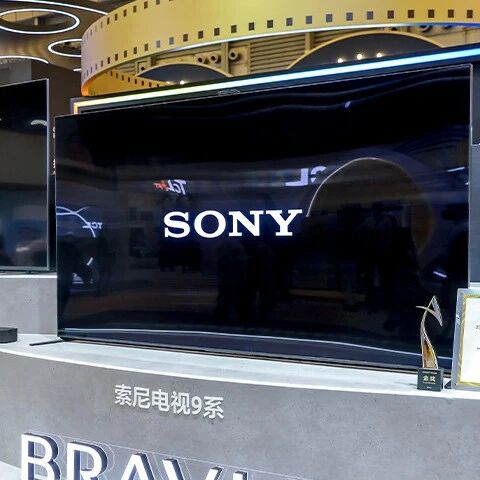
Industry Overview - The global TV industry is undergoing unprecedented adjustments, with significant market differentiation driven by large screen adoption, Mini LED technology proliferation, and AI integration [2] - Global TV shipments fell below 200 million units in 2025, marking a ten-year low, with a projected further decline of 5%-7% in 2026 [2] - China's TV market, as the largest consumer market, saw a shipment drop to 32.895 million units in 2025, a decline of 8.5%, the lowest in 16 years [2][3] Market Dynamics - The Chinese market showed a notable split in performance, with a slight increase of 1.4% in the first half of 2025 due to government subsidies, followed by a significant decline of 16.9% in the second half [2] - European markets are under pressure, with Western Europe expected to see a decline, while Eastern Europe may experience slight growth due to economic recovery [2][3] - North America remains relatively stable, supported by a solid consumer base and event marketing [2] Emerging Markets - Emerging markets in Asia-Pacific, Latin America, and the Middle East and Africa still hold growth potential, but price sensitivity may limit actual volume if prices rise due to memory cost increases [3] - The Indian market, despite strong demand, is dominated by local brands using low-price strategies, posing challenges for international brands [3] Technology Trends - Mini LED technology is expected to enter a phase of widespread adoption in 2026, with RGB-Mini LED shipments projected to exceed 300,000 units, becoming a new profit driver in the high-end market [6] - In 2025, China's Mini LED TV shipments surged by 92.8%, with a penetration rate of 28.9%, and are expected to exceed 10 million units in 2026 [6][7] Competitive Landscape - Chinese brands like Hisense and TCL are leading innovations in RGB-Mini LED and SQD-Mini LED technologies, respectively, with significant growth in global shipments [6][7] - International brands such as Samsung and Sony are entering the RGB technology space, but Chinese companies maintain advantages in technology iteration and cost control [8] - The competition is shifting from price wars to a comprehensive contest of technology, supply chain, and globalization capabilities [3][8] Consumer Trends - Large screen adoption is an irreversible trend, with 75-inch and larger TVs expected to account for 23% of the Chinese market in 2025, with further growth anticipated in 2026 [9] - AI technology is redefining the role of TVs as central to living spaces, with companies like Huawei and Skyworth investing heavily in AI capabilities for their products [9] Market Share - In 2025, the top three brands—Samsung, TCL, and Hisense—held over 43% of the global market share, with Samsung leading at 35.3 million units shipped [9] - TCL's growth of 5.4% positioned it as the most significant growing brand, while Hisense maintained a strong presence with 29.3 million units shipped [9] Strategic Partnerships - Sony and TCL have signed a memorandum of understanding for strategic cooperation in the home entertainment sector, which may impact market dynamics and competition [10]


格局重塑!TCL控股索尼电视业务
Guan Cha Zhe Wang· 2026-01-22 13:28
Core Viewpoint - The collaboration between Sony and TCL represents a strategic response to the shifting dynamics of the global television industry, moving from incremental expansion to a focus on existing market competition and complementary advantages [1][3]. Group 1: Company Collaboration - Sony and TCL announced plans to establish a joint venture, with TCL holding 51% and leading operations, while Sony retains 49% ownership [1]. - The new company will take over Sony's global television and home audio equipment business, including R&D, design, manufacturing, sales, logistics, and customer service, while continuing to use the Sony and BRAVIA brands [1][4]. - The partnership is seen as a necessary adaptation to the challenges posed by rising costs and declining profits in the television market, with both companies aiming to leverage their respective strengths [3][4]. Group 2: Market Context - The global television market is projected to see a slight decline in shipment volume, with an expected 2.21 million units in 2025, down 0.7% year-on-year [3]. - Sony's global television shipment is forecasted to be around 4.1 million units in 2025, giving it a market share of 1.9%, ranking it tenth globally [3]. - TCL is expected to ship approximately 30.4 million televisions in 2025, capturing a market share of 13.8%, making it the second-largest player after Samsung [4]. Group 3: Strategic Advantages - Sony's focus on high-end markets and its technological advantages, such as the XR cognitive chip, allow it to maintain premium pricing in the OLED segment, despite challenges in profitability [3][4]. - TCL's strengths lie in its scale and supply chain capabilities, particularly in Mini LED technology, where it holds over 40% of the global market share [4]. - The collaboration is expected to combine Sony's brand and technology with TCL's manufacturing and operational expertise, creating a synergistic effect that enhances competitiveness in the market [5].