WTECL(600157)

Search documents
永泰能源:公司正在实施3亿至5亿元的股份回购并注销计划
Zheng Quan Ri Bao Wang· 2026-01-22 13:41
证券日报网讯1月22日,永泰能源(600157)在互动平台回答投资者提问时表示,市值管理工作是一项 长期且持续性工作,受行业不同、板块热点不同和市场投资偏好差异等原因,在一定时期内二级市场股 价可能无法完全体现上市公司真实价值,且近期传统行业板块走势偏弱。近年来,公司高度重视市值管 理工作,在法律法规允许范围内结合实际情况,已采取了核心管理人员增持、股票回购、现金分红等各 项措施,全力维护公司股价。为进一步维护股价稳定,公司正在实施3亿至5亿元的股份回购并注销计 划,以促进公司股价回归合理水平。后续,公司将坚持不懈、多措并举,不断夯实煤电主业,加快海则 滩煤矿重点项目建设,持续提升公司经营业绩和长期投资价值。 ...

永泰能源:公司暂无更名计划
Zheng Quan Ri Bao· 2026-01-22 13:40
(文章来源:证券日报) 证券日报网讯 1月22日,永泰能源在互动平台回答投资者提问时表示,公司现有名称已综合反映了当前 经营主业和发展战略,暂无更名计划。 ...

永泰能源:2025年,公司无存续债券,不存在债券违约情况
Zheng Quan Ri Bao Wang· 2026-01-22 12:13
证券日报网讯1月22日,永泰能源(600157)在互动平台回答投资者提问时表示,2025年,公司无存续 债券,不存在债券违约情况。目前公司有息负债主要为已通过债务重整/重组展期的中长期债务,并按 计划每年正常还本付息。自完成重整/重组以来,公司生产经营正常,经营性净现金流稳定,发展持续 向好,随着海则滩煤矿今年下半年即将试采出煤,将进一步增加经营性净现金流,为还本付息提供有力 保障。 ...
永泰能源:公司现任董秘李军先生系公司按照监管要求聘任
Zheng Quan Ri Bao· 2026-01-22 11:45
证券日报网讯 1月22日,永泰能源在互动平台回答投资者提问时表示,公司现任董秘李军先生系公司按 照监管要求聘任,其个人简历请参阅公司相关公告。 (文章来源:证券日报) ...
永泰能源:公司股东人数将在定期报告中披露
Zheng Quan Ri Bao Wang· 2026-01-22 11:41
证券日报网讯1月22日,永泰能源(600157)在互动平台回答投资者提问时表示,按照上市公司信息披 露规定,公司股东人数将在定期报告中披露。 ...
页岩气概念上涨2.99% 6股主力资金净流入超亿元
Zheng Quan Shi Bao Wang· 2026-01-22 09:23
Group 1 - The shale gas concept index rose by 2.99%, ranking 6th among concept sectors, with 44 stocks increasing, including RenZhi Co. and Shengli Co. hitting the daily limit [1] - Leading stocks in the shale gas sector included Sinopec, Shengli Co., and PetroChina, with net inflows of 3.12 billion, 2.13 billion, and 2.02 billion respectively [2][4] - The top three stocks by net inflow ratio were Shengli Co. at 31.94%, RenZhi Co. at 19.71%, and PetroChina at 14.64% [3] Group 2 - The shale gas sector saw a net inflow of 10.61 billion, with 22 stocks receiving net inflows, and 6 stocks exceeding 1 billion in net inflow [2] - The highest daily gainers in the shale gas sector included Shengli Co. at 9.92%, PetroChina at 4.19%, and Sinopec at 4.12% [4][5] - The overall market performance showed a mixed trend, with some stocks like Hongtian Co. and ShaanGu Power experiencing declines of 3.62% and 1.78% respectively [1][6]




煤炭开采板块1月20日涨1.28%,大有能源领涨,主力资金净流入3.71亿元
Zheng Xing Xing Ye Ri Bao· 2026-01-20 08:59
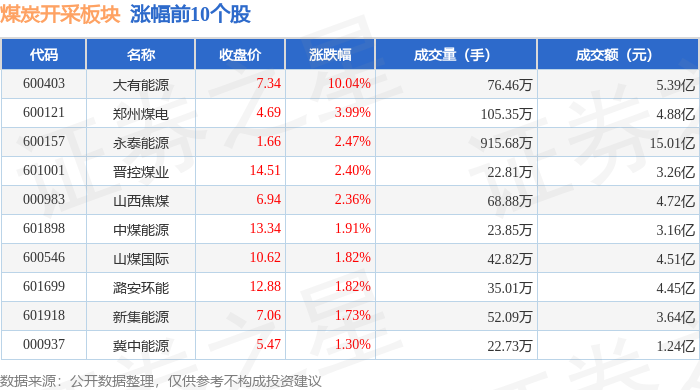
Group 1: Market Performance - The coal mining sector increased by 1.28% compared to the previous trading day, with Dayou Energy leading the gains [1] - The Shanghai Composite Index closed at 4113.65, down 0.01%, while the Shenzhen Component Index closed at 14155.63, down 0.97% [1] Group 2: Individual Stock Performance - Dayou Energy (600403) closed at 7.34, up 10.04% with a trading volume of 764,600 shares and a transaction value of 539 million [1] - Zhengzhou Coal Power (600121) closed at 4.69, up 3.99% with a trading volume of 1,053,500 shares [1] - Yongtai Energy (600157) closed at 1.66, up 2.47% with a trading volume of 9,156,800 shares [1] - Other notable stocks include Jinkong Coal Industry (601001) at 14.51, up 2.40%, and Shanxi Coking Coal (000983) at 6.94, up 2.36% [1] Group 3: Capital Flow Analysis - The coal mining sector saw a net inflow of 371 million from main funds, while retail funds experienced a net outflow of 143 million [2] - Dayou Energy had a main fund net inflow of 176 million, representing 32.63% of its trading volume, while retail funds saw a net outflow of 112 million [3] - Yongtai Energy recorded a main fund net inflow of 141 million, with a retail net outflow of 64.86 million [3]




永泰能源涨2.47%,成交额10.74亿元,主力资金净流入8473.48万元
Xin Lang Cai Jing· 2026-01-20 06:37
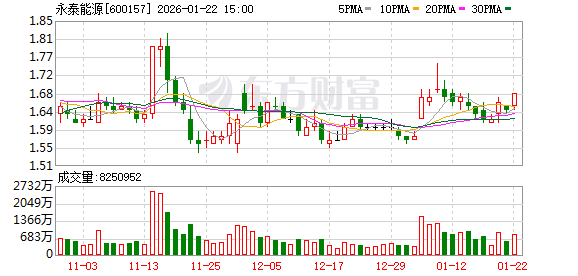
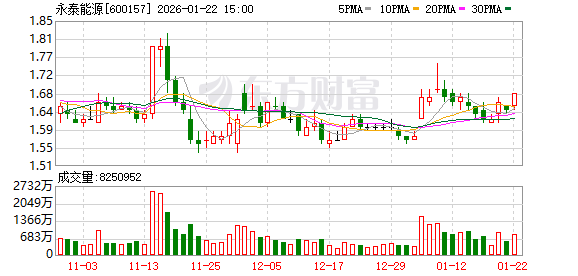
Group 1 - The stock price of Yongtai Energy increased by 2.47% on January 20, reaching 1.66 CNY per share, with a trading volume of 1.074 billion CNY and a turnover rate of 3.02%, resulting in a total market capitalization of 36.217 billion CNY [1] - Since the beginning of the year, Yongtai Energy's stock price has risen by 5.73%, with a slight decline of 0.60% over the last five trading days, a 3.75% increase over the last 20 days, and a 0.61% increase over the last 60 days [2] - Yongtai Energy's main business segments include electricity (73.28% of revenue), coal (23.77%), and other businesses (2.95%) [2] Group 2 - As of September 30, 2025, Yongtai Energy reported a revenue of 17.728 billion CNY, a year-on-year decrease of 20.77%, and a net profit attributable to shareholders of 198 million CNY, down 86.48% year-on-year [2] - The company has distributed a total of 1.741 billion CNY in dividends since its A-share listing, with 122 million CNY distributed over the last three years [3] - The top ten circulating shareholders of Yongtai Energy include Southern CSI 500 ETF, holding 323 million shares, a decrease of 6.6534 million shares from the previous period, and Hong Kong Central Clearing Limited, holding 258 million shares, an increase of 6.3687 million shares [3]
电力ETF华宝(159146)今日火热上市!一图读懂核心看点
Xin Lang Cai Jing· 2026-01-20 00:36
Core Insights - The rapid development of AI technology is driving explosive growth in data center construction, which significantly increases electricity demand and is a major reason for the electricity supply gap [2][9] - The electricity index is currently at a historically low valuation, with a PE ratio of approximately 17 times as of December 31, 2025, providing a certain margin of safety for investors [4][12] Group 1: Electricity Demand and Supply - Data centers are becoming the core growth engine for electricity demand due to their massive power consumption [2][9] - The electricity supply gap is primarily caused by the increasing energy needs of data centers [2][9] Group 2: Index Composition and Weighting - The index includes various power generation methods with the following weightings: thermal power (40.81%), hydroelectric (24.81%), wind (14.25%), nuclear (11.83%), and solar (6.87%) [10][11] - The top ten weighted stocks in the index include leading companies such as Changjiang Electric Power, China Nuclear Power, and Three Gorges Energy, collectively accounting for 52.07% of the index [3][10] Group 3: Valuation Insights - The current valuation of the electricity index is lower than most of the past decade, indicating potential investment opportunities [4][12] - The historical PE ratio trend of the index suggests a favorable entry point for investors [5][12]




银行股破净71%,铁路股跌掉31%,房地产龙头亏掉87%!抄底者遭遇腰斩
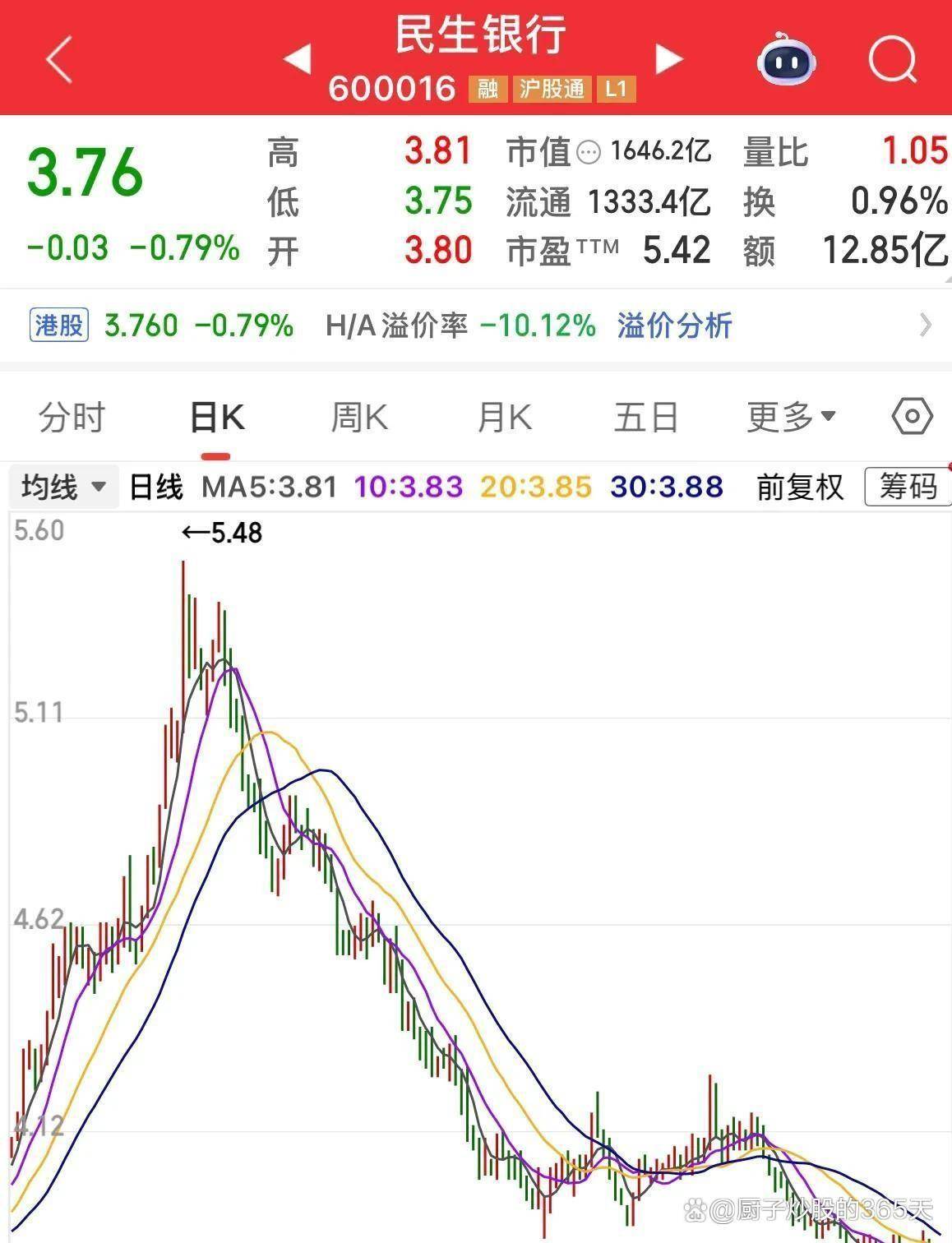
Sou Hu Cai Jing· 2026-01-19 09:49
Core Viewpoint - The article discusses the significant decline in stock prices of several companies, highlighting the disconnect between attractive valuation metrics and actual market performance, leading to investor confusion and losses. Group 1: Company Performance - Daqin Railway's stock price has fallen from 7.17 yuan in July 2025 to below 5 yuan by January 2026, with a total decline of 31% over the past six months [5][12] - Minsheng Bank's stock price has dropped to 3.76 yuan, representing a 32% loss for investors who bought in the last six months, with a price-to-earnings ratio of 5.42 and a net asset value of 12.83 yuan [7][10] - Vanke A's stock has plummeted from a peak of 36 yuan to 4.7 yuan, with an 87% cumulative decline and a 52% drop in the past year [12][14] - Yongtai Energy's stock price has remained below 2 yuan, with a recent brief increase due to a buyback announcement, but quickly returned to 1.62 yuan [17][19] Group 2: Market Dynamics - The decline in these stocks is attributed to fundamental changes in their respective industries, such as the decline of coal transportation for Daqin Railway and the real estate downturn affecting Minsheng Bank [19][20] - The presence of a large number of retail investors with dispersed holdings has led to a lack of coordinated buying power, exacerbating the downward pressure on stock prices [21][22] - Investors are falling into psychological traps, misjudging the value based on past prices and static valuation metrics, leading to repeated miscalculations of the bottom [23][25] Group 3: Valuation and Future Outlook - The article emphasizes that traditional valuation metrics like price-to-earnings ratios can be misleading if future earnings are expected to decline significantly, potentially leading to a situation where a seemingly low valuation becomes high [24][25] - The market is undergoing a severe revaluation process, focusing on current realities and future expectations rather than past performance, which is causing significant pain for previously well-regarded stocks [26]