
ZJJH(600160)

Search documents
多项涉化成果入选国家产业化试点
Zhong Guo Hua Gong Bao· 2026-01-30 02:20
工信部相关负责人表示,此批试点实施周期为自名单公布之日起两年,各试点单位要及时完善试点实施 方案,按照方案扎实推进试点工作,确保如期实现试点目标;各地省级主管部门要加大对试点单位的政 策支持力度,及时总结工作进展和经验做法;试点期满后,工信部将组织开展评估评价。 据悉,此次试点工作旨在强化产业供需对接、活化创新主体动力、优化产业化服务保障,切实促成一批 国家重点研发计划成果转化为实实在在的生产力。 记者梳理发现,此次试点名单涉及高端功能与智能材料、先进结构与复合材料、新型显示与战略性电子 材料、稀土新材料、高性能制造技术与重大装备、智能传感器、工业软件等领域。其中,在高端功能与 智能材料名单中,巨化集团有限公司的液冷热管理材料制备成套技术、数据中心单相浸没式液冷解决方 案,华南理工大学的面向氢气高效分离的无机二维材料膜入列;在先进结构与复合材料名单中,北京科 技大学的大吨位碳纤维复合材料拉索在列。沈阳化工大学、中国科学院大连化学物理研究所、上海化工 研究院有限公司等入选产业化实施类试点单位名单。 中化新网讯 近日,工信部公布2025年度国家重点研发计划高新技术成果产业化试点名单,67个试点成 果、108个试点 ...

太猛了!加快轮动了
Ge Long Hui· 2026-01-29 11:49
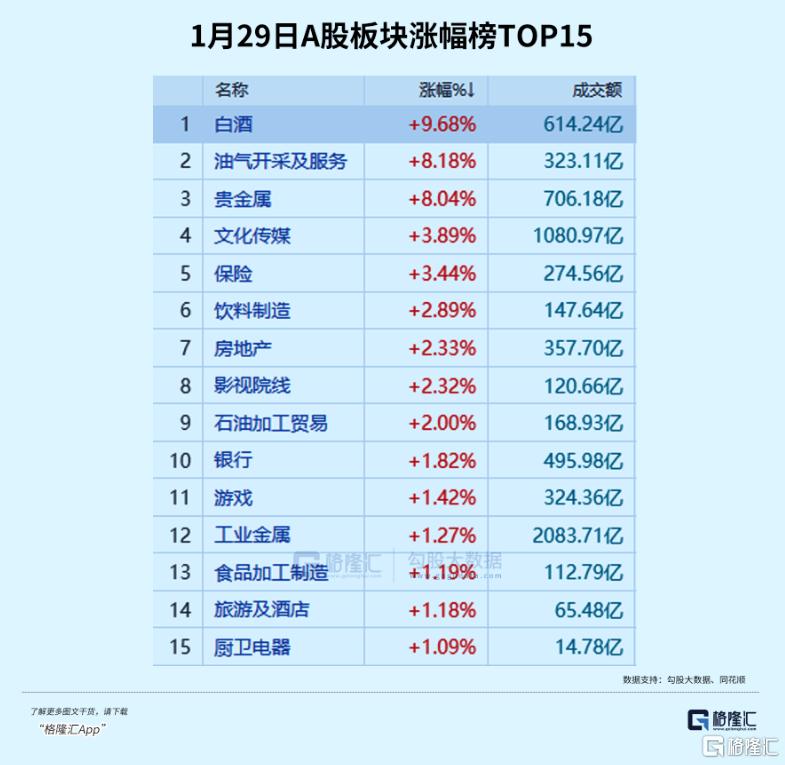
Group 1: Market Performance - The A-share liquor sector experienced a significant surge, with a rise of 9.68% on January 29, leading the market performance for the day [1][2] - The oil and gas extraction and service sector also saw a notable increase of 8.18%, with a total transaction volume of 32.31 billion [2] - The precious metals sector rose by 8.04%, with a transaction volume of 70.62 billion, indicating strong market interest [2] Group 2: Energy and Petrochemical Sector Dynamics - The energy and petrochemical sector's rise began in early January 2026, with domestic crude oil futures rebounding from 411 yuan/barrel to 475 yuan/barrel, a 15% increase [4] - The oil and gas extraction and service sector has accumulated a remarkable increase of 44.22% year-to-date, ranking second in market performance, only behind precious metals [7] - The petrochemical ETF (159731) has shown a cumulative increase of 14.71% since the beginning of the year, reflecting strong investor interest [9] Group 3: Geopolitical and Economic Influences - The recent surge in the petrochemical sector is driven by escalating geopolitical tensions, particularly between the U.S. and Iran, raising concerns over oil supply stability [11] - The market has priced in a risk premium of $3-8 per barrel due to fears of potential disruptions in oil supply from Iran, which produces approximately 3.3 million barrels per day [11] - The classic rotation pattern in commodity markets, where precious metals lead, followed by industrial metals and then energy, is being validated again [14][16] Group 4: Agricultural Sector Insights - The agricultural sector is expected to gain market attention as commodity prices rise, driven by increased costs in agricultural production due to higher energy prices [17][24] - The CPI and food prices have shown signs of recovery, with the CPI rising by 0.8% year-on-year, indicating a potential shift in consumer price dynamics [18] - The agricultural ETF (516810) tracks a comprehensive index covering the entire agricultural value chain, which may benefit from the rising commodity prices [26] Group 5: Industry Outlook - The petrochemical industry is at a turning point, with new policies aimed at preventing excessive competition and improving profitability [22] - The capital expenditure ratios in the refining and chemical sectors are showing a trend towards conservatism, indicating a strategic shift among companies [23] - The anticipated recovery in the petrochemical sector is supported by both geopolitical factors and the broader commodity market dynamics, suggesting a favorable outlook for industry leaders [24][25]





成交额超2亿元,石化ETF(159731)连续16天净流入
Sou Hu Cai Jing· 2026-01-29 02:16
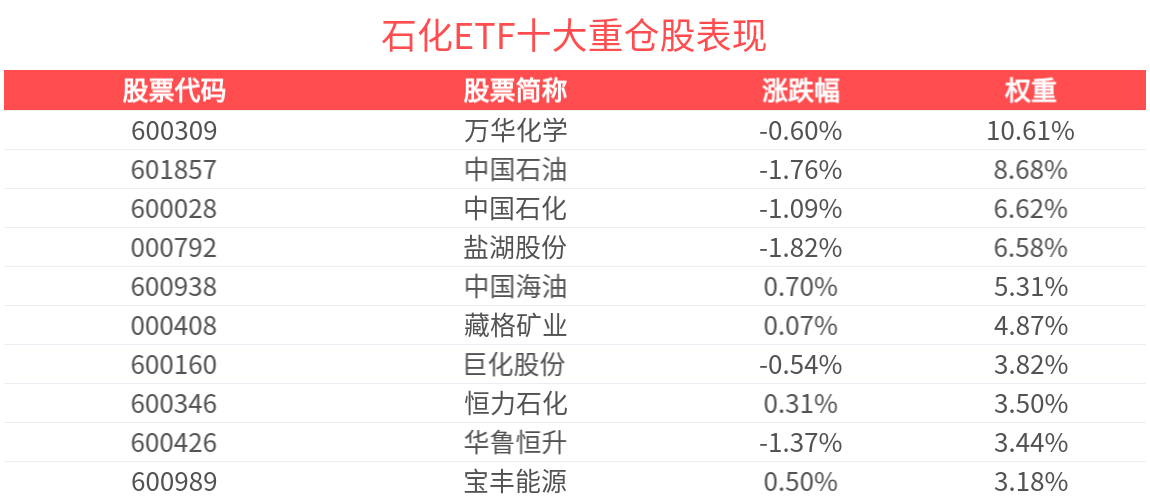
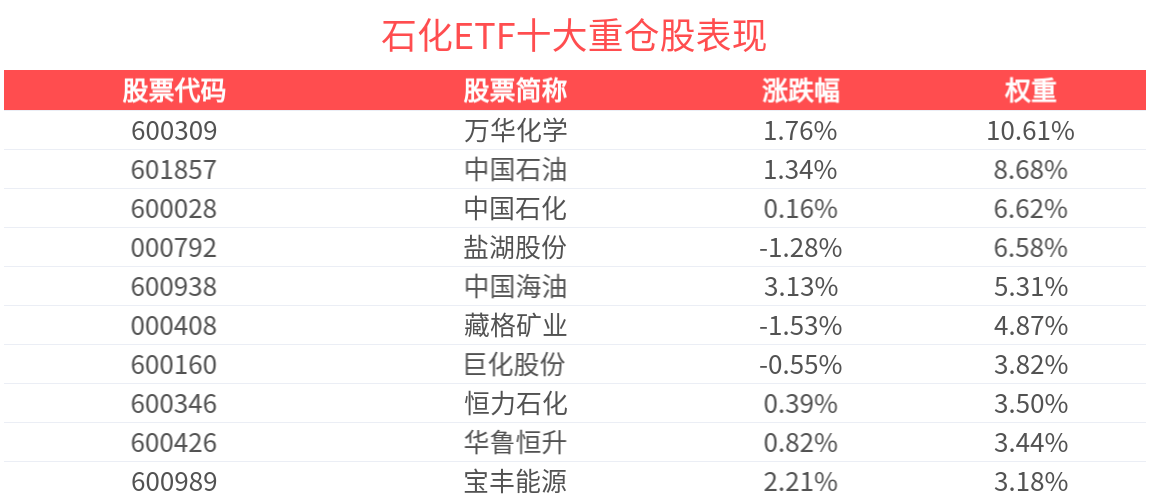
Core Viewpoint - The petrochemical sector is experiencing mixed performance, with the China Petroleum and Chemical Industry Index showing a slight decline, while the Petrochemical ETF has seen significant inflows and growth in net value over the past two years [1][2]. Group 1: Market Performance - As of January 29, 2026, the China Petroleum and Chemical Industry Index decreased by 0.27%, with stocks like Sankeshu and Zhongfu Shenying leading gains, while companies like Hebang Bio and China Petroleum faced declines [1]. - The Petrochemical ETF (159731) fell by 0.47%, with a latest price of 1.05 yuan and a trading volume of 2.12 billion yuan, indicating active market participation with a turnover rate of 17.99% [1]. Group 2: Fund Flows and Performance Metrics - The Petrochemical ETF has seen continuous net inflows for 16 days, totaling 838 million yuan, with the latest share count reaching 1.106 billion and a total scale of 1.166 billion yuan, marking a new high [2]. - Over the past two years, the net value of the Petrochemical ETF has increased by 66.80%, with the highest single-month return recorded at 15.86% and the longest consecutive monthly gain spanning 8 months, achieving a maximum increase of 41.6% [2]. - The average return during the rising months of the Petrochemical ETF is 5.25%, and as of January 23, 2026, the one-year Sharpe ratio stands at 2.22 [2]. Group 3: Industry Trends and Outlook - According to Guosen Securities, the petrochemical sector is strictly implementing capacity reduction and replacement requirements for new refining projects, focusing on upgrading old facilities and demonstrating new technologies [2]. - The refining capacity in China is approaching the policy threshold of 1 billion tons, leading to the gradual consolidation and elimination of smaller capacities, while larger refineries are expected to increase their market share, optimizing the industry structure [2]. - With limited growth in refined oil demand, the transition towards "reducing oil and increasing chemicals" will be essential for refineries [2]. Group 4: Key Stocks in the Index - The top ten weighted stocks in the China Petroleum and Chemical Industry Index as of December 31, 2025, include Wanhua Chemical, China Petroleum, and China Petrochemical, collectively accounting for 56.73% of the index [2].



01月28日R22价格17333.33元/吨 60天上涨11.83%
Xin Lang Cai Jing· 2026-01-29 01:49
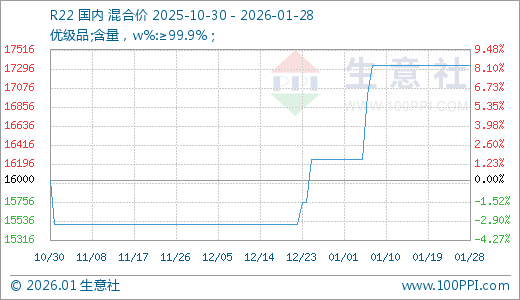
Price Trends - The latest price of R2201 as of January 28 is 17,333.33 yuan per ton, reflecting an increase of 11.83% over the last 60 days [2][4] Related Companies - Relevant producers include: - Juhua Co., Ltd. (600160) - Yonghe Co., Ltd. (605020) - Sanmei Co., Ltd. (603379) - Luxi Chemical Co., Ltd. (000830) - Haohua Technology Co., Ltd. (600378) [2][4]


公募顶流四季报揭秘:科技冲锋与价值深蹲下的业绩分野
2 1 Shi Ji Jing Ji Bao Dao· 2026-01-28 12:31
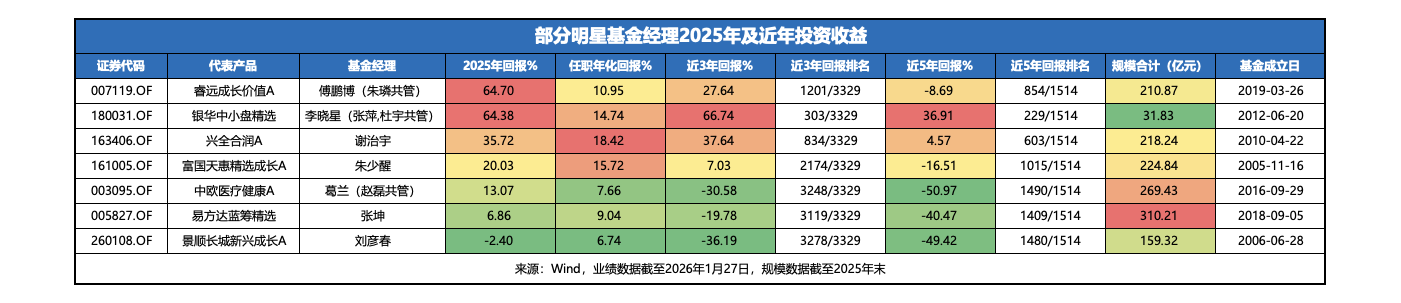
Core Viewpoint - The market experienced increased volatility in Q4 2025, with A-shares and Hong Kong stocks showing mixed performance, while sectors like AI computing and semiconductors thrived, contrasting with weaker performances in real estate and pharmaceuticals [1] Group 1: Market Performance - The Shanghai Composite Index rose by 2.22% in Q4 2025, while the Hang Seng Index fell by 4.56% [1] - The technology growth sector, particularly AI computing and semiconductors, showed significant gains, while industries such as real estate and pharmaceuticals faced challenges [1] Group 2: Fund Manager Performance - Star fund managers like Fu Pengbo and Li Xiaoxing achieved over 60% returns in 2025, focusing on AI computing and semiconductors [2] - Balanced allocation funds, such as Zhu Shaoxing's, demonstrated stability with a 20% annual return, benefiting from diversified investments across various sectors [3][14] Group 3: Investment Strategies - Fu Pengbo's fund increased its allocation to data center cooling and computing-related companies, with a top ten stock concentration of 70.38% [5] - Li Xiaoxing emphasized AI hardware innovation and semiconductor investments, with a focus on domestic advancements in the semiconductor industry [6] Group 4: Traditional Value Investments - Fund managers like Zhang Kun and Liu Yanhun maintained positions in traditional sectors like consumer goods and pharmaceuticals, despite facing net value pressures [8][12] - Liu Yanhun's fund experienced a 5.85% decline in Q4, reflecting the challenges faced by traditional value sectors [12] Group 5: Policy and Market Outlook - Fund managers noted the impact of "anti-involution" policies on corporate fundamentals, suggesting a shift towards supply-side optimization [17] - Despite market rebounds, equity assets are still viewed as attractive, with a focus on high-quality listed companies as scarce income-generating assets [18]





都知道科技能赚钱,但怎么赚?看乔迁、谢治宇的调仓“变阵”
市值风云· 2026-01-28 10:13
Core Viewpoint - The article discusses the focus of fund managers on semiconductor equipment and technology sectors, highlighting the performance of key fund managers and their investment strategies in these areas [4][20]. Fund Manager Performance - Fund managers Xie Zhiyu and Qiao Qian have significant management scales of 38.6 billion and 24 billion respectively, with annualized returns of 18% and 13.52% since their tenure began [4]. - Xie Zhiyu's fund, Xingquan Helun Mixed A, achieved a return of 35.7% in 2025, outperforming the CSI 300 index by 18 percentage points [4][5]. - Qiao Qian's fund, Xingquan Business Model Mixed A, recorded a return of 38.05% in 2025, with a net value growth exceeding 10% in early 2026 [5][6]. Investment Focus - Both fund managers are concentrating on technology sectors, particularly overseas computing power and semiconductor equipment [8][9]. - Xie Zhiyu maintains a high equity position, with 92.5% of the fund's net value in stocks by the end of the fourth quarter [11]. - Qiao Qian's fund also operates with a high equity position of 94.4% at the end of the fourth quarter [16]. Portfolio Adjustments - Xie Zhiyu's fund saw significant changes in its top holdings, with the introduction of storage testing and module leader Baiwei Storage, which is expected to see a net profit growth of 427%-520% in 2025 [12]. - New entries in the top ten holdings for Xie Zhiyu include semiconductor equipment stocks Tuo Jing Technology and Huahai Qingke, while North China Innovation, Lens Technology, and Focus Media exited the list [13]. - Qiao Qian's fund also adjusted its top holdings significantly, with six new entries, including Baiwei Storage and Huahai Qingke, while North China Innovation and Lens Technology were removed [17]. Overall Market Outlook - The two fund managers agree on the positive outlook for technology sectors, particularly semiconductor equipment, storage, and overseas computing power [20].






25Q4公募基金化工重仓股分析:25Q4公募基金化工重仓股配置环比明显增加,头部白马类比例增加,重视底部配置机会
Shenwan Hongyuan Securities· 2026-01-28 05:42
Investment Rating - The report maintains an "Optimistic" rating for the chemical industry [2]. Core Insights - In Q4 2025, the overall allocation of public funds in the chemical sector has significantly increased, indicating a bottoming out and potential investment opportunities [2]. - The top ten chemical stocks held by public funds saw a recovery in their market value share, with a notable increase in the proportion of leading blue-chip stocks, suggesting a preference for stable investments in cyclical products with price elasticity [2][12]. - The total market value of the top 30 chemical stocks held by public funds reached approximately 79.89 billion, reflecting a significant increase of about 45.23% compared to the previous quarter [24]. Summary by Sections 1. Q4 2025 Public Fund Chemical Holdings Changes - The proportion of heavy chemical stocks in overall public fund holdings increased by 0.70 percentage points to 2.37%, marking a new high for 2025 [7]. - Regional allocations also saw increases, with East China rising by 0.63 percentage points to 2.33%, South China by 0.96 percentage points to 3.02%, and North China by 0.44 percentage points to 1.44% [7]. 2. Changes in the Number of Funds Holding Chemical Stocks - The number of funds holding chemical stocks increased significantly, driven mainly by blue-chip stocks. The top three stocks with the highest increase in the number of funds were Wanhua Chemical, China National Offshore Oil Corporation (CNOOC), and Hualu Hengsheng, with increases of 119, 85, and 75 funds respectively [15][19]. 3. Total Market Value and Concentration of Chemical Holdings - The total market value of the top 30 chemical stocks held by public funds increased significantly, with these stocks accounting for 84.68% of the total market value of all heavy chemical stocks, an increase of 3.34 percentage points [24]. - The leading stocks by market value included Wanhua Chemical at approximately 89.41 billion, CNOOC at 67.53 billion, and Juhua Co., Ltd. at 59.78 billion [24].


化工行业迎来战略窗口期,石化ETF(159731)连续15日合计“吸金”7.45亿元
Sou Hu Cai Jing· 2026-01-28 02:11
Core Viewpoint - The petrochemical sector is experiencing a positive trend, with the China Petrochemical Industry Index showing an increase, and significant inflows into the Petrochemical ETF, indicating strong investor interest and potential for growth [1][2]. Group 1: Market Performance - As of January 28, 2026, the China Petrochemical Industry Index rose by 0.54%, with key stocks like Zhejiang Longsheng hitting the daily limit up, and others such as China National Offshore Oil Corporation and Hubei Biopharma also seeing gains [1]. - The Petrochemical ETF (159731) increased by 0.39%, with a turnover rate of 4.34% during the trading session [1]. - Over the past 15 days, the Petrochemical ETF has attracted a total net inflow of 745 million yuan, reaching a record high of 1.018 billion shares and a total size of 1.045 billion yuan [1]. Group 2: Performance Metrics - The Petrochemical ETF has seen a net value increase of 62.39% over the past two years [1]. - The highest monthly return since inception was 15.86%, with the longest streak of consecutive monthly gains being 8 months and a maximum cumulative increase of 41.60% [1]. - The average monthly return during the rising months was 5.25%, and the ETF outperformed its benchmark with an annualized excess return of 2.35% over the past year [1]. Group 3: Industry Outlook - Tianfeng Securities indicates that a turning point in policy and capital expenditure is evident, with the concept of "anti-involution" suggesting improved profitability and healthier long-term development for the industry [1]. - The chemical industry is entering a strategic window, characterized by the exit of high-cost marginal capacity overseas and a restructuring of the global chemical order [1]. Group 4: Top Holdings - As of December 31, 2025, the top ten weighted stocks in the China Petrochemical Industry Index accounted for 56.73% of the index, including Wanhua Chemical, China Petroleum, and China Petrochemical among others [2].
政策指引+价格回暖+业绩预喜,化工行业ETF易方达(516570)汇聚“三桶油”与细分领域化工龙头
Sou Hu Cai Jing· 2026-01-27 11:18
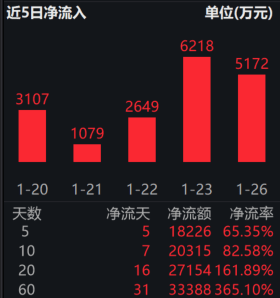
Group 1 - The global chemical industry is transitioning from "overcapacity" to "high-quality supply" by 2026, driven by national growth policies, marginal recovery in overseas demand, and the initiation of a restocking cycle, leading to a stabilization and rebound in the prices of basic chemicals and a significant improvement in industry profit expectations [1][3]. - The E Fund Chemical Industry ETF (516570) has become a core tool for investors to capitalize on the petrochemical industry's recovery, with the index it tracks rising by 15.10% in the past month and 51.39% over the past year as of January 26, 2026 [1][5]. - The ETF has attracted significant capital inflow, with over 180 million yuan in net inflows in the past five days and over 270 million yuan in the past twenty days [1][5]. Group 2 - The "High-Quality Development" policy framework has been established, emphasizing the control of new refining capacities and the scientific regulation of ethylene and paraxylene production, marking a shift from quantity-driven growth to quality and efficiency improvements [3][4]. - A global restocking cycle has commenced, with widespread price increases for chemical products, including a 550 yuan/ton increase for butadiene and a 100 yuan/ton increase for bisphenol A, alongside sulfur prices reaching near ten-year highs [3][4]. - Major international companies like BASF and Dow have also raised prices for MDI/TDI, indicating a strong performance in the polyurethane market, supported by increased global oil demand projected at 950,000 barrels per day for 2026 [4][5]. Group 3 - Chemical companies are expected to report positive earnings, with Salt Lake Co. forecasting a net profit of 8.29 to 8.89 billion yuan for 2025, representing a year-on-year growth of 77.78% to 90.65%, and other companies like Juhua Co. and Cangge Mining also projecting significant profit increases [5][6]. - The E Fund Chemical Industry ETF (516570) tracks the CSI Petrochemical Industry Index, with top holdings including major companies like Wanhua Chemical and China Petroleum, covering over 56% of the index, thus providing a balanced exposure to both energy security and growth in new materials [5][6]. - The ETF has a low comprehensive fee rate of 0.20% per year, making it an ideal tool for participating in the current economic upturn in the chemical sector [5][6].


英伟达AI服务器液冷:大陆厂商的破晓之路与星辰大海
Quan Jing Wang· 2026-01-27 06:18
Core Insights - The article emphasizes the transformation of liquid cooling technology from a niche to a necessity in the AI computing era, driven by advancements in AI chip power consumption and the need for efficient cooling solutions [1] - It highlights the shift from reliance on foreign technology to a robust domestic industry capable of competing on a global scale, marking a significant milestone in China's manufacturing capabilities [1] Group 1: Technological Breakthroughs - The iteration of liquid cooling technology is described as a brutal elimination race, with domestic manufacturers overcoming technical barriers and moving from a follower to a competitor position [2] - Domestic companies like Readore and Envicool have achieved significant milestones by obtaining NVIDIA certification for critical components, indicating a shift in market dynamics and the potential for capturing substantial market share [3] Group 2: Comprehensive Industry Development - The article discusses the collaborative efforts across the entire liquid cooling supply chain, with domestic players filling gaps left by foreign companies, particularly in the production of cooling fluids and system components [4] - The establishment of a complete domestic liquid cooling ecosystem is highlighted, which is crucial for resisting foreign competition and ensuring self-sufficiency [4] Group 3: Market Opportunities - The current market landscape shows that cold plate liquid cooling holds a 65% market share, making it an ideal entry point for domestic manufacturers amid supportive government policies and market demand [5] - The rapid growth of the Chinese liquid cooling server market, projected to exceed $3.39 billion by 2025, provides a solid foundation for domestic companies to expand their market presence [8] Group 4: Competitive Landscape - The article notes a significant shift in the competitive landscape, with domestic manufacturers moving from being mere subcontractors to becoming key players in the global liquid cooling supply chain [6] - The entry of domestic brands into high-profile projects, such as Google's TPU solution, signifies a transition from passive participation to active competition for core market shares [7] Group 5: Future Prospects - The global liquid cooling market is expected to reach $14 billion by 2026, with a compound annual growth rate of nearly 50%, presenting a substantial opportunity for domestic manufacturers to establish themselves on the global stage [10] - The article concludes that the journey of domestic manufacturers is just beginning, with ongoing advancements in technology and the potential for expansion into new sectors, reinforcing the notion that domestic innovation is key to future success [10]


