Shanghai Jahwa(600315)

Search documents
深耕皮肤屏障23年,玉泽如何造出“医研长城”?
FBeauty未来迹· 2026-01-23 09:03
Core Viewpoint - The article emphasizes the importance of skin barrier repair in the skincare industry, positioning it as a long-term commitment akin to the Great Wall of China, which symbolizes protection and stability [4][12][36]. Group 1: Company Development and Research - Yuze has been focused on skin barrier repair for 23 years, undergoing a long phase of high investment and slow returns, which has not been fully understood by the market [6][10]. - The initial research was based on clinical practices at Ruijin Hospital, where skin barrier issues were not yet mainstream, highlighting the need for scientific and sustainable daily care [6][8]. - The first skin barrier repair product took six years to develop, involving 1,386 clinical validations, and over 5,000 clinical studies have been conducted in collaboration with more than 40 top-tier hospitals [8][12]. Group 2: Product Development Stages - Yuze's development is divided into four stages: 1. Medical research origin phase, focusing on establishing evidence-based standards [10]. 2. Product and application expansion phase, validating the skin barrier repair concept [10]. 3. Formation of a technical system, marked by the patent of PBS technology, transitioning to systematic technical accumulation [11]. 4. Current phase centered on systematic and long-term principles, emphasizing clinical insights and evidence-based standards [11][12]. Group 3: Market Position and Strategy - Yuze's commitment to skin barrier repair has created a competitive advantage in a rapidly changing industry, allowing for sustained output and continuous validation [14][36]. - The launch of the second-generation skin barrier repair cream in 2025 achieved over 100 million yuan in sales in its first year, becoming a significant growth driver for the company [12][36]. - The brand's long-term focus on skin barrier repair is seen as a strategic choice that aligns with public health values, addressing chronic skin conditions that require ongoing care [34][36]. Group 4: Public Health and Social Responsibility - The establishment of the "Shanghai Jahwa-Ruijin Guangci Skin Disease Charity Fund" aims to assist economically disadvantaged patients with skin diseases, creating a positive feedback loop between public health, research, and brand development [32][34]. - The article highlights the need for a comprehensive understanding of skin health as a public health issue, emphasizing the importance of stable skin barrier maintenance over quick fixes [34][36]. Group 5: Cultural and Educational Initiatives - Yuze's collaboration with the Great Wall Small Station for the "Barrier Art Exhibition" aims to elevate the understanding of skin health and repair as a cultural action, reinforcing the brand's image as a protector of life [35][36]. - The release of the "National Skin Barrier Health Green Book" seeks to establish a framework for understanding skin barriers that is accessible to the public while remaining grounded in medical logic [24][32].



2026年中国化妆品展望:为高质量增长重置,ROI改善利好品牌领导者
Goldman Sachs· 2026-01-22 07:45
Investment Rating - The report upgrades MGP to Buy from Neutral, highlighting its sustainable growth and resilient margins in the premium beauty market [10] - Giant Biogene is rated Buy, with expectations of a gradual recovery in sales and strong long-term growth potential [16] - Shanghai Jahwa is also rated Buy, indicating a turnaround in its skincare business and solid growth prospects [22] Core Insights - The China cosmetics industry is expected to see sustained momentum driven by higher-quality channels and a focus on new product cycles [3] - The government's anti-involution measures are likely to increase traffic acquisition costs, impacting sales on platforms like Douyin [3] - There is a shift towards reliability and brand trust in consumer preferences, prompting companies to innovate and upgrade their product offerings [4] Summary by Sections Key Trends - Higher-quality channels are expected to maintain momentum, particularly on Tmall, supported by government measures [3] - The product landscape is shifting towards proven efficacy and brand trust, with companies innovating to create new value propositions [4] Company-Specific Insights - MGP is positioned for sustainable growth with a projected 34%/38% sales/NI CAGR from 2021-2025, and 23%/22% from 2025-2027 [10][11] - Giant Biogene anticipates a sales decline in the short term but expects recovery driven by its leading brand position and product pipeline [16] - Shanghai Jahwa is experiencing strong growth in its key brands, with a projected CAGR of 2%/34% for its personal care/cosmetics segment from 2025-2027 [22] Valuation Methodology - MGP's target price is set at HK$105 based on a 28x 2027E P/E, reflecting its high growth profile [12] - Giant Biogene's target price is HK$46, based on a 22x 2027E P/E, indicating a recovery in its sales profile [17] - Shanghai Jahwa's target price is RMB 28, based on a 30x 2027E P/E, reflecting its improving sales and net profit profile [23]
2025年中国化妆品交易额突破1.1万亿元 国货品牌竞争力持续领跑
Zheng Quan Ri Bao Wang· 2026-01-21 11:41
Core Insights - The 2025 China Cosmetics Industry Data Release Conference highlighted the industry's significant growth and transformation, emphasizing the importance of high-quality development amidst global economic uncertainties [1][2] Group 1: Market Overview - By 2025, the Chinese cosmetics market is projected to reach a record high of 1.1 trillion yuan (approximately 1104.25 billion yuan), with a year-on-year growth of 2.83% [1] - Domestic brands continue to lead in competitiveness, increasing their market share to 57.37% [1] - Online sales are expected to reach 721.77 billion yuan, growing by 4.45% and accounting for 65.36% of total sales, while offline sales remain stable at 382.47 billion yuan [1] Group 2: Industry Trends - The market concentration is increasing, with over 60% of the top 500 brands experiencing positive growth, while only 26% of brands ranked below 500 show growth [2] - The industry is transitioning from total expansion to structural optimization, focusing on depth competition rather than breadth [2] - The number of eliminated brands reached 26,900, indicating a rationalization of competition within the industry [2] Group 3: Innovation and Development - The conference featured discussions on the integration of AI and other technologies in the cosmetics industry, highlighting innovative practices that drive brand growth [3] - Media's role in promoting high-quality development in the beauty industry was also emphasized, showcasing innovative pathways for industry growth [2][3]


化妆品板块1月21日涨0.25%,拉芳家化领涨,主力资金净流出5552.25万元
Zheng Xing Xing Ye Ri Bao· 2026-01-21 09:08
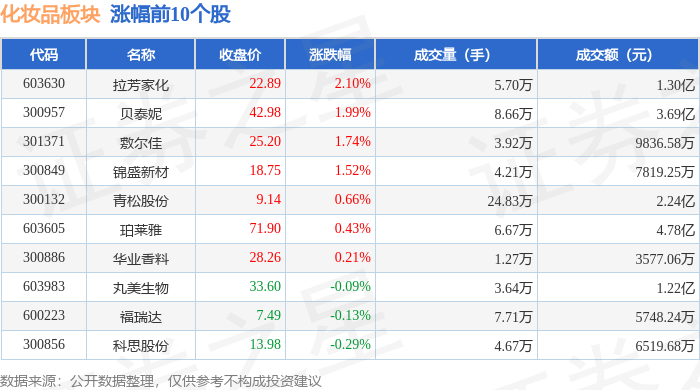
Group 1 - The cosmetics sector experienced a slight increase of 0.25% on January 21, with Lafang Jiahua leading the gains [1] - The Shanghai Composite Index closed at 4116.94, up 0.08%, while the Shenzhen Component Index closed at 14255.12, up 0.7% [1] - Lafang Jiahua's closing price was 22.89, reflecting a rise of 2.10%, with a trading volume of 57,000 shares and a transaction value of 130 million yuan [1] Group 2 - The cosmetics sector saw a net outflow of 55.52 million yuan from institutional investors, while retail investors had a net inflow of 30.86 million yuan [2] - The trading data for various companies showed mixed performance, with some companies like Betaini and Lafang Jiahua experiencing net outflows from institutional investors [3] - Betaini had a net outflow of 14.09 million yuan from institutional investors, while Lafang Jiahua saw a net inflow of 13.43 million yuan [3]




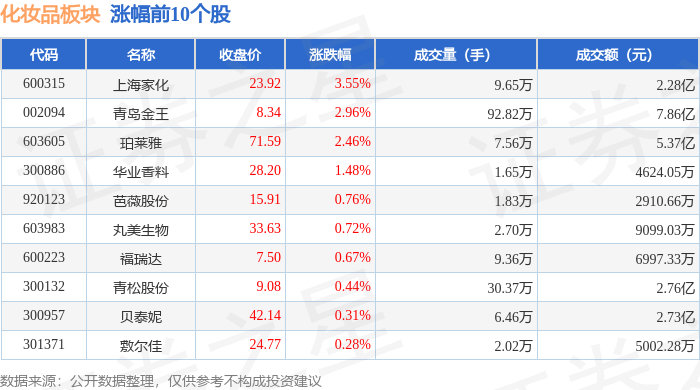
化妆品板块1月20日涨1.11%,上海家化领涨,主力资金净流入3030.2万元
Zheng Xing Xing Ye Ri Bao· 2026-01-20 08:59
Group 1 - The cosmetics sector experienced a rise of 1.11% on January 20, with Shanghai Jahwa leading the gains [1] - The Shanghai Composite Index closed at 4113.65, down 0.01%, while the Shenzhen Component Index closed at 14155.63, down 0.97% [1] - Key stocks in the cosmetics sector showed varied performance, with Shanghai Jahwa closing at 23.92, up 3.55%, and Qingdao Kingking at 8.34, up 2.96% [1] Group 2 - The cosmetics sector saw a net inflow of 30.3 million yuan from institutional investors, while retail investors experienced a net outflow of 54.5 million yuan [2] - Notable individual stock performances included Shanghai Jahwa with a net inflow of 20.5 million yuan from institutional investors, and Qingdao Kingking with a net inflow of 23.3 million yuan [3] - The overall market sentiment reflected a mixed response, with some stocks like Banlaya experiencing significant net outflows from both institutional and retail investors [3]

中国化妆品 - 2026 展望:重启更高质量增长;投资回报率改善利好品牌龙头-China Cosmetics_ 2026 Outlook_ Reset for higher-quality growth; improving ROI favors branded leaders
2026-01-20 03:19
Summary of the China Cosmetics 2026 Outlook Industry Overview - The report focuses on the **China Cosmetics** industry, projecting trends and company performances leading into 2026 [3][9]. Key Trends Trend 1: Higher-Quality Channels - **Tmall's Growth**: Anticipated sustained growth in Gross Merchandise Value (GMV) on Tmall, supported by platform strengths such as better product returns and subsidies, increased user loyalty, and stronger brand collaborations [3][4]. - **Government Regulations**: Implementation of stricter tax enforcement limiting promotional costs to 30% of sales for cosmetics, potentially increasing traffic acquisition costs and impacting sales on traffic-dependent platforms like Douyin [3][4]. Trend 2: Product Innovation - **Consumer Preferences**: Shift towards reliability, proven efficacy, and brand trust due to the absence of a dominant ingredient cycle [4][5]. - **Ingredient Trends**: Companies are innovating with new ingredients like PDRN in skincare products, with notable examples including L'Oreal and Proya. Helena Rubinstein has increased the Pro-Xylane content in its flagship product from 30% to 50% [4][5]. Company Insights Mao Geping Cosmetics (MGP) - **Performance**: Upgraded from Neutral to Buy, with expected sales and net income CAGR of 23% and 22% from 2025 to 2027, respectively. MGP is positioned as a local premium player in the Chinese beauty market [9][10]. - **Market Position**: MGP has shown resilience with a 34% sales CAGR from 2021 to 2025 despite market headwinds, supported by a strong omni-channel strategy and consumer engagement [9][10]. Giant Biogene - **Market Leadership**: Recognized as a global leader in recombinant collagen, despite facing a projected sales decline of 21% and 8% in 2H25E and 1H26E, respectively [14][15]. - **Recovery Outlook**: Expected gradual recovery starting in 2H26E, with a projected sales growth of 12% to 17% in 2027, driven by strong product pipelines and market position in skin repair [14][15]. Shanghai Jahwa - **Turnaround Strategy**: Focused on core brands and online channels, achieving significant growth in key cosmetics brands, with Dr. Yu and Herborist showing 40% and 150% growth, respectively [19][20]. - **Future Projections**: Anticipated CAGR of 2% for personal care and cosmetics segments from 2025 to 2027, with cosmetics expected to contribute 35% of total revenue by 2027 [22][19]. Valuation and Risks - **MGP Valuation**: Target price set at HK$105 based on a 28x 2027E P/E, reflecting a premium due to its high growth profile [11][12]. - **Giant Biogene Valuation**: Target price of HK$46 based on a 22x 2027E P/E, with risks including competition and product development challenges [15][16]. - **Jahwa Valuation**: Target price of RMB 28 based on a 30x 2027E P/E, with risks related to overseas business performance and execution in online channels [20][21]. Conclusion - The China cosmetics industry is poised for growth driven by higher-quality channels and product innovation. Companies like MGP, Giant Biogene, and Shanghai Jahwa are positioned to capitalize on these trends, although they face various risks that could impact their performance.
国补高基数下12月社零同增0.9%
HTSC· 2026-01-20 02:02
Investment Rating - The report maintains a "Buy" rating for the consumer discretionary sector, highlighting structural investment opportunities [5][10]. Core Insights - The report indicates that in December, the total retail sales of consumer goods increased by 0.9% year-on-year to 4.5 trillion yuan, with a month-on-month decline of 0.4 percentage points, primarily due to high base effects from durable goods like automobiles and home appliances [7][9]. - The report emphasizes the importance of the new round of trade-in policies for 2026, which focus on core home appliance categories and expand into new categories like smart glasses and products for the elderly, supporting demand in these segments [7]. - The report suggests that consumer sentiment remains strong, particularly in sectors like emotional consumption, technology consumption, and undervalued high-dividend stocks, recommending a focus on domestic brands and global brand expansion [10]. Summary by Sections Retail Sales Performance - In December, retail sales of food and beverages grew by 2.2% and 0.7% respectively, with urban and rural retail sales increasing by 0.7% and 1.7% year-on-year [8]. - Online retail sales of physical goods in December increased by 0.8% year-on-year, with a total annual growth of 5.2%, accounting for 26.1% of total retail sales [8]. Consumer Categories - The report notes a structural differentiation in consumer categories, with home appliances, building materials, and furniture experiencing declines of 18.7%, 11.8%, and 2.2% respectively due to high base effects and trade-in policy impacts [9]. - Conversely, communication equipment saw a significant increase of 20.9% year-on-year, while emotional and self-care products like sports and entertainment goods and cosmetics grew by 9.0% and 8.8% respectively [9]. Investment Recommendations - The report identifies four main investment themes: 1. Rise of domestic brands and global brand expansion, recommending companies like Pop Mart, Shangmei, and Anta Sports [10]. 2. Technology consumption empowered by AI, recommending companies like Midea Group and Haier Smart Home [10]. 3. Emotional consumption, recommending companies like Gu Ming and Yum China [10]. 4. Undervalued high-dividend blue-chip leaders, recommending companies like Li Ning and Shenzhou International [10]. Company-Specific Insights - For Smoore International (6969 HK), the report forecasts a revenue of 10.21 billion yuan for Q1-3 2025, with a year-on-year growth of 21.8%, and maintains a "Buy" rating with a target price of 27.00 HKD [48]. - For Juzhibio (2367 HK), the report highlights the approval of a new collagen product, projecting significant sales potential and maintaining a "Buy" rating with a target price of 85.00 HKD [49]. - For Pop Mart (9992 HK), the report notes a revenue increase of 245-250% in Q3 2025, driven by strong performance in both domestic and international markets, maintaining a "Buy" rating with an updated target price of 410 HKD [51].



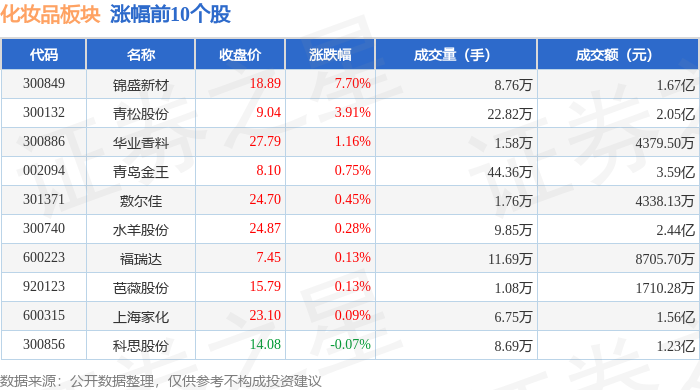
化妆品板块1月19日涨0.09%,锦盛新材领涨,主力资金净流出5088.16万元
Zheng Xing Xing Ye Ri Bao· 2026-01-19 08:58
Group 1 - The cosmetics sector experienced a slight increase of 0.09% on January 19, with Jinsheng New Materials leading the gains [1] - The Shanghai Composite Index closed at 4114.0, up by 0.29%, while the Shenzhen Component Index closed at 14294.05, up by 0.09% [1] - Jinsheng New Materials saw a closing price of 18.89, with a significant increase of 7.70%, and a trading volume of 87,600 shares, amounting to a transaction value of 167 million yuan [1] Group 2 - The cosmetics sector faced a net outflow of 50.88 million yuan from institutional investors, while retail investors saw a net inflow of 42.92 million yuan [2] - The trading data indicates that LaFang Family, with a closing price of 22.58, experienced a decline of 3.30%, with a trading volume of 70,600 shares and a transaction value of 161 million yuan [2] - The individual stock performance shows that Beitaini had a net inflow of 25.48 million yuan from institutional investors, but a net outflow of 39.58 million yuan from retail investors [3]

上海家化:化妆品调研要点-三大品牌为 2026 年核心支柱;产品创新势头延续;给予 “买入” 评级
2026-01-16 02:56
Summary of Shanghai Jahwa United (600315.SS) Conference Call Company Overview - **Company**: Shanghai Jahwa United - **Industry**: Cosmetics Key Takeaways 1. Brand Outlook & Key Initiatives for 2026 - Shanghai Jahwa identifies three brands as key growth pillars for skincare by 2026: Herborist, Dr.Yu, and Liushen - Herborist aims to exceed Rmb1 billion in sales, driven by products like "Dabai Mud" (Rmb300 million) and "Herbal Oil" (Rmb100 million) with projected high double-digit growth [1][2] - Dr.Yu also targets over Rmb1 billion in sales, focusing on sensitive skin creams and new product launches, including a large-molecule sunscreen and Artemisia annua essence [2] - Liushen expects significant growth from its Mosquito Repellent Egg, projected to reach Rmb100 million in sales by 2025, with over 50% growth anticipated [2] 2. Channel Strategy - The company expects Douyin's growth to surpass Tmall's in 2026, enhancing channel efficiency through in-house content creation [1][6] - Current sales distribution: Herborist (60% online), Dr.Yu (80% online), and Liushen (80% offline) with plans to reduce offline sales to 70% by 2026 [9] 3. Profitability and ROE Outlook - After a projected loss in 2024 and a bottoming out in 2025, profit growth is expected to outpace revenue growth in 2026, supported by economies of scale and cost optimization [1][6] - The company plans to achieve growth without significant capital expenditure or increased headcount, leveraging existing factory capacity [6] 4. Long-Term Ambition - Shanghai Jahwa aims for Rmb20 billion in revenue, targeting top-three market share in niche categories like mud, oil, and shower gel [1][7] - Specific long-term targets include Liushen at 10% CAGR, Herborist and Dr.Yu each at Rmb3 billion, and Shuangmei at Rmb1 billion [7] 5. Financial Projections - 12-month price target set at Rmb28, representing a 20.2% upside from the current price of Rmb23.29 [10] - Revenue projections for 2026 estimate Rmb7.1 billion, with EBITDA expected to grow significantly [10] 6. Key Risks - Potential impairment losses from overseas business due to shrinking demand and competition [9] - Risks associated with store closures for Herborist if offline sales continue to decline [9] - Lower-than-expected sales growth for Dr.Yu and execution challenges in online channels [9] Additional Insights - The company is strategically focusing on less competitive niche segments to enhance market share and profitability [1] - Management emphasizes the importance of brand and product development in the near term to achieve long-term goals [1][6]
化妆品板块1月15日跌0.36%,水羊股份领跌,主力资金净流出1186.31万元
Zheng Xing Xing Ye Ri Bao· 2026-01-15 08:58
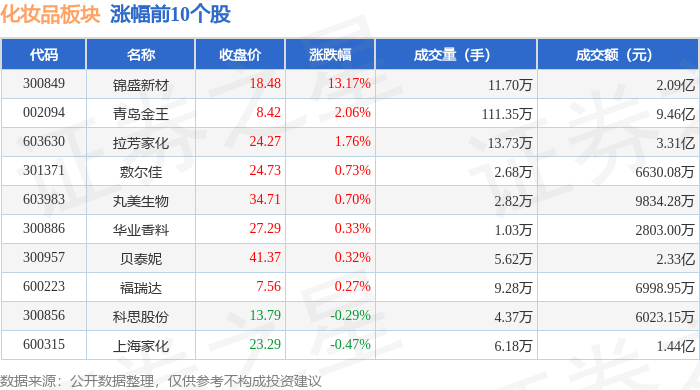
Market Overview - The cosmetics sector experienced a decline of 0.36% on January 15, with Shuiyang Co. leading the drop [1] - The Shanghai Composite Index closed at 4112.6, down 0.33%, while the Shenzhen Component Index closed at 14306.73, up 0.41% [1] Individual Stock Performance - Jinsheng New Material (300849) saw a significant increase of 13.17%, closing at 18.48 with a trading volume of 117,000 shares and a turnover of 209 million yuan [1] - Qingdao Kingway (002094) increased by 2.06%, closing at 8.42 with a trading volume of 1,113,500 shares [1] - Lafang Home (603630) rose by 1.76%, closing at 24.27 with a trading volume of 137,300 shares [1] - Other notable performances include Fulejia (301371) up 0.73%, Marubi Biological (603983) up 0.70%, and Betaini (300957) up 0.32% [1] Capital Flow Analysis - The cosmetics sector saw a net outflow of 11.86 million yuan from institutional investors and 53.27 million yuan from retail investors, while retail investors had a net inflow of 65.13 million yuan [2] - The capital flow for individual stocks indicates that Lafang Home had a net inflow of 77.73 million yuan from institutional investors, while Betaini had a net inflow of 14.81 million yuan [3] - Conversely, Shuiyang Co. experienced a net outflow of 5.39 million yuan from institutional investors [2][3]