WHEE(600475)

Search documents
2026绿证交易价格有望提升,微电网建设指南约束园区消纳
GOLDEN SUN SECURITIES· 2026-01-11 15:05
Investment Rating - The report suggests a "Buy" rating for several companies in the power sector, including Huaneng International, Huadian International, Guodian Power, and Datang Power, among others [9]. Core Insights - The National Energy Administration has released detailed regulations for green certificate management, which is expected to reshape market rules and enhance the trading price of green certificates by 2026 [2][14]. - The new regulations clarify that independent energy storage discharge will no longer be eligible for green certificate issuance, which may lead to a reduction in the overall circulation of green certificates and an increase in their trading prices [2][14]. - The guidelines for industrial microgrid construction require that new renewable energy generation in industrial parks must have a self-consumption ratio of at least 60% annually, promoting local production and consumption of green electricity [6][16]. Summary by Sections Green Certificate Regulations - The new regulations maintain the core measurement standard of issuing one green certificate for every 1,000 kWh of renewable energy generated [2][14]. - Independent energy storage discharge will not receive green certificates, and projects must measure generation and storage separately [2][17]. - From January 1, 2026, the production year of the electricity must match the consumption year for green certificate cancellation, changing the previous practice of purchasing historical certificates [2][17]. Industrial Microgrid Guidelines - The guidelines aim to enhance the capacity for local production and consumption of green electricity in industrial sectors [6][16]. - New renewable energy projects in industrial parks must achieve a minimum self-consumption ratio of 60% [6][16]. - The guidelines introduce a requirement for integrating various systems, including renewable energy generation and energy management technologies [6][16]. Market Performance - The report notes that the Shanghai Composite Index rose by 3.82% during the week of January 5-9, with the power and utilities sector index increasing by 2.4%, underperforming the broader market [66][67]. - The report highlights that most listed companies in the power and utilities sector experienced stock price increases during this period [66].





华光环能股价涨5.73%,华夏基金旗下1只基金位居十大流通股东,持有207.84万股浮盈赚取226.55万元
Xin Lang Cai Jing· 2026-01-07 05:40
Group 1 - Huaguang Huaneng's stock price increased by 5.73% to 20.11 CNY per share, with a trading volume of 348 million CNY and a turnover rate of 1.91%, resulting in a total market capitalization of 19.224 billion CNY [1] - Huaguang Huaneng, established on December 26, 2000, and listed on July 21, 2003, is based in Wuxi, Jiangsu Province, and specializes in boiler equipment manufacturing, power station engineering and services, environmental engineering and services, and local energy supply [1] - The company's main business revenue composition includes: local thermal power and photovoltaic power operation services (46.56%), energy-efficient power generation equipment (13.95%), power station engineering and services (13.11%), municipal environmental engineering and services (9.95%), environmental operation services (7.66%), environmental equipment (7.08%), and others (1.70%) [1] Group 2 - Huaxia Fund's Huaxia CSI 1000 ETF (159845) entered the top ten circulating shareholders of Huaguang Huaneng in the third quarter, holding 2.0784 million shares, which is 0.22% of the circulating shares, with an estimated floating profit of approximately 2.2655 million CNY [2] - The Huaxia CSI 1000 ETF was established on March 18, 2021, with a latest scale of 45.469 billion CNY, and has achieved a year-to-date return of 3.56%, ranking 2803 out of 5488 in its category, and a one-year return of 41.99%, ranking 1744 out of 4192 [2]

【行业深度】洞察2025:中国锅炉制造行业竞争格局及市场份额(附市场集中度、企业竞争力等)
Qian Zhan Wang· 2026-01-06 02:12
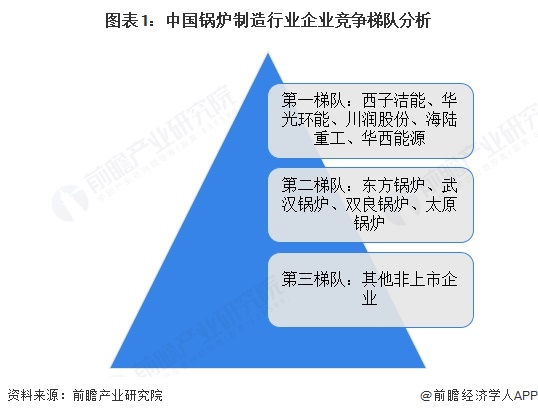
Group 1 - The core viewpoint of the article highlights the competitive landscape and market concentration in China's boiler manufacturing industry, indicating a high level of competition among numerous manufacturers with similar products [1][3][6] - The first tier of the competitive landscape includes major listed companies such as Xizi Clean Energy, Huaguang Huaneng, Chuanrun Co., Hailu Heavy Industry, and Huaxi Energy, while the second tier consists of larger non-listed companies like Dongfang Boiler and Wuhan Boiler [1][3] - The market concentration in the boiler manufacturing industry is relatively high, with leading companies gaining more market share as low-end capacities exit the market due to environmental policies [6][7] Group 2 - The number of large-scale boiler manufacturing enterprises in China is significant, but many lack scale production, with the largest companies having registered capital exceeding 500 million yuan [3][10] - The geographical concentration of industrial boiler manufacturers is primarily in Shandong, Jiangsu, and Hebei, which together account for 43% of the total number of manufacturers in the country [7] - The competitive state of the boiler manufacturing industry is characterized by strong bargaining power from suppliers of raw materials, while consumer bargaining power is relatively weak due to regulatory requirements for boiler updates [11][12]


华光环能:董事长蒋志坚等5名高管减持 金额合计约1274万元
2 1 Shi Ji Jing Ji Bao Dao· 2026-01-06 02:06
Core Viewpoint - The announcement reveals that key executives of Huaguang Huaneng have completed share reductions between December 4 and December 31, 2025, indicating potential changes in insider sentiment towards the company's stock [1] Executive Share Reductions - Chairman Jiang Zhijian reduced holdings by 171,200 shares for a total of 2.9981 million yuan, with a price range of 17.10 to 18.60 yuan per share [1] - General Manager Miao Qiang also reduced holdings by 171,200 shares, amounting to 3.2038 million yuan, with a price range of 18.20 to 18.88 yuan per share [1] - Vice General Manager Mao Junhua reduced holdings by 151,400 shares for 2.6399 million yuan [1] - Executive Zhou Jianwei reduced holdings by 121,800 shares for 2.2341 million yuan [1] - Executive Zhu Junzhong reduced holdings by 94,600 shares for 1.6663 million yuan [1]
无锡华光环保能源集团股份有限公司部分董事及高管减持股份结果公告
Shang Hai Zheng Quan Bao· 2026-01-05 20:28
Group 1 - The company announced the results of share reduction by certain directors and executives, ensuring the announcement's content is truthful and complete [1] - Before the share reduction plan, the chairman and executives held the following shares: Chairman Jiang Zhijian held 684,913 shares (0.0716%), General Manager Miao Qiang held 684,913 shares (0.0716%), Vice General Manager Mao Junhua held 605,600 shares (0.0633%), Vice General Manager Zhou Jianwei held 487,300 shares (0.0510%), and Vice General Manager Zhu Junzhong held 378,574 shares (0.0396%) [2] - The share reduction plan was disclosed on November 12, 2025, with the executives planning to reduce their holdings within three months, not exceeding 25% of their total shares [3] Group 2 - The actual share reduction was completed as planned, with the following reductions: Jiang Zhijian reduced by 171,200 shares, Miao Qiang by 171,200 shares, Mao Junhua by 151,400 shares, Zhou Jianwei by 121,800 shares, and Zhu Junzhong by 94,600 shares [3][5] - The company confirmed that the actual reductions matched the previously disclosed plan, and the reduction was fully implemented within the specified timeframe [5]
华光环能(600475) - 无锡华光环保能源集团股份有限公司部分董事及高管减持股份结果公告
2026-01-05 10:02
证券代码:600475 证券简称:华光环能 公告编号:临 2026-001 无锡华光环保能源集团股份有限公司 部分董事及高管减持股份结果公告 本公司董事会、全体董事及相关股东保证本公告内容不存在任何虚假记载、 误导性陈述或者重大遗漏,并对其内容的真实性、准确性和完整性承担法律责任。 重要内容提示: 董事、高管持股的基本情况 本次股份减持计划实施前,无锡华光环保能源集团股份有限公司(以下简称 "公司")董事长蒋志坚先生持有公司股份 684,913 股,占公司总股本的 0.0716%; 董事、总经理缪强先生持有公司股份 684,913 股,占公司总股本的 0.0716%;副 总经理毛军华先生持有公司股份 605,600 股,占公司总股本的 0.0633%;副总经 理周建伟先生持有公司股份 487,300 股,占公司总股本的 0.0510%;副总经理朱 俊中先生持有公司股份 378,574 股,占公司总股本的 0.0396%。 减持计划的实施结果情况 公司于 2025 年 11 月 12 日披露了《无锡华光环保能源集团股份有限公司部 分董事及高管减持股份计划公告》(公告编号:2025-069)。因个人资金需求,蒋志 ...
年协电价落地释压,1 月新能源差价补贴最高 6.17 分/度
GOLDEN SUN SECURITIES· 2026-01-04 11:28
Investment Rating - The industry investment rating is maintained as "Increase" [4] Core Insights - The annual negotiated electricity price has been established, leading to a significant drop in trading prices in Jiangsu and Zhejiang for 2026, with a decrease of 16.5% and 16.4% respectively. The new energy price subsidy in January is at a maximum of 6.17 cents per kilowatt-hour [3][13] - The electricity market is undergoing a restructuring with the full entry of new energy sources, which is expected to bring about a new equilibrium in electricity pricing sooner than anticipated [3] - The report highlights the performance of various sectors within the electricity industry, noting a general decline in stock prices for most listed companies in the power and utilities sector [6][63] Summary by Sections Industry Overview - The average trading price for electricity in Jiangsu for 2026 is 344.19 yuan per megawatt-hour, down 16.5% year-on-year, while in Zhejiang it is 344.85 yuan per megawatt-hour, also down 16.4% [13] - The total transaction volume in Jiangsu's electricity market for 2026 is 272.481 billion kilowatt-hours, with a weighted average price of 344.19 yuan per megawatt-hour [13] - The report indicates that the electricity prices in 28 regions have been adjusted downwards, with reductions ranging from 0.65% to 24.68% [3][13] Market Performance - The Shanghai Composite Index closed at 3968.84 points, up 0.13%, while the CSI 300 Index closed at 4629.94 points, down 0.59%. The CITIC Power and Utilities Index closed at 3042.43 points, down 2.35%, underperforming the CSI 300 Index by 1.76 percentage points [6][63] - Most stocks in the power and utilities sector experienced declines, with notable drops in companies such as Guodian Power and Huaneng International [67] Investment Recommendations - The report suggests focusing on high-dividend coal-fired power leaders and companies with stable electricity prices and coal-electric integration, such as Huaneng International, Huadian International, and Guodian Power [3] - It also recommends investing in flexible coal-fired power transformation leaders and companies in the wind and solar sectors, such as Xintian Green Energy and Longyuan Power [3] - For the gas sector, it highlights quality leaders like Chengran and New Hope Energy, which are expected to recover profits while maintaining stable dividends [3]
——申万公用环保周报(25/12/22~25/12/26):二三产拉动11月用电全球气价小幅震荡-20251229
Shenwan Hongyuan Securities· 2025-12-29 10:36
Investment Rating - The report provides a positive investment outlook for various sectors within the energy industry, particularly recommending companies involved in coal power, hydropower, nuclear power, green energy, and gas [1]. Core Insights - The report highlights that in November 2025, the total electricity consumption reached 835.6 billion kWh, marking a year-on-year increase of 6.2%. The growth contributions from the primary, secondary, and tertiary industries, as well as residential consumption, were 2%, 49%, 29%, and 19% respectively [4][6]. - The secondary industry remains the largest contributor to electricity consumption, accounting for over 60% of the total, with significant growth in high-tech and equipment manufacturing sectors [5][6]. - Natural gas prices have shown fluctuations, with the U.S. Henry Hub spot price at $3.31/mmBtu, reflecting a weekly decline of 7.30%. The report notes that the domestic LNG ex-factory price is 3915 yuan/ton, down 2.85% week-on-week [1][16]. Summary by Sections Electricity Sector - In November 2025, the electricity consumption by the first, second, and third industries grew by 7.9%, 4.4%, and 10.3% respectively, while residential consumption increased by 9.8% [4][6]. - The high-tech and equipment manufacturing sectors saw a 6.7% increase in electricity consumption, with automotive manufacturing leading at a 10% growth rate [5][6]. Natural Gas Sector - The report indicates that global gas prices are experiencing slight fluctuations, with the U.S. market showing a significant drop in spot prices. The report anticipates that the demand for natural gas will increase as winter approaches, potentially stabilizing prices [1][16]. - Recommendations include focusing on integrated gas companies and those benefiting from cost reductions and improved profitability due to lower oil prices [39][40]. Investment Recommendations - For coal power, companies like Guodian Power and Inner Mongolia Huadian are recommended due to their diversified revenue sources [1]. - Hydropower companies such as Yangtze Power and State Power Investment Corporation are favored due to expected improvements in profit margins from reduced capital expenditures [1]. - Nuclear power firms like China National Nuclear Power and China General Nuclear Power are highlighted for their stable cost structures and growth potential [1]. - In the green energy sector, companies like Xintian Green Energy and Longyuan Power are recommended for their stable returns and increasing operational value [1]. - The report also suggests investment in gas companies like Shenzhen Energy and Kunlun Energy, which are expected to benefit from cost reductions and improved market conditions [1][39].


申万公用环保周报:二三产拉动11月用电,全球气价小幅震荡-20251229
Shenwan Hongyuan Securities· 2025-12-29 07:16
Investment Rating - The report maintains a "Positive" outlook on the utility and environmental sectors, indicating potential investment opportunities in these areas [2]. Core Insights - The report highlights that in November, the total electricity consumption in China reached 835.6 billion kWh, representing a year-on-year growth of 6.2%. The contributions from various sectors were: primary industry (7.9%), secondary industry (4.4%), tertiary industry (10.3%), and urban and rural residents (9.8%) [3][8]. - The growth in electricity consumption is primarily driven by the tertiary industry, particularly in sectors related to big data analysis and artificial intelligence services, which saw significant increases in electricity usage [9]. - The report notes that the natural gas market is experiencing slight fluctuations, with LNG prices continuing to decline. As of December 26, the national LNG ex-factory price was 3915 RMB/ton, down 2.85% week-on-week [3][40]. Summary by Sections Electricity Sector - In November, the total electricity consumption was 8356 billion kWh, with a year-on-year increase of 6.2%. The secondary industry contributed 49% to the growth, while the tertiary industry followed with a 29% contribution [10][11]. - The high-tech and equipment manufacturing sectors showed a notable increase in electricity consumption, with a year-on-year growth of 6.7%, surpassing the average growth rate of the manufacturing sector by 2.5 percentage points [9][10]. Natural Gas Sector - The report indicates that global gas prices are experiencing minor fluctuations, with the Henry Hub spot price at $3.31/mmBtu, reflecting a weekly decrease of 7.30%. The TTF spot price in the Netherlands was €27.70/MWh, down 1.42% week-on-week [3][19]. - The report suggests that the LNG ex-factory price in China is under pressure due to high inventory levels and low-cost sea gas resources, leading to a continued downward trend [40][41]. Investment Recommendations - The report recommends several companies based on their performance and market positioning: - For thermal power, companies like Guodian Power, Inner Mongolia Huadian, and Datang Power are highlighted for their integrated coal and power operations [3][17]. - In the hydropower sector, companies such as Yangtze Power and Guotou Power are recommended due to their stable financial performance and reduced capital expenditures [3][17]. - For nuclear power, China National Nuclear Power and China General Nuclear Power are suggested due to their stable cost structures and growth potential [3][17]. - In the green energy sector, companies like Xintian Green Energy and Longyuan Power are noted for their improved returns from stable project yields [3][17].
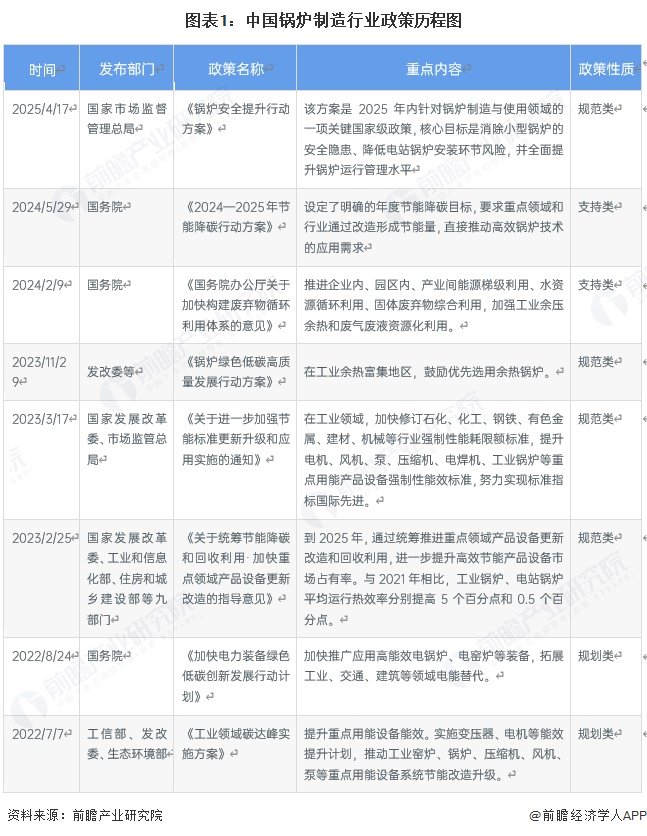
重磅!2025年中国及31省市锅炉制造行业政策汇总及解读(全)
Qian Zhan Wang· 2025-12-26 02:16
Core Insights - The boiler manufacturing industry in China is transitioning towards energy efficiency, environmental protection, and user-friendliness, as highlighted in the "13th Five-Year Plan" which emphasizes energy-saving actions across various sectors [1] Policy Overview - The Chinese government has introduced several key policies aimed at enhancing the safety and efficiency of boiler manufacturing, including the "Boiler Safety Improvement Action Plan" set for implementation by April 2025, which targets the elimination of safety hazards in small boilers [3] - The "2024-2025 Energy Saving and Carbon Reduction Action Plan" mandates specific energy-saving and carbon reduction targets for key industries, promoting the adoption of high-efficiency boiler technologies [3] - The "Guidelines for Accelerating the Construction of Waste Resource Utilization Systems" encourage the utilization of industrial waste heat and resources, further supporting the boiler industry's transition to greener practices [3] Industry Development Goals - The industry aims to continuously improve the energy efficiency of equipment systems, focusing on the application of high-efficiency energy equipment and the renovation of existing energy-consuming devices [15] - There is a push for the development of integrated services for high-efficiency and energy-saving boilers, including design, production, installation, and operation [15] - The promotion of low-carbon transformation in industrial energy use is emphasized, particularly in sectors such as copper, iron, petrochemicals, and building materials, advocating for the use of electric heating technologies [15] Provincial Policies - Various provinces are implementing their own policies to support the boiler manufacturing industry, such as Beijing's initiative to enhance the efficiency of gas boilers and promote electric heating systems [16] - In Hebei, a plan has been established to encourage the replacement of old equipment with energy-efficient models, aligning with national energy-saving goals [16] - Inner Mongolia's policy aims for over 80% of steel production capacity to achieve ultra-low emissions by 2025, which includes the comprehensive implementation of low-emission standards for coal-fired boilers [16]