CS&S(600536)

Search documents
国产软件板块活跃 10月以来融资资金加仓7只概念股均超亿元
Zheng Quan Shi Bao· 2025-10-13 18:07
Group 1 - The domestic software sector is experiencing significant activity, with industrial software and Xinchuang direction leading the gains, as stocks like Rongji Software, China Software, and Yingjianke hit the daily limit, while others like Chengmai Technology and Kingsoft Office also saw substantial increases [1] - The Ministry of Industry and Information Technology and six other departments recently issued a plan to promote service-oriented manufacturing innovation from 2025 to 2028, highlighting key productive service industries including technology services, industrial design, software and information services, and more [1] - The potential for domestic software to replace foreign products is vast across various fields, with industrial software being crucial for enhancing China's manufacturing autonomy and global competitiveness [1] Group 2 - Domestic software concept stocks have seen an average price increase of 31.15% this year, with Huasheng Tiancai and Dongtu Technology leading with gains of 170.85% and 135.19% respectively [2] - Zhongke Chuangda, a global leader in intelligent platform technology, has a research and development team spread across 16 countries, enabling quick responses to market trends and customer needs [2] - Runhe Software focuses on innovation in domestic and intelligent sectors, with significant efforts in open-source Hongmeng and Euler, impacting industries like finance, energy, healthcare, and education [2] Group 3 - As of October 10, over 70% of concept stocks have seen an increase in financing, with companies like Kingsoft Office and Zhongke Chuangda receiving net financing inflows exceeding 100 million yuan [3] - Kingsoft Office has the highest net financing inflow, accumulating 643 million yuan since October, with its WPS Office suite being a key product [3]




30股特大单净流入超2亿元
Xin Lang Cai Jing· 2025-10-13 13:18
Group 1 - The article highlights that 30 stocks experienced a net inflow of over 2 billion yuan, with Baotou Steel leading at a net inflow of 2.436 billion yuan [1] - China Software follows in second place with a net inflow of 1.451 billion yuan [1] - Other notable stocks with significant net inflows include Northern Rare Earth, Huayou Cobalt, and SMIC [1] Group 2 - On the other hand, BYD saw the highest net outflow of funds, totaling 1.176 billion yuan [1] - Sirius and Dongfang Wealth ranked second and third in net outflows, with 922 million yuan and 892 million yuan respectively [1]



IT服务板块10月13日涨0.23%,国子软件领涨,主力资金净流入1.58亿元
Zheng Xing Xing Ye Ri Bao· 2025-10-13 12:45
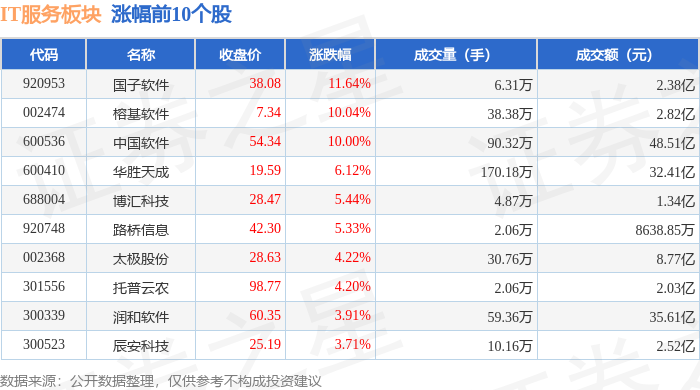
Core Insights - The IT services sector experienced a slight increase of 0.23% on October 13, with Guozi Software leading the gains [1] - The Shanghai Composite Index closed at 3889.5, down 0.19%, while the Shenzhen Component Index closed at 13231.47, down 0.93% [1] IT Services Sector Performance - Guozi Software saw a significant rise in its stock price, closing at 38.08 with a gain of 11.64% and a trading volume of 63,100 shares, resulting in a transaction value of 238 million yuan [1] - Other notable performers included Rongmu Software, which increased by 10.04% to 7.34, and China Software, which rose by 10.00% to 54.34, with transaction values of 282 million yuan and 4.851 billion yuan respectively [1] - The overall trading volume and transaction values for various IT service stocks indicate strong market activity, with China Software leading in transaction value at 48.51 billion yuan [1] Capital Flow Analysis - The IT services sector saw a net inflow of 158 million yuan from institutional investors, while retail investors contributed a net inflow of 788 million yuan [2] - Notably, the sector experienced a net outflow of 946 million yuan from speculative funds, indicating a shift in investment strategies among different investor types [2] Individual Stock Capital Flow - China Software had a net inflow of 265.6 million yuan from institutional investors, representing 19.76% of its total trading volume, while it faced a net outflow of 69.7 million yuan from speculative funds [3] - Other companies like Huasheng Tiancai and Runhe Software also showed varying degrees of net inflow and outflow, reflecting diverse investor sentiment across the sector [3]


WPS附件,与A股风口前后事
2 1 Shi Ji Jing Ji Bao Dao· 2025-10-13 12:44
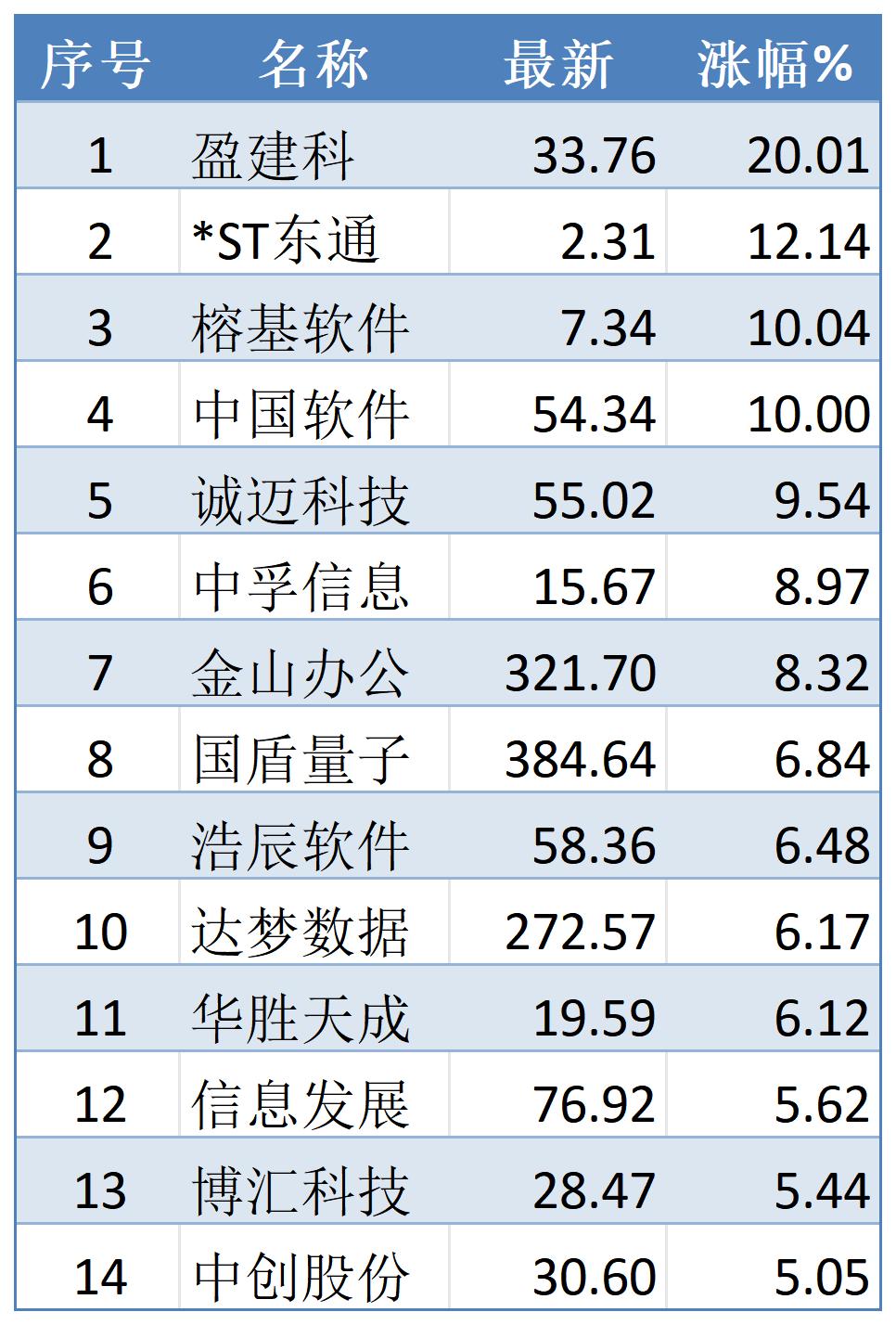
Core Viewpoint - The recent announcement by the Ministry of Commerce, which utilized the WPS format for the first time, is interpreted as a signal for accelerated domestic software replacement, leading to a strong performance in the A-share domestic software sector [1][3][6]. Market Performance - On October 13, the overall A-share market showed volatility, while the domestic software sector surged, with stocks like Yingjian Technology and China Software hitting the daily limit, and several others, including Rongji Software and Chengmai Technology, rising over 8% [1][4]. - The software ETF (159852) increased by 1.07% on the same day, with a high turnover rate of 18.36% and a transaction amount of 1 billion yuan, reflecting growing market enthusiasm for the software sector [3]. Sector Analysis - The software sector's rise exhibited significant structural characteristics, with different segments performing distinctly. China Software, a core operating system provider, closed at the daily limit, boosting the domestic operating system supply chain [4]. - In the office software segment, Kingsoft Office saw an 8.32% increase, ranking as the second-highest gainer among the top ten weighted stocks in the CSI Software Service Index [4]. - Other segments like industrial software and cybersecurity also showed positive performance, with companies like Haocen Software and Zhongfu Information recording gains [4]. Fundamental Support - The software and information technology service industry has shown a positive operational trend, with software business revenue reaching 96,409 billion yuan, a year-on-year increase of 12.6%, and total profits growing by 13.0% [8]. - The Ministry of Industry and Information Technology reported that software business exports reached 404.4 billion USD, reflecting a 6.4% year-on-year growth [8]. Strategic Implications - The use of WPS format in official documents is seen as a significant endorsement for domestic office software, indicating a shift towards self-sufficiency and technological breakthroughs in the industry [6][7]. - The domestic software industry is experiencing a historical transition from "usable" to "user-friendly," with local vendors becoming competitive against international giants in terms of capability and cost [9]. Future Outlook - The policy environment is favorable for the development of domestic software, with increasing demand for self-sufficiency and security driving growth in industrial software and computing power sectors [12]. - The upcoming bidding opportunities in the domestic software market are expected to accelerate development, particularly in light of potential increased technology sanctions from the U.S. [12].

主力资金 | 尾盘抢筹6股超亿元
Sou Hu Cai Jing· 2025-10-13 11:17
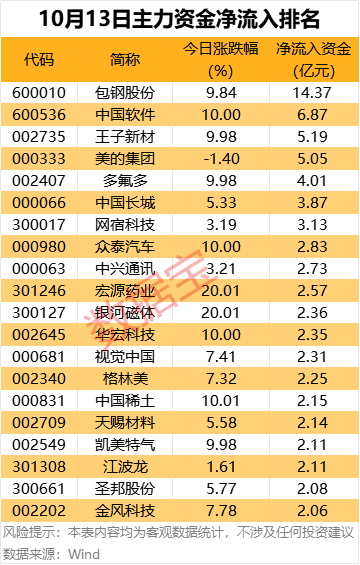
Core Viewpoint - The A-share market experienced significant fluctuations on October 13, with major indices opening lower but recovering throughout the day. The overall trend showed a net outflow of 39.864 billion yuan in main funds, while six industries saw net inflows, particularly in steel, environmental protection, and agriculture [1][2]. Group 1: Industry Performance - The A-share market saw a net outflow of 39.864 billion yuan in main funds, with six industries experiencing net inflows, including steel with 0.892 billion yuan, and environmental protection, agriculture, and light manufacturing each exceeding 0.2 billion yuan [1]. - The electronic and power equipment industries faced the largest net outflows, each exceeding 6 billion yuan, while the automotive and machinery sectors also saw outflows exceeding 3 billion yuan [1]. Group 2: Individual Stock Performance - Seven stocks received net inflows exceeding 0.3 billion yuan, with Baogang Co. leading at 1.437 billion yuan, followed by China Software with 0.687 billion yuan. Baogang Co. saw a significant increase due to active trading in the rare earth sector [2][3]. - A total of 44 stocks experienced net outflows exceeding 0.2 billion yuan, with BYD, Luxshare Precision, and Dongfang Wealth each seeing outflows exceeding 0.7 billion yuan [4][5]. Group 3: Tail-End Fund Flows - At the end of the trading day, the main funds saw a net inflow of 4.031 billion yuan, with the non-ferrous metal industry attracting over 1 billion yuan in buying [6]. - Individual stocks such as New Yi Sheng, ZTE, and North Rare Earth saw net inflows exceeding 0.1 billion yuan in the tail-end trading [7]. Group 4: Earnings Forecasts - Changchuan Technology announced an earnings forecast for the first three quarters, expecting a net profit of 0.827 to 0.877 billion yuan, representing a year-on-year growth of 131.39% to 145.38%, driven by strong demand in the semiconductor market [8].




数据复盘丨稀土永磁、可控核聚变等概念走强 龙虎榜机构抢筹18股
Zheng Quan Shi Bao Wang· 2025-10-13 10:04
Market Overview - The Shanghai Composite Index closed at 3889.50 points, down 0.19%, with a trading volume of 1,085.4 billion yuan. The Shenzhen Component Index fell 0.93% to 13231.47 points, with a trading volume of 1,269.34 billion yuan. The ChiNext Index decreased by 1.11% to 3078.76 points, with a trading volume of 578.01 billion yuan. The STAR Market 50 Index rose by 1.4% to 1473.02 points, with a trading volume of 111.6 billion yuan. The total trading volume for both markets was 2,354.738 billion yuan, a decrease of 160.531 billion yuan from the previous trading day [1]. Sector Performance - Among industry sectors, non-ferrous metals, steel, environmental protection, national defense and military industry, and banking showed the highest gains. In contrast, sectors such as automobiles, home appliances, beauty care, media, pharmaceuticals, oil and petrochemicals, education, and insurance experienced significant declines [3]. - The main stocks that hit the daily limit were concentrated in non-ferrous metals, electronics, construction decoration, computers, and chemicals [3]. Capital Flow - The net outflow of main funds in the Shanghai and Shenzhen markets was 39.864 billion yuan, with the ChiNext experiencing a net outflow of 15.796 billion yuan. The CSI 300 index saw a net outflow of 10.045 billion yuan, while the STAR Market had a net outflow of 3.957 billion yuan [6]. - Six sectors saw net inflows, with the steel sector leading at a net inflow of 0.892 billion yuan. Other sectors with net inflows included environmental protection, agriculture, forestry, animal husbandry, and fishery, and light industry manufacturing [6]. Individual Stock Performance - A total of 1613 stocks experienced net inflows, with 62 stocks receiving over 1 billion yuan in net inflows. Baogang Co. had the highest net inflow of 1.437 billion yuan, followed by China Software, Wangzi New Materials, and Midea Group [9][10]. - Conversely, 3532 stocks faced net outflows, with 107 stocks seeing over 1 billion yuan in net outflows. BYD had the largest net outflow of 1.502 billion yuan, followed by Luxshare Precision, Dongfang Wealth, and Ningde Times [13][14]. Institutional Activity - Institutional investors had a net buying of approximately 280 million yuan, with 18 stocks seeing net purchases. The stock with the highest net purchase was Canxin Co., with a net inflow of about 203 million yuan [17][18]. - The stocks with the highest net selling by institutions included Huahong Semiconductor, with a net outflow of approximately 361 million yuan, followed by Ganfeng Lithium and Tianji Co. [17].

两市主力资金净流出381.69亿元 电力设备行业净流出居首
Zheng Quan Shi Bao Wang· 2025-10-13 09:31
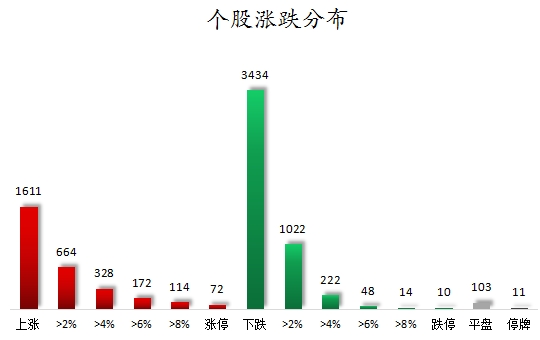
Market Overview - On October 13, the Shanghai Composite Index fell by 0.19%, the Shenzhen Component Index decreased by 0.93%, and the ChiNext Index dropped by 1.11% [1] - The Shanghai and Shenzhen 300 Index declined by 0.50% [1] - Among the tradable A-shares, 1,684 stocks rose, accounting for 31.05%, while 3,634 stocks fell [1] Capital Flow - The main capital experienced a net outflow of 38.169 billion yuan, marking the fourth consecutive trading day of net outflows [1] - The ChiNext saw a net outflow of 14.297 billion yuan, while the Sci-Tech Innovation Board had a net outflow of 3.681 billion yuan [1] - The Shanghai and Shenzhen 300 constituent stocks faced a net outflow of 10.916 billion yuan [1] Industry Performance - Among the 28 primary industries classified by Shenwan, 6 industries saw gains, with the non-ferrous metals and environmental protection sectors leading with increases of 3.35% and 1.65%, respectively [1] - The automotive and home appliance sectors had the largest declines, with decreases of 2.33% and 1.74% [1] Industry Capital Inflows - Nine industries experienced net inflows, with the steel industry leading at a net inflow of 1.351 billion yuan and a daily increase of 1.49% [3] - The non-ferrous metals sector followed with a net inflow of 1.087 billion yuan and a daily increase of 3.35% [3] Industry Capital Outflows - A total of 22 industries faced net outflows, with the electric equipment sector leading at a net outflow of 7.198 billion yuan and a daily decline of 0.68% [2] - The electronics sector also saw significant outflows, with a net outflow of 7.140 billion yuan and a slight decline of 0.05% [2] Individual Stock Performance - A total of 1,604 stocks experienced net inflows, with 552 stocks having inflows exceeding 10 million yuan [3] - The stock with the highest net inflow was Baogang Co., which rose by 9.84% with a net inflow of 1.860 billion yuan [3] - Conversely, stocks with the largest net outflows included BYD, with a net outflow of 1.508 billion yuan, followed by Sailis and Dongfang Wealth [3]

30股特大单净流入资金超2亿元
Zheng Quan Shi Bao Wang· 2025-10-13 09:18
Market Overview - The two markets experienced a net outflow of 17.085 billion yuan, with 30 stocks seeing a net inflow exceeding 200 million yuan, led by Baogang Co. with a net inflow of 2.436 billion yuan [1] - The Shanghai Composite Index closed down by 0.19%, with 1,682 stocks seeing net inflows and 3,060 stocks seeing net outflows [1] Industry Performance - Among the 10 industries with net inflows, the non-ferrous metals sector had the highest net inflow of 2.234 billion yuan, with an index increase of 3.35%. The steel industry followed with a net inflow of 2.090 billion yuan and a 1.49% increase [1] - A total of 21 industries experienced net outflows, with the automotive sector leading with a net outflow of 4.185 billion yuan, followed by the power equipment sector with a net outflow of 3.656 billion yuan [1] Individual Stock Performance - The top 30 stocks with net inflows over 200 million yuan included Baogang Co. (2.436 billion yuan), China Software (1.451 billion yuan), and Northern Rare Earth (869 million yuan) [2] - Stocks with significant net outflows included BYD with a net outflow of 1.176 billion yuan, followed by Sailyis and Dongfang Caifu with outflows of 922 million yuan and 892 million yuan, respectively [2][4] Stock Price Movements - Stocks with net inflows over 200 million yuan saw an average increase of 9.36%, outperforming the Shanghai Composite Index. Notable performers included Galaxy Magnetic Materials and Hongyuan Pharmaceutical, which closed at their daily limit [2] - The top stocks with net inflows and their respective price changes included Baogang Co. (+9.84%), China Software (+10.00%), and Northern Rare Earth (+10.00%) [2] Summary of Net Inflows and Outflows - The ranking of stocks with the highest net inflows included: - Baogang Co. (2.436 billion yuan) - China Software (1.451 billion yuan) - Northern Rare Earth (869 million yuan) [2] - The ranking of stocks with the highest net outflows included: - BYD (-1.176 billion yuan) - Sailyis (-922 million yuan) - Dongfang Caifu (-892 million yuan) [4]
中国软件涨停
Zhong Guo Jing Ji Wang· 2025-10-13 08:09
Core Viewpoint - China Software (SH:600536) experienced a significant stock price increase, closing at 54.34 yuan with a rise of 10.00%, resulting in a total market capitalization of 50.742 billion yuan [1]. Company Summary - The stock price of China Software reached its daily limit, indicating strong investor interest and confidence in the company's performance [1]. - The total market capitalization of China Software is reported at 50.742 billion yuan, reflecting its substantial position in the market [1].
超3600只个股下跌
Di Yi Cai Jing· 2025-10-13 07:41
Market Overview - On October 13, A-shares opened lower but closed higher, with the Shanghai Composite Index down 0.19%, the Shenzhen Component Index down 0.93%, and the ChiNext Index down 1.11%. The Sci-Tech Innovation 50 Index rose over 1% [1][2]. Sector Performance - The self-controlled industrial chain saw a significant surge, particularly in the rare earth permanent magnet sector, which experienced a wave of涨停 (limit-up) stocks. Other strong sectors included lithography machines, lithium batteries, rare metals, and operating systems, while robotics, consumer electronics, auto parts, and CRO concepts generally declined [2]. - Specific stocks in the rare earth permanent magnet sector, such as Galaxy Magnetic, New Lai Fu, and Northern Rare Earth, saw涨停, with over 10 stocks hitting the limit-up [2]. Trading Volume and Stock Movement - The total trading volume in the Shanghai and Shenzhen markets was 2.35 trillion yuan, a decrease of 160.9 billion yuan compared to the previous trading day, with over 3,600 stocks declining [2]. - Major inflows were observed in steel, banking, and non-ferrous metals sectors, with net inflows into Baogang Co., China Software, and Northern Rare Earth amounting to 1.758 billion yuan, 959 million yuan, and 724 million yuan, respectively. Conversely, significant outflows were noted in consumer electronics, auto parts, and batteries, with BYD, Luxshare Precision, and Seres facing net outflows of 1.424 billion yuan, 1.103 billion yuan, and 1.098 billion yuan, respectively [6]. Institutional Insights - Guotai Junan Securities noted that recent market fluctuations do not alter the long-term positive outlook for the stock market. External shocks leading to asset declines present a good opportunity to increase holdings in the Chinese market. The current trade risks are clearer compared to previous shocks, and domestic financial stability is more assured, suggesting that external disturbances will not end the upward trend. Short-term adjustments and structural opportunities coexist, with a continued positive outlook on technology growth, finance, and certain cyclical sectors [7]. - Guoyuan Securities highlighted that the rare earth sector is experiencing short-term rotations, with mid-term value reassessment driving upward volatility [7].