
NJEC(600699)

Search documents
均胜电子投资灵巧手公司「临界点」,已完成机器人核心部件布局
Quan Jing Wang· 2026-02-11 05:29
Group 1 - The core viewpoint of the article is that Agilink, a company specializing in robotics, has successfully completed a new round of financing amounting to several hundred million yuan, with participation from various industry investors including Joyson Electronics [1] - The financing round involved major internet companies, leading capital firms, industrial capital, financial institutions, and existing shareholders [1] - Agilink is positioned as a key player in the transition from "model capability" to "real-world operational capability" in embodied intelligence, which is crucial for accelerating the deployment of robots in industrial scenarios [1] Group 2 - Since 2025, Joyson Electronics has set two main goals: to promote the research and manufacturing of core robotic components and to facilitate the application of these technologies in industrial settings [1] - Joyson Electronics has released a series of products including robotic head assemblies, thoracic and chassis assemblies, sensor kits, energy management systems, and lightweight mechas, effectively completing the core component layout for embodied intelligent robots [1] - Human-shaped robots have already undergone scenario training at Joyson Electronics' factory in Ningbo, indicating progress in the practical application of robotics in industrial environments [1] Group 3 - Agilink, formerly known as the dexterous hand department of Zhiyuan Robotics, was established on January 14, 2026, as Shanghai Agilink Innovation Intelligent Technology Co., Ltd [1] - The company has successfully completed three rounds of financing, with its legal representative being Deng Taihua, the chairman and CEO of Zhiyuan Robotics, and led by Xiong Kun [1]

千台规划量产、节拍比人快6秒,机器人工厂落地还有多远?
2 1 Shi Ji Jing Ji Bao Dao· 2026-02-10 11:06
Group 1 - The core viewpoint of the article highlights the significant advancements in the deployment of humanoid robots in high-end manufacturing, particularly in the automotive and electronics sectors, with companies like Ningbo Joyson Electronics achieving a success rate of approximately 99% in robotic operations [1][3] - Morgan Stanley has doubled its forecast for humanoid robot sales in China by 2026 to 28,000 units, indicating a strong consensus between capital and industry on the role of robots in high-end manufacturing [1][3] - The deployment of the ZhiYuan G2 robot in Ningbo has demonstrated impressive efficiency, with a cycle time of 12 seconds, outperforming human workers by 6 seconds [4] Group 2 - The current focus of the robotics industry is on high-precision manufacturing sectors such as automotive parts, 3C electronics, and semiconductors, driven by the need for standardized industrial environments and labor shortages [3][4] - Companies like Tianqi Co. and UBTECH have established joint ventures to develop humanoid robot applications, particularly in logistics and automotive manufacturing, aiming for large-scale deployment [3][4] - The G2 robot's operational success is attributed to its ability to achieve a placement success rate of 99.33% through reinforcement learning, showcasing the potential for rapid training and deployment in industrial settings [4][8] Group 3 - Despite the promising efficiency of robots in isolated tasks, challenges remain for full integration into production lines, particularly regarding delivery capabilities and supply chain constraints [5][6] - Key components for robot production face bottlenecks, with some suppliers not investing in molds due to rapid product iterations, leading to reliance on imported equipment for precision processing [7] - The integration of robots into manufacturing execution systems (MES) and programmable logic controllers (PLC) is essential for large-scale deployment, with the G2 robot already meeting operational requirements for continuous work [7][8]



深度梳理!均胜电子的投资版图:智驾+机器人双线发力
Feng Huang Wang Cai Jing· 2026-02-10 09:56
Core Viewpoint - The listing of Aisin Yuan Zhi, a leading AI chip company in Hong Kong, highlights the strategic investments of Junsheng Electronics in the smart automotive and robotics sectors, aiming to strengthen its industry position through diversified investments and acquisitions [1][8]. Investment in Core Sectors: Focus on Smart Driving and Chips - Junsheng Electronics emphasizes smart driving as a primary focus, with chips being crucial for intelligent driving systems, creating a comprehensive ecosystem from perception to decision-making [2]. - Aisin Yuan Zhi is a global leader in AI inference system chips, enhancing Junsheng's AI perception and computing capabilities through its proprietary NPU technology [2]. - Junsheng has increased its stake in New Chip Hangtu, a company specializing in autonomous driving chip design, which has developed a high-performance chip for urban NOA, positioning Junsheng in the high-end vehicle market [2]. - The collaboration with Hezhima Smart, a domestic leader in intelligent driving chips, has led to the mass production of integrated cockpit solutions, enhancing Junsheng's domestic chip ecosystem [3]. - Tuda Technology, a provider of long-range lidar solutions, has delivered over 600,000 units, supporting advanced autonomous driving and robotics applications, thus enhancing Junsheng's perception capabilities [3]. - Ouyue Semiconductor focuses on the third-generation E/E architecture for smart vehicles, significantly reducing development costs and time for Junsheng's new products [3]. Investment in Emerging Fields: Focus on Embodied Intelligent Robots - Junsheng Electronics is strategically investing in embodied intelligent robots, leveraging its existing automotive technology to gain a competitive edge in this sector [4]. - The company is also exploring onboard optical module communication, aligning with trends in high-level smart driving and vehicle networking, with plans to develop a 1.6T silicon photonic chip for automotive applications by 2026 [4]. Expanding Investment Boundaries through Industry Funds - Junsheng is participating in the establishment of industry funds to integrate resources and broaden its investment scope, achieving a win-win through professional investment and industry collaboration [5]. - The Fund for Service Trade Phase II, with a total investment of 10 billion yuan, aligns with Junsheng's focus on digital economy and smart transportation, allowing for the identification of quality targets in intelligent driving and robotics [6]. - The Zhaoshang Zhiyuan Industry Fund, with a total commitment of 800 million yuan, enables Junsheng to leverage investment management expertise to target high-quality enterprises in the smart automotive and robotics sectors [6]. Financial Backing: Hong Kong Listing and Accelerated Acquisition Strategy - Junsheng Electronics raised 3.41 billion HKD through its Hong Kong listing, with part of the funds earmarked for potential investments and acquisitions, providing a solid financial foundation for expanding its investment landscape [7]. - The company is expected to continue focusing on smart automotive and embodied intelligent robotics sectors, aiming to fill industry gaps and enhance core technological advantages through strategic investments and acquisitions [7]. Summary: Industry Logic as Core, Capital as Wings - Junsheng Electronics maintains a clear investment logic centered on its core businesses in smart automotive and robotics, utilizing a three-dimensional approach of direct investments, industry fund establishment, and capital from its Hong Kong listing to achieve technological synergy and industry collaboration [8]. - The company's projected net profit for 2025 is approximately 1.35 billion yuan, indicating a continuous improvement in profitability that supports its investment strategy [8]. - Each investment is strategically aligned with Junsheng's industry needs, aiming to either fill gaps, strengthen advantages, or explore new growth opportunities, ultimately reinforcing its global position in the automotive and robotics sectors [8].
这家上市公司,增资约10%
Sou Hu Cai Jing· 2026-02-10 08:26
Core Viewpoint - Junsheng Electronics (均胜电子) has increased its registered capital from approximately 1.41 billion RMB to about 1.55 billion RMB, marking an increase of approximately 10% [1]. Group 1: Company Overview - Junsheng Electronics Co., Ltd. was established in August 1992 and is represented by Wang Jianfeng. The company's business scope includes mold design, manufacturing, processing, manufacturing project investment, and import-export of goods and technology [1]. - The shareholders of Junsheng Electronics include Junsheng Group Co., Ltd., Hong Kong Central Clearing Limited, and Wang Jianfeng among others [1]. Group 2: Capital Change - The registered capital change reflects an increase from 1,408,701,543.00 RMB to 1,550,770,563.00 RMB, which is an increase of 10.0851% [2].
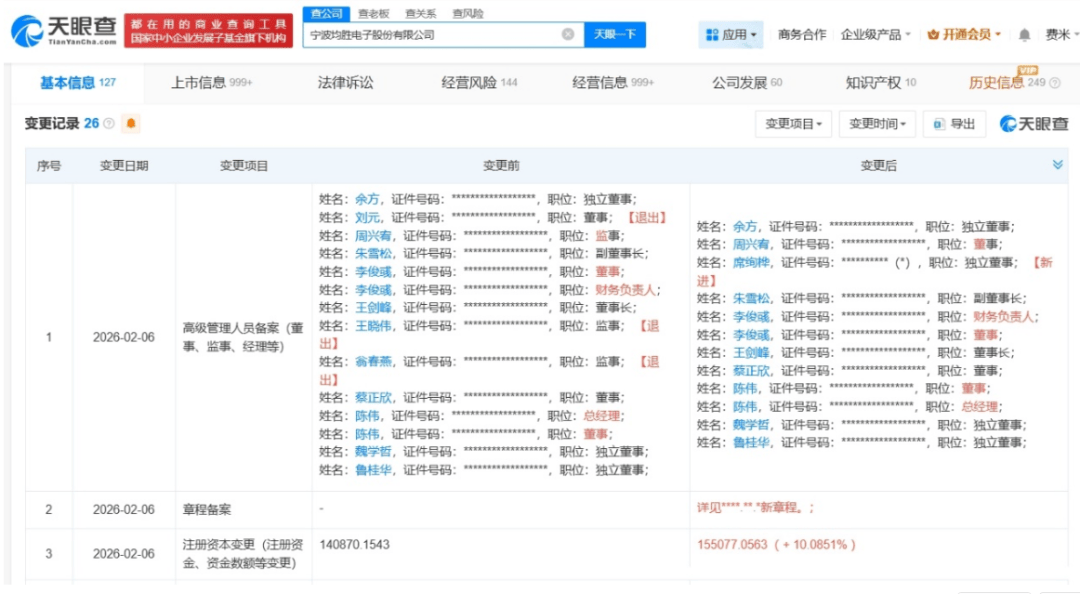
均胜电子增资至15.5亿元
Sou Hu Cai Jing· 2026-02-10 04:17
Core Viewpoint - Recently, Joyson Electronics (均胜电子) has increased its registered capital from approximately 1.41 billion RMB to about 1.55 billion RMB, marking an increase of approximately 10% [1]. Company Information - Joyson Electronics was established in August 1992 and is legally represented by Wang Jianfeng. The company's business scope includes mold design, manufacturing, processing, manufacturing project investment, and import-export of goods and technology [1][3]. - The company is a publicly listed entity and operates in the electronic device manufacturing sector [3]. Shareholder Information - The shareholders of Joyson Electronics include Joyson Group Limited, Hong Kong Central Clearing Limited, and Wang Jianfeng among others [1][4]. - The major shareholders hold the following percentages: Joyson Group Limited (37.31%), Hong Kong Central Clearing Limited (6.66%), and Wang Jianfeng (2.54%) [4].
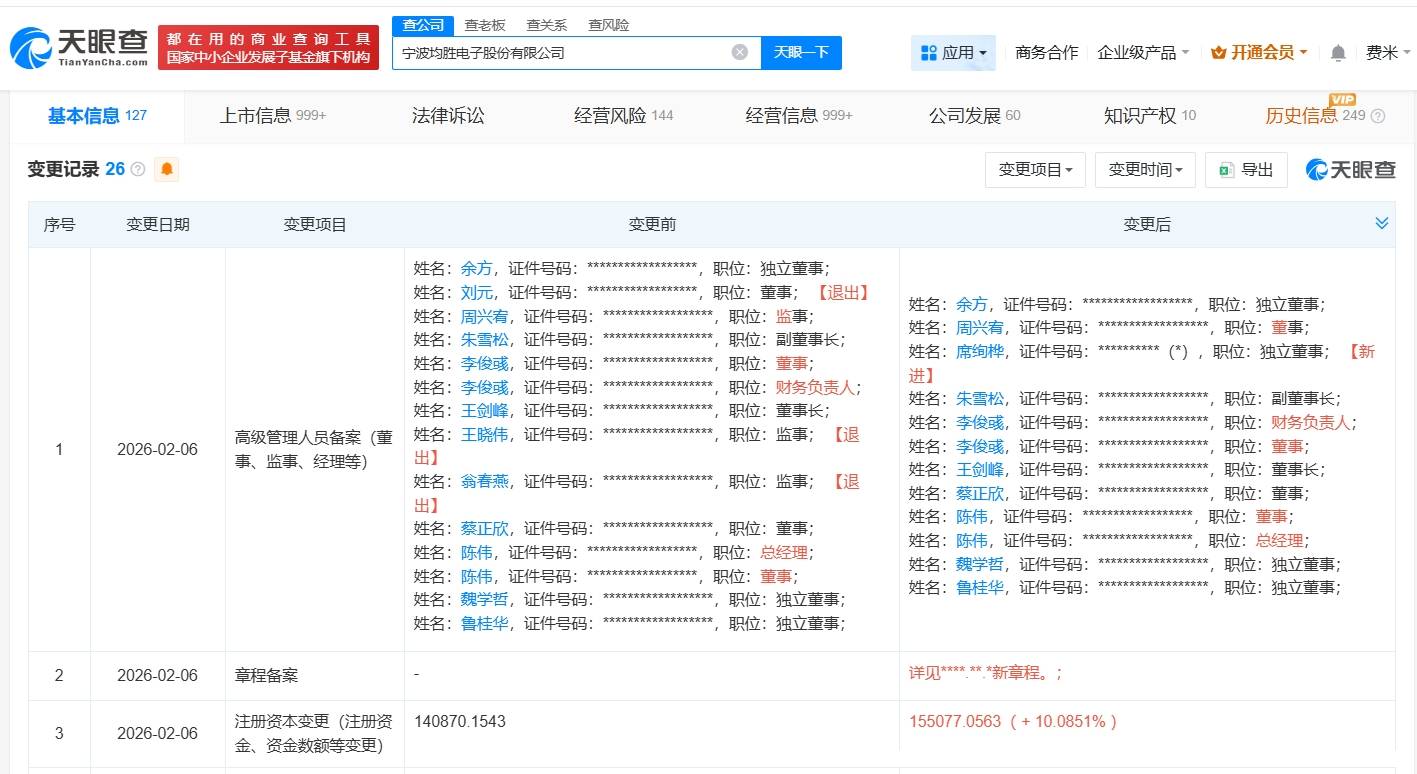
均胜电子增资至15.5亿,增幅约10%
Xin Lang Cai Jing· 2026-02-10 03:27
Core Viewpoint - Junsheng Electronics has increased its registered capital by approximately 10%, from about 1.41 billion RMB to about 1.55 billion RMB, indicating growth and potential for further investment opportunities [1] Company Information - Junsheng Electronics Co., Ltd. was established in August 1992 and is represented by Wang Jianfeng [1] - The company's business scope includes mold design, manufacturing, processing, manufacturing project investment, and import and export of goods and technology [1] - Shareholder information reveals that the company is jointly held by Junsheng Group Co., Ltd., Hong Kong Central Clearing Limited, and Wang Jianfeng [1]
【汽车零部件&机器人主线周报】Optimus再获马斯克高度评价,智元将举办机器人晚会
东吴汽车黄细里团队· 2026-02-09 15:55
Investment Highlights - The SW auto parts index increased by 0.34% this week, ranking 4th among SW automotive sectors, with a year-to-date increase of 3.20% [3][14] - The latest PE (TTM) for SW auto parts is at the 83.10% historical percentile, while the PB (LF) is at the 77.55% historical percentile [3][35] - The Wande robot index decreased by 0.21% this week, with a year-to-date increase of 0.27%, underperforming the SW auto parts sector by 0.55% [4][14] - The latest PE (TTM) for the Wande robot index is at the 67.47% historical percentile, and the PB (LF) is at the 77.11% historical percentile [4][44] Key Stock Movements - The top five gainers this week are: - Yinchuan Co., Ltd. +17.13% - Xingyu Co., Ltd. +8.65% - Daimai Co., Ltd. +6.67% - Yap Co., Ltd. +3.71% - Ruima Precision +2.74% [6][51] Major Events - On February 4, Elon Musk publicly praised Optimus again - On February 8, Zhiyuan will host the world's first large-scale robot gala [7][45] Core Coverage Changes - Xinquan announced a $100 million investment in Bayern Xinquan and the establishment of subsidiaries in Malaysia and Kaifeng - Precision Forging Technology established a subsidiary in Germany [8][54] Investment Recommendations - For auto parts, focus on structural opportunities by selecting product-oriented companies and those entering high-value sectors to increase ASP, with a priority on potential leading companies in Europe, North America, and Southeast Asia [9][56] - For robots, seek certainty in opportunities, with Musk stating that Optimus V3 is expected to be released in Q1 2026, and monitor the order timeline and application deployment by domestic companies like Xiaopeng, Yushu, and Zhiyuan [9][56]





中国汽车 - 智能驾驶座舱加速走向集成-China Autos & Shared Mobility-One box, one dream - Smart-drivingcockpit racing towards integration
2026-02-05 02:22
Summary of Conference Call on China Autos & Shared Mobility Industry Overview - The focus is on the integration of smart-driving and cockpit functionalities within the automotive industry, particularly in China. This integration is expected to accelerate significantly in the next 6-12 months due to advancements in VLA (vision-language-action) models and a pressing need for cost savings [1][2]. Key Insights 1. **Integration of Smart Systems**: The integration of smart cockpit and smart driving systems is anticipated to reach a new level, with penetration rates of approximately 80% for smart cockpits and 60% for smart driving (L2 and above) in China by 2025. This shift is driven by the synergy between these systems, increased AI computing needs, and OEMs' focus on cost savings [2][3]. 2. **Cost Savings from Integration**: Integrating cockpit and driving functions onto a single SoC (System on Chip) could yield cost savings of Rmb2-3k per vehicle by eliminating the need for separate hardware components. This integration is expected to make advanced features accessible in vehicles priced below Rmb150k [10][11]. 3. **Technological Advancements**: The automotive industry is witnessing rapid technological upgrades, with chip processes advancing from 7nm to 5nm and below. This is crucial for meeting the higher computing power demands of L3 autonomous driving systems, which require onboard computing power ranging from 700 to 2250 TOPS [4]. 4. **Market Dynamics**: Companies like Horizon Robotics are positioned to benefit from this trend, provided they can compete effectively with established players like Nvidia in the SoC market. However, this integration poses risks for tier-one DCU makers, as it may lead to a decrease in the value content of their products [11][16]. Additional Considerations - **Supplier Landscape**: Key suppliers and OEMs adopting integrated smart cockpit and driving solutions are highlighted, indicating a shift in the competitive landscape within the industry [11]. - **Risks**: Potential risks include slower-than-expected adoption of ADAS/AD technologies, supply chain disruptions, and successful in-house hardware design initiatives by OEMs [18]. Conclusion The automotive industry in China is on the brink of significant transformation with the integration of smart-driving and cockpit functionalities. This shift is driven by technological advancements, cost-saving measures, and changing market dynamics, presenting both opportunities and risks for stakeholders involved.


均胜电子(600699) - H股公告(截至2026年1月31日止之股份发行人的证券变动月报表)
2026-02-03 10:45
FF301 股份發行人及根據《上市規則》第十九B章上市的香港預託證券發行人的證券變動月報表 截至月份: 2026年1月31日 狀態: 新提交 公司名稱: 寧波均勝電子股份有限公司 呈交日期: 2026年2月3日 I. 法定/註冊股本變動 | 1. 股份分類 | 普通股 | 股份類別 H | | | 於香港聯交所上市 (註1) | | 是 | | | --- | --- | --- | --- | --- | --- | --- | --- | --- | | 證券代號 (如上市) | 00699 | 說明 | | | | | | | | | | 法定/註冊股份數目 | | | 面值 | | 法定/註冊股本 | | | 上月底結存 | | | 155,100,000 | RMB | | 1 RMB | | 155,100,000 | | 增加 / 減少 (-) | | | | 0 | | RMB | | 0 | | 本月底結存 | | | 155,100,000 | RMB | | 1 RMB | | 155,100,000 | | 2. 股份分類 | 普通股 | 股份類別 | A | | 於香港聯交所上市 ( ...
自动驾驶元年,一二级市场或将迎来估值重塑
Huan Qiu Wang· 2026-01-30 03:02
Group 1 - The Shanghai government has launched the "Mosu Zhixing" action plan aiming for large-scale implementation of high-level autonomous driving scenarios by 2027, emphasizing "cross-domain connectivity" and "scene integration" [1] - The focus of autonomous driving development has shifted from mere vehicle intelligence to a spatial service network deeply integrated with urban functions [1] Group 2 - Citic Securities notes that Tesla's FSD V14 may have reached near Level 4 autonomy, with expectations for a relaxed regulatory environment, making 2026 a potential year for commercializing autonomous driving [2] - The industry is undergoing a paradigm shift, moving from "transportation technology validation" to "scaled scene services and sustainable operations" [2][3] - Nvidia's launch of the "Alpamayo" platform aims to accelerate the development of autonomous vehicles and support new-generation robots, indicating a shift towards a composite model of "space services + high-frequency operations" [2] Group 3 - The competitive landscape is evolving from a focus on "chip-algorithm-data" self-research to an ecosystem collaboration, with Nvidia's open-source approach lowering R&D barriers for second-tier automakers and tech companies [3] - Companies like PIX are exemplifying new business models by launching commercial operations such as the "WonderLoop" project, which integrates smart transportation into urban infrastructure [3] Group 4 - The changing industry dynamics are leading to a revaluation in the capital markets, with companies like Joyson Electronics being recognized for their role in integrating open-source models into production [4] - Joyson Electronics has seen its market value increase from 24 billion on January 28, 2025, to 44 billion on January 28, 2026, reflecting market recognition of its upgraded positioning as "automotive + robotics Tier 1" [4] Group 5 - The competition in the second half of the autonomous driving sector will hinge on understanding specific scenarios, building sustainable business models, and enhancing collaborative efficiency within the open industry ecosystem [5][6] - Innovative companies like PIX are focusing on "urban robots" to avoid saturated competition, leveraging modular chassis for flexible configurations and efficient integration into the open industry ecosystem [6]
