
Bank Of Jiangsu(600919)

Search documents
1月以来机构扎堆调研优质股曝光 大金重工获318家机构调研居首
Mei Ri Jing Ji Xin Wen· 2026-02-22 04:57
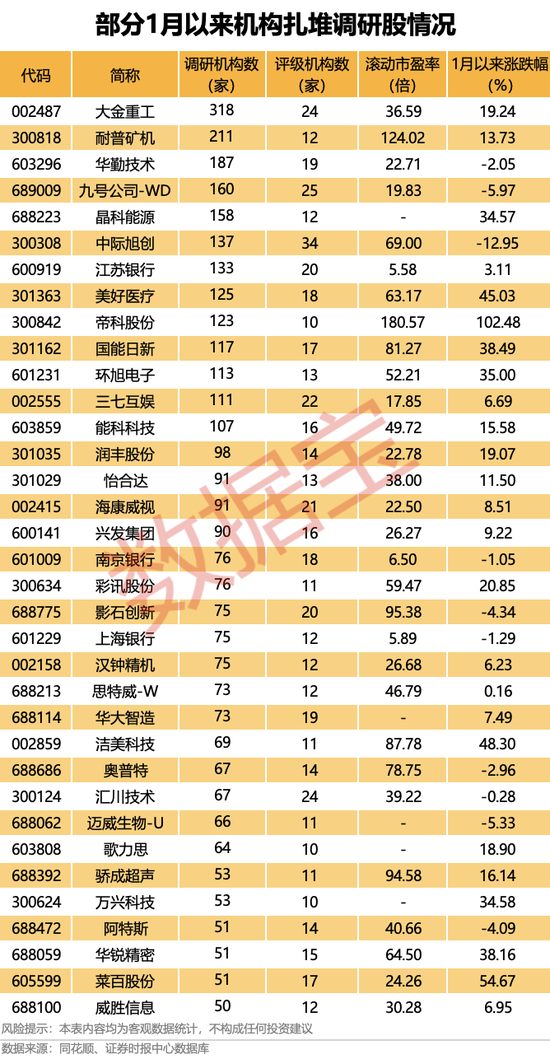
每经AI快讯,据证券时报·数据宝统计,1月以来,调研机构数在50家及以上且评级机构数在10家及以上 的公司,合计有35家。其中,大金重工获得318家机构调研居首。从评级机构数来看,中际旭创获34家 机构评级居首。江苏银行、上海银行、南京银行3只银行股进入榜单,其中江苏银行有多达133家机构调 研。数据显示,上榜个股今年以来平均涨幅超过16%,远超大盘同期表现。其中,帝科股份、菜百股 份、洁美科技、美好医疗等个股均涨超40%。 ...





机构扎堆调研的优质股曝光!
Xin Lang Cai Jing· 2026-02-22 04:21
节后行情怎么走?机构扎堆调研情况或提供一些线索。 随着春节假期进入尾声,市场即将重新开市,投资者关注度逐渐升温,机构资金的动向尤为引人瞩目。 其中,大金重工获得318家机构调研居首。公司在近期的调研中表示,英国AR7拍卖了8.4GW的海风项 目,超出前期市场预计数量,项目规模和补贴金额均创历史新高,固定式和漂浮式项目的执行电价相较 上一轮均实现同比上升,补贴年限也从15年延长至20年,提高了开发商的参与热情。另外,AR8预计在 今年也将拍出一定体量的项目量。本轮AR7中标的业主是公司已合作的重要客户,公司对本年市场订单 的获取很有信心。 从评级机构数来看,中际旭创获34家机构评级居首。国泰海通证券认为,公司业绩符合预期。从行业情 况看,1.6T有望在2026年快速上量,2027年需求有望进一步大幅提升。公司为云数据中心客户提供 400G、800G和1.6T等高速光模块,赢得了海内外客户的广泛认可,并保持了市场份额的持续成长,有 望大幅受益。 江苏银行、上海银行、南京银行3只银行股进入榜单,其中江苏银行有多达133家机构调研。 在众多的市场参与主体中,机构投资者凭借其专业的研究能力和信息优势,往往能率先布局具备 ...


股份制银行差异化竞争,头部效应显著
Xin Lang Cai Jing· 2026-02-18 05:56
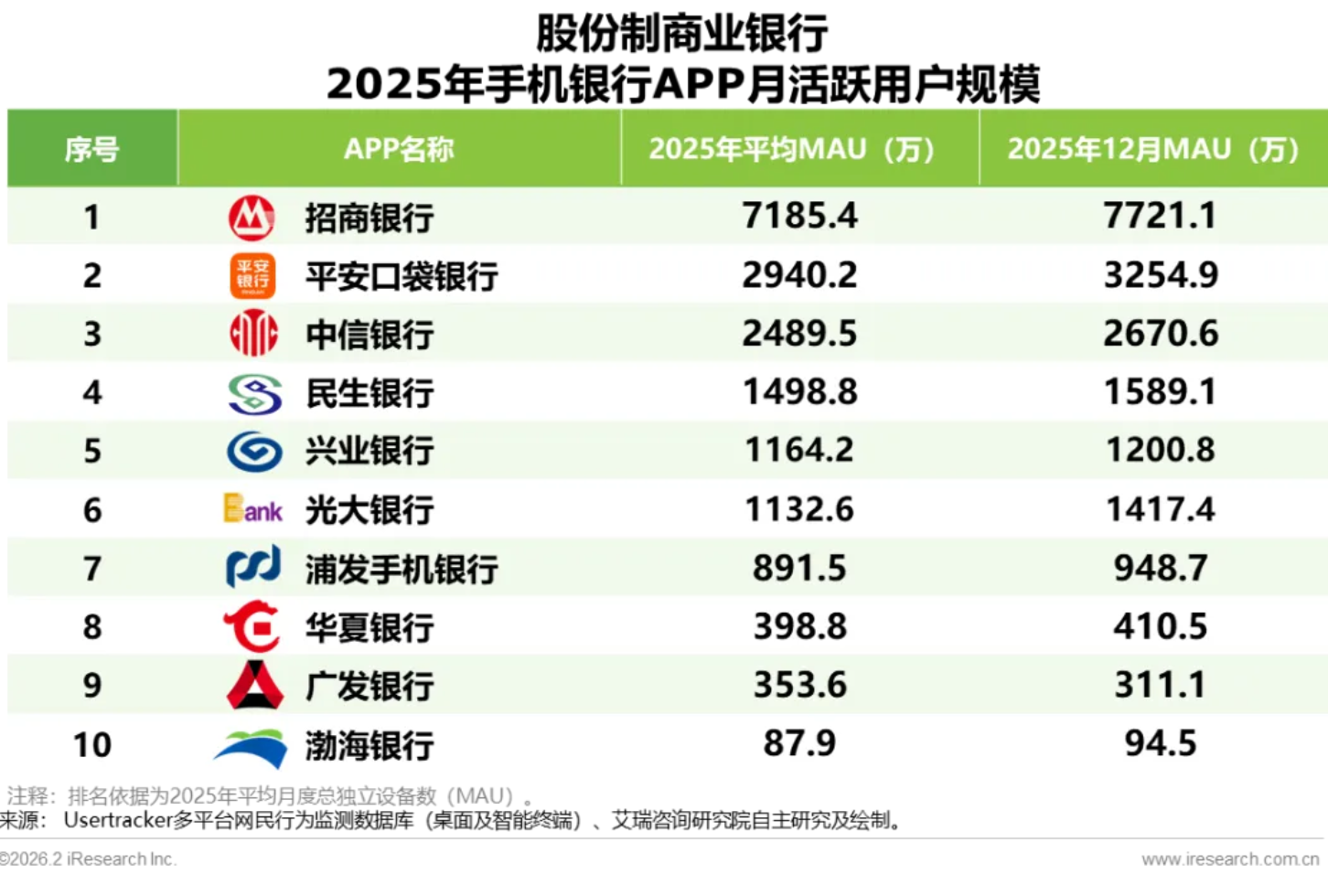
Core Insights - The mobile banking user base in China is expected to peak in 2025, shifting the industry focus from acquiring new users to enhancing existing user engagement [1] - Financial institutions must achieve extreme efficiency and precision in their ecosystems to survive in this new environment [1] Industry Overview - According to an iResearch report, joint-stock banks are adopting differentiated survival strategies, leading to significant head effects [1] - China Merchants Bank leads joint-stock banks with 71.854 million monthly active users (MAU), surpassing some state-owned banks due to its focus on wealth management and intelligent interaction [1] - Ping An Bank and CITIC Bank form the second tier, maintaining MAUs between 20 million and 30 million, with Ping An Bank leveraging AI to reconstruct service chains and CITIC Bank integrating consumer ecosystems [1] Competitive Landscape - Third-tier institutions, such as Minsheng Bank and Everbright Bank, have seen their MAUs drop to between 10 million and 20 million, indicating a tightening survival space [1] - Local banks are experiencing growth by focusing on their local markets, with city commercial banks like Jiangsu Bank and Beijing Bank maintaining MAUs above 3 million [1] - Among rural commercial banks and rural credit cooperatives, Fujian Rural Credit has surpassed 4.5 million MAUs, capturing traffic in county and rural areas [1] Challenges for Private Banks - The situation for private banks is dire, with the top 50 list for 2025 nearly extinct due to a lack of physical branches, local living ecosystems, and high customer acquisition costs, leading to a loss of competitiveness in the mobile banking sector [1] - In the era of stock competition, ecological and regional capabilities are becoming the key to success [1]




国有大行主导手机银行市场,生态嵌入构筑护城河
Jing Ji Guan Cha Wang· 2026-02-18 05:47
Core Insights - The Chinese mobile banking market is entering a stage of stock competition in 2025, with monthly active users (MAU) stabilizing between 648 million and 739 million [2] - State-owned commercial banks dominate the market due to their ecological embedding advantages, with Agricultural Bank of China leading at 249 million MAU, followed by Industrial and Commercial Bank of China (194 million) and China Construction Bank (109 million) [2] - Private banks are expected to collectively exit the top 50 MAU rankings in 2025 due to a lack of offline branch support and local living ecosystems [2] Group 1: Major Players - Agricultural Bank of China has the highest MAU at 249 million, followed by Industrial and Commercial Bank of China with 194 million and China Construction Bank with 109 million, forming the first tier of banks [2] - China Bank and Postal Savings Bank have MAUs exceeding 50 million, constituting the second tier [2] - China Merchants Bank leads the joint-stock banks with 71.85 million MAU, while Ping An Bank and CITIC Bank form the second tier, with other joint-stock banks generally below 20 million MAU [2] Group 2: Market Dynamics - The core advantage of state-owned banks lies in their "full-scenario integration" capabilities, embedding services deeply into high-frequency life scenarios such as government affairs, social security, healthcare, and education [2] - Agricultural Bank of China extends its services to rural areas through intelligent service matching and customer customization, while Industrial and Commercial Bank of China utilizes its "Gong Xiao Zhi" model for interactive service [2] - Regional banks like Jiangsu Bank, Beijing Bank, and Ningbo Bank show stable performance by focusing on local markets, with some rural commercial banks like Fujian Rural Credit exceeding 4.5 million MAU, indicating the sustainability of localized operations in the stock market [2]




2.7分钟定生死 手机银行存量厮杀谁在“断臂”,谁在“吃肉”?
Jing Ji Guan Cha Wang· 2026-02-18 04:57
Core Insights - The report by iResearch indicates that the monthly active users (MAU) of mobile banking apps in China have stabilized after fluctuating between 648 million and 739 million, signaling a ceiling in user growth and a shift from acquiring new users to enhancing existing user engagement [2] - User behavior is undergoing a structural reversal, with the effective daily usage time per device dropping from 4.9 minutes in 2023 to around 2.7 minutes by mid-2025, leading to a focus on high-frequency, short-duration, and functional usage [2] - Financial institutions are compelled to streamline operations and focus resources on core transaction scenarios to survive in this competitive landscape, where efficiency and precision are paramount [2] Mobile Banking Market Overview - The top three banks in terms of MAU are Agricultural Bank of China (2.49 billion), Industrial and Commercial Bank of China (1.94 billion), and China Construction Bank (1.09 billion), with all six major state-owned banks ranking in the top ten [3][5][6] - Private banks, represented by WeBank and MYbank, have faced significant setbacks, with many dropping out of the top 50 MAU rankings by 2025 [4] Competitive Landscape - State-owned banks are solidifying their dominance through extensive customer bases and integrated ecosystems, leveraging services embedded in high-frequency life scenarios such as government services and healthcare [7] - Joint-stock commercial banks are adopting a "specialized and precise" survival strategy, with China Merchants Bank leading among them with 71.85 million MAU, focusing on wealth management and intelligent interaction [8][10] - Regional banks are thriving by deeply engaging with local markets, while private banks struggle due to high customer acquisition costs and lack of local ecosystem support [13][14] Future Outlook - The mobile banking market is transitioning from a phase of scale expansion to one of value cultivation, with state-owned banks building moats through ecosystems, joint-stock banks seeking niches through specialization, and regional banks solidifying their local roots [14] - The ability to create irreplaceable value in a limited user engagement environment will be crucial, with technology applications such as AI reshaping service processes and enhancing risk management [15][16]

银行行业2026年1月金融数据点评:政府债发力明显,股市活跃推动存款搬家
Zhong Guo Yin He Zheng Quan· 2026-02-15 06:24
Investment Rating - The report maintains a "Recommended" rating for the banking sector, highlighting its high dividend and low valuation attributes that continue to attract long-term capital [5]. Core Insights - The banking sector is experiencing a significant contribution from government bonds to social financing growth, with a notable increase in government bond issuance in January 2026 [5]. - The report indicates that while social financing has increased year-on-year, the growth rate has decreased compared to the previous month, primarily due to weaker RMB loans and fluctuating demand from the real economy [5]. - The capital market's activity is driving a "deposit migration" process, as increased market engagement leads to higher liquidity in the banking sector [5]. Summary by Sections Banking Industry - In January 2026, new social financing reached 7.22 trillion yuan, an increase of 165.4 billion yuan year-on-year, with government bonds being the main contributor [5]. - RMB loans increased by 4.9 trillion yuan, which is a decrease of 319.4 billion yuan year-on-year, influenced by demand fluctuations and debt restructuring [5]. - The report notes that short-term loans in the real sector have increased, while medium and long-term loans remain weak, particularly in the real estate sector, which saw a 28.5% decline in sales for major developers [5]. Market Activity - The report highlights that M1 and M2 growth rates are at 4.9% and 9% respectively, indicating an increase in liquidity [5]. - Financial institutions' RMB deposits increased by 9.9% year-on-year, with a monthly increase of 8.09 trillion yuan, driven by both household and corporate deposits [5]. - The report emphasizes the role of an active capital market in attracting deposits, with a 58% increase in average daily trading volume in January [5].

银行业周报:央行关注存款搬家,2025Q4银行业净利增速回正
Zhong Guo Yin He Zheng Quan· 2026-02-15 06:24
Investment Rating - The report maintains a "Recommended" rating for the banking sector, highlighting the continued attractiveness of high dividend yields and low valuations for long-term investors [5]. Core Insights - The banking sector is expected to benefit from a stable growth in scale and a recovery in net profit growth, with a year-on-year increase of 2.33% in net profit for 2025 [9][11]. - The central bank's monetary policy will continue to be moderately accommodative, focusing on structural optimization and financial support for key areas such as domestic demand and small and medium enterprises [7][8]. - The phenomenon of "deposit migration" is impacting the liability structure of banks, but overall liquidity remains stable [8][9]. Summary by Sections Latest Research Insights - The central bank's 2025Q4 monetary policy report emphasizes maintaining ample liquidity and optimizing financial resource allocation through fiscal and monetary policy coordination [7]. - The report indicates that the average weighted interest rate for new loans in 2025 was 3.15%, a decrease of 9 basis points compared to the previous year [7]. Weekly Market Performance - The banking sector underperformed the market, with a decline of 1.31% compared to a 0.36% increase in the CSI 300 index [5]. - The current price-to-book ratio for the banking sector is 0.64, with a dividend yield of 4.64% [5]. Regulatory and Policy Updates - The banking sector's key regulatory indicators for 2025Q4 show a net profit growth recovery, with total assets increasing by 9% year-on-year [9][10]. - The non-performing loan ratio decreased to 1.5%, indicating an improvement in asset quality across various types of banks [10][11]. Investment Recommendations - The report suggests focusing on banks with low valuations and high dividend yields, recommending specific banks such as ICBC, Agricultural Bank of China, and Postal Savings Bank [5][39]. - The anticipated continuation of accommodative monetary policy and structural financial support is expected to enhance the effectiveness of policies aimed at boosting domestic demand [5][7].
2026年1月金融数据点评:存款搬家加速,M1、M2增速大幅回升
GF SECURITIES· 2026-02-14 05:23
Investment Rating - The industry rating is "Buy" [6] Core Insights - The overall social financing growth slightly declined to 8.2% in January, while M1 and M2 growth rates significantly rebounded, with M1 growing by 4.9% and M2 by 9.0% [6][16] - Government net financing increased significantly by 2,831 billion yuan year-on-year, contributing to the overall social financing growth [6][17] - The report indicates a shift in deposit structure due to accelerated deposit migration, impacting M1 negatively while having limited effect on M2 [6][16] Summary by Sections Overall Situation - Social financing growth decreased slightly to 8.2%, while M1 and M2 growth rates increased significantly [15][16] - M1 and M2 growth rates rose by 1.1 percentage points and 0.5 percentage points respectively compared to the previous month [6][16] Government Sector - Fiscal strength showed a year-on-year decline, impacting overall financing dynamics [39] Household Sector - Demand remained stable year-on-year, with short-term loan demand increasing [39] Corporate Sector - Short-term loan demand increased year-on-year, while bill financing saw a significant reduction [39] Non-Bank Sector - The acceleration of deposit migration was noted, with non-bank deposits increasing by 1.45 trillion yuan year-on-year [6][39]


最新21家系统重要性银行名单公布
Jing Ji Ri Bao· 2026-02-14 04:21
Group 1 - The People's Bank of China and the National Financial Regulatory Administration have conducted an assessment for the 2025 systemically important banks, identifying 21 domestic banks as systemically important, including 6 state-owned commercial banks, 10 joint-stock commercial banks, and 5 city commercial banks [1][3] - The list aims to establish a comprehensive macro-prudential management system and strengthen the regulation of systemically important financial institutions [2] Group 2 - Systemically important banks in China are categorized into five groups based on their importance scores, with the first group consisting of 11 banks, the second group having 4 banks, the third group with 2 banks, the fourth group containing 4 banks, and no banks in the fifth group [3] - The People's Bank of China plans to enhance the combined effect of macro-prudential management and micro-prudential regulation, continuing to solidify additional supervision for systemically important banks to promote their safe and sound operation and better serve the high-quality development of the real economy [3]


国内系统重要性银行名单发布 21家银行入选
Cai Jing Wang· 2026-02-14 02:03
Core Viewpoint - The People's Bank of China has conducted an assessment of systemically important banks for 2025, identifying 21 domestic banks categorized into five groups based on their systemic importance scores [1] Group 1: Assessment Overview - The assessment is part of a broader effort to establish a comprehensive macro-prudential management system and strengthen the regulation of systemically important financial institutions [1] - The evaluation was carried out in collaboration with the National Financial Regulatory Administration [1] Group 2: Classification of Banks - A total of 21 banks were recognized as systemically important, including 6 state-owned commercial banks, 10 joint-stock commercial banks, and 5 city commercial banks [1] - The banks are divided into five groups based on their systemic importance scores: - Group 1: 11 banks including China Minsheng Bank, China Everbright Bank, Ping An Bank, Huaxia Bank, Ningbo Bank, Jiangsu Bank, Beijing Bank, Nanjing Bank, Guangfa Bank, Zheshang Bank, and Shanghai Bank [1] - Group 2: 4 banks including Industrial Bank, China CITIC Bank, Shanghai Pudong Development Bank, and China Postal Savings Bank [1] - Group 3: 2 banks including Bank of Communications and China Merchants Bank [1] - Group 4: 4 banks including Industrial and Commercial Bank of China, Bank of China, China Construction Bank, and Agricultural Bank of China [1] - Group 5: No banks were classified in this group [1]