CNOOC(600938)

Search documents
中国海油2月3日获融资买入1.22亿元,融资余额15.88亿元
Xin Lang Cai Jing· 2026-02-04 02:56
来源:新浪证券-红岸工作室 2月3日,中国海油涨0.75%,成交额14.52亿元。两融数据显示,当日中国海油获融资买入额1.22亿元, 融资偿还1.52亿元,融资净买入-2993.49万元。截至2月3日,中国海油融资融券余额合计15.96亿元。 融资方面,中国海油当日融资买入1.22亿元。当前融资余额15.88亿元,占流通市值的1.57%,融资余额 低于近一年30%分位水平,处于低位。 融券方面,中国海油2月3日融券偿还4.29万股,融券卖出3.20万股,按当日收盘价计算,卖出金额 108.10万元;融券余量24.25万股,融券余额819.16万元,低于近一年30%分位水平,处于低位。 资料显示,中国海洋石油有限公司位于北京市东城区朝阳门北大街25号,香港花园道1号中银大厦65层, 成立日期1999年8月20日,上市日期2022年4月21日,公司主营业务涉及中国海洋石油有限公司是一家主 要从事原油和天然气的勘探、生产及销售的中国公司。该公司经营三个分部。勘探及生产分部从事常规 油气业务、页己油气业务、油砂业务和其他非常规油气业务。贸易业务分部从事原油转口贸易业务。公 司业务分部从事总部管理、资金管理以及研究开 ...

【行业深度】一文洞察2026年中国沥青行业发展前景及投资趋势研究报告
Sou Hu Cai Jing· 2026-02-04 02:20
Core Viewpoint - The demand for asphalt in China remains strong due to ongoing economic development and infrastructure construction, but the industry is entering a new phase characterized by supply surplus and limited capacity growth [2]. Group 1: Industry Overview - The asphalt industry in China has seen a steady increase in production capacity, reaching 79 million tons in 2023, with an annual increase of 8 million tons, representing a growth of 11.27% year-on-year [2]. - The average operating rate of refineries has remained low at around 50%, indicating a persistent supply surplus in the domestic asphalt market [2]. - The production profit for asphalt is expected to drop to its lowest point in recent years in 2024, which will further inhibit refineries from increasing production capacity [2]. Group 2: Demand and Supply Factors - The overall demand for asphalt is projected to decline due to local fiscal pressures and stricter approvals for infrastructure projects [2]. - Potential implementation of a consumption tax policy could significantly increase production costs, further weakening the willingness of refineries to expand production [2]. Group 3: Industry Development History - The asphalt industry in China began to develop significantly in the 1980s with the construction of high-grade highways, leading to increased demand for asphalt [7]. - The "Twelfth Five-Year Plan" period saw rapid development in various transportation modes, which further stimulated the asphalt industry [7]. - The "Thirteenth Five-Year Plan" period is characterized by a focus on supporting major national strategies, indicating a broad market potential for the asphalt industry [7]. Group 4: Industry Chain - The upstream of the asphalt industry chain includes raw materials such as coal, emulsifiers, modifiers, and petrochemicals [9]. - The midstream involves the production and manufacturing of asphalt, while the downstream applications include highways, waterproof building materials, municipal road construction, and airport construction [9]. Group 5: Future Outlook - The asphalt industry is expected to face stagnation in capacity growth due to multiple factors, including declining demand and rising production costs [2]. - The continuous expansion of the highway network and periodic maintenance needs will provide stable and sustained market demand for the asphalt industry in the future [14].




A股低开,贵金属板块走强
第一财经· 2026-02-04 01:48
Market Overview - The A-share market opened lower with the Shanghai Composite Index down 0.08%, the Shenzhen Component down 0.39%, and the ChiNext Index down 0.80% [3][4] - The Hong Kong market also opened lower, with the Hang Seng Index down 0.14% and the Hang Seng Tech Index down 0.87% [5][6] Sector Performance - The storage chip sector experienced significant declines, with companies like Deep Kangjia A hitting the daily limit down, and others such as Puran, Lanke Technology, Baiwei Storage, and Shannon Chip also opening lower [2] - The AI computing power industry chain saw a downturn, particularly in the storage and CPO sectors, while semiconductor and consumer electronics themes were among the hardest hit [4] - Conversely, gold, basic metals, and oil and gas sectors showed signs of rebound [4]



油气ETF华泰柏瑞(561570)开盘涨1.22%,重仓股中国海油涨1.98%,中国石油涨2.01%
Xin Lang Cai Jing· 2026-02-04 01:42
Group 1 - The oil and gas ETF Huatai-PB (561570) opened with a gain of 1.22%, priced at 1.331 yuan [1] - Major holdings in the ETF saw positive movements: CNOOC rose by 1.98%, PetroChina by 2.01%, Sinopec by 0.79%, and others like Jereh, COSCO Shipping, and Guanghui Energy also experienced gains [1] - The ETF's performance benchmark is the CSI Oil and Gas Industry Index, managed by Huatai-PB Fund Management Co., with a return of 31.70% since its inception on October 9, 2024, and a monthly return of 14.01% [1]


渤中19-4油田连续三年产油超百万吨
Zhong Guo Hua Gong Bao· 2026-02-03 23:16
为实现"破局",渤西作业公司多点发力,聚焦"工艺系统处理能力低、储量动用率低、注采井网不完 善"等难题,多专业协同开展攻关提效。通过使用绿色短工艺全流程系统,实现油田原油日处理能力翻 倍;通过"设计依托—钻采同步—岸基预制—海上安装"的递进式施工,构建起"生产油田模块化协同开 发"新模式。新项目自2025年6月试生产以来,增产原油超10万吨。 渤中19-4油田位于渤海西南部海域,是渤西作业公司增储上产主力军,由一座中心处理平台和两座井口 平台组成,是我国海上典型的极窄河道油田,具有储层展布复杂、储量丰度低、层间矛盾明显、纵向叠 合差等突出特点。历经15年高效开发,油田主力砂体已全部动用,剩余非主力砂体储量规模小,难以动 用,逐渐陷入"稳产难、增产更难"的困局。 中化新网讯 近日,从中国海油(600938)渤海油田传来消息,渤西作业公司渤中19-4油田2025年累产 原油继续保持100万吨高位。自2023年油田原油产量首破百万吨大关以来,该油田已连续三年实现稳产 原油超100万吨。 ...
中国海洋石油(00883.HK):2月3日南向资金减持2170.59万股
Sou Hu Cai Jing· 2026-02-03 19:44
中国海洋石油有限公司是一家主要从事原油和天然气勘探、开发、生产及销售的中国公司。该公司通过 三个分部开展业务。勘探及生产分部从事上游石油业务,主要包括常规油气业务,页岩油气业务,油砂 业务和其他非常规油气业务。贸易业务分部从事原油贸易业务,主要包括石油产品分成合同下销售归属 于外国合作方的原油及天然气以及第三方原油贸易业务。公司业务分部从事总部管理、资金管理,以及 研究开发等业务。该公司主要在国内及海外市场开展业务。 以上内容为证券之星据公开信息整理,由AI算法生成(网信算备310104345710301240019号),不构成 投资建议。 证券之星消息,2月3日南向资金减持2170.59万股中国海洋石油(00883.HK)。近5个交易日中,获南向 资金减持的有2天,累计净减持470.8万股。近20个交易日中,获南向资金增持的有13天,累计净增持 5661.9万股。截至目前,南向资金持有中国海洋石油(00883.HK)102.85亿股,占公司已发行普通股的 21.63%。 ...

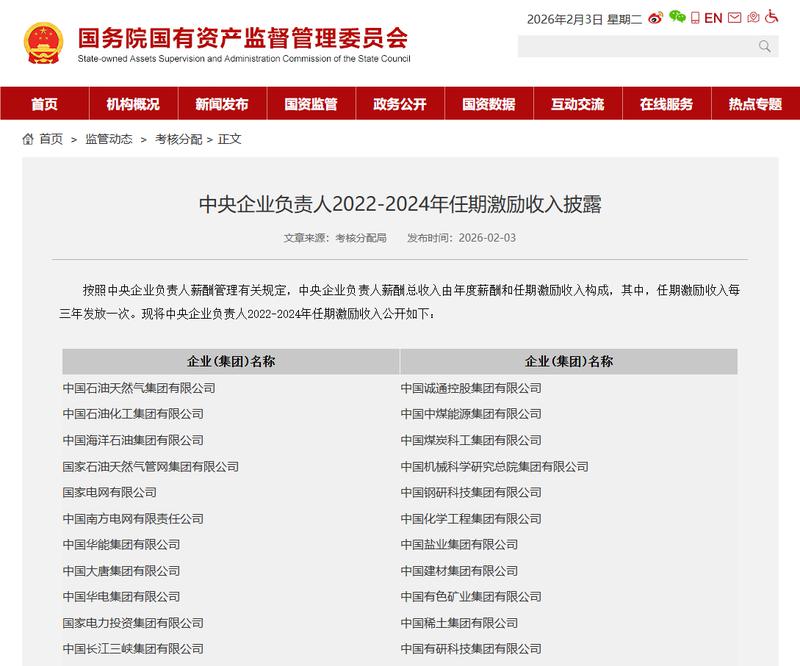
80多家中央企业负责人激励收入披露
Xin Jing Bao· 2026-02-03 12:00
Group 1 - The total income of central enterprise leaders consists of annual salary and term incentive income, with the latter being distributed every three years [1] - The term incentive income for central enterprise leaders for the period 2022-2024 has been publicly disclosed [1] - The disclosure includes various state-owned enterprises such as China National Petroleum Corporation and State Grid Corporation of China [1]

油气开采板块2月3日跌0.7%,洲际油气领跌,主力资金净流入7651.72万元
Zheng Xing Xing Ye Ri Bao· 2026-02-03 09:10
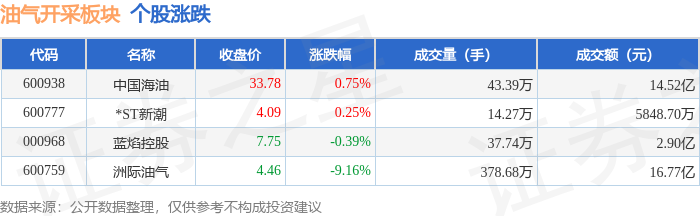
Core Viewpoint - The oil and gas extraction sector experienced a decline of 0.7% on February 3, with Intercontinental Oil and Gas leading the drop, while the overall market indices showed positive performance with the Shanghai Composite Index rising by 1.29% and the Shenzhen Component Index increasing by 2.19% [1]. Group 1: Market Performance - The oil and gas extraction sector's decline was primarily driven by Intercontinental Oil and Gas, which saw a significant drop of 9.16% in its stock price [1]. - The Shanghai Composite Index closed at 4067.74, reflecting an increase of 1.29%, while the Shenzhen Component Index closed at 14127.1, up by 2.19% [1]. Group 2: Individual Stock Performance - The closing prices and performance of key stocks in the oil and gas extraction sector included: - China National Offshore Oil Corporation (CNOOC) at 33.78, up by 0.75% with a trading volume of 433,900 shares and a transaction value of 1.452 billion [1]. - ST Xinchao at 4.09, up by 0.25% with a trading volume of 142,700 shares [1]. - Blue Flame Holdings at 7.75, down by 0.39% with a trading volume of 377,400 shares and a transaction value of 290 million [1]. - Intercontinental Oil and Gas at 4.46, down by 9.16% with a trading volume of 3,786,800 shares and a transaction value of 1.677 billion [1]. Group 3: Fund Flow Analysis - The oil and gas extraction sector saw a net inflow of 76.5172 million from institutional investors, while retail investors experienced a net outflow of 21.8852 million [1]. - Detailed fund flow for key stocks included: - CNOOC with a net inflow of 62.6866 million from institutional investors, but a net outflow of 5.11433 million from retail investors [2]. - Intercontinental Oil and Gas with a net inflow of 60.1285 million from institutional investors, but a net outflow of 2.04715 million from retail investors [2]. - ST Xinchao with a net inflow of 1.4906 million from institutional investors, but a net outflow of 336.70 thousand from retail investors [2]. - Blue Flame Holdings with a significant net outflow of 47.7885 million from institutional investors [2].


高股息策略配置性价比进一步提升,港股通红利ETF广发(520900)涨1.34%
Xin Lang Cai Jing· 2026-02-03 08:04
Group 1 - The core viewpoint of the articles emphasizes the increasing interest in high dividend yield stocks, particularly in the context of declining bond yields and the need for investors to seek higher returns in equity investments [1][2][3] - Long-term value in dividend investing is shifting from merely seeking high dividend rates to focusing on sustainable dividend capabilities, with a recommended expected return rate of over 3%-5% and a strong safety margin [1][2] - The performance of high dividend sectors has shown recovery, driven by strong demand for insurance funds and favorable pricing logic in cyclical high dividend sectors such as oil, steel, and coal [1][2] Group 2 - The market is experiencing challenges in restoring risk premiums, with significant volatility in cyclical products affecting market profitability, leading to a potential "small platform period" for investor risk appetite [2][3] - The insurance sector is seeing robust growth in new business, particularly in dividend insurance sales, which is increasing the allocation of investment funds towards long-duration assets [2][3] - The dividend strategy remains a key focus for equity investments, with pressures on cash investment returns expected to increase by 2026, reinforcing the importance of dividend strategies for companies [2][3] Group 3 - Looking ahead to 2026, dividend strategies are expected to continue serving as a stabilizing force in investment portfolios, with dividend assets showing lower valuation levels and volatility compared to other asset classes [3][9] - The Hong Kong Stock Connect Dividend ETF (520900) closely tracks the CSI National New Hong Kong Stock Connect Central Enterprise Dividend Index, which selects stable dividend-paying companies from the central state-owned enterprises [3][9] - The top five industries in the CSI National New Hong Kong Stock Connect Central Enterprise Dividend Index include oil and petrochemicals (28.63%), telecommunications (21.75%), coal (11.80%), transportation (10.47%), and public utilities (7.94%), indicating a strong value and defensive characteristic [4][10]

对硝基氯化苯、LLDPE等涨幅居前,建议关注进口替代、纯内需、高股息等方向
Huaxin Securities· 2026-02-03 07:45
Investment Rating - The report maintains a "Buy" rating for several companies including Xinyangfeng, Senqilin, Ruifeng New Materials, Sinopec, Juhua, Yangnong Chemical, CNOOC, Tongkun, Daotong Technology, and others [10]. Core Views - The report highlights significant price increases in products such as p-nitrochlorobenzene (up 27.91%) and LLDPE (up 24.72%), while products like natural gas and LDPE saw substantial declines [6][18]. - It suggests focusing on investment opportunities in areas such as import substitution, domestic demand, and high dividend stocks, particularly in light of fluctuating international oil prices [6][19]. - The report anticipates that international oil prices will stabilize around $65 per barrel in 2026, influenced by geopolitical uncertainties and expectations of price declines [19]. Summary by Sections Product Price Movements - Notable price increases this week include p-nitrochlorobenzene (27.91%), LLDPE (24.72%), and liquid chlorine (20.90) [18]. - Conversely, significant declines were observed in natural gas (-22.34%) and LDPE (-18.02%) [5][21]. Industry Performance - The chemical industry remains in a weak position overall, with mixed performance across sub-sectors due to past capacity expansions and weak demand [21]. - Specific sectors like the glyphosate industry are showing signs of potential recovery, with decreasing inventories and rising prices, suggesting a possible entry into a favorable cycle [21]. Investment Recommendations - The report recommends focusing on companies with strong competitive positions and growth potential, such as Ruifeng New Materials and Baofeng Energy [21]. - It emphasizes the importance of domestic chemical fertilizer and pesticide sectors, which are expected to maintain stable demand due to self-sufficiency [21]. - The report also highlights the benefits for major oil companies like Sinopec, which are expected to gain from lower raw material costs due to declining oil prices [21].