BOB(601169)

Search documents
银行经营周期如何定价各类资产?
GF SECURITIES· 2026-02-24 12:04
Investment Rating - The report assigns a "Buy" rating for the banking sector, indicating an expectation of stock performance exceeding the market by more than 10% over the next 12 months [58]. Core Insights - In 2025, the banking sector's asset growth is projected to be 8.01%, an increase from 6.52% in 2024, driven by factors such as fiscal stimulus, cross-border capital inflows, and the activation of maturing deposits [5][13]. - The report identifies two key cycles affecting asset pricing in banking: the bank expansion cycle and the interest margin cycle, suggesting a comprehensive analysis of these cycles [5][13]. - The debt cycle is characterized as a fundamental aspect of the bank expansion cycle, with a model proposed by Dalio outlining seven stages of a typical debt cycle, which can be influenced by external debt reliance [16][19]. - The report anticipates limited upward space for the debt cycle in 2026, with government leverage expected to increase by 5.89%, lower than the 7.6% projected for 2025 [35][36]. - The banking interest margin cycle is expected to stabilize in 2025, following two complete cycles since 2010, with a correlation observed between bank interest margins and the 30Y-10Y government bond spread [41][45]. Summary by Sections Bank Expansion Cycle - The asset growth rates for different types of banks in 2025 are projected as follows: state-owned banks at 11%, joint-stock banks at 4.74%, city commercial banks at 9.68%, and rural commercial banks at 5.17%, all exceeding the average growth rate [5][13]. - The report emphasizes the importance of understanding the relationship between bank assets and liabilities, highlighting that credit and debt expansion are cyclical and self-reinforcing [15][16]. Debt Cycle Analysis - The report outlines that the current debt cycle, which began in 2022, has lasted 16 quarters, surpassing previous cycles, and indicates a shift in leverage dynamics among enterprises, government, and households [35][36]. - The analysis includes a comparison of deflationary and inflationary debt cycles, noting that the U.S. faces greater inflationary pressures due to higher external debt reliance compared to China [21][19]. Interest Margin Cycle - The report notes that the banking interest margin has experienced significant fluctuations since 2010, with a stabilization phase expected to begin in 2025 [41][45]. - It highlights the impact of loan repricing cycles on interest margins, with a notable decline in loan rates observed in recent years [49][50].




马年春节刚过完,聪明的家长悄悄将闲钱转入儿童银行账户
Jing Ji Guan Cha Wang· 2026-02-24 09:00
2月23日(正月初七),从老家返京的程程和妈妈兴致勃勃地来到银行,办理了自己人生的第一笔存款业务。过去,程程的压岁钱往往以两种方式终结:要 么被父母"代管"后悄然并入家庭日常开支,要么静静躺在钱包里,没有任何升值。 程程妈妈登陆小京卡(北京银行发行的儿童借记卡)管理账户,发现孩子名下的钱比大人的钱更"值钱"。 在北京银行针对儿童客群推出的"小京卡"及"小京压岁宝"专区,小京卡用户3年期定存利率为1.75%,起存金额1000元,最大存入金额50万元;2年期和1年期 定存利率分别为1.60%、1.50%,起存金额同样为1000元。 程程妈妈查询北京银行官网发现,该行3年期整存整取挂牌利率为1.30%。这意味着,如果把程程1万元的压岁钱存入小京卡,3年后到期利息可达525元,比 大人的定存利息高出不少。 由于手头恰好有2万元闲置资金,程程妈妈萌生了一个念头,何不一起存入孩子的小京压岁宝账户?返京第一天,程程妈妈便带着孩子来到银行,将3万元都 存入了孩子的银行账户,3年到期后,利息可达1575元。 其实,程程们的选择有很多。 每逢春节前后,金融机构都会盯上儿童的压岁钱。马年春节的一大看点就是,多家银行推出了儿童专属存 ...



中国人民银行、金融监管总局 发布我国系统重要性银行名单
Jin Rong Shi Bao· 2026-02-24 01:28
Core Viewpoint - The People's Bank of China and the National Financial Regulatory Administration have conducted the 2025 assessment of systemically important banks, identifying 21 domestic banks categorized into five groups based on their systemic importance scores [1] Group 1: Assessment of Systemically Important Banks - A total of 21 domestic systemically important banks have been recognized, including 6 state-owned commercial banks, 10 joint-stock commercial banks, and 5 city commercial banks [1] - The banks are divided into five groups based on their systemic importance scores, with the first group consisting of 11 banks, the second group having 4 banks, the third group with 2 banks, the fourth group containing 4 banks, and the fifth group having no banks [1] Group 2: Breakdown of Bank Groups - The first group includes: China Minsheng Bank, China Everbright Bank, Ping An Bank, Huaxia Bank, Ningbo Bank, Jiangsu Bank, Beijing Bank, Nanjing Bank, Guangfa Bank, Zheshang Bank, and Shanghai Bank [1] - The second group consists of: Industrial Bank, China CITIC Bank, Shanghai Pudong Development Bank, and China Postal Savings Bank [1] - The third group includes: Bank of Communications and China Merchants Bank [1] - The fourth group comprises: Industrial and Commercial Bank of China, Bank of China, China Construction Bank, and Agricultural Bank of China [1] - The fifth group currently has no banks included [1] Group 3: Future Regulatory Actions - The People's Bank of China and the National Financial Regulatory Administration will implement additional regulatory measures for systemically important banks according to the "Regulations on Additional Supervision of Systemically Important Banks (Trial)" [1] - The aim is to enhance the synergy between macro-prudential management and micro-prudential supervision, ensuring the safe and sound operation of systemically important banks [1] - This initiative is intended to better support the high-quality development of the real economy [1]




布局儿童金融 银行争揽压岁钱
Zhong Guo Zheng Quan Bao· 2026-02-23 20:29
对于银行推出的压岁钱专属产品,不少投资者表示很心动。小俊今年13岁,他告诉记者,每年的压岁钱 自己都攒起来,目前已有四万余元。当记者问及是否愿意办理专属银行卡存压岁钱时,小俊高兴地 说:"当然愿意,还能挣点利息,反正这笔钱家长平时也不让我花,存起来正合适。"小俊的妈妈李女士 表示,自己对银行推出的压岁钱专属产品很满意,这类产品既可以培养孩子的攒钱习惯,又能提供一定 的利息收入。 业内人士认为,压岁钱专属产品既是银行应对揽储压力的营销手段,也是挖掘场景金融、增强客户黏性 的重要工具。 ● 本报记者 李蕴奇 新春佳节之际,孩子们的压岁钱是不少家庭绕不开的话题。多家银行敏锐捕捉到这一热点,在春节期间 推出压岁钱专属产品,积极围绕儿童压岁钱开展营销活动,通过存款利率上浮、赠送权益等方式吸引客 户。专家分析,压岁钱专属产品既可以缓解银行揽储压力,也可通过场景金融,深化客户对银行品牌的 认知,增强客户黏性。 专属产品集中登场 中国证券报记者近期走访银行网点发现,多家银行围绕儿童压岁钱推出不少特色产品。北京银行 (601169)推出儿童专属银行卡——"小京卡"。北京银行微信公众号显示,当该行客户通过"小京卡"办 理三年期定 ...
股份制银行差异化竞争,头部效应显著
Xin Lang Cai Jing· 2026-02-18 05:56
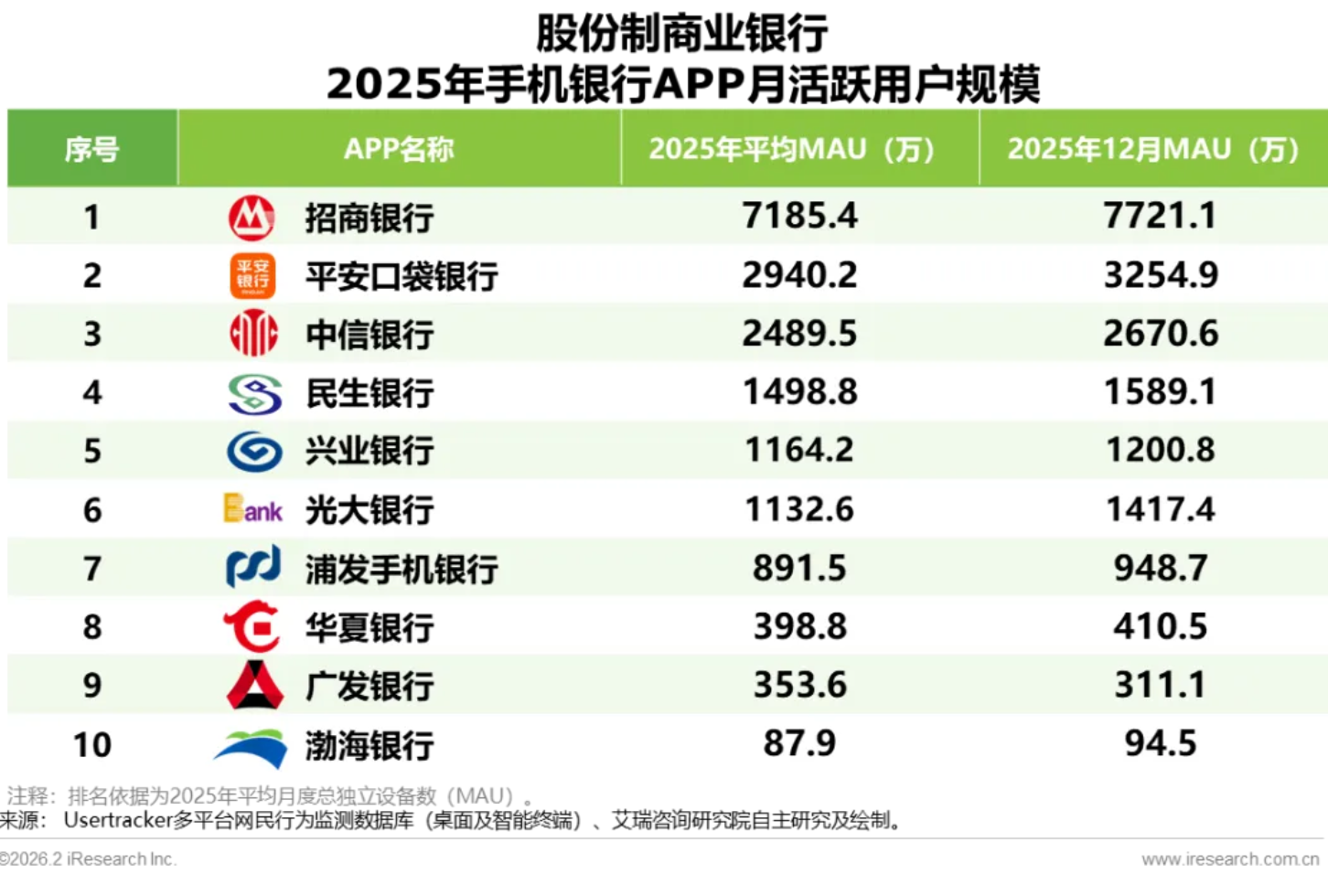
Core Insights - The mobile banking user base in China is expected to peak in 2025, shifting the industry focus from acquiring new users to enhancing existing user engagement [1] - Financial institutions must achieve extreme efficiency and precision in their ecosystems to survive in this new environment [1] Industry Overview - According to an iResearch report, joint-stock banks are adopting differentiated survival strategies, leading to significant head effects [1] - China Merchants Bank leads joint-stock banks with 71.854 million monthly active users (MAU), surpassing some state-owned banks due to its focus on wealth management and intelligent interaction [1] - Ping An Bank and CITIC Bank form the second tier, maintaining MAUs between 20 million and 30 million, with Ping An Bank leveraging AI to reconstruct service chains and CITIC Bank integrating consumer ecosystems [1] Competitive Landscape - Third-tier institutions, such as Minsheng Bank and Everbright Bank, have seen their MAUs drop to between 10 million and 20 million, indicating a tightening survival space [1] - Local banks are experiencing growth by focusing on their local markets, with city commercial banks like Jiangsu Bank and Beijing Bank maintaining MAUs above 3 million [1] - Among rural commercial banks and rural credit cooperatives, Fujian Rural Credit has surpassed 4.5 million MAUs, capturing traffic in county and rural areas [1] Challenges for Private Banks - The situation for private banks is dire, with the top 50 list for 2025 nearly extinct due to a lack of physical branches, local living ecosystems, and high customer acquisition costs, leading to a loss of competitiveness in the mobile banking sector [1] - In the era of stock competition, ecological and regional capabilities are becoming the key to success [1]



国有大行主导手机银行市场,生态嵌入构筑护城河
Jing Ji Guan Cha Wang· 2026-02-18 05:47
Core Insights - The Chinese mobile banking market is entering a stage of stock competition in 2025, with monthly active users (MAU) stabilizing between 648 million and 739 million [2] - State-owned commercial banks dominate the market due to their ecological embedding advantages, with Agricultural Bank of China leading at 249 million MAU, followed by Industrial and Commercial Bank of China (194 million) and China Construction Bank (109 million) [2] - Private banks are expected to collectively exit the top 50 MAU rankings in 2025 due to a lack of offline branch support and local living ecosystems [2] Group 1: Major Players - Agricultural Bank of China has the highest MAU at 249 million, followed by Industrial and Commercial Bank of China with 194 million and China Construction Bank with 109 million, forming the first tier of banks [2] - China Bank and Postal Savings Bank have MAUs exceeding 50 million, constituting the second tier [2] - China Merchants Bank leads the joint-stock banks with 71.85 million MAU, while Ping An Bank and CITIC Bank form the second tier, with other joint-stock banks generally below 20 million MAU [2] Group 2: Market Dynamics - The core advantage of state-owned banks lies in their "full-scenario integration" capabilities, embedding services deeply into high-frequency life scenarios such as government affairs, social security, healthcare, and education [2] - Agricultural Bank of China extends its services to rural areas through intelligent service matching and customer customization, while Industrial and Commercial Bank of China utilizes its "Gong Xiao Zhi" model for interactive service [2] - Regional banks like Jiangsu Bank, Beijing Bank, and Ningbo Bank show stable performance by focusing on local markets, with some rural commercial banks like Fujian Rural Credit exceeding 4.5 million MAU, indicating the sustainability of localized operations in the stock market [2]


2.7分钟定生死 手机银行存量厮杀谁在“断臂”,谁在“吃肉”?
Jing Ji Guan Cha Wang· 2026-02-18 04:57
Core Insights - The report by iResearch indicates that the monthly active users (MAU) of mobile banking apps in China have stabilized after fluctuating between 648 million and 739 million, signaling a ceiling in user growth and a shift from acquiring new users to enhancing existing user engagement [2] - User behavior is undergoing a structural reversal, with the effective daily usage time per device dropping from 4.9 minutes in 2023 to around 2.7 minutes by mid-2025, leading to a focus on high-frequency, short-duration, and functional usage [2] - Financial institutions are compelled to streamline operations and focus resources on core transaction scenarios to survive in this competitive landscape, where efficiency and precision are paramount [2] Mobile Banking Market Overview - The top three banks in terms of MAU are Agricultural Bank of China (2.49 billion), Industrial and Commercial Bank of China (1.94 billion), and China Construction Bank (1.09 billion), with all six major state-owned banks ranking in the top ten [3][5][6] - Private banks, represented by WeBank and MYbank, have faced significant setbacks, with many dropping out of the top 50 MAU rankings by 2025 [4] Competitive Landscape - State-owned banks are solidifying their dominance through extensive customer bases and integrated ecosystems, leveraging services embedded in high-frequency life scenarios such as government services and healthcare [7] - Joint-stock commercial banks are adopting a "specialized and precise" survival strategy, with China Merchants Bank leading among them with 71.85 million MAU, focusing on wealth management and intelligent interaction [8][10] - Regional banks are thriving by deeply engaging with local markets, while private banks struggle due to high customer acquisition costs and lack of local ecosystem support [13][14] Future Outlook - The mobile banking market is transitioning from a phase of scale expansion to one of value cultivation, with state-owned banks building moats through ecosystems, joint-stock banks seeking niches through specialization, and regional banks solidifying their local roots [14] - The ability to create irreplaceable value in a limited user engagement environment will be crucial, with technology applications such as AI reshaping service processes and enhancing risk management [15][16]

“小”压岁钱撬动“大”市场,银行发力差异化竞争新赛道
Zhong Guo Zheng Quan Bao· 2026-02-14 13:09
Core Viewpoint - The upcoming Spring Festival has prompted banks to launch special products for children's "lucky money," aiming to attract customers through higher deposit rates and additional benefits, thereby addressing their deposit acquisition pressures and enhancing brand recognition and customer loyalty [1]. Group 1: Bank Products - Beijing Bank has introduced a children's exclusive bank card called "Xiao Jing Card," offering a three-year fixed deposit rate of 1.75%, which is higher than the standard rate for the same term, with a minimum deposit of 1,000 yuan [2]. - Industrial and Commercial Bank of China (ICBC) has launched the "Baby Card" for children under 16, providing a three-year deposit rate of 1.55% for a 5,000 yuan deposit, along with waived card issuance and annual fees [3]. - Huaxia Bank's "Sunshine Growth Plan" offers a specialized savings service for minors, with a minimum deposit of only 50 yuan and an annual interest rate of 1.75% [4]. Group 2: Industry Insights - Industry experts view these children's financial products as a marketing strategy to alleviate deposit acquisition pressures and as a means to enhance customer loyalty through scenario-based finance [5]. - The competition in the banking sector is intensifying, and children's financial products are seen as a new growth point for deposits, allowing banks to bind family relationships and transition from simple savings to comprehensive services that include education and support [6]. - The strategic focus on children's financial services not only aims to secure current funds but also seeks to integrate financial literacy into family wealth management, creating a cross-generational customer value chain [6].

2026年1月金融数据点评:存款搬家加速,M1、M2增速大幅回升
GF SECURITIES· 2026-02-14 05:23
Investment Rating - The industry rating is "Buy" [6] Core Insights - The overall social financing growth slightly declined to 8.2% in January, while M1 and M2 growth rates significantly rebounded, with M1 growing by 4.9% and M2 by 9.0% [6][16] - Government net financing increased significantly by 2,831 billion yuan year-on-year, contributing to the overall social financing growth [6][17] - The report indicates a shift in deposit structure due to accelerated deposit migration, impacting M1 negatively while having limited effect on M2 [6][16] Summary by Sections Overall Situation - Social financing growth decreased slightly to 8.2%, while M1 and M2 growth rates increased significantly [15][16] - M1 and M2 growth rates rose by 1.1 percentage points and 0.5 percentage points respectively compared to the previous month [6][16] Government Sector - Fiscal strength showed a year-on-year decline, impacting overall financing dynamics [39] Household Sector - Demand remained stable year-on-year, with short-term loan demand increasing [39] Corporate Sector - Short-term loan demand increased year-on-year, while bill financing saw a significant reduction [39] Non-Bank Sector - The acceleration of deposit migration was noted, with non-bank deposits increasing by 1.45 trillion yuan year-on-year [6][39]
1月信贷社融点评:温和开门红
ZHESHANG SECURITIES· 2026-02-14 05:23
Investment Rating - The industry investment rating is "Positive" (maintained) [4] Core Insights - The report highlights a "strong deposit, weak loan" characteristic in the opening month of the year [4] - In January 2026, new social financing increased by 7.2 trillion yuan, a year-on-year increase of 166.2 billion yuan, with a balance growth of 8.2% [4][5] - New RMB loans in January 2026 amounted to 4.7 trillion yuan, a year-on-year decrease of 420 billion yuan, with a balance growth of 6.1% [4][5] - The report indicates that consumer demand has shown some recovery, particularly in short-term loans, but overall consumer credit demand may remain pessimistic throughout the year [1][2] Summary by Sections Credit Overview - Entity credit remained stable, with a significant reduction in bill financing [1] - Retail loans saw an increase of 456.5 billion yuan in January, with short-term loans contributing 109.7 billion yuan [1] - Corporate loans totaled 4.5 trillion yuan, a year-on-year decrease of 330 billion yuan, influenced by a substitution effect between short-term loans and bill financing [2] Social Financing - Government bonds contributed significantly to social financing, with new issuance of 976.4 billion yuan in January, a year-on-year increase of 283.1 billion yuan [5] - The report notes a trend of "deposit migration," with non-bank deposits reaching 36 trillion yuan, accounting for 10.7% of total deposits [5] Investment Recommendations - The report recommends a "New Momentum Portfolio" including banks like Nanjing Bank, Shanghai Bank, and others, highlighting their potential for value recovery [3][5] - It emphasizes the importance of high-dividend bank stocks in the current environment, suggesting that banks with new growth drivers may achieve greater value restoration [5]