
SHCI(601225)

Search documents
日耗爬坡缓慢拖累煤价,供应偏紧不改后市可期
ZHONGTAI SECURITIES· 2025-12-06 12:00
Investment Rating - The report maintains an "Overweight" rating for the coal industry, indicating a positive outlook for investment opportunities in this sector [5]. Core Views - The coal price is expected to maintain a strong upward trend due to seasonal demand increases and supply constraints, despite short-term pressures from low consumption rates in certain regions [7][8]. - The report highlights the potential for coal prices to rise as winter approaches, with increased demand from power plants for stock replenishment [7]. - The introduction of stricter safety regulations is likely to impact coal production rates, further tightening supply [7][8]. Summary by Sections 1. Industry Overview - The coal industry consists of 37 listed companies with a total market capitalization of approximately 19,360.92 billion [2]. - The circulating market value of the industry is around 18,986.29 billion [2]. 2. Price Tracking - As of December 5, 2025, the average daily production of thermal coal from 462 sample mines is 5.512 million tons, showing a week-on-week increase of 0.22% but a year-on-year decrease of 7.53% [8]. - The price of thermal coal at the Qinhuangdao port is reported at 790 yuan per ton, down 31 yuan from the previous week, reflecting a week-on-week decline of 3.78% [8]. 3. Supply and Demand Dynamics - The report notes that the daily coal consumption across 25 provinces reached 5.839 million tons, an increase of 428,000 tons from the previous week, indicating a week-on-week growth of 7.91% [8]. - The report anticipates that as winter progresses, coal demand will increase, particularly in southern regions affected by cold weather [7]. 4. Company Performance and Recommendations - Key companies recommended for investment include Yanzhou Coal Mining Company, Shanxi Coal and Chemical Industry Group, and Jinneng Holding Group, which are expected to benefit from the anticipated rise in coal prices [7][8]. - The report emphasizes the importance of focusing on companies with high elasticity in their stock performance, particularly those involved in thermal coal production [7].





陕西国企改革板块12月5日涨1.26%,建设机械领涨,主力资金净流入8.53亿元



Sou Hu Cai Jing· 2025-12-05 09:49
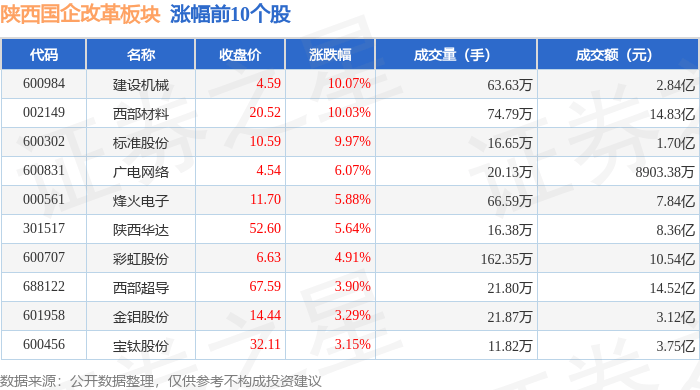
Market Performance - The Shaanxi state-owned enterprise reform sector rose by 1.26% on December 5, with construction machinery leading the gains [1] - The Shanghai Composite Index closed at 3902.81, up 0.7%, while the Shenzhen Component Index closed at 13147.68, up 1.08% [1] Key Stocks in Shaanxi State-Owned Enterprise Reform Sector - Construction Machinery (600984) closed at 4.59, up 10.07%, with a trading volume of 636,300 shares and a transaction value of 284 million [1] - Western Materials (002149) closed at 20.52, up 10.03%, with a trading volume of 747,900 shares and a transaction value of 1.483 billion [1] - Standard Shares (600302) closed at 10.59, up 9.97%, with a trading volume of 166,500 shares and a transaction value of 170 million [1] - Other notable stocks include Broadcast Network (600831) up 6.07%, and Huada (301517) up 5.64% [1] Capital Flow Analysis - The Shaanxi state-owned enterprise reform sector saw a net inflow of 853 million from main funds, while retail funds experienced a net outflow of 334 million [2] - The main funds showed significant interest in Western Materials, with a net inflow of 3.33 billion, while retail funds had a net outflow of 1.55 billion [3] - Construction Machinery attracted a net inflow of 956 million from main funds, but retail funds saw a net outflow of 5.48 million [3]

自由现金流ETF中证全指(561080)涨0.73%,半日成交额292.18万元
Xin Lang Cai Jing· 2025-12-05 05:01
Core Viewpoint - The Freedom Cash Flow ETF CSI All Share (561080) experienced a 0.73% increase, closing at 1.243 yuan with a trading volume of 2.9218 million yuan on December 5 [1] Group 1: ETF Performance - The Freedom Cash Flow ETF CSI All Share (561080) has a performance benchmark based on the CSI All Share Free Cash Flow Index return [1] - Since its inception on April 23, 2025, the fund has achieved a return of 23.58%, with a monthly return of 2.50% [1] Group 2: Major Holdings Performance - Major stocks in the ETF include: - China National Offshore Oil Corporation (CNOOC) down 0.89% - Midea Group up 0.11% - Gree Electric Appliances down 0.54% - Wuliangye Yibin up 0.26% - China Merchants Energy down 0.40% - Luoyang Molybdenum up 2.85% - TCL Technology up 2.06% - China Aluminum Corporation up 3.95% - SF Express up 0.37% - Shaanxi Coal and Chemical Industry down 0.62% [1]




能源ETF广发(159945)开盘跌0.34%,重仓股中国神华跌0.36%,中国石油跌0.30%
Xin Lang Cai Jing· 2025-12-05 01:35
Core Viewpoint - The Energy ETF Guangfa (159945) opened at a decline of 0.34%, indicating a slight downturn in the energy sector on December 5th [1] Group 1: ETF Performance - The Energy ETF Guangfa (159945) opened at 1.187 yuan [1] - Since its establishment on June 25, 2015, the fund has achieved a return of 19.05% [1] - The fund's performance over the past month has seen a decline of 0.68% [1] Group 2: Major Holdings - Major stocks within the Energy ETF include: - China Shenhua: down 0.36% - China Petroleum: down 0.30% - Shaanxi Coal and Chemical Industry: up 0.44% - China Petroleum & Chemical Corporation: unchanged - China National Offshore Oil Corporation: up 0.21% - Jereh Oilfield Services: up 0.46% - Yanzhou Coal Mining: down 0.14% - Guanghui Energy: unchanged - China Coal Energy: down 0.36% - Shanxi Coking Coal: up 0.30% [1]

煤炭市场旺季预期减弱,逐步进入淡季状态
China Securities· 2025-12-04 14:25
Investment Rating - The report indicates a "downgrade" for the coal mining sector, suggesting it is "weaker than the market" [5]. Core Insights - The coking coal and coke markets are weakening, transitioning into an off-peak season, with coking coal prices declining, providing room for downstream coke price reductions. Steel mills are cautious in their procurement, focusing on inventory consumption. Following the completion of the fourth round of price increases, major steel mills have initiated the first round of price reductions for coke, expected to take effect on December 1 [1][2]. - The thermal coal market is also weakening, characterized by a "weak demand and increased supply" scenario, leading to downward pressure on prices. Supply remains stable, but price support is loosening, with high inventory levels at ports and cautious procurement behavior from consumers [1][2]. Summary by Sections Coking Coal - Prices for coking coal have decreased, with the low-sulfur coking coal price at 1400 RMB/ton, down 3% week-on-week. The total coking coal inventory at sampled coking plants is 10.1 million tons, also down 3% and at a historically low level [3][4]. Coke - The closing price for coke at ports is 1670 RMB/ton, unchanged from the previous week. The total inventory of coke across coking plants, steel mills, and ports is 9.01 million tons, down 1% [4]. Thermal Coal - The average price index for thermal coal in the Bohai Rim is 698 RMB/ton, stable compared to last week. Newcastle thermal coal price is 112.9 USD/ton, down 1%. The supply from 17 inland provinces is 3.51 million tons, up 2%, while the supply from eight coastal provinces is 2.11 million tons, up 10%. Inland coal inventory stands at 102 million tons, up 1%, and coastal inventory is 3.454 million tons, up 3% [4][2].
两家保险巨头的九大重仓股
表舅是养基大户· 2025-12-04 13:34
Core Viewpoint - The article discusses the significant role of the insurance-related private equity fund "Guofeng Xinghua," established by China Life and Xinhua Insurance, in the current market landscape, highlighting its substantial capital and investment strategies [5][6][7]. Group 1: Fund Overview - Guofeng Xinghua is a unique private equity fund that does not sell products externally and is the first insurance-related off-balance-sheet private equity fund in the market [6]. - The fund has a total scale of 1.1 trillion yuan, with three phases: 500 billion yuan for Phase I, 200 billion yuan for Phase II, and 400 billion yuan for Phase III [7]. - This fund's scale positions it among the top ten active equity fund managers in the market, significantly influencing investment trends within the insurance sector [7]. Group 2: Stock Holdings - The fund currently holds nine stocks among the top ten shareholders of listed companies, with four of them being newly added in the third quarter [9]. - The stocks include major companies such as Yili, Sinopec, and China Telecom, with most having market capitalizations around or above 200 billion yuan [11][12]. - A notable characteristic is that eight of the nine stocks have shown negative profit growth in the first three quarters, indicating a focus on stability rather than growth [12]. Group 3: Valuation and Dividend Analysis - The price-to-earnings (PE) ratios of the stocks range from 10 to 23, with Yili being the most expensive at 23 times [12]. - The dividend yields for 2024 are generally above 3.5%, with some stocks exceeding 5%, suggesting that these investments are more attractive compared to last year [12]. - The dividend payout ratios for all nine stocks exceed 50%, with Yili's payout ratio over 90%, indicating a commitment to shareholder returns [13]. Group 4: Investment Strategy Insights - The article emphasizes that the insurance private equity fund is likely not fully invested yet, with ongoing capital inflows expected as the model transitions from pilot to regular operation [15]. - It highlights the importance of long-term investment strategies in the current low-interest-rate environment, suggesting that both A-shares and Hong Kong stocks with high dividends are worth considering as core assets [16]. - The article also notes that institutional investors are increasingly attracted to high-dividend stocks, particularly those with monopolistic characteristics, as they ensure sustainable future dividends [16].





陕西煤业大宗交易成交703.48万元
Zheng Quan Shi Bao Wang· 2025-12-03 15:12
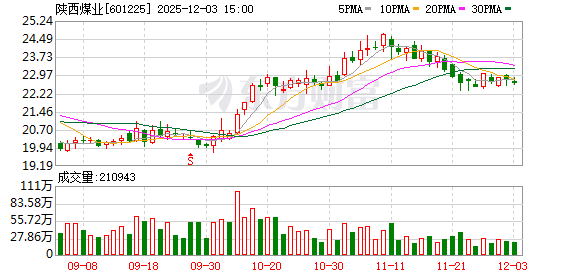
Core Insights - Shaanxi Coal Industry conducted a block trade on December 3, with a transaction volume of 311,000 shares and a transaction value of 7.0348 million yuan, at a price of 22.62 yuan per share [2][3] - The closing price of Shaanxi Coal Industry on the same day was 22.62 yuan, reflecting a decrease of 0.88%, with a daily turnover rate of 0.22% and a total transaction amount of 479 million yuan [2] - The net inflow of main funds for the day was 10.2845 million yuan, and the stock has seen a cumulative increase of 0.62% over the past five days, with a total net inflow of 4.9422 million yuan [2] Trading Data Summary - The block trade details include a transaction volume of 31.10 million shares, a transaction amount of 703.48 million yuan, and a transaction price of 22.62 yuan, with no premium over the closing price [3] - Both the buyer and seller in the block trade were from Guotai Junan Securities Co., Ltd. headquarters [3] Financing Information - The latest financing balance for Shaanxi Coal Industry is 639 million yuan, with an increase of 5.8931 million yuan over the past five days, representing a growth rate of 0.93% [3] - Shaanxi Coal Industry was established on December 23, 2008, with a registered capital of 969.5 million yuan [3]
陕西煤业今日大宗交易平价成交31.1万股,成交额703.48万元
Xin Lang Cai Jing· 2025-12-03 09:37
Group 1 - The core transaction of Shaanxi Coal Industry involved 311,000 shares traded on December 3, with a total transaction value of 7.0348 million yuan, accounting for 1.45% of the total trading volume for the day [1][2] - The transaction price was 22.62 yuan, which remained stable compared to the market closing price of 22.62 yuan [1][2]

12月指数定期调样的影响估算




HTSC· 2025-12-01 12:34
Quantitative Models and Construction Methods 1. Model Name: Liquidity Impact Coefficient Model - **Model Construction Idea**: This model measures the liquidity impact of index adjustments on individual stocks by calculating the ratio of net fund flows to the stock's recent average daily trading volume[12][13] - **Model Construction Process**: The liquidity impact coefficient for a stock is calculated as follows: $$ impact_{i} = \sum_{k=1}^{N} \frac{\Delta weight_{k,i} \times AUM_{k}}{amt\_avg_{i,20}} $$ - \( \Delta weight_{k,i} \): Estimated weight change of stock \( i \) in index \( k \) - \( AUM_{k} \): Total assets under management of passive products tracking index \( k \) as of the end of November - \( amt\_avg_{i,20} \): Average daily trading volume of stock \( i \) over the past 20 trading days as of the end of November[12][13] - **Model Evaluation**: The model provides a quantitative framework to estimate short-term liquidity shocks caused by index adjustments, but it is subject to data discrepancies and assumptions, which may lead to deviations from actual results[13] --- Model Backtesting Results Liquidity Impact Coefficient Model - **Top 5 Stocks with Highest Positive Impact Coefficients**: - Zhangjiagang Bank (002839 CH): 11.55[15] - Jiangzhong Pharmaceutical (600750 CH): 11.44[15] - Tower Group (002233 CH): 11.04[15] - Jichuan Pharmaceutical (600566 CH): 10.14[15] - Zhengbang Technology (002157 CH): 9.99[15] - **Top 5 Stocks with Highest Negative Impact Coefficients**: - Shenzhen Expressway (600548 CH): -24.95[16] - Vanward Electric (002543 CH): -20.90[16] - Aviation Materials (688563 CH): -14.06[16] - Huaxi Biology (688363 CH): -10.81[16] - Ninghu Expressway (600377 CH): -10.54[16] --- Quantitative Factors and Construction Methods 1. Factor Name: Net Fund Flow Factor - **Factor Construction Idea**: This factor estimates the net fund inflow or outflow for stocks due to index adjustments, based on changes in index weights and the total AUM of passive products tracking the index[9][10] - **Factor Construction Process**: - Outflow Amount: Total AUM of linked products multiplied by the stock's actual weight in the index as of the end of November - Inflow Amount: Total AUM of linked products multiplied by the estimated weight of the stock in the index post-adjustment - Weight estimation is based on free-float market capitalization and index-specific weighting rules, such as dividend yield weighting or market capitalization weighting[9][10] - **Factor Evaluation**: The factor provides a transparent and systematic approach to estimate fund flows, but it is sensitive to assumptions about future index weights and AUM changes[9][10] --- Factor Backtesting Results Net Fund Flow Factor - **Top 5 Stocks with Highest Net Fund Inflows**: - Victory Precision (300476 CH): 112.61 billion CNY[10] - Dongshan Precision (002384 CH): 99.32 billion CNY[10] - Guangqi Technology (002625 CH): 77.81 billion CNY[10] - Sugon Information (603019 CH): 65.44 billion CNY[10] - Top Group (601689 CH): 53.07 billion CNY[10] - **Top 5 Stocks with Highest Net Fund Outflows**: - China Mobile (600941 CH): -40.02 billion CNY[11] - CRRC Corporation (601766 CH): -36.40 billion CNY[11] - Aluminum Corporation of China (601600 CH): -34.29 billion CNY[11] - TCL Zhonghuan (002129 CH): -30.07 billion CNY[11] - Huagong Tech (000988 CH): -27.44 billion CNY[11]
2026年度投资策略:中枢抬升,价值优先
ZHESHANG SECURITIES· 2025-12-01 08:20
Core Insights - The report maintains a positive outlook on the coal industry, emphasizing a preference for value investments as the price center is expected to rise in 2026 [1]. Group 1: 2025 Review - Coal production in China showed a trend of high output in the first half of 2025, followed by a decline, with a total of 397.3 million tons produced from January to October, marking a year-on-year increase of 1.5% [2][16]. - Coal imports decreased significantly, with a total of 38.8 million tons imported from January to October, representing an 11% year-on-year decline [2][24]. - The overall coal consumption remained resilient, with a total of approximately 4.24 billion tons consumed from January to October, reflecting a slight year-on-year increase of 0.1% [3][44]. Group 2: Supply Dynamics - The coal price experienced a V-shaped recovery, with prices for thermal coal, coking coal, and anthracite rebounding to 816, 1670, and 930 CNY per ton respectively by November 28, 2025 [4]. - The report highlights that the supply-demand balance is maintained through policies that regulate production while ensuring supply stability [5]. Group 3: 2026 Outlook - The report forecasts coal consumption to reach 4.95 billion tons in 2026, with a year-on-year growth of 1%, driven primarily by demand from the power and chemical sectors [5]. - It is anticipated that coal production will slightly increase to 4.87 billion tons in 2026, reflecting a year-on-year growth of 0.6% [5]. - The investment strategy suggests focusing on high-dividend coal companies and those showing signs of recovery from financial distress, such as China Shenhua, Shaanxi Coal, and Yanzhou Coal [5].