Bank Of Shanghai(601229)

Search documents
1月以来机构扎堆调研优质股曝光 大金重工获318家机构调研居首
Mei Ri Jing Ji Xin Wen· 2026-02-22 04:57
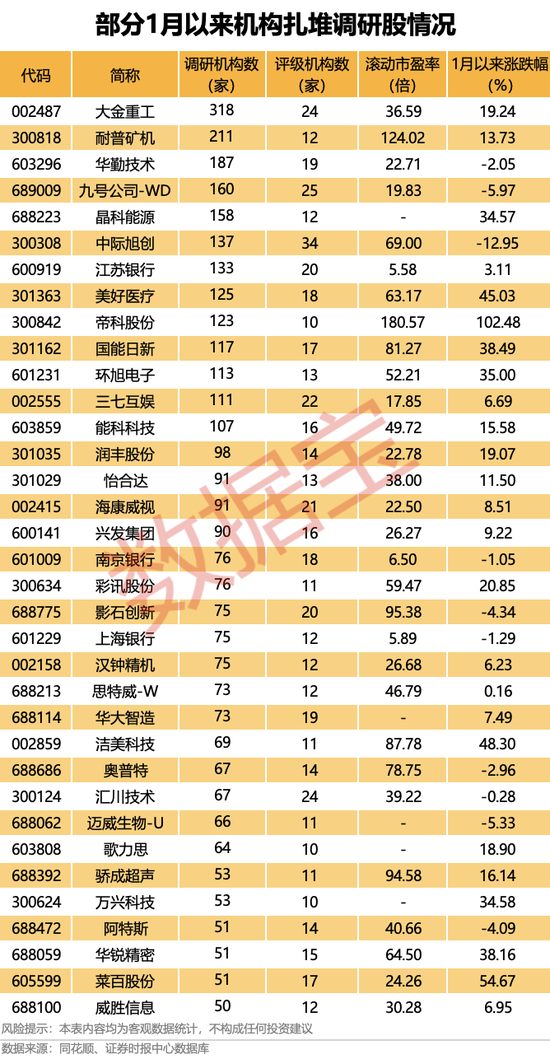
每经AI快讯,据证券时报·数据宝统计,1月以来,调研机构数在50家及以上且评级机构数在10家及以上 的公司,合计有35家。其中,大金重工获得318家机构调研居首。从评级机构数来看,中际旭创获34家 机构评级居首。江苏银行、上海银行、南京银行3只银行股进入榜单,其中江苏银行有多达133家机构调 研。数据显示,上榜个股今年以来平均涨幅超过16%,远超大盘同期表现。其中,帝科股份、菜百股 份、洁美科技、美好医疗等个股均涨超40%。 ...






机构扎堆调研的优质股曝光!
Xin Lang Cai Jing· 2026-02-22 04:21
节后行情怎么走?机构扎堆调研情况或提供一些线索。 随着春节假期进入尾声,市场即将重新开市,投资者关注度逐渐升温,机构资金的动向尤为引人瞩目。 其中,大金重工获得318家机构调研居首。公司在近期的调研中表示,英国AR7拍卖了8.4GW的海风项 目,超出前期市场预计数量,项目规模和补贴金额均创历史新高,固定式和漂浮式项目的执行电价相较 上一轮均实现同比上升,补贴年限也从15年延长至20年,提高了开发商的参与热情。另外,AR8预计在 今年也将拍出一定体量的项目量。本轮AR7中标的业主是公司已合作的重要客户,公司对本年市场订单 的获取很有信心。 从评级机构数来看,中际旭创获34家机构评级居首。国泰海通证券认为,公司业绩符合预期。从行业情 况看,1.6T有望在2026年快速上量,2027年需求有望进一步大幅提升。公司为云数据中心客户提供 400G、800G和1.6T等高速光模块,赢得了海内外客户的广泛认可,并保持了市场份额的持续成长,有 望大幅受益。 江苏银行、上海银行、南京银行3只银行股进入榜单,其中江苏银行有多达133家机构调研。 在众多的市场参与主体中,机构投资者凭借其专业的研究能力和信息优势,往往能率先布局具备 ...


【养老金融】首笔!上海银行成功落地全市首笔养老场景“民间投资”担保业务,为“社区食堂”注入金融活力
Xin Lang Cai Jing· 2026-02-14 14:36
Core Viewpoint - Shanghai Bank has successfully implemented the first "private investment" guarantee business in the elderly care sector in Shanghai, aimed at enhancing financial support for民生服务 and promoting the development of the private economy [1][2]. Group 1: Business Implementation - The "private investment" financing plan was tailored for Yuanyuan Catering, a company specializing in community elderly meal services, which operates over 40 self-managed community canteens and serves more than 30 cooperative meal points [1][2]. - The financing solution addresses the company's operational needs for stable working capital, including food procurement and employee salaries, with approval and disbursement completed in just 2 working days [1][2]. Group 2: Policy Support and Collaboration - The Municipal Financing Guarantee Fund Management Center provided comprehensive professional guidance during the implementation, offering differentiated policy support such as expanding financing areas and increasing credit limits [3]. - Shanghai Bank established a special working group to study policy details and align with fiscal interest subsidies, focusing on accurately meeting the financing needs of small and micro enterprises [3]. Group 3: Future Plans - Shanghai Bank plans to deepen cooperation with government and guarantee institutions, optimizing products like personal business loans and fixed asset loans under the "private investment" guarantee policy [2][3]. - The bank aims to expand the coverage of inclusive finance, focusing on key areas such as green, digital, and health elderly care, to support high-quality development of the real economy and private sector [2][3].
1月信贷社融点评:温和开门红
ZHESHANG SECURITIES· 2026-02-14 05:23
Investment Rating - The industry investment rating is "Positive" (maintained) [4] Core Insights - The report highlights a "strong deposit, weak loan" characteristic in the opening month of the year [4] - In January 2026, new social financing increased by 7.2 trillion yuan, a year-on-year increase of 166.2 billion yuan, with a balance growth of 8.2% [4][5] - New RMB loans in January 2026 amounted to 4.7 trillion yuan, a year-on-year decrease of 420 billion yuan, with a balance growth of 6.1% [4][5] - The report indicates that consumer demand has shown some recovery, particularly in short-term loans, but overall consumer credit demand may remain pessimistic throughout the year [1][2] Summary by Sections Credit Overview - Entity credit remained stable, with a significant reduction in bill financing [1] - Retail loans saw an increase of 456.5 billion yuan in January, with short-term loans contributing 109.7 billion yuan [1] - Corporate loans totaled 4.5 trillion yuan, a year-on-year decrease of 330 billion yuan, influenced by a substitution effect between short-term loans and bill financing [2] Social Financing - Government bonds contributed significantly to social financing, with new issuance of 976.4 billion yuan in January, a year-on-year increase of 283.1 billion yuan [5] - The report notes a trend of "deposit migration," with non-bank deposits reaching 36 trillion yuan, accounting for 10.7% of total deposits [5] Investment Recommendations - The report recommends a "New Momentum Portfolio" including banks like Nanjing Bank, Shanghai Bank, and others, highlighting their potential for value recovery [3][5] - It emphasizes the importance of high-dividend bank stocks in the current environment, suggesting that banks with new growth drivers may achieve greater value restoration [5]



最新21家系统重要性银行名单公布
Jing Ji Ri Bao· 2026-02-14 04:21
Group 1 - The People's Bank of China and the National Financial Regulatory Administration have conducted an assessment for the 2025 systemically important banks, identifying 21 domestic banks as systemically important, including 6 state-owned commercial banks, 10 joint-stock commercial banks, and 5 city commercial banks [1][3] - The list aims to establish a comprehensive macro-prudential management system and strengthen the regulation of systemically important financial institutions [2] Group 2 - Systemically important banks in China are categorized into five groups based on their importance scores, with the first group consisting of 11 banks, the second group having 4 banks, the third group with 2 banks, the fourth group containing 4 banks, and no banks in the fifth group [3] - The People's Bank of China plans to enhance the combined effect of macro-prudential management and micro-prudential regulation, continuing to solidify additional supervision for systemically important banks to promote their safe and sound operation and better serve the high-quality development of the real economy [3]




银行1月信贷社融点评:温和开门红
ZHESHANG SECURITIES· 2026-02-14 03:24
Investment Rating - The industry investment rating is "Positive" (maintained) [4] Core Insights - The report highlights a "strong deposit, weak loan" characteristic in the opening month of the year [4] - In January 2026, new social financing increased by 7.2 trillion yuan, a year-on-year increase of 166.2 billion yuan, with a balance growth of 8.2% [4][5] - New RMB loans in January 2026 amounted to 4.7 trillion yuan, a year-on-year decrease of 420 billion yuan, with a balance growth of 6.1% [4][5] - The report indicates that consumer demand has shown some recovery, particularly in short-term loans, but overall consumer credit demand may remain pessimistic throughout the year [1][2] Summary by Sections Credit Overview - Entity credit remained stable, with a significant reduction in bill financing [1] - Retail loans added 456.5 billion yuan in January, a year-on-year increase of 12.7 billion yuan [1] - Corporate loans added 4.5 trillion yuan, a year-on-year decrease of 330 billion yuan, primarily due to a reduction in bill financing [2] Social Financing - Government bonds contributed significantly to social financing, with new issuance of 976.4 billion yuan, a year-on-year increase of 283.1 billion yuan [5] - The report notes a trend of "deposit migration," with non-bank deposits reaching 36 trillion yuan, accounting for 10.7% of total deposits [5] Investment Recommendations - The report recommends a "New Momentum Portfolio" including banks such as Nanjing Bank, Shanghai Bank, and Industrial and Commercial Bank of China, highlighting their potential for value recovery [3][5] - It emphasizes the importance of high-dividend bank stocks as having allocation value amid steady declines in credit growth [5]
国有大行首次“上岗”这一职位,由行长兼任!中小银行早已跟进,有何影响?
券商中国· 2026-02-14 03:12
Core Viewpoint - The establishment of Chief Compliance Officers (CCOs) in major state-owned banks marks a significant shift in compliance management, emphasizing the importance of compliance at the highest management level [1][2][6]. Group 1: Establishment of Chief Compliance Officers - On February 13, Agricultural Bank of China and Bank of China announced the appointment of their respective CCOs, with the positions held by the banks' presidents [1][2]. - This move signifies the formal establishment of CCOs in major state-owned banks, replacing the previous supervisory board system that has been in place for over 20 years [2]. - The appointment of CCOs by bank presidents is seen as a way to elevate compliance responsibilities to the highest management level, fostering a culture of compliance within the organization [2][8]. Group 2: Regulatory Background - The "Compliance Management Measures" issued by the Financial Regulatory Authority came into effect on March 1, 2025, with a one-year transition period that is nearing its end [4][5]. - As of February 13, 21 out of 42 A-share listed banks have appointed CCOs, while half of the banks have yet to finalize their appointments [7]. Group 3: Industry Trends and Practices - Many listed banks are following suit in appointing CCOs, with recent announcements from Qilu Bank, Shanghai Bank, and Everbright Bank regarding their CCO appointments [3]. - Approximately half of the banks have adopted a model where senior executives, particularly bank presidents, serve as CCOs, which is prevalent among state-owned banks and some city commercial banks [7][8]. - The practice of having senior executives serve as CCOs is recommended to enhance the importance of compliance management and reduce operational costs associated with appointing separate compliance officers [8].



国内系统重要性银行名单发布 21家银行入选
Cai Jing Wang· 2026-02-14 02:03
Core Viewpoint - The People's Bank of China has conducted an assessment of systemically important banks for 2025, identifying 21 domestic banks categorized into five groups based on their systemic importance scores [1] Group 1: Assessment Overview - The assessment is part of a broader effort to establish a comprehensive macro-prudential management system and strengthen the regulation of systemically important financial institutions [1] - The evaluation was carried out in collaboration with the National Financial Regulatory Administration [1] Group 2: Classification of Banks - A total of 21 banks were recognized as systemically important, including 6 state-owned commercial banks, 10 joint-stock commercial banks, and 5 city commercial banks [1] - The banks are divided into five groups based on their systemic importance scores: - Group 1: 11 banks including China Minsheng Bank, China Everbright Bank, Ping An Bank, Huaxia Bank, Ningbo Bank, Jiangsu Bank, Beijing Bank, Nanjing Bank, Guangfa Bank, Zheshang Bank, and Shanghai Bank [1] - Group 2: 4 banks including Industrial Bank, China CITIC Bank, Shanghai Pudong Development Bank, and China Postal Savings Bank [1] - Group 3: 2 banks including Bank of Communications and China Merchants Bank [1] - Group 4: 4 banks including Industrial and Commercial Bank of China, Bank of China, China Construction Bank, and Agricultural Bank of China [1] - Group 5: No banks were classified in this group [1]
央行重要发布!名单公布
Sou Hu Cai Jing· 2026-02-14 01:14
Core Viewpoint - The People's Bank of China and the National Financial Regulatory Administration have conducted an assessment of systemically important banks for 2025, identifying 21 domestic banks categorized into five groups based on their systemic importance scores [1]. Group 1: Assessment of Systemically Important Banks - A total of 21 banks have been recognized as systemically important, including 6 state-owned commercial banks, 10 joint-stock commercial banks, and 5 city commercial banks [1]. - The banks are divided into five groups based on their systemic importance scores, with the first group containing 11 banks, the second group 4 banks, the third group 2 banks, the fourth group 4 banks, and the fifth group having no banks [1]. Group 2: Breakdown of Banks by Group - **First Group (11 banks)**: Includes China Minsheng Bank, China Everbright Bank, Ping An Bank, Huaxia Bank, Ningbo Bank, Jiangsu Bank, Beijing Bank, Nanjing Bank, Guangfa Bank, Zheshang Bank, and Shanghai Bank [1]. - **Second Group (4 banks)**: Includes Industrial Bank, China CITIC Bank, Shanghai Pudong Development Bank, and China Postal Savings Bank [1]. - **Third Group (2 banks)**: Includes Bank of Communications and China Merchants Bank [1]. - **Fourth Group (4 banks)**: Includes Industrial and Commercial Bank of China, Bank of China, China Construction Bank, and Agricultural Bank of China [1]. - **Fifth Group**: No banks are included in this group [1]. Group 3: Future Regulatory Actions - The People's Bank of China and the National Financial Regulatory Administration will implement additional regulatory measures for systemically important banks according to the "Regulations on Additional Supervision of Systemically Important Banks (Trial)" [1]. - The aim is to enhance the synergy between macro-prudential management and micro-prudential supervision, ensuring the safe and sound operation of systemically important banks and better supporting the high-quality development of the real economy [1].
我国系统重要性银行名单公布
新华网财经· 2026-02-14 01:10
Group 1 - The People's Bank of China and the National Financial Regulatory Administration have conducted an assessment for the 2025 systemically important banks, identifying 21 domestic banks, including 6 state-owned commercial banks, 10 joint-stock commercial banks, and 5 city commercial banks [3][4]. - The list aims to establish a comprehensive macro-prudential management system and strengthen the regulation of systemically important financial institutions [4]. - Systemically important banks are categorized into five groups based on their importance scores, with the first group including 11 banks such as China Minsheng Bank and China Everbright Bank, and the fourth group including major banks like Industrial and Commercial Bank of China and Bank of China [5]. Group 2 - The People's Bank of China and the National Financial Regulatory Administration will enhance the combined efforts of macro-prudential management and micro-prudential regulation to solidify additional supervision of systemically important banks, promoting their safe and sound operation to better serve the high-quality development of the real economy [5].