Bank Of Shanghai(601229)

Search documents
上海银行:聘任施红敏为首席合规官
Bei Jing Shang Bao· 2026-02-11 11:20
Core Viewpoint - Shanghai Bank has appointed Shi Hongmin as the Chief Compliance Officer, highlighting a significant leadership change within the organization [1] Group 1: Appointment Details - The board of Shanghai Bank approved the appointment of Shi Hongmin during its second meeting in 2026 [1] - Shi Hongmin has an extensive background in finance and compliance, having held various positions in China Construction Bank and other financial institutions [1] Group 2: Background of Shi Hongmin - Shi Hongmin was born in October 1968 and graduated from Tsinghua University with a master's degree in engineering [1] - He currently serves as the Deputy Secretary of the Party Committee, Vice Chairman, President, and Chief Financial Officer of Shanghai Bank [1] - His previous roles include positions in financial planning and management at China Construction Bank, as well as leadership roles in several financial organizations [1]

上海银行(601229) - 上海银行董事会2026年第二次会议决议公告
2026-02-11 11:15
证券代码:601229 证券简称:上海银行 公告编号:临2026-006 可转债代码:113042 可转债简称:上银转债 上海银行股份有限公司 董事会 2026 年第二次会议决议公告 上海银行股份有限公司(以下简称"公司")董事会及全体董事保证本公告 内容不存在任何虚假记载、误导性陈述或者重大遗漏,并对其内容的真实性、准 确性和完整性承担法律责任。 公司董事会 2026 年第二次会议于 2026 年 2 月 11 日以视频接入方式召开, 会议通知已于 2026 年 2 月 6 日以电子邮件方式发出。本次会议应出席董事 16 人,实际出席董事 16 人。本次会议的召开符合《中华人民共和国公司法》《上 海银行股份有限公司章程》《上海银行股份有限公司董事会议事规则》的规定。 本次会议由顾建忠董事长主持,会议经审议并通过以下议案: 一、关于聘任首席合规官的议案 表决情况:同意 16 票,反对 0 票,弃权 0 票。 1 附件: 施红敏先生简历及相关信息 公司董事会提名与薪酬委员会已事先审议通过本议案,并一致同意提交公司董 事会审议。公司独立董事一致同意本议案。 会议决定聘任施红敏先生为上海银行首席合规官(简历及相关信 ...
2025年四季度货币政策执行报告点评:从流动性总量视角看待“存款搬家”
GUOTAI HAITONG SECURITIES· 2026-02-11 11:12
Investment Rating - The report assigns an "Accumulate" rating for the banking sector, indicating a potential increase of over 15% relative to the CSI 300 index [2][12]. Core Insights - The central bank will continue to implement a moderately loose monetary policy, integrating both incremental and stock policies to enhance effectiveness [3]. - New loan interest rates have decreased, with the weighted average interest rate for new loans in December at 3.15%, down 10 basis points from September. The rates for general loans, corporate loans, bill financing, and mortgage loans are 3.55%, 3.10%, 1.14%, and 3.06%, respectively [4]. - The growth of asset management products is impacting the structure of bank deposits, with total assets of asset management products reaching 120 trillion yuan, a year-on-year increase of 13.1% [4]. - The central bank and the Ministry of Finance have announced a package of policy measures aimed at supporting small and micro enterprises and boosting consumption [4]. - A one-time credit repair policy will support individuals in improving their credit status by removing overdue debt records if paid off by March 31, 2026 [4]. Summary by Sections Loan Market - The report highlights a continued optimization in financing structure, with significant year-on-year growth in technology loans (11.5%), green loans (20.2%), inclusive loans (10.9%), elderly care industry loans (50.5%), and digital economy loans (14.1%) [4]. Asset Management Products - The rapid expansion of asset management products has led to a shift in the deposit structure, with a notable increase in non-bank deposits from small and medium banks [4]. - Over 80% of asset management products are allocated to fixed-income assets, primarily in interbank deposits and certificates of deposit, indicating that funds remain within the banking system [4]. Investment Recommendations - The report suggests focusing on three main lines for investment in the banking sector: 1. Identifying banks with expected growth in performance, recommending Ningbo Bank, China Merchants Bank, and Nanjing Bank [4]. 2. Considering banks with convertible bond expectations, recommending Chongqing Bank and Changshu Bank, with Shanghai Bank as a related target [4]. 3. Continuing the dividend strategy, recommending Bank of Communications, Jiangsu Bank, Chongqing Rural Commercial Bank, and Shanghai Rural Commercial Bank [4].



多家银行官宣“年中红包”!六大行数额亮了
Guo Ji Jin Rong Bao· 2026-02-11 06:34
Core Viewpoint - Increasing number of banks are adopting mid-year dividend plans, with 17 A-share listed banks planning to implement mid-year dividends for 2024, reflecting a shift towards more frequent cash distributions to investors [1][2][3] Group 1: Mid-Year Dividend Plans - CITIC Bank has expressed its intention to implement a mid-year dividend for 2024, following the lead of Minsheng Bank, marking it as the second shareholding bank to announce such plans [2] - As of July 4, 2023, 17 out of 42 A-share listed banks have decided to implement mid-year dividends for 2024, with six major state-owned banks already having made arrangements [2][3] - The mid-year dividend plans are part of a broader trend among banks to enhance investor returns and improve liquidity [1][4] Group 2: Regulatory Influence - The Chinese government has introduced policies to strengthen cash dividend regulations, encouraging companies to adopt stable and predictable dividend policies, including multiple distributions within a year [4][5] - The new regulations aim to enhance the frequency of dividends, aligning domestic banks with international practices where dividends are distributed more frequently [5] Group 3: Impact on Investor Sentiment - Increased dividend frequency is expected to enhance investor confidence and attract more investments, as it reflects banks' profitability and commitment to shareholder returns [3][5] - Analysts suggest that mid-year dividends can serve as a sign of banks' confidence in their earnings and can improve investor sentiment towards bank stocks [3][5] Group 4: Considerations for Banks - Banks need to balance dividend payouts with their profitability, capital adequacy, and risk management capabilities to ensure sustainable operations [5][6] - There is a need for banks to improve internal governance and operational efficiency to better serve the real economy while managing dividend policies [6]



落实个人信用修复,防范化解风险
HTSC· 2026-02-11 02:25
Investment Rating - The industry investment rating is "Overweight" [8] Core Insights - The report emphasizes the importance of personal credit repair policies and the collaboration between fiscal and monetary policies to support high-quality development [3][5] - The social comprehensive financing cost has decreased, with the weighted average interest rate for new loans at approximately 3.15%, down 10 basis points from September [2] - The report highlights the rapid growth of asset management products, which is changing the deposit structure and maintaining liquidity stability [4] Summary by Sections Section 1: Personal Credit Repair and Risk Prevention - The central bank has introduced a one-time personal credit repair policy to support individuals with overdue information under 10,000 yuan after full repayment, aiming to stimulate micro-entity vitality [4] Section 2: Financing Costs and Credit Structure - The weighted average interest rates for general loans and corporate loans have decreased to 3.55% and 3.10%, respectively, while personal housing loan rates remained stable at 3.06% [2] - Loans for technology, green finance, inclusive finance, and digital economy sectors have shown significant year-on-year growth, with increases of 11.5%, 20.2%, 10.9%, and 14.1% respectively [2] Section 3: Fiscal and Monetary Policy Collaboration - The central bank has increased the quotas for re-loans aimed at technological innovation and small enterprises by 900 billion yuan, alongside a dedicated 1 trillion yuan for private enterprises [3] - The green loan balance reached 44.8 trillion yuan, reflecting a 20.2% year-on-year growth, indicating a robust green finance market [3] Section 4: Liquidity and Credit Governance - The report suggests observing liquidity from a combined perspective of asset management products and bank deposits, noting an 8.1% year-on-year growth in total liquidity indicators [4] - The overall social financing environment remains loose, supporting the ongoing credit repair initiatives [4] Section 5: Future Monetary Policy Directions - The central bank aims to maintain reasonable growth in financial totals and implement moderately loose monetary policies, focusing on price recovery and risk prevention [5] - The report outlines the need for improved market-based interest rate formation and transmission mechanisms to better reflect loan market rates [5]
机构密集“淘金”区域性银行信贷投放与息差变化成焦点
Zhong Guo Zheng Quan Bao· 2026-02-10 20:22
Group 1 - As of February 10, 2023, 14 regional banks have received nearly 400 institutional research visits, with Nanjing Bank and Shanghai Bank being the most popular, each hosting over 70 institutions [1][2] - The focus of institutional inquiries includes credit issuance during the "opening red" period and trends in net interest margin [1][3] - Many banks plan to align their credit strategies with national and regional development strategies, enhancing service quality to the real economy and supporting consumption policies [1][4] Group 2 - The majority of banks receiving significant institutional attention are located in economically active regions, particularly in Jiangsu, Zhejiang, and Shanghai [2] - Regional banks are seen as attractive investment options due to their stable dividend expectations and improved asset quality, driven by local market expertise [2][3] - Institutions are particularly interested in how banks are managing net interest margins and asset quality, with several banks reporting stable performance in these areas [3][4] Group 3 - Banks are focusing on maintaining asset quality through comprehensive risk management systems and proactive measures to address non-performing loans [3][4] - The outlook for the banking sector in the first quarter of 2023 is positive, with expectations of stable credit issuance and improved operational conditions [4]
平安基金管理有限公司关于新增北京创金启富基金销售有限公司为旗下基金销售机构的公告
Shang Hai Zheng Quan Bao· 2026-02-10 18:28
Group 1 - The company announced that starting from February 11, 2026, investors can open accounts, subscribe, redeem, and perform regular investment and conversion operations for certain funds through Chuangjin Qifu [1] - The company has signed a supplementary sales agreement with Beijing Chuangjin Qifu Fund Sales Co., Ltd. to enhance service offerings to investors [1] - Investors can enjoy fee discounts when subscribing or performing regular investment and conversion operations through Chuangjin Qifu, with the specifics determined by Chuangjin Qifu [2] Group 2 - The company will suspend subscription, conversion, and regular investment operations for the Ping An Jin Guanjia Money Market Fund from February 12 to February 23, 2026, while redemption and conversion out operations will continue [4][6] - The Ping An Zhongzheng Interbank Certificate of Deposit AAA Index 7-Day Holding Period Securities Investment Fund will also suspend similar operations during the same period [8][10] - The company will resume these operations on February 24, 2026, and will not issue further announcements regarding this resumption [4][8] Group 3 - The company has appointed Fangzheng Securities Co., Ltd. as a liquidity service provider for the Ping An Hang Seng Hong Kong Stock Connect Technology Theme ETF, effective February 11, 2026 [12] - The company has announced the establishment of the Ping An New Sharp Quantitative Stock Selection Mixed Fund, with the fund contract becoming effective on February 11, 2026 [21][22] - The company will handle subscription and redemption operations for the new fund within three months of the fund contract's effectiveness [22]


A股银行股普涨,建设银行、交通银行续涨超1%
Ge Long Hui A P P· 2026-02-10 05:25
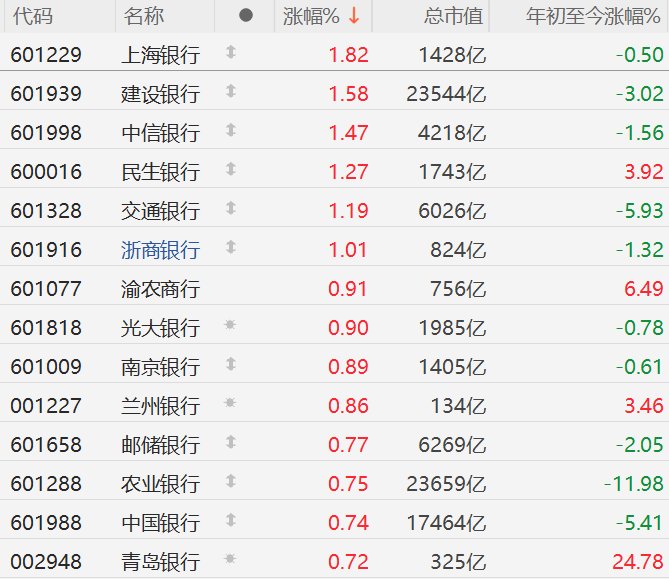
Core Viewpoint - The A-share market saw a broad increase in bank stocks, with Shanghai Bank, Construction Bank, CITIC Bank, Minsheng Bank, Bank of Communications, and Zheshang Bank all rising over 1% [1] Group 1: Stock Performance - Shanghai Bank (601229) increased by 1.82%, with a total market capitalization of 142.8 billion and a year-to-date decline of 0.50% [2] - Construction Bank (601939) rose by 1.58%, holding a market cap of 2,354.4 billion, and has a year-to-date decline of 3.02% [2] - CITIC Bank (601998) saw a rise of 1.47%, with a market cap of 421.8 billion and a year-to-date decline of 1.56% [2] - Minsheng Bank (600016) increased by 1.27%, with a market cap of 174.3 billion and a year-to-date increase of 3.92% [2] - Bank of Communications (601328) rose by 1.19%, with a market cap of 602.6 billion and a year-to-date decline of 5.93% [2] - Zheshang Bank (601916) increased by 1.01%, with a market cap of 82.4 billion and a year-to-date decline of 1.32% [2] Group 2: Additional Bank Performance - Chongqing Rural Commercial Bank (601077) rose by 0.91%, with a market cap of 75.6 billion and a year-to-date increase of 6.49% [2] - Everbright Bank (601818) increased by 0.90%, with a market cap of 198.5 billion and a year-to-date decline of 0.78% [2] - Nanjing Bank (6000009) rose by 0.89%, with a market cap of 140.5 billion and a year-to-date decline of 0.61% [2] - Lanzhou Bank (001227) increased by 0.86%, with a market cap of 13.4 billion and a year-to-date increase of 3.46% [2] - Postal Savings Bank (601658) rose by 0.77%, with a market cap of 626.9 billion and a year-to-date decline of 2.05% [2] - Agricultural Bank (601288) increased by 0.75%, with a market cap of 2,365.9 billion and a year-to-date decline of 11.98% [2] - Bank of China (601988) rose by 0.74%, with a market cap of 1,746.4 billion and a year-to-date decline of 5.41% [2] - Qingdao Bank (002948) increased by 0.72%, with a market cap of 32.5 billion and a year-to-date increase of 24.78% [2]



震荡市显韧性,黄金增强策略理财产品近3月收益仍领先
2 1 Shi Ji Jing Ji Bao Dao· 2026-02-09 01:15
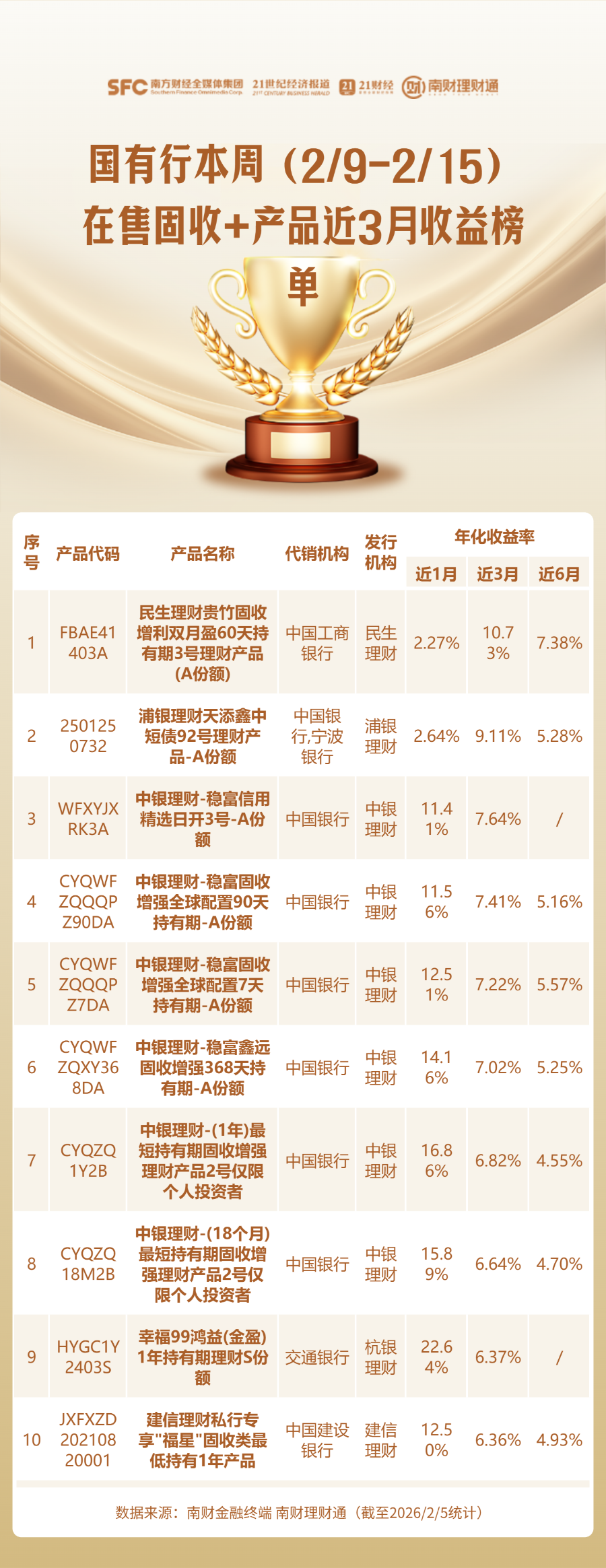
Core Insights - The report focuses on fixed income + products issued by wealth management companies, highlighting superior performing products available for investors through distribution channels [1] - A ranking of products is provided based on their annualized performance over the last month, three months, and six months, with a particular emphasis on the three-month annualized yield to reflect their performance amid recent market fluctuations [1] Distribution Channels - The report includes a list of 28 distribution institutions, which consist of major banks such as Industrial and Commercial Bank of China, Bank of China, Agricultural Bank of China, and others [1] Product Performance - The ranking showcases various products with their respective annualized yields, indicating the performance metrics over different time frames, such as 2.64% for one month and 9.11% for three months for a specific product [5] - The data is sourced from the South Finance Financial Terminal, with statistics as of February 5, 2026, providing a snapshot of the current market offerings [5][10]





收益率碾压现金产品!这份“闲钱理财”榜单透露了哪些机会?
2 1 Shi Ji Jing Ji Bao Dao· 2026-02-09 01:15
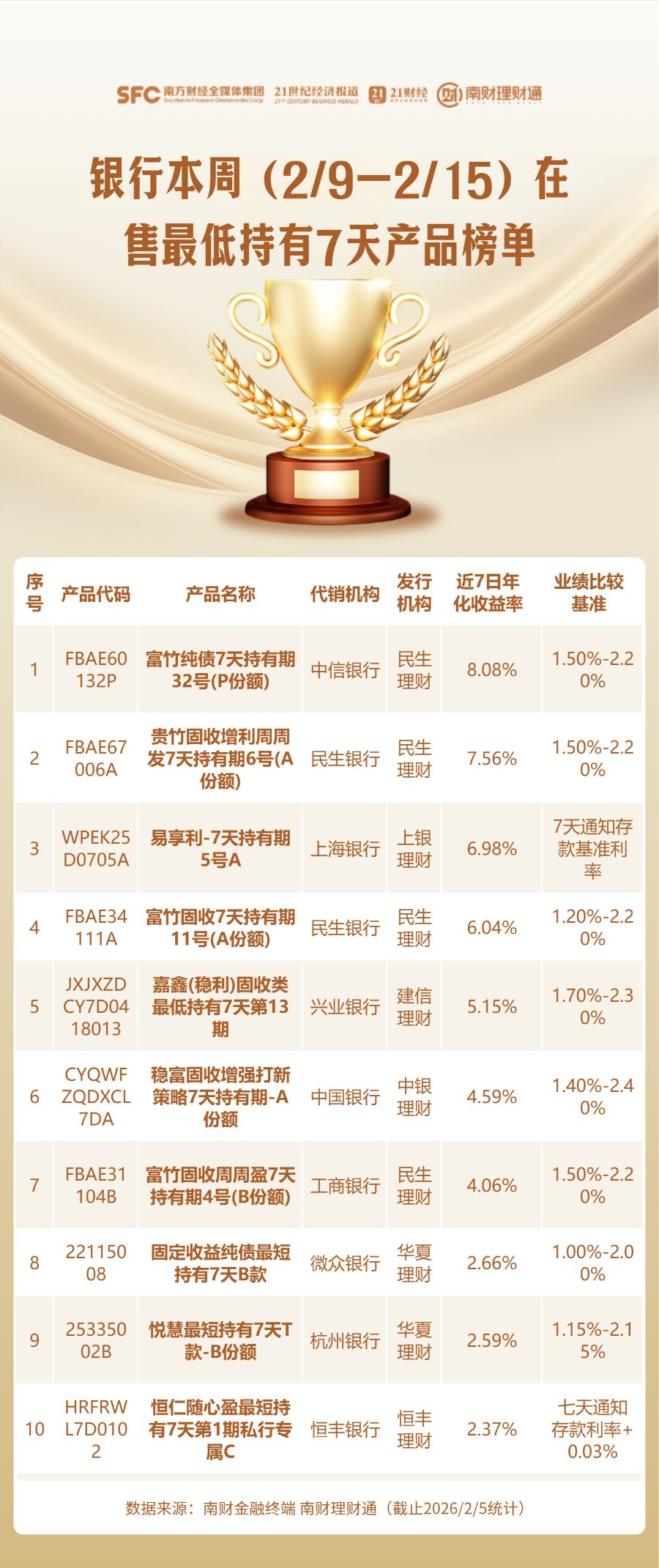
Core Insights - The article focuses on the performance of minimum holding period RMB public offering products, ranking them based on annualized returns for holding periods of 7, 14, 30, and 60 days [1] Group 1: 7-Day Holding Period Products - The top-performing product is from Minsheng Bank with an annualized return of 7.56% [5] - Other notable products include a 6.98% return from Shanghai Bank and a 6.04% return from Minsheng Bank [5] Group 2: 14-Day Holding Period Products - The leading product is from Minsheng Bank with a return of 7.39% [8] - China Bank follows with a return of 4.44% [8] Group 3: 30-Day Holding Period Products - The highest return is 18.14% from Hangzhou Bank [12] - Other significant returns include 12.34% from Minsheng Bank and 9.72% from Minsheng Bank [12][13] Group 4: 60-Day Holding Period Products - The top product is from China Bank with a return of 9.33% [15] - Other products include 5.95% from Shanghai Bank and 5.54% from Huaxia Bank [15][16]