PICC(601319)

Search documents
人保财险陕西2分公司被罚 未按规定领取营业执照等
Zhong Guo Jing Ji Wang· 2026-01-08 09:04
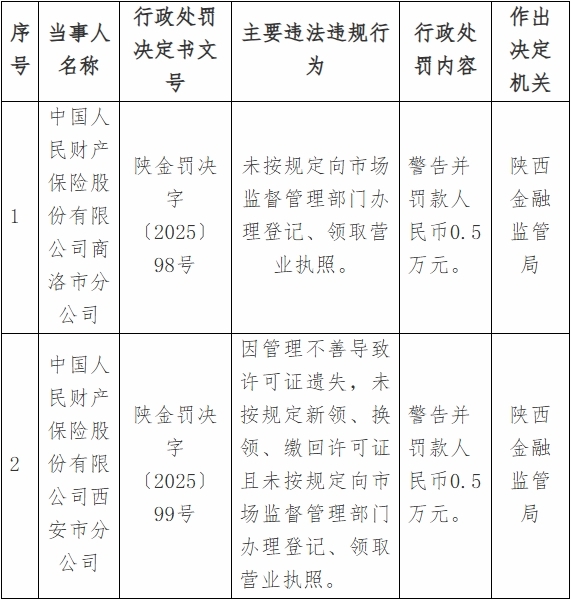
Group 1 - The article reports administrative penalties imposed by the Shaanxi Financial Regulatory Bureau on China People's Property Insurance Company, Shanzhou Branch, and Xi'an Branch for regulatory violations [1][2] - The Shanzhou Branch was fined 5,000 RMB for failing to register and obtain a business license as required by market supervision authorities [1][2] - The Xi'an Branch was also fined 5,000 RMB due to mismanagement leading to the loss of its license and failure to reapply or return the license as mandated [1][2]

2025年1-11月新疆维吾尔自治区原保险保费收入共计741.48亿元,同比增长4.09%
Chan Ye Xin Xi Wang· 2026-01-08 04:03
Group 1 - The core viewpoint of the news highlights the growth of the insurance industry in the Xinjiang Uygur Autonomous Region, with a total original insurance premium income of 74.148 billion yuan from January to November 2025, representing a year-on-year increase of 4.09% [1] - Life insurance accounted for the highest proportion of the total original insurance premium income in Xinjiang, amounting to 33.827 billion yuan, which is 45.62% of the total [1] - The report referenced is the "2026-2032 China Insurance Industry Development Analysis and Investment Prospect Forecast Report" published by Zhiyan Consulting, indicating a focus on future trends and investment opportunities in the insurance sector [1] Group 2 - The data source for the cumulative original insurance premium income statistics from 2020 to November 2025 is the National Financial Supervision Administration, organized by Zhiyan Consulting [2] - Zhiyan Consulting is recognized as a leading industry consulting firm in China, specializing in in-depth industry research reports, business plans, feasibility studies, and customized services [2]







2025年1-11月海南省原保险保费收入共计207.89亿元,同比增长2.88%
Chan Ye Xin Xi Wang· 2026-01-08 03:56
Core Viewpoint - The insurance premium income in Hainan Province for the period from January to November 2025 reached 20.789 billion, reflecting a year-on-year growth of 2.88% [1] Group 1: Insurance Premium Income - The total original insurance premium income in Hainan Province from January to November 2025 was 20.789 billion [1] - Life insurance accounted for the highest share of the total premium income, amounting to 9.512 billion, which represents 45.75% of the total [1] Group 2: Industry Analysis - The report titled "2026-2032 China Insurance Industry Development Analysis and Investment Prospect Forecast" was released by Zhiyan Consulting, a leading industry consulting firm in China [1] - Zhiyan Consulting has over a decade of experience in industry research, providing comprehensive industry research reports, business plans, feasibility studies, and customized services [1]

过渡期临近 险企首席合规官加速上岗
Bei Jing Shang Bao· 2026-01-08 02:48
Core Viewpoint - The recent appointment of chief compliance officers (CCOs) in various insurance companies, including China Insurance, reflects a significant shift in the industry towards proactive governance and compliance management in response to regulatory requirements [1][2]. Group 1: Regulatory Changes - The Financial Regulatory Bureau issued the "Compliance Management Measures for Financial Institutions," which will take effect on March 1, 2025, mandating the establishment of CCOs at the headquarters of financial institutions [2][4]. - The CCO is considered a senior management position, directly reporting to the chairman and CEO, and is responsible to the board of directors [2][4]. Group 2: Industry Trends - Multiple insurance companies have recently appointed CCOs, indicating a trend where compliance roles are becoming a focal point in corporate governance [1][2]. - The qualifications for CCOs are stringent, requiring extensive experience in both financial and legal fields, ensuring that appointees possess the necessary expertise [2][5]. Group 3: Implementation Challenges - The establishment of CCOs is not only a response to regulatory demands but also a restructuring of internal governance and risk management systems within insurance companies [4][5]. - Challenges in implementing the CCO role include potential resistance from business departments, the need for clear authority and resource allocation, and the complexity of compliance risks across various operational areas [4][5]. Group 4: Talent Development - There is a notable shortage of qualified professionals who can fulfill the multifaceted requirements of the CCO role, particularly in smaller insurance companies [5][6]. - Recommendations for overcoming these challenges include establishing direct communication between the board and CCOs, integrating compliance performance into executive assessments, and fostering a culture of compliance throughout the organization [5][6].
上证深一度 | 具身机器人也有自己的保单 险企竞逐机器人保险业务
Shang Hai Zheng Quan Bao· 2026-01-08 00:06
Group 1 - The core viewpoint of the articles highlights the rapid growth of the robot rental market, which is expected to reach a scale of 100 billion yuan by 2026, leading to increased demand for insurance products tailored for robots [1][2] - The first "insurance + rental" policy for humanoid robots has been launched by Ping An Property & Casualty Insurance, which includes comprehensive coverage such as third-party liability and product quality liability, addressing the limitations of traditional insurance models [3][4] - Major insurance companies like PICC and Taikang are actively developing robot insurance products, offering flexible coverage options to meet diverse market needs, indicating a shift towards a dynamic financial ecosystem that supports the entire lifecycle of the robot industry [4][5] Group 2 - The development of robot insurance faces challenges such as data barriers, difficulty in risk assessment, and unclear liability definitions, which need to be addressed through collaboration and innovation within the industry [6][7] - Experts suggest that establishing a data-sharing platform involving regulatory bodies, technology companies, and insurance institutions is crucial for overcoming pricing and data challenges in robot insurance [6][7] - The insurance sector is moving from providing static risk coverage to creating a comprehensive financial ecosystem that supports the dynamic needs of the robot industry, reflecting a fundamental upgrade in the financial industry's support logic for robotics [4][5]


中国人民保险集团(01339.HK):1月7日南向资金减持3537.1万股
Sou Hu Cai Jing· 2026-01-07 19:35
Group 1 - The core point of the article highlights that southbound funds have reduced their holdings in China People's Insurance Group (01339.HK) by 35.37 million shares on January 7, with a total net reduction of 45.82 million shares over the last five trading days [1] - Over the past 20 trading days, southbound funds have reduced their holdings on 13 days, resulting in a cumulative net reduction of 99.02 million shares [1] - As of now, southbound funds hold 2.572 billion shares of China People's Insurance Group, accounting for 29.46% of the company's total issued ordinary shares [1] Group 2 - China People's Insurance Group Co., Ltd. is a holding company primarily providing insurance products, including property insurance, health insurance, life insurance, reinsurance, Hong Kong insurance, and pension insurance [1] - The property insurance business includes products for both companies and individuals, such as motor vehicle insurance, agricultural insurance, property insurance, and liability insurance [1] - The health insurance business encompasses health and medical insurance products, while the life insurance business includes various life insurance products such as participating, whole life, annuity, and universal life insurance [1]

具身机器人也有自己的保单 险企竞逐机器人保险业务
Shang Hai Zheng Quan Bao· 2026-01-07 17:51
Core Insights - The insurance market for robots is rapidly evolving, with leading insurance companies actively expanding their robot insurance offerings to meet diverse needs [2][7] - The shift in the financial industry's support for the robot sector is moving from static risk coverage to a dynamic financial ecosystem that encompasses the entire lifecycle of the industry [2][7] - The development of embodied intelligent robot insurance in China is still in its early stages, facing challenges such as data barriers, risk assessment difficulties, and unclear liability definitions [3][8] Group 1: Market Demand and Innovations - The demand for robot leasing is expected to grow significantly, with projections indicating the market could reach 10 billion yuan by 2026 [2] - Major insurance companies are innovating in robot insurance, with products like Ping An's first "insurance + leasing" policy for embodied robots, which includes comprehensive coverage for third-party liability and product quality [4][6] - The "insurance + leasing" model addresses information asymmetry in single-device insurance and promotes a full-chain risk management approach from manufacturing to usage [6] Group 2: Challenges and Solutions - The development of robot insurance faces several challenges, including difficulties in risk assessment due to a lack of public risk data, poor product adaptability, and unclear liability among multiple stakeholders [8][9] - Experts suggest establishing a data-sharing platform involving regulatory bodies, tech companies, and insurance institutions to create industry standards for risk evaluation and pricing [9] - There is a need for policy guidance and industry innovation to overcome barriers in robot insurance development, including incentives for companies to insure and for insurers to innovate [8][9]

过渡期临近,险企首席合规官加速“上岗”
Bei Jing Shang Bao· 2026-01-07 12:24
Core Viewpoint - The recent appointment of compliance officers in various insurance companies, including Bai Feipeng at China Insurance, reflects a response to regulatory requirements and signifies a shift from "passive compliance" to "active governance" in the insurance industry, aiming to strengthen risk management for high-quality development [1][3]. Group 1: Regulatory Changes - The Financial Regulatory Bureau issued the "Compliance Management Measures" which will take effect on March 1, 2025, mandating financial institutions to establish a Chief Compliance Officer (CCO) at their headquarters [3][5]. - The CCO is a senior management position directly reporting to the board and is responsible for compliance management, with a one-year transition period provided for implementation [3][5]. Group 2: Appointment Trends - Several insurance companies have recently appointed CCOs, including Bai Feipeng at China Insurance, Wang Zhu at Guobao Life, and Miao Lianguang at Guohua Xingyi Insurance Asset Management [1][4]. - Some companies have chosen to appoint existing senior management as CCOs, while others have recruited new executives for the role [4]. Group 3: Compliance Management Evolution - The establishment of CCO positions is seen as a restructuring of internal governance and risk management systems within insurance companies [5]. - The CCO role is expected to enhance compliance management by creating a vertical compliance management system, clarifying compliance responsibilities, and embedding compliance throughout business processes [5][6]. Group 4: Challenges in Implementation - Despite the potential benefits, the implementation of the CCO role faces challenges, including resistance from business departments and the need for clear authority and resource allocation [5][6]. - The insurance sector's diverse operations create numerous compliance risk points, complicating the effective coverage of compliance management [5][6]. Group 5: Talent and Development Needs - There is a shortage of qualified professionals who possess the necessary expertise in finance, law, and risk management, particularly in smaller insurance companies [6]. - To address these challenges, insurance companies need to develop a comprehensive approach involving institutional support, talent cultivation, technological empowerment, and cultural integration to ensure the effective implementation of the CCO role [6].

安康金融监管分局同意中国人保财险安康市分公司江南营销服务部变更营业场所
Jin Tou Wang· 2026-01-07 11:05
二、中国人民财产保险股份有限公司应按照有关规定及时办理变更及许可证换领事宜。 2025年12月31日,安康金融监管分局发布批复称,《关于中国人民财产保险股份有限公司安康市分公司 江南营销服务部变更营业场所的请示》(安人保财险发〔2025〕98号)收悉。经审核,现批复如下: 一、同意中国人民财产保险股份有限公司安康市分公司江南营销服务部将营业场所变更为:陕西省安康 市汉滨区育才路72号。 ...
2025年金融机构被罚没31亿元,反洗钱和数据相关罚单大增
2 1 Shi Ji Jing Ji Bao Dao· 2026-01-07 10:47
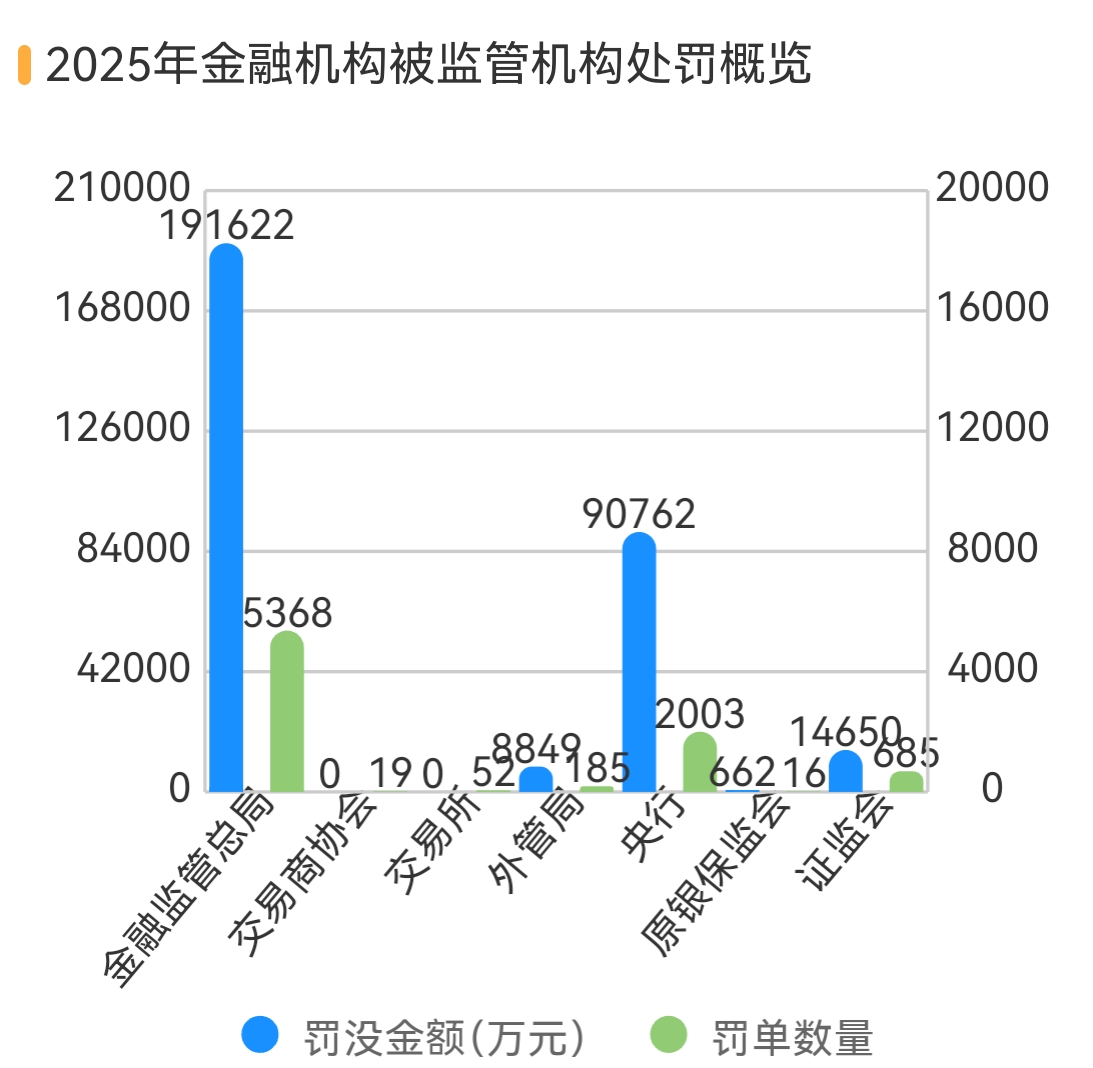
Core Insights - In 2025, financial institutions received a total of 8,328 fines, a year-on-year decrease of 8.41%, while the total amount of fines reached 3.065 billion yuan, an increase of 27.55% [1][2] Group 1: Penalty Overview - The National Financial Supervision Administration issued 5,368 fines totaling 1.916 billion yuan, the central bank issued 2,003 fines totaling 908 million yuan, the Securities Regulatory Commission issued 685 fines totaling 146 million yuan, and the State Administration of Foreign Exchange issued 185 fines totaling 88.49 million yuan [2] - Monthly distribution shows peaks in December, January, and July for the number of fines, with September and December having higher total fine amounts [4] Group 2: Institution-Specific Penalties - Banks received 5,313 fines in 2025, a decrease of 8.88% year-on-year, with total fines amounting to 2.461 billion yuan, an increase of 40.63% [7] - Insurance institutions received 2,166 fines, a decrease of 5.5%, with total fines of 325 million yuan, a decrease of 3.56% [7] - Securities firms received 195 fines, a significant decrease of 42.98%, but the total fines increased by 56.69% [7] Group 3: Major Penalty Cases - In 2025, there were 8 fines exceeding 50 million yuan, with the largest fine of 97.9 million yuan issued for issues related to company governance, loans, and asset quality management [13] - A village bank in Dalian had its financial license revoked due to multiple severe violations, marking a significant regulatory action [14] - A bank president was sentenced to death with a two-year reprieve for illegal lending and bribery, highlighting severe consequences for financial misconduct [15][16] Group 4: Compliance Characteristics - The main areas of violations for banks in 2025 were in credit business, anti-money laundering, and inadequate internal controls [22] - Insurance companies faced penalties primarily for untrue financial/business data and misleading sales practices [23] - Securities firms' violations were concentrated in personnel misconduct, investment banking, and internal control issues [24][25] Group 5: Anti-Money Laundering Violations - There was a significant increase of 188.25% in penalties related to anti-money laundering violations, with 1,349 fines issued [26] - Common violations included failure to identify customer identities and improper transaction reporting [26] Group 6: Data-Related Violations - Penalties related to data violations increased by 44.65%, with 554 fines issued, primarily affecting banks and insurance companies [27] Group 7: Penalty Rankings - Among non-banking institutions, Donghai Securities faced the highest fines at 60 million yuan, followed by China People's Property Insurance and China Pacific Property Insurance [30]