
PSBC(601658)

Search documents
多家银行调整个人客户上金所延期合约保证金比例
Zheng Quan Ri Bao Zhi Sheng· 2026-01-29 17:05
1月21日,邮储银行发布《关于再次调整我行个人客户上海黄金交易所延期合约保证金比例的通知》 称,自北京时间2026年1月22日收盘清算时起,该行将对代理个人上金所业务(包括黄金延期合约和白 银延期合约)的交易保证金比例进行调整。其中:Ag(T+D)、Au(T+D)、Au(T+N1)、Au (T+N2)、mAu(T+D)合约保证金比例均从80%调整为120%。事实上,这已是邮储银行在一个月内 第三次对该行个人客户上金所延期合约保证金比例进行调整。 本报记者 杨洁 近期,多家银行发布调整个人客户上海黄金交易所(以下简称"上金所")延期合约保证金比例的通知。 1月28日,建设银行发布通知称,自2026年1月29日(星期四)收盘清算时起,Au(T+D)、mAu (T+D)、Au(T+N1)、Au(T+N2)、NYAuTN06、NYAuTN12、Ag(T+D)合约的保证金比例从 44%调整为60%。 建设银行官方客服对记者表示,近期国内外贵金属价格波动加剧,市场风险提升,为顺应市场变化,保 护投资者权益,该行对个人客户上金所延期合约交易保证金比例进行调整,并提示投资者做好仓位控 制,理性投资。 工商银行1月27日发布通 ...


11大行去年理财代销增超万亿元
21世纪经济报道· 2026-01-29 12:08
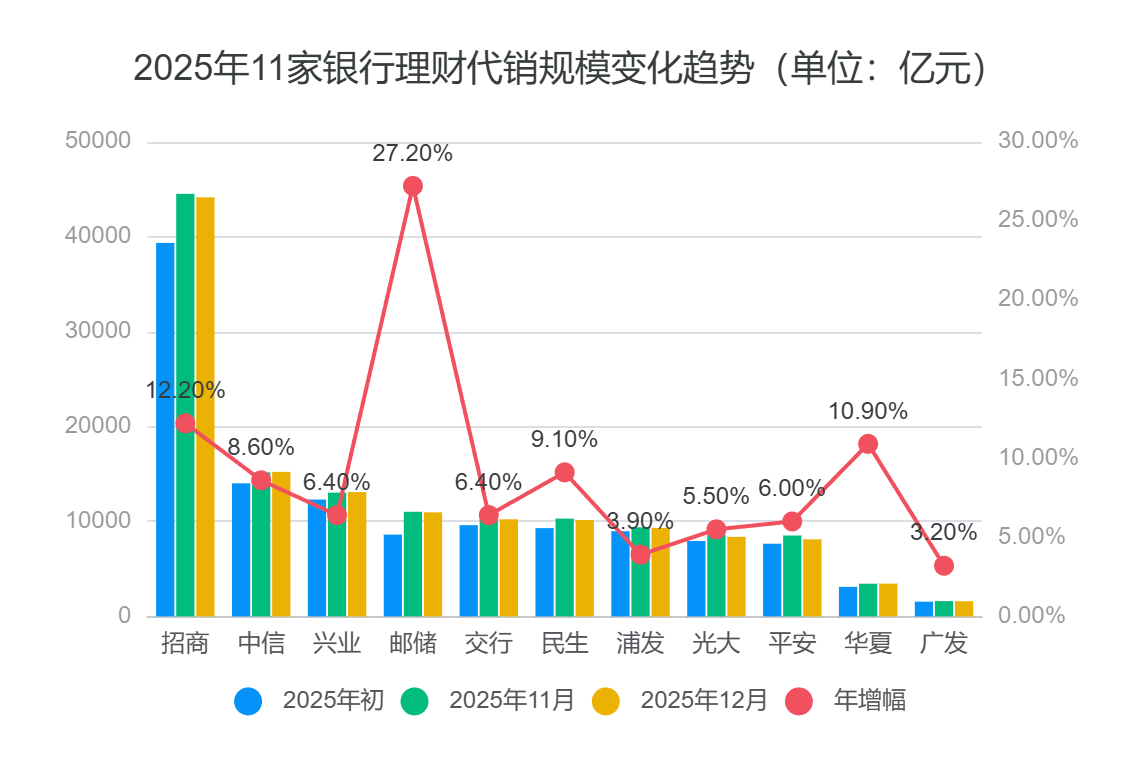
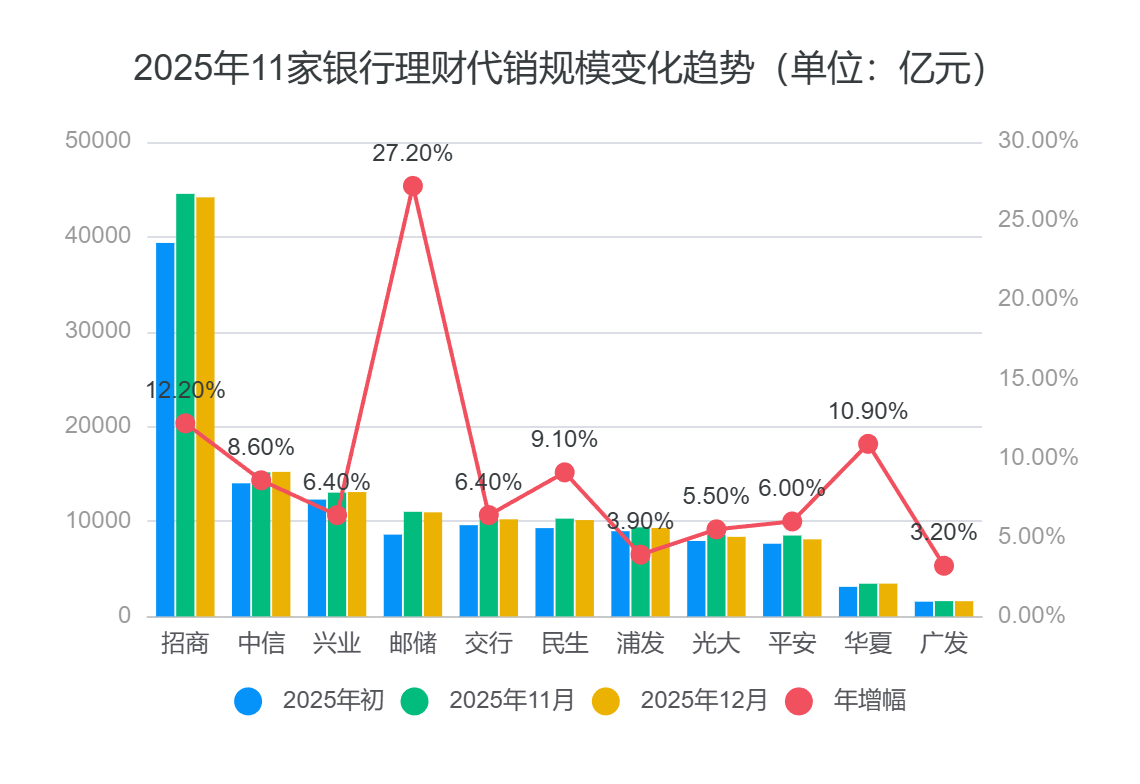
编辑|方海平 21世纪经济报道记者独家获得的一份银行理财代销规模数据显示, 2025年12月,11家全国性 银行代销理财规模13.46万亿元,较11月下降1.05%,较年初增长10%。 从年末两个月的数据 来看,银行理财仍然呈现"季末收缩"特征。从全年数据来看,理财规模增长背后"存款搬家"逻 辑仍然较强。 其中,邮储银行增势强劲,全年增幅达27.2%,增速在统计内的11家银行中居于首位,且断层 式领先, 增速第二的是冠有"零售之王"之称的招商银行,其较年初增长12.2%。业内人士分 析,发力广泛且下沉的渠道、战略重心转向"产品配置"等或成大幅增长的关键。 从绝对代销规模上来看,2025年12月,招商银行以4.41万亿元的规模独占鳌头;第二梯队,中 信、兴业、邮储、交行、民生规模也在万亿以上,其中中信、兴业分别达到1.5万亿、1.3万亿 的量级,另外三家均在1万亿级别;浦发、光大、平安三家规模接近万亿,分别在8000万到 9300万水平;华夏、广发规模较低,分别为3400万及1600万左右。 11家银行理财代销座次较年初相对稳定,仅邮储银行实现"飞升" ,超越交行、民生、浦发, 由年初的第7位升至年末的第4位。 ...




21独家|去年银行理财代销大增 邮储劲增27%超越交行等
2 1 Shi Ji Jing Ji Bao Dao· 2026-01-29 09:49
Core Insights - The report highlights a decline in the scale of bank wealth management sales, with a total of 13.46 trillion yuan by December 2025, down 1.05% from November but up 10% from the beginning of the year [1][7] - Postal Savings Bank showed remarkable growth, leading with a 27.2% increase, while China Merchants Bank followed with a 12.2% increase [1][5] - The overall growth in wealth management sales is attributed to a "deposit migration" trend, where customers are shifting their funds into wealth management products [7][10] Group 1: Bank Performance - By December 2025, China Merchants Bank led with a wealth management sales scale of 4.41 trillion yuan, followed by CITIC Bank and Industrial Bank, both exceeding 1 trillion yuan [1][2] - Postal Savings Bank's rise in ranking from 7th to 4th among the 11 banks indicates a significant shift in market dynamics [2][4] - The total growth in wealth management sales among the 11 banks amounted to 1.22 trillion yuan, with a year-on-year increase of 10% [7][6] Group 2: Factors Driving Growth - The growth of Postal Savings Bank's wealth management sales is linked to strategic reforms and an expansion of distribution channels, with approximately 40,000 outlets enhancing customer reach [5][6] - The shift in focus from "product sales" to "product configuration" aims to cater to high-net-worth clients, which is seen as a crucial strategy for growth [5][10] - The demand for stable, low-volatility wealth management products remains strong, particularly in a low-interest-rate environment, driving customer interest [9][10] Group 3: Market Trends - The report notes a seasonal pattern in bank wealth management, characterized by "quarter-end contraction" and "quarter-beginning recovery," influenced by regulatory requirements [8][10] - Despite a slight contraction in December, the overall wealth management scale showed resilience, indicating strong underlying demand [8][9] - Predictions suggest that the wealth management scale could reach approximately 38 trillion yuan by the end of 2026, with a projected growth rate of around 12% [12]

21独家|去年银行理财代销大增,邮储劲增27%超越交行等
2 1 Shi Ji Jing Ji Bao Dao· 2026-01-29 09:45
Core Insights - The report indicates that by December 2025, the wealth management distribution scale of 11 national banks reached 13.46 trillion yuan, a decrease of 1.05% from November but a 10% increase from the beginning of the year [1] - The growth in wealth management scale is largely driven by the "deposit migration" phenomenon, where customers are shifting their funds from traditional deposits to wealth management products [1][10] - Postal Savings Bank showed remarkable growth with a 27.2% increase, leading among the 11 banks, while China Merchants Bank followed with a 12.2% increase [1][6] Bank Performance - By December 2025, China Merchants Bank led with a wealth management distribution scale of 4.41 trillion yuan, followed by CITIC Bank and Industrial Bank with 1.5 trillion and 1.3 trillion yuan respectively [1] - The ranking of the 11 banks remained relatively stable, with Postal Savings Bank rising from 7th to 4th place by year-end [2] - The overall wealth management distribution scale of the 11 banks grew by 1.22 trillion yuan throughout the year, with a 10% year-on-year increase [8] Factors Driving Growth - The significant growth of Postal Savings Bank's wealth management distribution is attributed to its strategic reforms and expansion of distribution channels, which have broadened its retail business volume [6][7] - The bank's extensive network of approximately 40,000 outlets and a strong customer base have made low-volatility wealth management products attractive alternatives to traditional deposits [6] - The shift in focus from "product sales" to "product configuration" has allowed banks to better serve high-net-worth clients, enhancing their wealth management offerings [7] Market Trends - The average yield of wealth management products fell below 2% for the first time, recorded at 1.98%, yet the number of investors holding these products increased by 14.37% year-on-year [10] - The "deposit migration" narrative remains strong, with banks focusing on deeper market penetration and optimizing customer service to attract more clients [11] - The wealth management market is expected to continue growing, with projections indicating a potential scale of 38 trillion yuan by the end of 2026, reflecting a year-on-year growth rate of around 12% [12]
去年银行理财代销大增,邮储劲增27%超越交行等
Xin Lang Cai Jing· 2026-01-29 09:35
Core Insights - The total scale of wealth management products sold by 11 national banks reached 13.46 trillion yuan by December 2025, showing a decrease of 1.05% from November but a growth of 10% compared to the beginning of the year [1] Group 1: Wealth Management Market Trends - The data indicates a "quarter-end contraction" characteristic in the wealth management sector during the last two months of the year [1] - The growth in wealth management scale is largely driven by the "deposit migration" logic, suggesting a shift in consumer behavior towards wealth management products [1] Group 2: Bank Performance - Postal Savings Bank exhibited a strong growth rate of 27.2% for the year, leading among the 11 banks in the study [1] - China Merchants Bank, known as the "king of retail," recorded a growth of 12.2% from the beginning of the year, placing it second in growth rate [1] Group 3: Strategic Insights - Analysts suggest that the key to significant growth for these banks lies in their extensive and down-market channels, as well as a strategic shift towards "product allocation" [1]
国有大型银行板块1月29日涨0.37%,邮储银行领涨,主力资金净流入6.02亿元
Zheng Xing Xing Ye Ri Bao· 2026-01-29 09:03
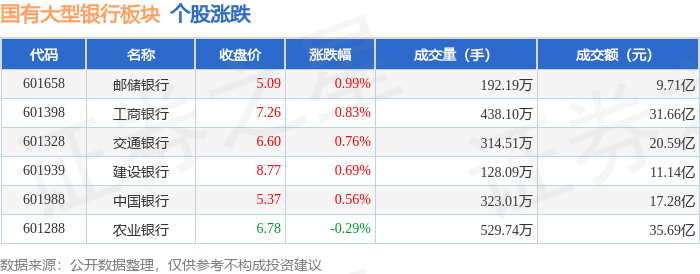
Group 1 - The core viewpoint of the news is that the state-owned large bank sector experienced a slight increase of 0.37% on January 29, with Postal Savings Bank leading the gains [1] - The Shanghai Composite Index closed at 4157.98, up 0.16%, while the Shenzhen Component Index closed at 14300.08, down 0.3% [1] - The trading performance of individual stocks in the state-owned large bank sector showed varied results, with Postal Savings Bank closing at 5.09, up 0.99%, and Agricultural Bank of China closing at 6.78, down 0.29% [1] Group 2 - The net inflow of main funds into the state-owned large bank sector was 602 million yuan, while retail investors saw a net outflow of 309 million yuan [1] - The detailed fund flow for individual banks indicated that Industrial and Commercial Bank of China had a main fund net inflow of 1.55 billion yuan, but also experienced net outflows from both retail and speculative funds [2] - The overall trend showed that while some banks like Postal Savings Bank had a positive net inflow from main funds, they still faced outflows from retail investors, indicating mixed investor sentiment [2]



“不仅懂我们,更能解难题”
Jin Rong Shi Bao· 2026-01-29 02:25
Group 1 - The core issue faced by the manganese mining company is the rising raw material prices, which have led to financial constraints and difficulties in stockpiling necessary resources [1] - The company initially had a credit limit of 2 million yuan, which was insufficient to cope with the rapid increase in manganese prices, resulting in a shrinking profit margin [1] - Postal Savings Bank's Huaihua branch identified the company's financing needs and increased its credit limit to 3.26 million yuan through a "credit + guarantee" model, enabling the company to purchase manganese at lower prices [1] Group 2 - The bank's proactive approach in addressing the financing challenges faced by small and micro enterprises has allowed them to stabilize production costs and enhance profit margins [1] - The bank has been focusing on the challenges posed by commodity price fluctuations, particularly in terms of inventory procurement and financing difficulties for businesses [1] - By utilizing a dual-channel approach of "online approval + guarantee enhancement," the bank has effectively expanded its credit coverage and supported the sustainable development of regional specialty industries [1]
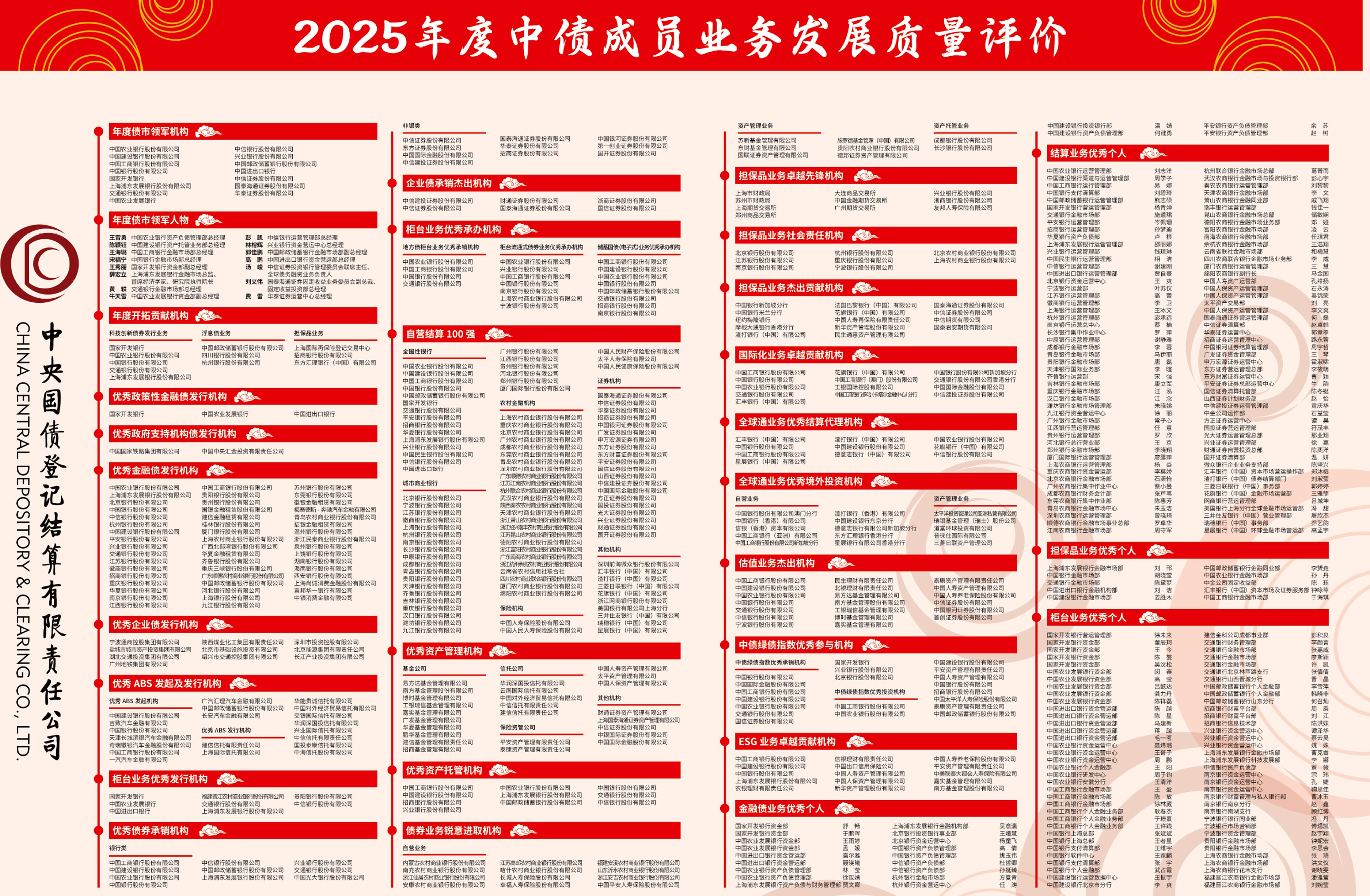
2025年度中债成员业务发展质量评价
Jin Rong Shi Bao· 2026-01-29 01:25
科技创新债券发行业务 国家开发银行 中国农业银行股份有限公司 中国银行股份有限公司 交通银行股份有限公司 上海浦东发展银行股份有限公司 中信银行股份有限公司 兴业银行股份有限公司 中国邮政储蓄银行股份有限公司 中国进出口银行 中信证券股份有限公司 国泰海通证券股份有限公司 华泰证券股份有限公司 年度债市领军人物 << 中国农业银行资产负债管理部总经理 壬雷勇 陈颖轩 中国建设银行资产托管业务部总经理 王海璐 中国工商银行金融市场部总经理 宋福宁 中国银行金融市场部总经理 国家开发银行资金部副总经理 于会服 蔭宏立 上海东东发展银行金$市场总监。 首席经济学家、研究院执行院长 8 裝 交通银行金融市场部总经理 牛天雪 中国农业发展银行资金部副总经理 年度开拓贡献机构 ~~ 年度债市领军机构 200 中国农业银行股份有限公司 中国建设银行股份有限公司 中国工商银行股份有限公司 中国银行股份有限公司 国家开发银行 上海浦东发展银行股份有限公司 交通银行股份有限公司 中国农业发展银行 中信银行运营管理部总经理 凯 林榕辉 兴业银行资金营运中心总经理 郭佳鹏 中国邮政储蓄银行金融市场部副总经理 高 此 中国进出口银行资 ...



六大行迅速发布信用卡分期贴息“指南”
Jin Rong Shi Bao· 2026-01-29 01:11
Core Viewpoint - The new policy on credit card installment interest subsidies aims to enhance consumer spending by including credit card bill installment services in the subsidy scope, thereby reducing the financial burden on consumers and stimulating consumption potential [1][4]. Group 1: Policy Implementation - The Ministry of Finance, the People's Bank of China, and the National Financial Regulatory Administration issued a notification that includes credit card bill installment services in the subsidy scope with a uniform annual subsidy rate of 1% [1]. - Major state-owned banks and some joint-stock banks have quickly responded by releasing implementation details, simplifying processes, and enhancing risk control measures to ensure effective policy execution [2][3]. - The policy reflects a strong public demand for support in consumer financing, aligning with the principle of "people-centered" policy design [2]. Group 2: Consumer Benefits - The subsidy allows consumers to save approximately 270 yuan in interest over a year when using a 50,000 yuan credit card bill divided into 12 installments [4]. - The policy is expected to significantly alleviate financial pressure on large purchases such as home appliances, cars, and education, thus converting latent consumer demand into actual purchasing behavior [4][5]. - The annual cap for total subsidies has been raised to 3,000 yuan per borrower, with the removal of previous limits on single transaction subsidies [5]. Group 3: Bank Responses and Services - Six major banks have clarified that existing customers with signed agreements will automatically benefit from the new policy without needing to re-sign [2]. - Banks like Agricultural Bank and Postal Savings Bank have outlined the steps for new customers to apply for the credit card installment interest subsidy, emphasizing a simplified process [2][3]. - The banks have committed to not charging any fees for processing the subsidy applications, ensuring a cost-free experience for consumers [8]. Group 4: Market Impact and Growth Potential - The policy is anticipated to drive growth in credit card installment services, especially as consumer awareness increases leading up to the Spring Festival [6]. - Smaller financial institutions are also preparing to implement similar measures, which will help extend the benefits to lower-tier cities and meet diverse consumer needs [6]. - The inclusion of credit card installments in the subsidy program is seen as a crucial step in supporting consumption expansion and improving the quality of financial services [7].
银行多维度落实个人消费贷贴息新政
Jin Rong Shi Bao· 2026-01-29 01:04
Core Viewpoint - The recent optimization and upgrade of the personal consumption loan interest subsidy policy aims to enhance consumer credit support and stimulate consumption through various measures, including extending the policy duration, expanding the subsidy scope, and increasing the subsidy standards [1][2][3]. Group 1: Policy Enhancements - The policy implementation period has been extended to September 1, 2025, through December 31, 2026, providing a longer support cycle for consumer credit [2]. - The subsidy scope has been expanded by removing the previous restriction on consumption fields for loans of 50,000 yuan and above, allowing for broader application [2][3]. - The subsidy standards have been optimized by eliminating the previous caps on single transaction subsidies and cumulative subsidies for amounts below 50,000 yuan, while maintaining an annual cap of 3,000 yuan per borrower at a single institution [3][4]. Group 2: Credit Card Bill Installment Subsidy - The most notable change is the inclusion of credit card bill installment payments in the subsidy program, with a subsidy rate of 1% applicable from January 1, 2026, to December 31, 2026 [4][5]. - This initiative aims to lower the financing costs for consumers using credit cards, thereby stimulating consumption and increasing merchant revenues [4][6]. - Banks are rapidly implementing operational processes for the new credit card installment subsidy to ensure quick policy execution [5][7]. Group 3: Risk Management and Process Optimization - Banks are focusing on simplifying application processes and enhancing risk management to prevent misuse of subsidy funds while ensuring effective policy implementation [7][8]. - Digital technologies are being leveraged to facilitate online processing of subsidy applications, allowing borrowers to manage their applications through mobile and online banking platforms [7]. - Strict measures are in place to prevent fraudulent activities related to subsidy applications, with banks retaining the right to recover funds in cases of non-compliance [8].