
SRCB(601825)

Search documents
农商行板块1月12日跌0.14%,渝农商行领跌,主力资金净流出5928.29万元
Zheng Xing Xing Ye Ri Bao· 2026-01-12 09:04
Market Overview - The agricultural commercial bank sector experienced a decline of 0.14% on January 12, with Yunnan Agricultural Commercial Bank leading the drop [1] - The Shanghai Composite Index closed at 4165.29, up 1.09%, while the Shenzhen Component Index closed at 14366.91, up 1.75% [1] Individual Bank Performance - Zijin Bank closed at 2.79, with an increase of 0.72% and a trading volume of 386,600 shares, totaling a transaction value of 107 million yuan [1] - Su Nong Bank closed at 5.06, up 0.40%, with a trading volume of 204,900 shares, totaling 104 million yuan [1] - Ruifeng Bank closed at 5.51, up 0.36%, with a trading volume of 181,100 shares, totaling approximately 99.28 million yuan [1] - Qing Nong Bank closed at 3.11, up 0.32%, with a trading volume of 422,100 shares, totaling 131 million yuan [1] - Yunnan Agricultural Commercial Bank closed at 6.51, down 0.91%, with a trading volume of 690,100 shares [1] Capital Flow Analysis - The agricultural commercial bank sector saw a net outflow of 59.28 million yuan from institutional investors, while retail investors contributed a net inflow of 49.11 million yuan [1] - The table of capital flow indicates that Changshu Bank had a net inflow of 7.30 million yuan from institutional investors, while it faced a net outflow of 22.43 million yuan from speculative funds [2] - Yunnan Agricultural Commercial Bank experienced a net outflow of 21.20 million yuan from institutional investors, but a net inflow of 42.56 million yuan from speculative funds [2]







息差稳定预期加强
Xiangcai Securities· 2026-01-11 13:46
Investment Rating - The industry rating is maintained at "Overweight" [10][37] Core Insights - The central bank's 2026 work meeting emphasized a stable interest margin expectation, indicating a shift in focus from reducing financing costs to maintaining them at low levels [7][34] - The meeting highlighted the importance of enhancing financial services for high-quality economic development, directing funds towards key areas such as technological innovation and small and medium enterprises [7][34] - The credit market is showing signs of stabilization, with a shift from quantity to quality in credit issuance, and a reduction in the pace of loan rate declines [8][34] Summary by Sections Market Review - The banking index fell by 1.90%, underperforming the CSI 300 index by 4.69 percentage points [12] - The performance of various banking sectors showed declines, with large banks down by 2.94% and regional banks performing relatively better [12] Monetary Policy - The central bank's monetary policy will remain moderately accommodative, focusing on both counter-cyclical and cross-cyclical adjustments [7][34] - The emphasis will be on stabilizing corporate financing cost expectations and preventing significant interest rate fluctuations [7][34] Investment Recommendations - The report suggests focusing on state-owned banks with stable asset deployment and regional banks with growth potential, recommending specific banks such as ICBC, Bank of China, and others [10][37]





进击的头部农商行:五家资产破万亿,重庆农商行、广州农商行主要指标超同城城商行
Xin Lang Cai Jing· 2026-01-10 07:14
Core Viewpoint - Chengdu Rural Commercial Bank has announced that its asset scale has surpassed 1 trillion yuan, making it the fifth rural commercial bank to achieve this milestone, joining Chongqing, Shanghai, Guangzhou, and Beijing Rural Commercial Banks [1][3]. Group 1: Asset Scale and Market Position - As of September 2025, the total assets of the five leading rural commercial banks reached 6.98 trillion yuan, accounting for 11.4% of the total assets of rural financial institutions, which stood at 61.06 trillion yuan [1][3]. - The number of rural commercial banks in China is 1,505, with additional institutions such as rural cooperative banks and rural credit cooperatives contributing to the overall landscape [1]. Group 2: Financial Performance - In the first three quarters of the previous year, all five banks reported revenue exceeding 10 billion yuan, with only Chongqing and Shanghai Rural Commercial Banks achieving net profits over 10 billion yuan [4]. - Chengdu Rural Commercial Bank reported a year-on-year revenue and net profit growth of approximately 7%, while Guangzhou Rural Commercial Bank experienced declines in both metrics [4]. Group 3: Loan and Asset Structure - The loan assets of the five banks account for about half of their total assets, with financial investments generally exceeding 30% [4]. - As of the end of 2024, the loan structure shows that Beijing and Chengdu Rural Commercial Banks have a high proportion of corporate loans, exceeding 70%, while Chongqing Rural Commercial Bank has 40% in personal loans [6][7]. Group 4: Asset Quality and Risk - The non-performing loan (NPL) ratios for Shanghai, Chongqing, and Beijing Rural Commercial Banks were 0.97%, 1.12%, and 1.19% respectively, which are better than the overall levels of large commercial banks [8]. - The overall NPL ratio for rural commercial banks was 2.82%, significantly higher than that of large commercial banks [8]. Group 5: Market Dynamics and Competitive Position - The five leading rural commercial banks have established a strong market presence, with some outperforming local city commercial banks in terms of asset scale, revenue, and net profit [11][12]. - The integration of smaller rural banks is accelerating, indicating a trend towards consolidation within the rural financial sector [15][16]. Group 6: Development Advantages and Challenges - Rural commercial banks benefit from extensive physical networks in rural areas, providing essential financial services to local communities, which enhances customer loyalty [18]. - However, they face challenges such as high industry concentration and limited risk management capabilities, which can hinder their ability to diversify risks [19].

上海农商行董事长徐力的署名文章写得很优美!很有意思
Xin Lang Cai Jing· 2026-01-09 04:14
Core Insights - Shanghai Rural Commercial Bank emphasizes creating value for customers and enhancing public trust in finance through professional and accessible services [3] - The bank's strategy focuses on reform-driven development, value creation through service, and identifying market opportunities by addressing social pain points [3] - Despite a decline in revenue, the bank managed to achieve a slight increase in net profit, indicating resilience in its financial performance [4] Financial Performance - For the first three quarters of 2025, Shanghai Rural Commercial Bank reported operating revenue of 19.831 billion yuan, a year-on-year decrease of 3.18% [4] - The bank's net profit attributable to shareholders reached 10.567 billion yuan, reflecting a year-on-year increase of 0.78% [4] - Revenue growth from 2019 to 2024 showed fluctuations with increases of 5.59%, 3.61%, 9.64%, 6.05%, 3.07%, and 0.86% respectively [4] Competitive Position - Shanghai Rural Commercial Bank has been a strong competitor alongside Chongqing Rural Commercial Bank, with both being top players among rural commercial banks in China [4] - In the first three quarters of 2025, Chongqing Rural Commercial Bank surpassed Shanghai Rural Commercial Bank with a net profit of 10.694 billion yuan, highlighting a close competition between the two [4] - The slight profit margin difference indicates that Shanghai Rural Commercial Bank remains a formidable player in the industry, with potential for regaining its leading position [4]
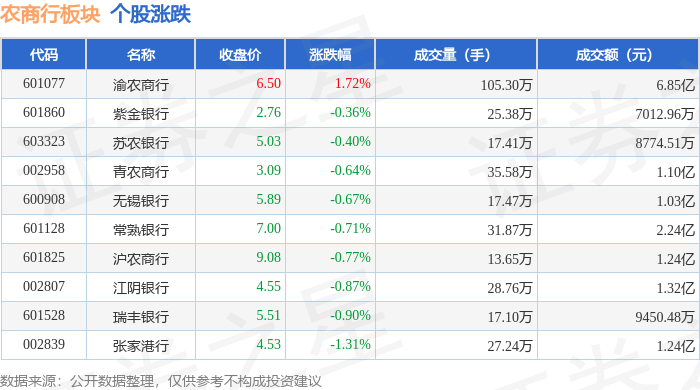
农商行板块1月8日跌0.18%,张家港行领跌,主力资金净流出3731.72万元
Zheng Xing Xing Ye Ri Bao· 2026-01-08 08:56
Core Viewpoint - The agricultural commercial bank sector experienced a slight decline of 0.18% on January 8, with Zhangjiagang Bank leading the drop [1] Group 1: Market Performance - The Shanghai Composite Index closed at 4082.98, down 0.07%, while the Shenzhen Component Index closed at 13959.48, down 0.51% [1] - The agricultural commercial bank sector's individual stock performance showed varied results, with Yunnan Agricultural Commercial Bank rising by 1.72% to a closing price of 6.50 [1] Group 2: Trading Volume and Turnover - The trading volume and turnover for various banks were reported, with Jiangyin Bank having a turnover of 1.32 billion and a trading volume of 287,600 shares [1] - The overall net outflow of main funds from the agricultural commercial bank sector was 37.32 million, while retail funds saw a net outflow of 18.16 million [1] Group 3: Fund Flow Analysis - The main fund inflow for Ruifeng Bank was 4.77 million, accounting for 5.04% of its total, while it faced a retail net outflow of 8.39 million [2] - Zhangjiagang Bank experienced a significant main fund outflow of 6.71 million, with retail investors also withdrawing 7.63 million [2]



银行积存金投资门槛大摸底
Bei Jing Shang Bao· 2026-01-08 06:43
Core Viewpoint - The recent announcement by Industrial and Commercial Bank of China (ICBC) to raise the risk acceptance level for personal gold accumulation business to C3 (balanced) and above has triggered significant changes in the precious metals investment market, reflecting a broader industry trend towards stricter risk management in response to increased market volatility and rising gold prices [1][6]. Group 1: Industry Trends - Major banks have collectively raised the entry-level risk tolerance for gold accumulation products to at least a balanced level (C3), with some banks even setting it to aggressive levels, indicating a comprehensive industry-wide upgrade in risk control measures [1][3][4]. - The international gold price has surpassed $4,400 per ounce, prompting banks to filter out investors with lower risk tolerance to prevent significant losses due to market volatility [6][7]. Group 2: Bank-Specific Requirements - ICBC requires personal clients to achieve a C3 (balanced) risk assessment result to engage in gold accumulation business, a shift from the previous requirement of C1 (conservative) [3][4]. - Other banks, such as Postal Savings Bank and Shanghai Rural Commercial Bank, have also raised their risk assessment standards, with some requiring a minimum of C3 or higher for participation in gold accumulation products [4][6]. - Banks like China CITIC Bank and Ningbo Bank have announced future adjustments to their risk assessment requirements, aligning with the trend of increasing risk thresholds for gold investment [6][7]. Group 3: Investor Behavior and Risks - There is a growing concern about investors attempting to misrepresent their risk tolerance in order to qualify for gold accumulation products, which undermines the integrity of the risk assessment process [8][9]. - The industry is urged to enhance investor education and awareness regarding the risks associated with gold investments, especially in a volatile market environment [8][9].






按揭、信用卡、消费贷与经营贷深度:深度银行四大零售资产的风险分析框架
ZHONGTAI SECURITIES· 2026-01-07 11:17
Investment Rating - The report maintains an "Overweight" rating for the banking sector [2] Core Insights - The four categories of retail loans (mortgages, credit cards, consumer loans, and business loans) collectively constitute household liabilities, each with distinct collateral types, duration structures, and policy influences. The report aims to establish a risk framework for these retail assets and assess their impact on banking operations in the future [2][4] - Under stress testing, the non-performing loan (NPL) ratios for mortgages, credit cards, and consumer loans are projected to increase by 11, 12, and 20 basis points respectively in 2026, while the growth in non-performing amounts remains manageable. The overall quality of corporate assets is expected to continue improving, indicating a stable banking sector [2][4] - Retail asset risks are deemed controllable, with policies expected to maintain stability in the near term [2] Summary by Sections Retail Asset Analysis Framework: Collateral Types + Duration Structure + Policy Impact - The overall NPL ratio for retail loans of listed banks is estimated at 1.27% in the first half of 2025, slightly above the corporate NPL ratio of 1.26%, but the increase in NPL ratios is stabilizing. The composition of existing NPLs is 63% corporate and 37% retail, with business loans and mortgages showing higher proportions of both existing and newly added NPLs [2][12] - The report establishes a risk analysis framework for retail assets, highlighting the differences in collateral types, duration structures, and policy impacts among the four categories of retail loans [2][4] Consumer Loans: "High-Risk" Assets - The relationship between consumer loans and consumption trends is closely aligned, with notable deviations occurring during strict property purchase restrictions and regulatory cycles for online loans. The market structure for consumer credit (excluding credit cards and mortgages) shows that listed banks hold over 51.5% of the market, while non-listed banks account for 17% and other players for 31% [2][4] - The risk logic for consumer credit indicates that risk pricing is primarily determined by interest rates, which can be categorized into four tiers based on risk levels. The report estimates that 4.4% of consumer loans fall into the "high-risk" category, with commercial banks' high-risk consumer loans representing only 0.6% of their total consumer loans [2][4] Mortgage Loans: Risk Sources and International Comparisons - The primary sources of mortgage risk include negative cash flow and high loan-to-value (LTV) ratios, with 1.2% of respondents reporting monthly incomes below their mortgage payments. The report anticipates that the current high LTV portion, which constitutes 2.9% of total mortgage balances, will not necessarily lead to increased NPLs [2][4] - International comparisons indicate that mortgage NPL ratios in most countries remain below 2%, suggesting that the risks in the domestic market are manageable [2][4] Business Loans: High-Risk Assets - The report estimates that approximately 2 trillion yuan of high-risk business loans were outstanding at the end of 2021, with nearly one-third of these high-risk assets already exposed. The peak of risk exposure is expected in 2024 and the first half of 2025, with NPL ratios projected to rise by 18 basis points to 1.96% under stress testing conditions [2][4] Credit Cards: Early NPL Exposure - Credit cards have historically shown early exposure to NPLs, with the NPL ratio at 2.44% in the first half of 2025. The report notes that the net increase in credit card NPLs has significantly decreased, indicating that credit cards are not currently a major pressure point for banks [2][4] Investment Recommendations - The report suggests two main investment lines for bank stocks: focusing on regional banks with strong certainty and advantages, particularly in areas like Jiangsu, Shanghai, Chengdu, Shandong, and Fujian, and recommending large banks with high dividend yields such as Agricultural Bank, Construction Bank, and Industrial and Commercial Bank [2][4]


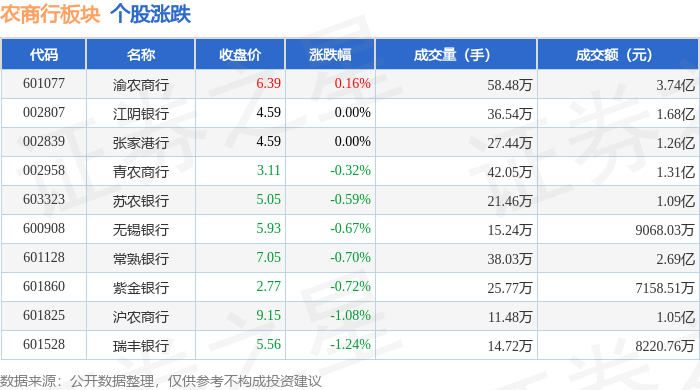
农商行板块1月7日跌0.57%,瑞丰银行领跌,主力资金净流入5042.72万元
Zheng Xing Xing Ye Ri Bao· 2026-01-07 08:58
Core Viewpoint - The rural commercial bank sector experienced a decline of 0.57% on January 7, with Ruifeng Bank leading the drop, while the Shanghai Composite Index rose by 0.05% and the Shenzhen Component Index increased by 0.06% [1] Group 1: Market Performance - The closing prices and performance of key rural commercial banks on January 7 are as follows: - Yunnan Rural Commercial Bank (601077) closed at 6.39, up by 0.16% - Jiangyin Bank (002807) closed at 4.59, unchanged - Zhangjiagang Bank (002839) closed at 4.59, unchanged - Qingnong Bank (002958) closed at 3.11, down by 0.32% - Sunan Bank (603323) closed at 5.05, down by 0.59% - Wuxi Bank (600908) closed at 5.93, down by 0.67% - Changshu Bank (601128) closed at 7.05, down by 0.70% - Zijin Bank (601860) closed at 2.77, down by 0.72% - Hunan Rural Commercial Bank (601825) closed at 9.15, down by 1.08% - Ruifeng Bank (601528) closed at 5.56, down by 1.24% [1] Group 2: Capital Flow - On January 7, the rural commercial bank sector saw a net inflow of 50.43 million yuan from main funds, while retail investors experienced a net outflow of 84.63 million yuan [1] - The capital flow for individual banks is as follows: - Zhangjiagang Bank (002839) had a main fund net inflow of 13.66 million yuan, but a retail net outflow of 13.84 million yuan - Changshu Bank (601128) had a main fund net inflow of 13.25 million yuan, with a retail net outflow of 22.78 million yuan - Qingnong Bank (002958) had a main fund net inflow of 12.24 million yuan, but a retail net outflow of 8.34 million yuan - Wuxi Bank (600908) had a main fund net inflow of 9.53 million yuan, with a retail net outflow of 6.99 million yuan [2]

沪农商行(601825) - 上海农村商业银行股份有限公司关于董事任职资格获监管机构核准的公告
2026-01-07 08:00
证券代码:601825 证券简称:沪农商行 公告编号:2026-001 梁晓丽女士、储晓明先生的简历请参见公司于 2025 年 11 月 5 日 披露于上海证券交易所网站(www.sse.com.cn)的《上海农村商业银 行股份有限公司 2025 年第一次临时股东会会议材料》。 特此公告。 上海农村商业银行股份有限公司董事会 2026 年 1 月 8 日 上海农村商业银行股份有限公司 关于董事任职资格获监管机构核准的公告 本公司董事会及全体董事保证本公告内容不存在任何虚假记载、 误导性陈述或者重大遗漏,并对其内容的真实性、准确性和完整性承 担法律责任。 上海农村商业银行股份有限公司(以下简称"公司")近日收到 《国家金融监督管理总局上海监管局关于梁晓丽上海农村商业银行 股份有限公司董事任职资格的批复》(沪金复〔2025〕875 号)、《国 家金融监督管理总局上海监管局关于储晓明上海农村商业银行股份 有限公司独立董事任职资格的批复》(沪金复〔2025〕878 号),国 家金融监督管理总局上海监管局已核准梁晓丽女士的公司董事任职 资格、储晓明先生的公司独立董事任职资格。 ...
沪农商行:董事任职资格获监管机构核准
Xin Lang Cai Jing· 2026-01-07 07:40
Group 1 - The company, Hu Nong Commercial Bank (601825.SH), announced that it has received approval from the Shanghai Regulatory Bureau of the National Financial Supervision Administration for the appointment qualifications of Liang Xiaoli as a company director and Chu Xiaoming as an independent director [1]