SRCB(601825)

Search documents
丈量地方性银行(3):川渝132家区域性银行全梳理-20260212
GF SECURITIES· 2026-02-12 14:21
Investment Rating - The industry investment rating is "Buy" [2] Core Insights - The report analyzes 132 regional banks in the Sichuan-Chongqing area, highlighting the growth and structural changes in the banking sector [6][27] - The asset growth rates of major city commercial banks in the region are higher than those of listed city commercial banks, indicating a robust expansion [38] - Profitability metrics show that city commercial banks in the region have lower ROE compared to listed banks, while rural commercial banks outperform them [6][27] - Asset quality is slightly weaker in regional banks compared to listed banks, with higher non-performing loan ratios [6][27] Summary by Sections Economic Structure Analysis - Sichuan province is positioned as a key driver for western development, with a focus on enhancing the Chengdu-Chongqing economic circle [13][14] - In 2025, Chengdu's GDP is projected to account for 38.7% of the province's total, with significant growth in various sectors [15] Banking Sector Overview - The Sichuan-Chongqing region has 132 commercial banks, including 14 city commercial banks, 65 rural banks, and 51 rural commercial banks [27] - The asset growth rates for major city commercial banks in the region are 15.6% and 18.2%, surpassing the 14.2% growth of listed city commercial banks [38] Asset and Liability Structure - The proportion of loans to total assets has been increasing since 2016, with city commercial banks in Sichuan projected to have a loan ratio of 56.1% by 2024 [38][40] - The financial investment ratio for city commercial banks is on a downward trend, with a slight recovery noted in the first half of 2025 [40][46] Profitability and Asset Quality - The average ROE for city commercial banks in the region is 10.97%, lower than the 11.99% average for listed city commercial banks [6][27] - Non-performing loan ratios for city commercial banks in the region are higher than those of listed banks, indicating potential asset quality concerns [6][27] Capital Adequacy - Capital adequacy ratios for regional banks are comparable to those of listed banks, providing a safety margin for operations [6][27]



2025年四季度货币政策执行报告点评:从流动性总量视角看待“存款搬家”
GUOTAI HAITONG SECURITIES· 2026-02-11 11:12
Investment Rating - The report assigns an "Accumulate" rating for the banking sector, indicating a potential increase of over 15% relative to the CSI 300 index [2][12]. Core Insights - The central bank will continue to implement a moderately loose monetary policy, integrating both incremental and stock policies to enhance effectiveness [3]. - New loan interest rates have decreased, with the weighted average interest rate for new loans in December at 3.15%, down 10 basis points from September. The rates for general loans, corporate loans, bill financing, and mortgage loans are 3.55%, 3.10%, 1.14%, and 3.06%, respectively [4]. - The growth of asset management products is impacting the structure of bank deposits, with total assets of asset management products reaching 120 trillion yuan, a year-on-year increase of 13.1% [4]. - The central bank and the Ministry of Finance have announced a package of policy measures aimed at supporting small and micro enterprises and boosting consumption [4]. - A one-time credit repair policy will support individuals in improving their credit status by removing overdue debt records if paid off by March 31, 2026 [4]. Summary by Sections Loan Market - The report highlights a continued optimization in financing structure, with significant year-on-year growth in technology loans (11.5%), green loans (20.2%), inclusive loans (10.9%), elderly care industry loans (50.5%), and digital economy loans (14.1%) [4]. Asset Management Products - The rapid expansion of asset management products has led to a shift in the deposit structure, with a notable increase in non-bank deposits from small and medium banks [4]. - Over 80% of asset management products are allocated to fixed-income assets, primarily in interbank deposits and certificates of deposit, indicating that funds remain within the banking system [4]. Investment Recommendations - The report suggests focusing on three main lines for investment in the banking sector: 1. Identifying banks with expected growth in performance, recommending Ningbo Bank, China Merchants Bank, and Nanjing Bank [4]. 2. Considering banks with convertible bond expectations, recommending Chongqing Bank and Changshu Bank, with Shanghai Bank as a related target [4]. 3. Continuing the dividend strategy, recommending Bank of Communications, Jiangsu Bank, Chongqing Rural Commercial Bank, and Shanghai Rural Commercial Bank [4].






多家银行官宣“年中红包”!六大行数额亮了
Guo Ji Jin Rong Bao· 2026-02-11 06:34
Core Viewpoint - Increasing number of banks are adopting mid-year dividend plans, with 17 A-share listed banks planning to implement mid-year dividends for 2024, reflecting a shift towards more frequent cash distributions to investors [1][2][3] Group 1: Mid-Year Dividend Plans - CITIC Bank has expressed its intention to implement a mid-year dividend for 2024, following the lead of Minsheng Bank, marking it as the second shareholding bank to announce such plans [2] - As of July 4, 2023, 17 out of 42 A-share listed banks have decided to implement mid-year dividends for 2024, with six major state-owned banks already having made arrangements [2][3] - The mid-year dividend plans are part of a broader trend among banks to enhance investor returns and improve liquidity [1][4] Group 2: Regulatory Influence - The Chinese government has introduced policies to strengthen cash dividend regulations, encouraging companies to adopt stable and predictable dividend policies, including multiple distributions within a year [4][5] - The new regulations aim to enhance the frequency of dividends, aligning domestic banks with international practices where dividends are distributed more frequently [5] Group 3: Impact on Investor Sentiment - Increased dividend frequency is expected to enhance investor confidence and attract more investments, as it reflects banks' profitability and commitment to shareholder returns [3][5] - Analysts suggest that mid-year dividends can serve as a sign of banks' confidence in their earnings and can improve investor sentiment towards bank stocks [3][5] Group 4: Considerations for Banks - Banks need to balance dividend payouts with their profitability, capital adequacy, and risk management capabilities to ensure sustainable operations [5][6] - There is a need for banks to improve internal governance and operational efficiency to better serve the real economy while managing dividend policies [6]



银行为何开始发射卫星了?
Jing Ji Ri Bao· 2026-02-10 07:15
Core Viewpoint - The successful launch of "Zhaoyin Jinkui" and "Puyin Shuzhi" satellites by China Merchants Bank and Pudong Development Bank marks a significant step in the integration of banking and commercial aerospace, highlighting the banks' strategic move to leverage satellite technology for enhancing digital financial infrastructure and supporting the commercial aerospace industry [2][10]. Group 1: Satellite Launch and Collaboration - The "Zhaoyin Jinkui" and "Puyin Shuzhi" satellites are part of the "Tianqi Constellation" low-orbit narrowband satellite IoT network, showcasing banks' involvement in satellite launches [2][3]. - This is not the first instance of banks collaborating with commercial satellite companies; previous launches include "Zhaoyin 1" and "Zhaoyin 2" by China Merchants Bank and "Ping An 1" and "Ping An 2" by Ping An Bank [3][4]. - Banks are adopting various paths to utilize satellite technology, including direct satellite launches and purchasing processed data from satellite companies for financial applications [3][4]. Group 2: Applications and Benefits of Satellite Technology - The integration of low-orbit satellites enhances banks' capabilities in financial asset management, risk control, and emergency communication, extending their digital infrastructure into space [3][6]. - Banks are increasingly moving from merely purchasing satellite data to actively participating in satellite launches, driven by the need for improved risk management and business continuity [6][7]. - The use of satellite technology allows banks to overcome geographical and environmental limitations, thus expanding their business reach, especially in remote areas [7][10]. Group 3: Cost and Market Dynamics - The cost of launching commercial satellites is expected to decrease due to technological advancements and economies of scale, making customized commercial applications more feasible [8][9]. - Current costs for launching a commercial satellite range from tens of millions to over a billion yuan, with significant potential for reduction as the industry matures [8][9]. - By 2030, the cost of satellite launches could drop to below 10,000 yuan per kilogram, further encouraging financial institutions to invest in satellite technology [9]. Group 4: Financial and Industrial Synergy - The collaboration between banks and satellite companies represents a deeper financial and industrial synergy, enabling banks to expand their service offerings and support the development of the commercial aerospace ecosystem [10][14]. - Banks are innovating financial products and services, such as satellite leasing and industry-specific funds, to meet the unique needs of the aerospace sector [14][15]. - The integration of satellite data into financial services is expected to enhance credit assessments and risk management, aligning financial services more closely with the real economy [10][15].





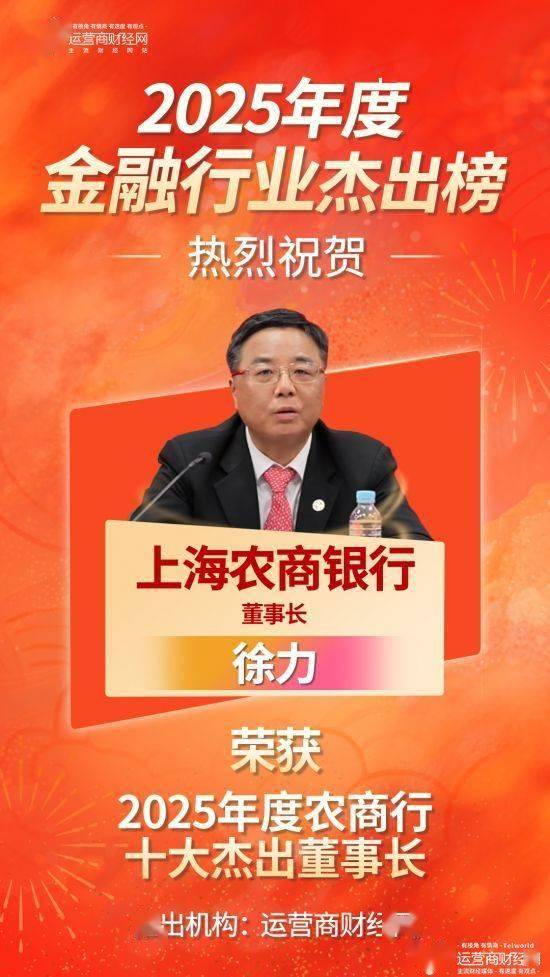
上海农商银行董事长徐力入选2025年度农商行十大杰出董事长!
Sou Hu Cai Jing· 2026-02-09 02:11
Core Viewpoint - The "Top Ten Outstanding Chairmen of Rural Commercial Banks in 2025" list has been released, with Xu Li, Chairman of Shanghai Rural Commercial Bank, receiving the award for his exceptional performance [1]. Group 1: Leadership and Tenure - Xu Li has served at Shanghai Rural Commercial Bank for ten years, being appointed as the bank's president in January 2016 and receiving his qualification approval in June 2016 [3]. - In April 2019, Xu Li's qualification as Chairman of Shanghai Rural Commercial Bank was approved, officially making him the leader of the bank [4]. Group 2: Achievements and Contributions - Under Xu Li's leadership, Shanghai Rural Commercial Bank has diversified its business, strengthened risk management, enhanced market competitiveness, and promoted digital transformation [4]. - The bank has also focused on team building and providing comprehensive and high-quality financial services to its customers [4]. - Liu Ping, Deputy Editor-in-Chief of Operator Finance, praised Xu Li for his outstanding leadership, deep professional knowledge, and keen market insight, which have guided the bank's continuous progress [4].
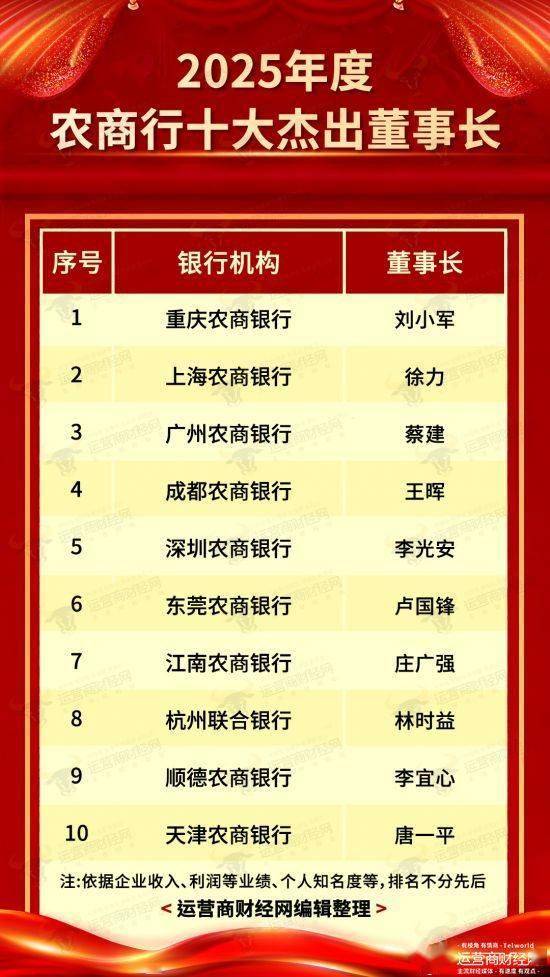
运营商财经网正式公布“2025年度农商行十大杰出董事长”榜单
Sou Hu Cai Jing· 2026-02-09 02:11
Core Viewpoint - The "2025 Outstanding Chairmen of Rural Commercial Banks" list has been officially announced, highlighting key figures in the financial industry, particularly in rural commercial banks [1]. Group 1: List of Outstanding Chairmen - The list includes notable chairmen from various rural commercial banks, such as: - Liu Xiaojun from Chongqing Rural Commercial Bank - Xu Li from Shanghai Rural Commercial Bank - Cai Jian from Guangzhou Rural Commercial Bank - Wang Hui from Chengdu Rural Commercial Bank - Li Guang'an from Shenzhen Rural Commercial Bank - Lu Guofeng from Dongguan Rural Commercial Bank - Zhuang Guangqiang from Jiangnan Rural Commercial Bank - Lin Shiyi from Hangzhou United Bank - Li Yixin from Shunde Rural Commercial Bank - Tang Yiping from Tianjin Rural Commercial Bank [2][3]. Group 2: Evaluation Criteria - The selection of the outstanding chairmen was based on a comprehensive assessment of various factors, including: - Company performance metrics such as sales, revenue, and profit - Personal recognition and contributions of the executives [3].

跨境流动性跟踪20260208:贸易回流比率再度回正,服务逆差大幅收窄
GF SECURITIES· 2026-02-09 01:11
Investment Rating - The industry rating is "Buy" [4] Core Views - The trade return ratio has turned positive again, and the service trade deficit has significantly narrowed [16][18] - The cross-border capital flow is expected to gradually return, positively impacting domestic liquidity [5][19] - The service trade deficit for December 2025 was 966 billion CNY, a year-on-year decrease of 466 billion CNY, with a full-year deficit of 13,760 billion CNY, down 2,544 billion CNY, approximately 16% [18] Summary by Sections 1. Current Observation - The State Administration of Foreign Exchange (SAFE) released data on China's international balance of payments for December 2025, indicating a potential impact on the central bank's willingness to settle foreign exchange [16] - The trade return ratio is at a historical high, with a monthly unconverted trade net outflow of 447 billion CNY, a year-on-year increase of 1,392 billion CNY [17] 2. Arbitrage Trading Returns - The arbitrage trading return rate for 10Y US Treasury bonds in CNY has dropped significantly to -1.77%, indicating a shift in cross-border capital dynamics [17] 3. Service Trade Deficit - The service trade deficit has narrowed significantly, with major contributions from improved policies for foreign visitors, reduced international shipping costs, and enhanced competitiveness in high-tech services [18] 4. Cross-Border Liquidity Outlook - Despite the recent appointment of Kevin Warsh as the next Federal Reserve Chair, the trend of cross-border capital return is expected to continue, influenced by the Fed's monetary policy stance [19][21] - The short-term liquidity in the US remains tight, with limited space for balance sheet reduction, while long-term prospects depend on economic performance [20][21]
2026陆家嘴金融沙龙丨第2期圆桌对话:打造科创智慧资产
Di Yi Cai Jing· 2026-02-07 13:04
Group 1 - The roundtable dialogue focused on "Technology Finance Supporting Intellectual Property Services to Build Smart Assets for Scientific Innovation" [3] - The event highlighted the challenges in transforming intellectual property from "knowledge" to "assets" and provided practical solutions from various fields [3][4] - Key participants included executives from the National Intellectual Property Operation (Shanghai) International Service Platform, Shanghai Clinical Innovation Transformation Research Institute, Shanghai Rural Commercial Bank, and other industry leaders [3] Group 2 - Clinical intellectual property transformation faces long cycles, high thresholds, and significant investment challenges, with a need for a stable risk-sharing mechanism [4] - The Shanghai Clinical Innovation Transformation Research Institute is exploring a "corporatized operation" model to connect industry, finance, and clinical outcomes [4] - There is a gap between domestic and international clinical technology transfer systems, emphasizing the need for awareness and capability building among hospitals and doctors [4][5] Group 3 - Shanghai Rural Commercial Bank identified three main risk points in intellectual property financial services: assessing the value of core intellectual property, evaluating sustainable development capabilities, and accurate valuation challenges [5] - The bank has developed a multi-dimensional solution involving a professional team, data-driven approaches, and comprehensive risk control throughout the loan process [5][6] - Innovations include expanding the types of intellectual property collateral, exploring securitization tools, and implementing a "donation+" model to support projects in the medical-engineering intersection [6] Group 4 - Incubators play a crucial role in early-stage project intellectual property value assessment, leveraging AI tools and their knowledge of project teams [7][8] - Two paths for scaling intellectual property value include direct recognition of the intellectual property and binding it to company growth [8] - Investment institutions prioritize core intellectual property in their evaluations, focusing on technological advancement, legal stability, and market application prospects [8]


上海农商银行2月6日起把单位结算卡纳入企业电子渠道交易限额体系
Jin Tou Wang· 2026-02-06 03:35
Group 1 - The Shanghai Rural Commercial Bank announced that starting from February 6, 2026, it will include corporate settlement cards in the enterprise electronic channel transaction limit system to ensure account fund security [1] - The adjustment applies only to customers who have configured enterprise electronic channel transaction limits; those without such configuration will have their transactions limited to their predefined business limits [1] - The original business limits are as follows: ATM/intelligent cabinet withdrawals are capped at 20,000 RMB per day per account; ATM/intelligent cabinet transfers are capped at 10,000 RMB per card per day; POS consumption is capped at 30,000 RMB per card per day [1] Group 2 - Customers who find the new limits insufficient for their normal business transactions can contact the Shanghai Rural Commercial Bank to request a reassessment of their enterprise electronic channel transaction limits [2] - During the reassessment process, customers may need to provide supporting documentation [2] Group 3 - The bank emphasizes that it will not request customers to provide digital certificates, U-shield passwords, SMS verification codes, transaction passwords, or any other personal information during this process [3] - Customers are advised to protect their information and avoid clicking on suspicious links, particularly those claiming to adjust limits or cancel restrictions, to prevent fraud [3] Group 4 - The Shanghai Rural Commercial Bank expresses gratitude for customer understanding and support, reaffirming its commitment to providing safe and high-quality financial services [4]
12家区域性银行迎155家机构调研!“开门红”信贷投放等成关注焦点
Guo Ji Jin Rong Bao· 2026-02-06 03:21
Core Viewpoint - The enthusiasm for institutional research on listed banks has increased since the beginning of the year, with a focus on credit allocation and interest margin management for 2026 [1][3]. Group 1: Institutional Research Activity - As of February 5, 2026, 12 regional banks have received 155 institutional research visits, totaling 327 interactions [1][3]. - Zhangjiagang Rural Commercial Bank has been actively engaging with multiple institutions, receiving five visits in less than a week [2]. - Shanghai Bank has been the most scrutinized, with 75 institutions participating in nine rounds of research since January 12, 2026 [3]. Group 2: Credit Allocation Focus - The "opening red" credit allocation for 2026 is a key focus, with banks reporting a positive start and increased public loan allocations compared to previous years [5]. - Banks like Hangzhou Bank and Zhangjiagang Bank are targeting key industries and projects, including infrastructure and technological upgrades [5][6]. - Analysts expect that new RMB loans in January 2026 will be around 5 trillion yuan, with a growth rate of approximately 6.2% [6]. Group 3: Deposit Structure Adjustments - The net interest margin for banks has been narrowing, with a historical low of 1.42% as of Q3 2025 [7]. - Banks are planning to optimize their liability structures and control deposit costs to stabilize interest margins [7][8]. - Institutions like Zijin Bank and Shanghai Bank are focusing on adjusting deposit sources and terms to manage costs effectively [7][8]. Group 4: Future Outlook on Interest Margins - Shanghai Bank anticipates a continued decline in the Loan Prime Rate (LPR) in 2026, which may lead to a further decrease in interest margins [8]. - Regional banks are expected to maintain stable earnings, although there may be a divergence in performance based on regional economic vitality [8].