
BANK OF CHINA(601988)

Search documents
何颖总领事出席中行(新西兰)基督城分行迁址招待会
Shang Wu Bu Wang Zhan· 2026-02-23 15:30
(原标题:何颖总领事出席中行(新西兰)基督城分行迁址招待会) 何颖总领事出席中行(新西兰)基督城分行迁址招待会 何颖总领事致辞祝贺基督城分行乔迁,表示近年来中新关系持续深化,经贸合作成果丰硕,新西兰中行 扎根当地,在跨境金融、贸易融资和双向投资服务方面发挥了重要桥梁作用,并竭诚回馈社会,为促进 中新经贸合作和地方发展作出积极贡献。当前基督城和坎特伯雷地区正处于复兴和产业升级关键阶段, 希望中行等中资企业继续提升服务能力,为深化中新合作和南岛经济发展作出更大贡献。 2月20日,何颖总领事出席中国银行(新西兰)有限公司基督城分行迁址暨新春招待会。驻新使馆张新 宇公参、国会议员陆楠、克市议员萨姆·麦克唐纳、中行(新西兰)行长兼新中商会会长胡北海及各界 嘉宾80余人出席。 ...


银行股分红大比拼!谁才是真现金奶牛?
Sou Hu Cai Jing· 2026-02-22 08:54
现在的理财圈,简直比菜市场还卷。 存款利率一降再降,放一年利息少得可怜。 基金净值上蹿下跳,心脏不好根本扛不住。 理财产品打破刚兑,赚钱亏钱全看运气。 普通老百姓想找个稳当当、能长期拿的"钱生钱"路子,难上加难。 就在大家愁眉不展的时候,低调的银行股直接亮出王炸。 每年几百上千亿的现金分红,股息率碾压定期存款。 工行、建行、农行、中行轮番发红包,被股民亲切叫作"股市现金奶牛"。 银行股分红大比拼!谁才是真·现金奶牛? 农业银行、中国银行也不示弱,单年分红均超600亿元,红包拿到手软。 2025年中期分红更是加码,六大行合计派息超2000亿元。 工行单中期就分掉504亿元,创下上市银行中期分红纪录。 别人分红是发零花钱,大行分红直接是下红包雨。 再看分红比例,政策托底稳得很。 证监会《上市公司监管指引第3号》明确鼓励现金分红,新"国九条"更是强化要求。 国有大行常年把分红比例锁定在30%以上,雷打不动。 部分股份行如招行,分红率直接干到35%+,诚意拉满。 以前银行一年分一次,现在响应政策,中期+年度两次分红。 相当于一年领两次工资,现金流直接翻倍。 老百姓最关心的股息率,更是吊打传统理财。 国有大行A股股息率 ...




中国银行2026年初动态:增资、高管变动与监管处罚
Jing Ji Guan Cha Wang· 2026-02-20 02:29
经济观察网 基于最新信息,中国银行(601988)在2026年初有以下值得关注的事件,主要涉及资本变 动、高管调整、经营部署和监管动态: 公司状况 注册资本增加:2026年2月10日,中国银行完成工商变更,注册资本从约2944亿元增至约3222亿元,增 幅约9.5%。 高管变动 高管任命与纪律处分:2026年2月13日,中央汇金投资有限责任公司黄学玲到任中国银行,有望出任副 行长;同时,原副行长林景臻因严重违纪违法被开除党籍。 资金走向 资金流向波动:2026年2月12日,中国银行A股主力资金净流出1.98亿元,当日股价下跌1.29%。 战略推进 2026年经营重点部署:在2026年工作会议中,中国银行强调巩固全球化优势、防范金融风险,并聚 焦"错位发展"策略,以服务国家战略。 监管情况 监管处罚事件:2026年2月2日,中国银行河南省分行因"数据质量管理不审慎"等问题被罚款150万元。 以上内容基于公开资料整理,不构成投资建议。 ...

中国手机银行用户规模见顶,行业逻辑转向存量提升
Xin Lang Cai Jing· 2026-02-18 05:56
Core Insights - The report indicates that the average monthly active users (MAU) for major Chinese mobile banking apps in 2025 shows a significant user base, with the Agricultural Bank of China leading at approximately 24.9 million users [1]. Group 1: User Metrics - The average MAU for the top five mobile banking apps in 2025 are as follows: Agricultural Bank of China (24.9 million), Industrial and Commercial Bank of China (19.4 million), China Construction Bank (10.9 million), Bank of China (8.9 million), and Postal Savings Bank (5.3 million) [1]. - The total number of independent devices for mobile banking in China is projected to stabilize between 648 million and 739 million, indicating a plateau in user growth [1]. Group 2: Industry Trends - The report highlights a shift in industry dynamics from acquiring new users to enhancing existing user engagement, as the flow of new users has reached a ceiling [1]. - User behavior is changing structurally, with the effective daily usage time per device decreasing from 4.9 minutes in 2023 to around 2.7 minutes by mid-2025, stabilizing at approximately 3 minutes [1]. - The trend towards high-frequency, short-duration, and function-oriented usage is prompting financial institutions to streamline processes and focus on core transaction scenarios [1].

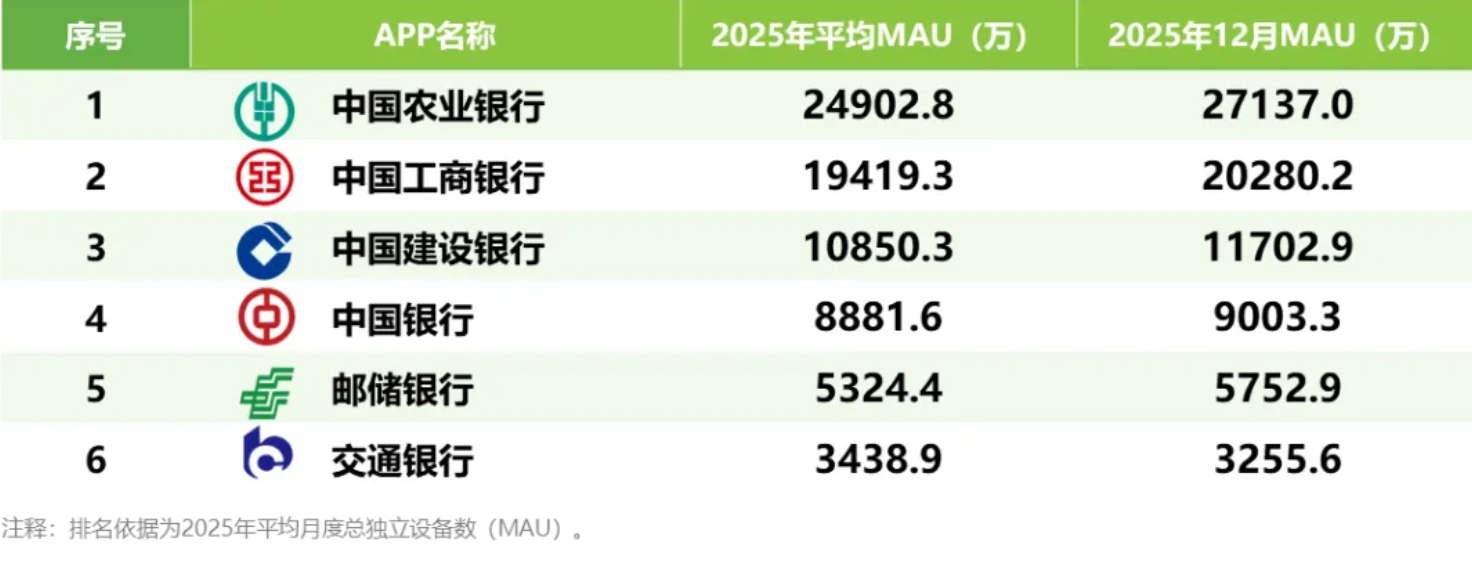
国有大行主导手机银行市场,生态嵌入构筑护城河
Jing Ji Guan Cha Wang· 2026-02-18 05:47
Core Insights - The Chinese mobile banking market is entering a stage of stock competition in 2025, with monthly active users (MAU) stabilizing between 648 million and 739 million [2] - State-owned commercial banks dominate the market due to their ecological embedding advantages, with Agricultural Bank of China leading at 249 million MAU, followed by Industrial and Commercial Bank of China (194 million) and China Construction Bank (109 million) [2] - Private banks are expected to collectively exit the top 50 MAU rankings in 2025 due to a lack of offline branch support and local living ecosystems [2] Group 1: Major Players - Agricultural Bank of China has the highest MAU at 249 million, followed by Industrial and Commercial Bank of China with 194 million and China Construction Bank with 109 million, forming the first tier of banks [2] - China Bank and Postal Savings Bank have MAUs exceeding 50 million, constituting the second tier [2] - China Merchants Bank leads the joint-stock banks with 71.85 million MAU, while Ping An Bank and CITIC Bank form the second tier, with other joint-stock banks generally below 20 million MAU [2] Group 2: Market Dynamics - The core advantage of state-owned banks lies in their "full-scenario integration" capabilities, embedding services deeply into high-frequency life scenarios such as government affairs, social security, healthcare, and education [2] - Agricultural Bank of China extends its services to rural areas through intelligent service matching and customer customization, while Industrial and Commercial Bank of China utilizes its "Gong Xiao Zhi" model for interactive service [2] - Regional banks like Jiangsu Bank, Beijing Bank, and Ningbo Bank show stable performance by focusing on local markets, with some rural commercial banks like Fujian Rural Credit exceeding 4.5 million MAU, indicating the sustainability of localized operations in the stock market [2]

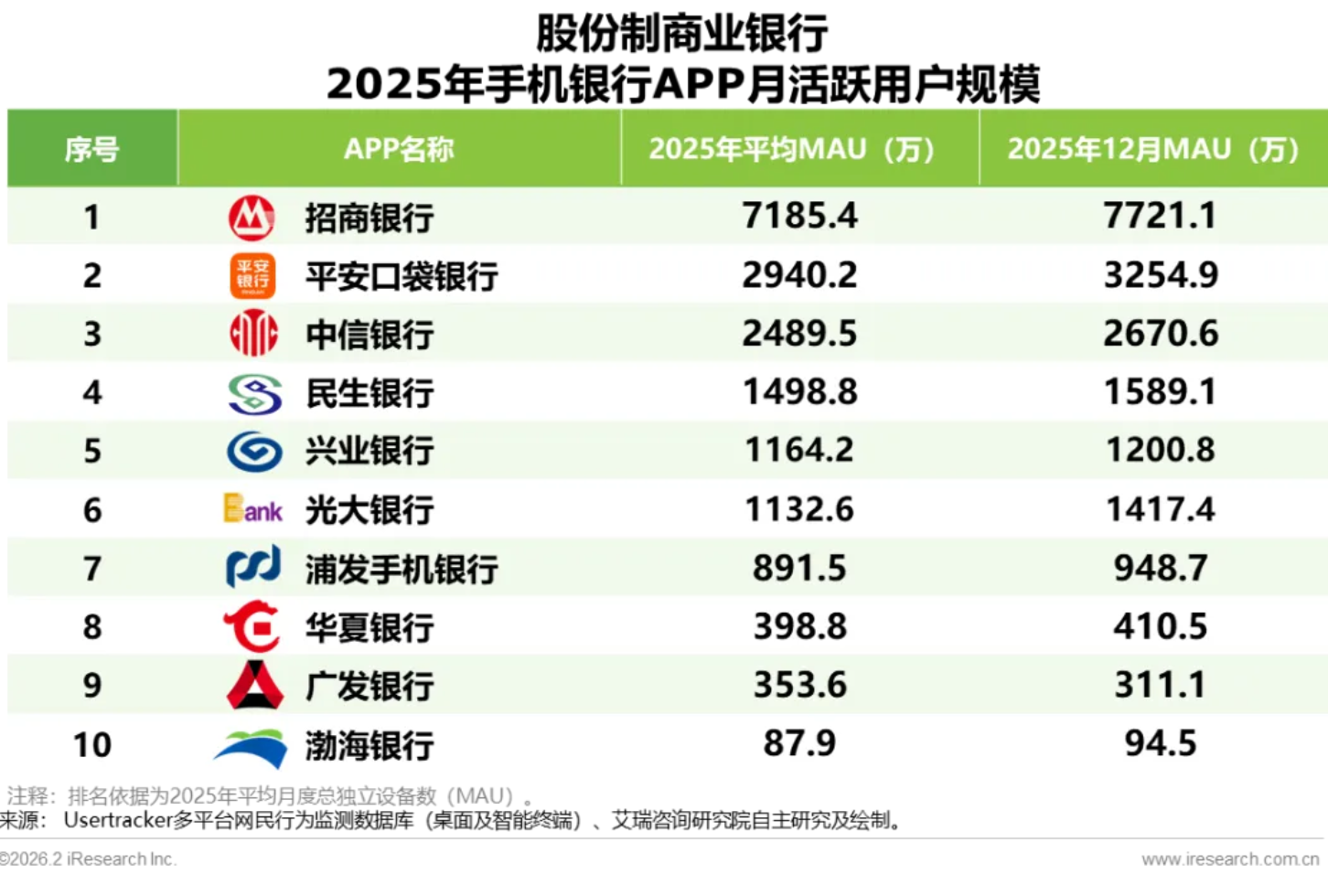
手机银行TOP50再无民营 生态壁垒高筑草根绝迹
Jing Ji Guan Cha Wang· 2026-02-18 05:47
Core Insights - The monthly active users (MAU) of mobile banking apps in China have stabilized between 648 million and 739 million, indicating that user growth has reached a ceiling, marking the end of a decade-long traffic dividend period [2] - User behavior has shifted significantly, with average session duration decreasing from 4.9 minutes in 2023 to approximately 2.7 minutes by mid-2025, reflecting a preference for high-frequency, short-duration, and function-oriented usage [2] - Major state-owned banks have solidified their market dominance, with all six major state-owned banks ranking in the top ten for MAU, led by Agricultural Bank of China with 249 million MAU [2] Industry Dynamics - The core competitive advantage of state-owned banks lies in their "full-scenario integration" capabilities, providing financial services deeply embedded in public services such as government, social security, healthcare, and education [3] - Joint-stock banks are adopting specialized development strategies, with China Merchants Bank leading its peers with 71.85 million MAU, while Ping An Bank and Citic Bank are leveraging AI technology to enhance service processes and maintain user engagement [3] - Local banks are experiencing polarization, with some city commercial banks maintaining MAU above 3 million due to their deep understanding of local markets, while private banks like WeBank and MYbank have fallen out of the top 50 due to challenges in customer acquisition and retention [3] Future Trends - As the industry standard for single-session usage time becomes 3 minutes, banks must rethink their value creation strategies [4] - AI-driven service process optimization, real-time risk control systems, and multi-device collaboration within ecosystems are reshaping the competitive landscape [4] - Key factors for institutional success in the future will include precise user insights, prudent risk management, and robust ecosystem integration capabilities [4]


2.7分钟定生死 手机银行存量厮杀谁在“断臂”,谁在“吃肉”?
Jing Ji Guan Cha Wang· 2026-02-18 04:57
Core Insights - The report by iResearch indicates that the monthly active users (MAU) of mobile banking apps in China have stabilized after fluctuating between 648 million and 739 million, signaling a ceiling in user growth and a shift from acquiring new users to enhancing existing user engagement [2] - User behavior is undergoing a structural reversal, with the effective daily usage time per device dropping from 4.9 minutes in 2023 to around 2.7 minutes by mid-2025, leading to a focus on high-frequency, short-duration, and functional usage [2] - Financial institutions are compelled to streamline operations and focus resources on core transaction scenarios to survive in this competitive landscape, where efficiency and precision are paramount [2] Mobile Banking Market Overview - The top three banks in terms of MAU are Agricultural Bank of China (2.49 billion), Industrial and Commercial Bank of China (1.94 billion), and China Construction Bank (1.09 billion), with all six major state-owned banks ranking in the top ten [3][5][6] - Private banks, represented by WeBank and MYbank, have faced significant setbacks, with many dropping out of the top 50 MAU rankings by 2025 [4] Competitive Landscape - State-owned banks are solidifying their dominance through extensive customer bases and integrated ecosystems, leveraging services embedded in high-frequency life scenarios such as government services and healthcare [7] - Joint-stock commercial banks are adopting a "specialized and precise" survival strategy, with China Merchants Bank leading among them with 71.85 million MAU, focusing on wealth management and intelligent interaction [8][10] - Regional banks are thriving by deeply engaging with local markets, while private banks struggle due to high customer acquisition costs and lack of local ecosystem support [13][14] Future Outlook - The mobile banking market is transitioning from a phase of scale expansion to one of value cultivation, with state-owned banks building moats through ecosystems, joint-stock banks seeking niches through specialization, and regional banks solidifying their local roots [14] - The ability to create irreplaceable value in a limited user engagement environment will be crucial, with technology applications such as AI reshaping service processes and enhancing risk management [15][16]

根治农民工欠薪,数字人民币方案上新
Sou Hu Cai Jing· 2026-02-17 14:22
Core Viewpoint - The digital RMB wallet integrates account management, mobile payments, interest accrual, and programmability, positioning itself as a potential digital entry point for personal financial services [2][5]. Group 1: Digital RMB Implementation - The first digital RMB salary payment for migrant workers was successfully executed in Chengdu, with over 1 million yuan disbursed by Bank of Communications [3]. - The digital RMB's interest-bearing mechanism was officially launched on January 1, 2026, marking a significant transition from "digital cash" to "digital deposits" [3][15]. - The digital RMB wallet is expected to become a "super" digital financial entry point for commercial banks, combining various financial functionalities [5][18]. Group 2: Smart Contract Applications - Smart contracts are highlighted as a key advantage of the digital RMB wallet over traditional bank accounts, enabling precise control and automation of fund usage [10]. - The digital RMB's smart contract system is designed to be compatible with both bank account-based and blockchain-based contracts, facilitating seamless integration [10][11]. - The application of smart contracts in salary payments aims to enhance transparency and reduce risks associated with fund misappropriation [9][14]. Group 3: Opportunities for Banks - The digital RMB 2.0 era presents new commercial opportunities for banks, including low-cost, high-retention core liabilities and the potential to reclaim strategic control over payment channels [18]. - Banks are focusing on integrating digital RMB into existing product systems, covering major business areas such as deposits, loans, and investments [17][19]. - The digital RMB wallet's capabilities allow banks to create customized smart contracts and offer high-value services, leading to new revenue streams distinct from traditional transaction fees [18].



中国银行在多地落实设备更新贴息政策
Xin Hua She· 2026-02-17 02:22
Group 1 - The core viewpoint of the article highlights that the Bank of China has successfully implemented its equipment renewal interest subsidy service across 25 provinces, benefiting over 180 enterprises with nearly 200 million yuan in central government subsidies [1] - The Bank of China aims to continuously optimize its "one-stop" service chain, transforming policy support into competitive advantages through comprehensive financial solutions [1] - The initiative covers key sectors such as advanced manufacturing, green energy, and modern logistics, indicating a strategic focus on fostering new productive forces [1]
中国银行2025年熊猫债承销规模近380亿元
Xin Lang Cai Jing· 2026-02-16 03:38
Core Insights - The core viewpoint of the article highlights the significant growth in the bond underwriting scale of the Bank of China, particularly in panda bonds and dim sum bonds, contributing positively to the influence of the Renminbi in the international financial system [1] Group 1: Panda Bonds - In 2025, the Bank of China's panda bond underwriting scale is projected to reach nearly 38 billion yuan [1] - This growth is expected to enhance the Renminbi's impact within the international financial framework [1] Group 2: Dim Sum Bonds - The Bank of China's dim sum bond underwriting scale is anticipated to exceed 110 billion yuan in 2025 [1] - The bank is actively leading efforts to assist the Ministry of Finance in issuing the first offshore Renminbi green sovereign bond worth 6 billion yuan [1] Group 3: Overall Bond Underwriting Growth - From 2023 to 2025, the Bank of China's total bond underwriting scale is expected to grow by nearly 300 billion yuan, reaching 1.68 trillion yuan [1]