
CNCB(601998)

Search documents
11家银行年报抢先看!浦发、中信规模突破10万亿,青岛银行增速领跑
Xin Lang Cai Jing· 2026-02-23 02:11
Core Insights - 11 A-share banks reported their 2025 performance, showing an average total asset growth rate of 11.32%, with city commercial banks significantly outperforming joint-stock banks in profitability [1][12]. Group 1: Performance Overview - The average growth rate of total assets for the 11 banks was 11.32%, while the average growth rate for operating income was 3.30%, and the average growth rate for net profit attributable to shareholders was 7.83% [1][12]. - Analyst Zheng Qingming from Shenwan Hongyuan Securities predicts that listed banks will exhibit stable revenue with gradually improving profit growth, expecting a 0.9% year-on-year revenue growth and a 1.9% recovery in net profit growth for 2025 [1][13]. Group 2: Joint-Stock Banks Performance - Four joint-stock banks (Shanghai Pudong Development Bank, CITIC Bank, China Merchants Bank, and Industrial Bank) reported total assets exceeding 10 trillion yuan, with Shanghai Pudong Development Bank's total assets reaching 100,817.46 billion yuan, a 6.55% increase from 2024 [2][15]. - Shanghai Pudong Development Bank achieved the fastest net profit growth among joint-stock banks, with a net profit of 500.17 billion yuan, an increase of 10.52% year-on-year [2][15]. Group 3: City Commercial Banks Performance - City commercial banks outperformed joint-stock banks in several metrics, with an average total asset growth rate of 15.1%, operating income growth of 5.73%, and net profit growth of 11% [5][19]. - Qingdao Bank emerged as the fastest-growing bank, with total assets growing by 18.12% to 8149.60 billion yuan and net profit increasing by 21.66% [5][19]. Group 4: Asset Quality and Income - Shanghai Pudong Development Bank reported a decrease in non-performing loans and a decline in the non-performing loan ratio, indicating improved asset quality [3][16]. - Several banks, including Ningbo Bank and Nanjing Bank, reported significant increases in net interest income, with Ningbo Bank achieving a 10.77% increase to 531.61 billion yuan [10][25].






银行业监管数据发布,中信银行股价波动引关注
Jing Ji Guan Cha Wang· 2026-02-21 05:36
经济观察网 近期银行业热点集中在2025年四季度监管数据及2026年1月金融数据发布。2026年2月14 日,金融监管总局发布4Q25银行业数据,显示商业银行净利润同比增长2%,单季增速达12%,主要受 城农商行低基数推动;净息差稳定在1.42%,同比降幅收窄至11bp。2026年1月社融增量创历史同期新 高至7.22万亿元,直接融资同比多增3228亿元,居民短贷需求改善(同比多增1594亿元),反映消费政 策提振效应。此外,中英金融工作组首次会议达成多项合作成果,或增强金融市场互联互通预期。 机构观点 西部证券2月15日报告指出,2026年银行息差有望趋势企稳,净利息收入复苏或驱动估值修复,优质城 商行和股份行弹性较强。华创证券同日分析认为,存款活化及信贷结构优化将支撑银行业绩,建议关 注"红利+成长"双主线,如中信银行等财富管理业务突出的股份行。中金公司2月14日点评预计,2026年 商业银行息差降幅进一步收窄,净利息收入增速可能接近5%。 以上内容基于公开资料整理,不构成投资建议。 股票近期走势 中信银行A股(601998.SH)最新交易数据更新至2026年2月13日(春节休市前),收盘价7.34元,单 ...
股份制银行差异化竞争,头部效应显著
Xin Lang Cai Jing· 2026-02-18 05:56
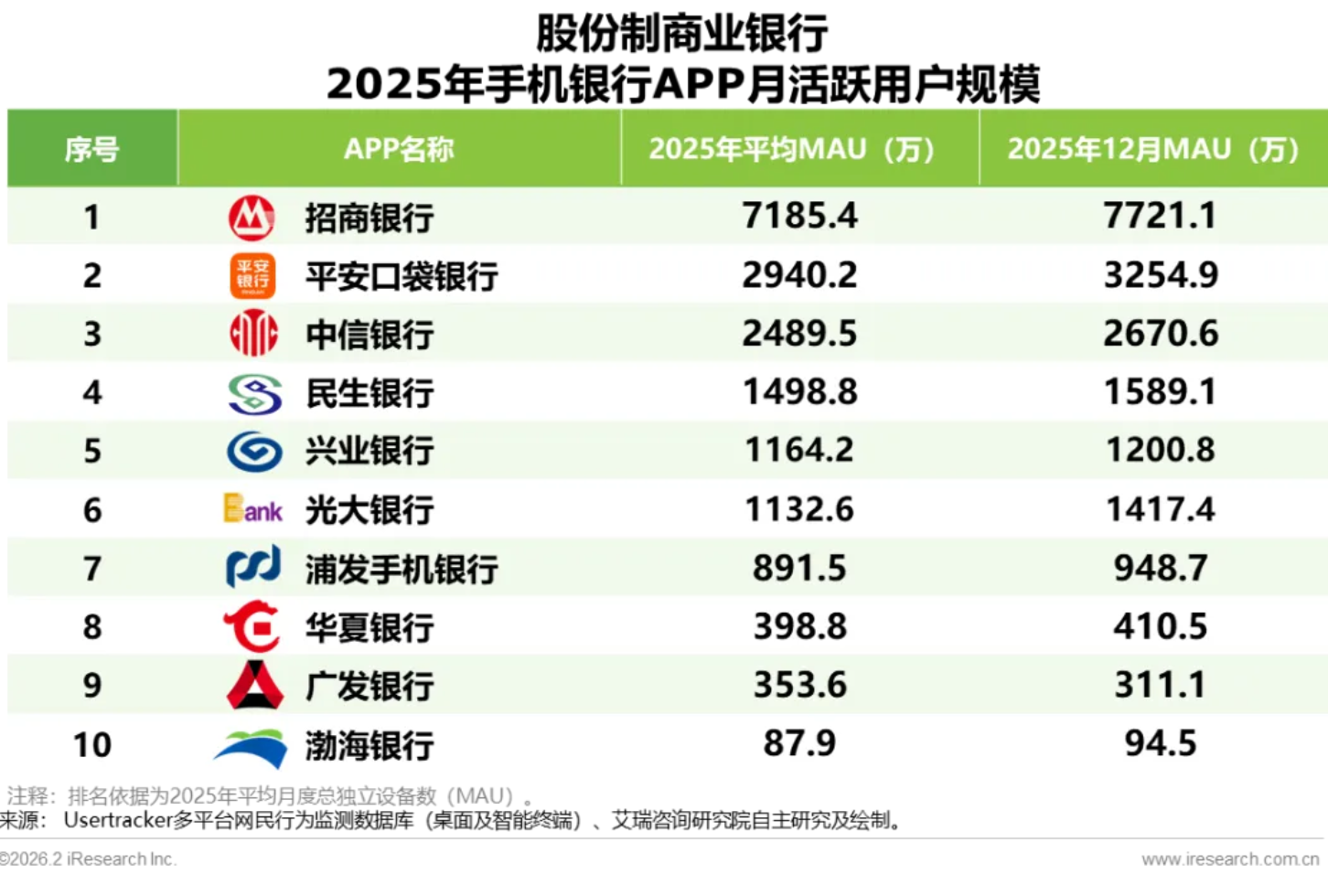
Core Insights - The mobile banking user base in China is expected to peak in 2025, shifting the industry focus from acquiring new users to enhancing existing user engagement [1] - Financial institutions must achieve extreme efficiency and precision in their ecosystems to survive in this new environment [1] Industry Overview - According to an iResearch report, joint-stock banks are adopting differentiated survival strategies, leading to significant head effects [1] - China Merchants Bank leads joint-stock banks with 71.854 million monthly active users (MAU), surpassing some state-owned banks due to its focus on wealth management and intelligent interaction [1] - Ping An Bank and CITIC Bank form the second tier, maintaining MAUs between 20 million and 30 million, with Ping An Bank leveraging AI to reconstruct service chains and CITIC Bank integrating consumer ecosystems [1] Competitive Landscape - Third-tier institutions, such as Minsheng Bank and Everbright Bank, have seen their MAUs drop to between 10 million and 20 million, indicating a tightening survival space [1] - Local banks are experiencing growth by focusing on their local markets, with city commercial banks like Jiangsu Bank and Beijing Bank maintaining MAUs above 3 million [1] - Among rural commercial banks and rural credit cooperatives, Fujian Rural Credit has surpassed 4.5 million MAUs, capturing traffic in county and rural areas [1] Challenges for Private Banks - The situation for private banks is dire, with the top 50 list for 2025 nearly extinct due to a lack of physical branches, local living ecosystems, and high customer acquisition costs, leading to a loss of competitiveness in the mobile banking sector [1] - In the era of stock competition, ecological and regional capabilities are becoming the key to success [1]


国有大行主导手机银行市场,生态嵌入构筑护城河
Jing Ji Guan Cha Wang· 2026-02-18 05:47
Core Insights - The Chinese mobile banking market is entering a stage of stock competition in 2025, with monthly active users (MAU) stabilizing between 648 million and 739 million [2] - State-owned commercial banks dominate the market due to their ecological embedding advantages, with Agricultural Bank of China leading at 249 million MAU, followed by Industrial and Commercial Bank of China (194 million) and China Construction Bank (109 million) [2] - Private banks are expected to collectively exit the top 50 MAU rankings in 2025 due to a lack of offline branch support and local living ecosystems [2] Group 1: Major Players - Agricultural Bank of China has the highest MAU at 249 million, followed by Industrial and Commercial Bank of China with 194 million and China Construction Bank with 109 million, forming the first tier of banks [2] - China Bank and Postal Savings Bank have MAUs exceeding 50 million, constituting the second tier [2] - China Merchants Bank leads the joint-stock banks with 71.85 million MAU, while Ping An Bank and CITIC Bank form the second tier, with other joint-stock banks generally below 20 million MAU [2] Group 2: Market Dynamics - The core advantage of state-owned banks lies in their "full-scenario integration" capabilities, embedding services deeply into high-frequency life scenarios such as government affairs, social security, healthcare, and education [2] - Agricultural Bank of China extends its services to rural areas through intelligent service matching and customer customization, while Industrial and Commercial Bank of China utilizes its "Gong Xiao Zhi" model for interactive service [2] - Regional banks like Jiangsu Bank, Beijing Bank, and Ningbo Bank show stable performance by focusing on local markets, with some rural commercial banks like Fujian Rural Credit exceeding 4.5 million MAU, indicating the sustainability of localized operations in the stock market [2]




手机银行TOP50再无民营 生态壁垒高筑草根绝迹
Jing Ji Guan Cha Wang· 2026-02-18 05:47
Core Insights - The monthly active users (MAU) of mobile banking apps in China have stabilized between 648 million and 739 million, indicating that user growth has reached a ceiling, marking the end of a decade-long traffic dividend period [2] - User behavior has shifted significantly, with average session duration decreasing from 4.9 minutes in 2023 to approximately 2.7 minutes by mid-2025, reflecting a preference for high-frequency, short-duration, and function-oriented usage [2] - Major state-owned banks have solidified their market dominance, with all six major state-owned banks ranking in the top ten for MAU, led by Agricultural Bank of China with 249 million MAU [2] Industry Dynamics - The core competitive advantage of state-owned banks lies in their "full-scenario integration" capabilities, providing financial services deeply embedded in public services such as government, social security, healthcare, and education [3] - Joint-stock banks are adopting specialized development strategies, with China Merchants Bank leading its peers with 71.85 million MAU, while Ping An Bank and Citic Bank are leveraging AI technology to enhance service processes and maintain user engagement [3] - Local banks are experiencing polarization, with some city commercial banks maintaining MAU above 3 million due to their deep understanding of local markets, while private banks like WeBank and MYbank have fallen out of the top 50 due to challenges in customer acquisition and retention [3] Future Trends - As the industry standard for single-session usage time becomes 3 minutes, banks must rethink their value creation strategies [4] - AI-driven service process optimization, real-time risk control systems, and multi-device collaboration within ecosystems are reshaping the competitive landscape [4] - Key factors for institutional success in the future will include precise user insights, prudent risk management, and robust ecosystem integration capabilities [4]



2.7分钟定生死 手机银行存量厮杀谁在“断臂”,谁在“吃肉”?
Jing Ji Guan Cha Wang· 2026-02-18 04:57
Core Insights - The report by iResearch indicates that the monthly active users (MAU) of mobile banking apps in China have stabilized after fluctuating between 648 million and 739 million, signaling a ceiling in user growth and a shift from acquiring new users to enhancing existing user engagement [2] - User behavior is undergoing a structural reversal, with the effective daily usage time per device dropping from 4.9 minutes in 2023 to around 2.7 minutes by mid-2025, leading to a focus on high-frequency, short-duration, and functional usage [2] - Financial institutions are compelled to streamline operations and focus resources on core transaction scenarios to survive in this competitive landscape, where efficiency and precision are paramount [2] Mobile Banking Market Overview - The top three banks in terms of MAU are Agricultural Bank of China (2.49 billion), Industrial and Commercial Bank of China (1.94 billion), and China Construction Bank (1.09 billion), with all six major state-owned banks ranking in the top ten [3][5][6] - Private banks, represented by WeBank and MYbank, have faced significant setbacks, with many dropping out of the top 50 MAU rankings by 2025 [4] Competitive Landscape - State-owned banks are solidifying their dominance through extensive customer bases and integrated ecosystems, leveraging services embedded in high-frequency life scenarios such as government services and healthcare [7] - Joint-stock commercial banks are adopting a "specialized and precise" survival strategy, with China Merchants Bank leading among them with 71.85 million MAU, focusing on wealth management and intelligent interaction [8][10] - Regional banks are thriving by deeply engaging with local markets, while private banks struggle due to high customer acquisition costs and lack of local ecosystem support [13][14] Future Outlook - The mobile banking market is transitioning from a phase of scale expansion to one of value cultivation, with state-owned banks building moats through ecosystems, joint-stock banks seeking niches through specialization, and regional banks solidifying their local roots [14] - The ability to create irreplaceable value in a limited user engagement environment will be crucial, with technology applications such as AI reshaping service processes and enhancing risk management [15][16]

黄金跌了价,2026年2月16日,国内黄金新价格、人民币黄金新价格
Sou Hu Cai Jing· 2026-02-16 21:39
Group 1: Gold Market Prices - As of February 16, 2026, the domestic gold market shows a mixed trend with a real-time trading price of 1119 CNY per gram and a basic gold price set at 1125 CNY per gram [1] - The price range for jewelry brand gold products is between 1300-1579 CNY per gram, with major brands like Chow Tai Fook and Luk Fook uniformly priced at 1529 CNY per gram, while Lao Feng Xiang is slightly higher at 1548 CNY per gram [2] - The Shanghai Gold Exchange reports that the AuT D contract price is 1108.50 CNY per gram, down 1.47% from the previous day, and the Au9999 contract is at 1109.00 CNY per gram, with a decline of 1.20% [2] Group 2: Bank Gold Bar Pricing - Major banks are quoting investment gold bars in the range of 1121-1145 CNY per gram, with differences attributed to handling fees and brand premiums [4] - Among state-owned banks, Industrial and Commercial Bank of China is at 1143.43 CNY per gram, and China Construction Bank at 1141.30 CNY per gram, while joint-stock banks are slightly lower [5] - China Gold and Cai Bai Jewelry report prices of 1139 CNY per gram and 1137 CNY per gram respectively, while jewelry brands like Chow Tai Fook and Lao Feng Xiang have gold bar prices reaching 1342-1403 CNY per gram, exceeding bank channel prices [6] Group 3: Investment Case Studies - Investor Xue Di, with a strategy of gradual accumulation since 2023, turned an initial capital of 2.8 million CNY into over 5.6 million CNY by January 2026, emphasizing gold's value preservation [8] - In contrast, investor Shi Yue faced losses after buying at a high of 1200 CNY per gram, leading to an average cost of 1185.73 CNY per gram and a significant weekly loss [8] - Investor Tian Rui missed the opportunity to purchase gold at 553 CNY per gram in 2023, now facing much higher prices, highlighting the importance of timing in investment success [8] Group 4: Pricing Power Shift and Supply Variables - Since 2025, the pricing logic of gold has undergone structural changes, moving from a negative correlation with U.S. Treasury real interest rates to a new model influenced by global debt levels and central bank gold purchases [9] - In 2025, global gold demand reached a record high of 5002 tons, with central bank purchases of 863 tons stabilizing the market, indicating a shift in the pricing system towards a tripartite structure involving Asian demand, North American demand, and central bank purchases [9] - Supply dynamics are also changing, as seen in Ghana, where gold production reached a record 6 million ounces in 2025, with artisanal mining surpassing large commercial mines, indicating a surge in informal supply channels [10] Group 5: Consumer Awareness and Investment Strategies - Consumers are advised to be cautious of "one-price" gold products that may not clearly indicate weight, potentially leading to high per-gram prices upon resale [12] - For genuine investors, transparency is crucial, with institutions like China Construction Bank and Agricultural Bank of China offering gold bars at only a slight premium over market prices, making them preferable for risk-averse investments [12] - The strategic reserve demand from global central banks, alongside U.S. monetary policy expectations and geopolitical risk factors, supports high gold prices, emphasizing the distinction between jewelry and investment-grade gold [12]





1月金融数据点评:存款开门更红,债券融资靠前
KAIYUAN SECURITIES· 2026-02-14 08:15
Investment Rating - The industry investment rating is "Overweight" (maintained) [1] Core Insights - The report highlights a significant rebound in M1 and M2 growth rates due to the Spring Festival effect and proactive marketing by banks, with January M1 growth at 4.9% and M2 at 9.0% [3] - January saw a notable increase in new RMB deposits, totaling 8.09 trillion yuan, significantly higher than the previous year's 4.32 trillion yuan, driven by corporate, fiscal, and non-bank deposits [3] - The report indicates a shift towards short-term loans, with January's new RMB loans at 4.71 trillion yuan, reflecting a decrease in medium to long-term loans [4][5] - The investment suggestion emphasizes the need to monitor credit and deposit maturity windows in March, with large banks and quality regional banks expected to benefit from expansion and performance certainty [5] Summary by Sections Deposit and Loan Trends - January's new RMB deposits were 8.09 trillion yuan, with corporate deposits increasing by 2.82 trillion yuan, fiscal deposits by 1.22 trillion yuan, and non-bank deposits by 2.56 trillion yuan [3] - The structure of loans shows a significant increase in short-term loans, with corporate short-term loans up by 3.1 trillion yuan, while medium to long-term loans decreased by 2.8 trillion yuan [5] Social Financing - The total social financing in January was 7.22 trillion yuan, with a stock growth rate of 8.2%, reflecting a slight decrease from the previous month [4] - Direct financing, including corporate and government bonds, saw a year-on-year increase, indicating a shift in financing methods [4] Investment Recommendations - The report recommends focusing on banks with strong balance sheet expansion capabilities, specifically mentioning Citic Bank and Suzhou Bank, while also highlighting beneficiaries like Agricultural Bank, Industrial and Commercial Bank, Jiangsu Bank, and Chongqing Bank [5]

最新21家系统重要性银行名单公布
Jing Ji Ri Bao· 2026-02-14 04:21
Group 1 - The People's Bank of China and the National Financial Regulatory Administration have conducted an assessment for the 2025 systemically important banks, identifying 21 domestic banks as systemically important, including 6 state-owned commercial banks, 10 joint-stock commercial banks, and 5 city commercial banks [1][3] - The list aims to establish a comprehensive macro-prudential management system and strengthen the regulation of systemically important financial institutions [2] Group 2 - Systemically important banks in China are categorized into five groups based on their importance scores, with the first group consisting of 11 banks, the second group having 4 banks, the third group with 2 banks, the fourth group containing 4 banks, and no banks in the fifth group [3] - The People's Bank of China plans to enhance the combined effect of macro-prudential management and micro-prudential regulation, continuing to solidify additional supervision for systemically important banks to promote their safe and sound operation and better serve the high-quality development of the real economy [3]

爱芯元智携手中信银行重庆分行,共推AI芯片赋能智慧金融
Cai Fu Zai Xian· 2026-02-14 02:06
Group 1 - Aixin YuanZhi Semiconductor Co., Ltd. has established a long-term strategic partnership with CITIC Bank Chongqing Branch to innovate AI applications in the financial sector, focusing on smart risk control and service optimization [1][2] - Aixin YuanZhi's self-developed mixed-precision NPU and multi-core AI processors offer high computing power, low power consumption, and strong perception, achieving large-scale applications in smart cities, intelligent transportation, and consumer electronics [1] - The company went public on the Hong Kong Stock Exchange on February 10, further solidifying its technical strength and market prospects, which supports its strategic collaboration with financial institutions [1] Group 2 - The collaboration between CITIC Bank Chongqing Branch and Aixin YuanZhi represents a deep exploration of building an "AI + finance" ecosystem, aiming to provide reliable and efficient intelligent solutions tailored to financial scenarios [2] - Both parties will form a joint project team to explore AI applications in inclusive finance, supply chain finance, and digital operations, creating a model for smart financial solutions in the industry [2] - The partnership is expected to enhance CITIC Bank's competitive edge in regional finance through the integration of cutting-edge AI technology, contributing to the acceleration of local economic development [2][3]