
NKF(603707)

Search documents
健友股份10连买!但90%人不懂门道
Sou Hu Cai Jing· 2025-10-20 11:45
Core Insights - The article discusses the phenomenon of continuous net buying by institutional investors in certain stocks, highlighting the disparity between retail and institutional investor behavior [1][3][7] - It emphasizes the importance of understanding the underlying data behind stock movements, particularly the "institutional inventory" data, to differentiate between sustainable growth and temporary spikes [5][7][8] Group 1: Market Behavior - The current market is characterized as a "liquidity bull market," where retail investors often react too late to market movements, leading to missed opportunities and losses [3][7] - The article draws a parallel to the quote from Qian Zhongshu's "Fortress Besieged," illustrating the conflicting desires of investors inside and outside the market [3] Group 2: Institutional vs. Retail Investors - Retail investors tend to enter the market after institutional investors have already made their moves, resulting in a detrimental time lag that can lead to significant losses [3][7] - The analysis of two contrasting stocks reveals that while one stock had a strong rebound, it lacked institutional support, indicating a potential trap for retail investors [5][7] Group 3: Stock Analysis - The article highlights 84 stocks that have seen continuous net buying from major funds, questioning whether this buying behavior is part of a strategic long-term investment or a short-term tactical move [7] - Historical data shows that stocks with a sustained upward trend in "institutional inventory" are more likely to experience long-term growth, while those with erratic inventory patterns may only see temporary gains [7] Group 4: Earnings Reports and Market Expectations - As the third-quarter earnings reports approach, the focus will shift to performance expectations, with "expectation gaps" being more critical than the earnings figures themselves [7] - The article suggests that monitoring changes in "institutional inventory" around earnings announcements can provide insights into whether institutions are selling on good news or buying into the stock [7][8]

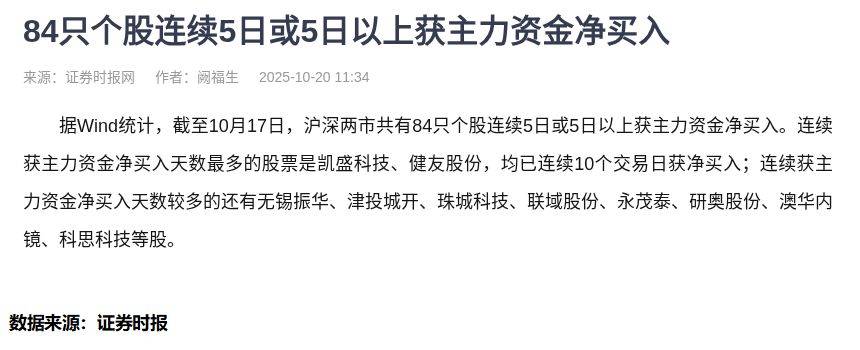
84只个股连续5日或5日以上获主力资金净买入


Zheng Quan Shi Bao Wang· 2025-10-20 04:09
Core Insights - As of October 17, a total of 84 stocks in the Shanghai and Shenzhen markets have experienced net buying from major funds for five consecutive days or more [1] - The stocks with the longest streak of net buying are Kaisheng Technology and Jianyou Co., both of which have seen net buying for 10 consecutive trading days [1] - Other notable stocks with significant net buying days include Wuxi Zhenhua, Jintou Chengkai, Zhucheng Technology, Lianyu Co., Yongmaotai, Yan'ao Co., Aohua Endoscopy, and Kesi Technology [1]
78只个股连续5日或5日以上获主力资金净买入


Zheng Quan Shi Bao Wang· 2025-10-17 03:38
Core Insights - As of October 16, a total of 78 stocks in the Shanghai and Shenzhen markets have experienced net buying from major funds for five consecutive days or more [1] - The stocks with the longest streak of net buying are Kaisheng Technology, Wanxin Media, Jianyou Co., and Jinling Hotel, each having received net buying for nine consecutive trading days [1] - Other notable stocks with significant net buying days include Tiancheng Technology, China Electric Research, Junpu Intelligent, Hangxin Technology, Dongpeng Holdings, Shandong Publishing, Tongkun Co., and Yuanfang Information [1]
74只个股连续5日或5日以上获主力资金净买入
Zheng Quan Shi Bao Wang· 2025-10-16 03:42
Core Insights - As of October 15, a total of 74 stocks in the Shanghai and Shenzhen markets have experienced net buying from major funds for five consecutive days or more [1] Group 1: Stocks with Longest Net Buying - The stocks with the longest consecutive net buying days are Wanxin Media, Jianyou Co., Jinling Hotel, Jinchun Co., and Kaisheng Technology, each having recorded net buying for eight consecutive trading days [1] Group 2: Other Notable Stocks - Other stocks with significant net buying days include Guanshi Technology, Haoneng Co., Ruidi Zhichu, Hangxin Technology, Tiancheng Technology, China Electric Research, Zhangzhou Development, and Junpu Intelligent [1]


健友股份(603707) - 健友股份关于股份回购进展的公告
2025-10-09 08:46
| 证券代码:603707 | | --- | | 证券简称:健友股份 公告编号:2025-073 | 本次回购资金总额不低于人民币 2,000 万元(含)且不超过人民币 4,000 万 元(含),本次回购股份的价格不超过 18.75 元/股(含),本次回购的股份用于 员工持股计划或股权激励,回购股份实施期限为自公司股东大会审议通过本次回 购股份方案之日起 12 个月内。具体内容详见公司于 2025 年 4 月 29 日披露的《健 友股份关于以集中竞价交易方式回购股份的预案》(公告编号:2025-028)。 二、回购股份的进展情况 本公司董事会及全体董事保证本公告内容不存在任何虚假记载、误导性陈述或者 重大遗漏,并对其内容的真实性、准确性和完整性承担法律责任。 重要内容提示: | 回购方案首次披露日 | 2025/4/29,由董事长唐咏群先生提议 | | | | | | | --- | --- | --- | --- | --- | --- | --- | | 回购方案实施期限 | 2025 年 月 20 5 | 5 | 日~2026 | 年 | 月 | 19 日 | | 预计回购金额 | 2,000万元~4 ...
健友股份(603707) - 健友股份关于“健友转债”转股结果暨股份变动的公告
2025-10-09 08:46
| 证券代码:603707 | 证券简称:健友股份 | 公告编号:2025-072 | | --- | --- | --- | | 债券代码:113579 | 债券简称:健友转债 | | 南京健友生化制药股份有限公司 关于"健友转债"转股结果暨股份变动的公告 本公司董事会及全体董事保证本公告内容不存在任何虚假记载、误导性陈述 或者重大遗漏,并对其内容的真实性、准确性和完整性承担个别及连带责任。 重要内容提示: 转股情况: 截至 2025 年 9 月 30 日,累计已有人民币 719,000 元"健友转债"转为公司 普通股,累计回售人民币 7,000 元"健友转债"。"健友转债"累计转股股数 18,035 股,占转股前公司股份总额的 0.001%。 未转股可转债情况: 截至 2025 年 9 月 30 日,尚未转股的"健友转债"金额为人民币 502,464,000 元,占"健友转债"发行总量的比例为 99.86%。 一、可转债的发行上市概况 经中国证券监督管理委员会《关于核准南京健友生化制药股份有限公司公开 发行可转换公司债券的批复》(证监许可[2020]603 号)核准,南京健友生化制 药股份有限公司(以下简 ...
健友股份:已累计回购88万股股份
Ge Long Hui· 2025-10-09 08:45
Core Viewpoint - The company, Jianyou Co., Ltd. (603707.SH), has announced a share buyback program, indicating a commitment to returning value to shareholders through capital management strategies [1] Summary by Categories Share Buyback Details - As of September 30, 2025, the company has repurchased a total of 880,000 shares [1] - The repurchased shares account for 0.05% of the company's total share capital [1] - The lowest transaction price was 11.58 CNY per share, while the highest was 11.66 CNY per share [1] - The total amount paid for the repurchase was 10.2207 million CNY, excluding transaction fees and stamp duty [1]
特朗普宣布将对专利及品牌药品加征100%关税,对国内药企影响几何?
财联社· 2025-09-26 07:06
Core Viewpoint - The article discusses the announcement by President Trump regarding a new round of high tariffs on various imported products, particularly focusing on the pharmaceutical industry, which will see a 100% tariff on patented and branded drugs starting October 1, 2023, significantly higher than the previous 15% agreement with Europe [1][2]. Group 1: Tariff Details and Market Reaction - The new tariffs include a 50% tariff on kitchen cabinets and bathroom sinks, a 30% tariff on imported furniture, and a 100% tariff on patented and branded drugs, with exemptions for companies that have manufacturing facilities "under construction" in the U.S. [1][2] - Following the announcement, the innovation drug index and various biotech ETFs saw declines of over 1%, with specific companies like Huahai Pharmaceutical and Baiyue Shenzhou experiencing stock price drops [2][3]. Group 2: Company Responses and Strategies - Many domestic pharmaceutical companies are assessing the impact of the new tariffs, with some indicating that their production capabilities in the U.S. may mitigate the effects. For instance, Huahai Pharmaceutical is evaluating whether its facilities meet the criteria for exemption [4][5]. - Major U.S. pharmaceutical companies like Johnson & Johnson and Eli Lilly have already invested significantly in expanding their domestic production capabilities, with Johnson & Johnson planning to invest approximately $20 billion in North Carolina and Eli Lilly announcing a $270 billion investment for new factories [3][4]. Group 3: Expert Opinions and Future Outlook - Industry experts suggest that the 100% tariff is politically motivated and may not significantly impact domestic innovative drug companies, as many already have manufacturing in the U.S. and the majority of their sales are through partnerships with multinational corporations [6][7]. - The anticipated implementation of a global drug pricing model by the U.S. government could further influence drug pricing and market dynamics, but experts believe that the overall impact on the domestic pharmaceutical industry will be limited [6][7].





华创医药2025年重点研究成果与会议合集
华创医药组公众平台· 2025-09-19 12:00
Core Viewpoint - The Chinese innovative drug industry is gradually catching up with Europe and the United States in terms of technology, with some targets and technical pathways already leading globally. The number and value of new drugs authorized for overseas markets continue to increase, leading to world-class pricing and non-linear investment elasticity. The domestic market is experiencing strong growth in demand, with domestic new drug sales continuing to rise, and several innovative pharmaceutical companies have turned losses into profits, entering a stable growth phase [2]. Group 1: Innovative Drugs - The innovative drug sector is witnessing a significant increase in sales driven by strong domestic demand, with a number of innovative companies achieving profitability [2]. - The trend of domestic innovative drugs going overseas is accelerating, with increasing numbers and values of new drug authorizations [2]. - The pricing power of innovative drugs is improving, reflecting the global competitiveness of Chinese pharmaceutical companies [2]. Group 2: High-Value Medical Consumables - The orthopedic sector is expected to see mild price reductions due to continued domestic substitution and accelerated overseas business progress [2]. - The neurosurgery and neurointervention fields are experiencing stable growth post-collection, with new products being launched [2]. - The high-value consumables market is expected to benefit from ongoing domestic replacement and the introduction of new products [2]. Group 3: Medical Devices - The medical device sector is seeing a recovery in bidding prices, with ongoing high-speed growth in bidding data this year [2]. - Companies are entering a phase of inventory reduction, with performance expected to improve in the second half of the year [2]. - The low-value consumables sector is experiencing product upgrades and accelerated expansion into overseas markets [2]. Group 4: Blood Products - The supply side of the blood products industry is concentrating on central state-owned enterprises, gradually clearing the competitive landscape [2]. - The demand side is expected to see continuous upgrades to new products, with industry sentiment gradually improving [2]. Group 5: API (Active Pharmaceutical Ingredients) - The API sector is benefiting from the end of a capital expenditure peak, with three growth logic points driving upward trends: new high-end market products, integrated consolidation and overseas expansion, and cost-leading CDMO [2]. - Leading companies in the API sector are expected to see explosive growth in revenue and profits [2]. Group 6: CXO (Contract Research Organization) - The CXO sector is witnessing a recovery in A+H financing activity, with multiple significant business developments enhancing market confidence [2]. - The focus is on optimizing the supply-side landscape and increasing market share for leading CRO companies [2]. Group 7: Traditional Chinese Medicine and Retail Pharmacy - The traditional Chinese medicine sector is showing signs of recovery, with friendly pricing for new drugs and ongoing observation of collection progress [2]. - The retail pharmacy sector is influenced by the pace of supply-side clearing and business model upgrades, with expectations of increased store closures in the second half of 2025 [2]. Group 8: Research and Development Services - The domestic innovative drug business development is heating up, likely driving downstream demand recovery [2]. - The overseas market presents significant growth opportunities for domestic companies, leveraging cost-effectiveness and service differentiation [2].




华创医药 | 2025年我们做了什么
华创医药组公众平台· 2025-09-18 03:41
Core Viewpoint - The Chinese innovative drug industry is gradually catching up with Europe and the United States in terms of technology, with some targets and technical pathways already leading globally. The number and value of new drugs authorized for overseas markets continue to increase, leading to world-class pricing and non-linear investment elasticity. The domestic market is experiencing strong growth in demand, with domestic new drug sales continuing to rise, and several innovative pharmaceutical companies have turned losses into profits, entering a stable growth phase [2]. Group 1: Innovative Drugs - The innovative drug sector is witnessing a significant increase in sales driven by strong domestic demand, with a number of innovative companies achieving profitability [2]. - The trend of domestic innovative drugs going overseas is accelerating, with increasing numbers and values of new drug authorizations [2]. - The industry is positioned for a "Davis double" effect, where both performance and valuation are expected to improve [2]. Group 2: High-Value Medical Consumables - The orthopedic sector is expected to see mild price reductions, while domestic replacements continue to grow, and overseas business progresses rapidly [2]. - The neurosurgery and neurointervention fields are stabilizing after centralized procurement, with new products expected to contribute to growth [2]. Group 3: Medical Devices - The medical device sector is experiencing a high-speed growth in bidding data, with companies entering a destocking phase, which is expected to improve performance in the second half of the year [2]. - The low-value consumables sector is seeing continuous product upgrades and accelerated expansion into overseas markets [2]. Group 4: Blood Products - The supply side of the blood products industry is increasingly concentrated among state-owned enterprises, leading to a clearer competitive landscape [2]. - The demand side is expected to upgrade towards new products, gradually improving the industry's overall health [2]. Group 5: API (Active Pharmaceutical Ingredients) - The industry is at an upward turning point due to the end of a capital expenditure peak, combined with three growth drivers: new high-end market products, integrated consolidation and overseas expansion, and cost-leading CDMO [2]. - Leading companies are expected to see explosive growth in revenue and profits in the medium term [2]. Group 6: CXO (Contract Research Organization) - The CXO sector is seeing a revival in A+H financing activity, with multiple significant business developments enhancing market confidence [2]. - The focus is on optimizing the supply-side landscape and increasing market share for leading CRO companies [2]. Group 7: Traditional Chinese Medicine and Retail Pharmacy - The traditional Chinese medicine sector is showing signs of recovery, with friendly pricing for new drugs, while the retail pharmacy sector is influenced by supply-side adjustments and business model upgrades [2]. - The performance of offline pharmacies is expected to improve in the second half of 2025, with leading chains like YaoXingTang making progress in store upgrades [2]. Group 8: Research Reports - A series of in-depth research reports on various companies and sectors within the pharmaceutical and medical device industries have been published, highlighting their growth potential and market positioning [3][4].

