Shanghai Geoharbour Construction (605598)

Search documents
未知机构:我们从去年持续强调建筑科技赛道2026年核心主线-20260211
未知机构· 2026-02-11 02:20
我们从去年持续强调:#建筑+科技赛道——2026年核心主线。 今天科技情绪继续上行,【上海港湾】涨停,【亚翔集成】、【圣晖集成】大涨,当前时间我们继续重申,请持 续关注重视! 我们从去年持续强调:#建筑+科技赛道——2026年核心主线。 ...



上海港湾跌2.71%,成交额5.72亿元,今日主力净流入-3653.50万
Xin Lang Cai Jing· 2026-02-10 07:54
商业航天+卫星导航+钙钛矿电池+一带一路+人民币贬值受益 异动分析 来源:新浪证券-红岸工作室 2月10日,上海港湾跌2.71%,成交额5.72亿元,换手率3.77%,总市值152.03亿元。 1、2025年3月6日微信公众号发布,作为A股主板上市公司上海港湾基础建设(集团)股份有限公司下 属控股子公司,伏曦炘空依托集团雄厚的技术实力和积累,在商业航天能源领域走出了一条创新之路。 伏曦炘空专注于为客户提供轻、廉、高效的空间能源系统解决方案及产品研发服务。其技术团队汇聚了 航天院所、中科院及高校精英,均有着15年以上航天工程经验,确保伏曦炘空能够为卫星、探测器等空 间飞行器提供低成本高性能的能源系统。公司能源系统产品,已成功保障15颗卫星成功发射,所有产品 在轨工作正常。 2、根据2025年7月11日投资者关系活动记录表:公司旗下控股子公司上海伏曦炘空科技有限公司,聚焦 卫星、空间飞行器、无人机等领域的能源需求,专注于为客户提供轻量化、低成本、高性能的空间能源 系统解决方案,并深度参与关键产品研发服务。在技术落地与市场应用层面,该公司已取得显著成果: 其能源系统产品成功助力 15 颗卫星发射入轨,40 余套卫星 ...
全球航天强国加码太空光伏!卫星组网驱动产业化提速,海内外共振拉升产业估值中枢
Xin Lang Cai Jing· 2026-02-09 10:09
Core Viewpoint - The articles highlight the growing interest and investment in space photovoltaic technology among various companies in China, indicating a significant potential for growth in this sector by 2026 as commercialization accelerates. Group 1: Company Overview - Xizi Clean Energy (002534) is a leading clean energy equipment manufacturer in China, focusing on high-performance perovskite photovoltaic technology and aiming to become a core supplier of materials for space photovoltaics by 2026 [1][24]. - Shanghai Port Construction (605598) is a major infrastructure company that is expanding into space photovoltaic systems, leveraging its engineering capabilities to support commercial space projects [2][25]. - TuoRi New Energy (002218) has a long-standing presence in the photovoltaic industry and is optimizing its space photovoltaic products, expecting to increase market share by 2026 [3][26]. - Mingyang Smart Energy (601615) is acquiring technology to enhance its capabilities in space solar cell development, aiming to integrate its wind and solar energy expertise [4][28]. - Woge Optoelectronics (603773) specializes in flexible solar wing materials for satellites, with a focus on high-temperature resistant films, anticipating significant growth in the space photovoltaic sector [5][29]. Group 2: Growth Outlook - Companies are expected to benefit from the rapid commercialization of space photovoltaics, with projections indicating substantial growth opportunities by 2026 [1][2][3][4][5]. - The synergy between commercial aerospace and space photovoltaic industries is anticipated to drive rapid business growth for companies like Shanghai Port Construction and Mingyang Smart Energy [2][4]. - The demand for flexible solar wings and high-efficiency photovoltaic materials is expected to surge, positioning companies like Woge Optoelectronics and TuoRi New Energy as key players in the market [3][5]. Group 3: Technological Advancements - Companies are focusing on developing materials that can withstand extreme space conditions, such as high-performance perovskite and flexible solar films, which are crucial for the success of space photovoltaic applications [1][5][6]. - The integration of advanced technologies, such as N-type solar cells and high-efficiency components, is being prioritized by firms like Junda Co. (002865) and Sanan Optoelectronics (600703) to enhance their competitive edge in the space photovoltaic market [6][10][35]. - The ongoing research and development efforts in high-efficiency solar technologies are expected to yield breakthroughs that will facilitate the commercialization of space photovoltaic solutions by 2026 [3][4][5][6].



钙钛矿电池板块走强 杭萧钢构涨停
Xin Lang Cai Jing· 2026-02-09 03:53
Group 1 - The perovskite battery sector is experiencing significant growth, with multiple companies seeing stock price increases [1] - Companies such as Hangxiao Steel Structure, Jinjing Technology, Xizi Clean Energy, Shanghai Port Bay, and Tuori New Energy have reached their daily price limits [1] - Other notable companies with substantial stock price gains include Baoxin Technology, Maiwei Co., Mingyang Smart Energy, Dier Laser, and Dike Co. [1]


A股午评 | 全球市场反攻!创业板指数半日涨3.11% 太空光伏、算力硬件股走强
智通财经网· 2026-02-09 03:52
全球市场开启大反攻! 跌幅方面,全市仅少数板块飘绿,此前走强的油气产业链陷入调整,潜能恒信、中曼石油等跌逾3%; 白酒股震荡走低,燃气板块表现落后。 展望后市,中信建投认为,当前外部扰动未对中国产业基本面形成实质性冲击且集中降温操作已结束, 市场情绪充分释放,调整较为到位,春节后春季行情有望延续,建议持股过节。 继上周五美股市场"逢低买入"情绪全面爆发道指历史性突破5万点后,北京时间周一美股股指期货涨幅 扩大。大宗商品市场方面,黄金、白银价格延续反弹走势。亚太市场方面,日韩股市强势上涨,港、A 股紧随其后。 具体来看,今日A股市场早盘高开高走,创业板指涨超3%。截至午间收盘,上证指数涨1.17%,深证成 指涨2.07%,创业板指涨3.11%。沪深两市半日成交额1.49万亿,较上个交易日放量1068亿。 盘面上,太空光伏概念领涨,TCL中环、双良节能等20余股涨停;AI产业链情绪持续回暖,光模块、数 据中心电源等AI硬件股持续走高,天孚通信逼近涨停,续创历史新高,杰普特、川润股份等封板;AI 应用概念活跃,影视股震荡走强,风语筑、上海电影、横店影视等封板;染料等化工概念全线走强,闰 土股份、百川股份涨停;商业航 ...


未知机构:国海机械张钰莹Again继续持续再次Call太空光伏设备0208-20260209
未知机构· 2026-02-09 02:45
Summary of Conference Call on Space Photovoltaic Equipment Industry Overview - The conference call focuses on the space photovoltaic industry, particularly in the context of China's satellite deployment plans and the evolution of satellite technology, including the Starlink project [1][2]. Key Points and Arguments 1. **China's Satellite Deployment Plans**: - By the end of 2025, China plans to submit approximately 203,000 satellites to the ITU, covering 14 satellite constellations. This includes 96,714 satellites for each of the CTC-1 and CTC-2 constellations, totaling nearly 193,000 satellites [1]. - Operators and commercial satellite companies are advancing medium-scale constellations, with China Mobile applying for 2,520 satellites, Yuanxin Satellite for 1,296, and Guodian Gaoke for 1,132 [1]. - As of December 2025, the overall launch completion rate for major domestic constellations remains low, indicating a "low launch rate and early networking stage" [1]. 2. **Starlink Project Development**: - As of January 25, 2026, Starlink has cumulatively launched approximately 11,034 satellites and applied for about 41,943 [2]. - The annual launch volume has increased from "hundreds" in 2018-2019 to an expected peak of around 3,200 satellites in 2025 [2]. 3. **Cost and Efficiency Dynamics**: - Gallium arsenide (GaAs) remains the mainstream technology for space photovoltaic applications, but it is no longer the only viable option due to high costs. The industry is exploring lower-cost alternatives such as silicon-based and perovskite solar cells [2]. - Starlink's V1-V3 satellites utilize crystalline silicon technology to achieve supply chain scalability and system-level cost reductions, sacrificing some unit efficiency for significant cost advantages [2]. 4. **Future Directions for Starlink**: - Starlink V4 may adopt P-type silicon HJT or P-type silicon HJT-perovskite tandem structures, which are expected to offer better reliability in space environments [3]. 5. **Domestic Space Photovoltaic Developments**: - The core technology remains multi-junction GaAs, but several companies are reporting progress in testing perovskite systems in orbit. For instance, Jiangyin Jinghao has completed over three months of stable operation for perovskite components in orbit as of May 6, 2025 [4]. - The industry outlook is positive, with an upgrade in the rating for the space photovoltaic sector to "recommended" due to accelerated satellite launches and ongoing validation of new photovoltaic technologies [4]. Additional Important Content - **Related Companies**: The call mentions several companies involved in the space photovoltaic sector, including Maiwei Co., Aotewi, High Measurement Co., Jing Sheng Machinery, Jiejia Weichuang, and Shanghai Port [5]. - **Risk Factors**: The report highlights several risks, including uncertainties in technology maturity and reliability, challenges in industrialization and commercialization, early investment and project execution risks, market space and competitive landscape uncertainties, and potential changes in policy and regulatory environments [7].




钙钛矿电池板块大涨 中来股份涨幅居前
Xin Lang Zheng Quan· 2026-02-09 02:24
Group 1 - The perovskite battery sector experienced a significant surge, with multiple companies reaching their daily price limit [1] - Notable companies that saw substantial gains include Hangxiao Steel Structure, Jinjing Technology, Xizi Clean Energy, Shanghai Port Bay, and Tuori New Energy [1] - Other companies with notable price increases include Zhonglai Co., Maiwei Co., Mingyang Smart Energy, Dongfang Risheng, and JA Solar Technology [1]


商业航天深度:太空光伏的技术底层逻辑(附29页PPT)
材料汇· 2026-02-08 15:24
Core Viewpoint - The article discusses the emergence of a new era in satellite technology, emphasizing the urgent need for efficient power supply systems for satellites as China prepares to launch a significant number of satellites by the end of 2025 [6][9]. Group 1: Satellite Launch and Development - By the end of 2025, China plans to submit approximately 203,000 satellites to the ITU, covering 14 satellite constellations, with the Radio Innovation Institute applying for two constellations, each with 96,714 satellites, totaling nearly 193,000 satellites [7][8]. - Major operators and commercial satellite companies are also advancing medium-scale constellations, with China Mobile applying for 2,520 satellites, Yuxin Satellite for 1,296, and Guodian Gaoke for 1,132 [8][10]. - As of December 2025, the overall launch completion rate for major domestic constellations remains low, indicating they are in the early stages of network formation [13]. Group 2: Starlink Program and Launch Trends - The Starlink program exhibits a clear generational rhythm, with cumulative launches reaching approximately 11,034 satellites and applications totaling about 41,943 as of January 2026 [2][16]. - The annual launch volume has increased significantly, with projections for 2025 reaching around 3,200 satellites, reflecting a trend of accelerating deployment [15][20]. - Starlink's V1 to V3 satellites utilize crystalline silicon technology to prioritize supply chain scalability and system-level cost reduction, while V4 may adopt P-type silicon HJT or P-type silicon HJT-perovskite tandem structures [3][4]. Group 3: Photovoltaic Technology in Space - The current mainstream technology for space photovoltaic applications in China is multi-junction gallium arsenide (GaAs), although there is ongoing testing and validation of perovskite systems by various companies [4][26]. - The high unit price of GaAs photovoltaic cells is becoming a significant factor limiting system economics, prompting the industry to explore lower-cost alternatives such as silicon-based and perovskite technologies [21][34]. - The article highlights the unique requirements for photovoltaic cells in space, including radiation resistance, thermal stability, and long-term reliability under extreme conditions [22][25]. Group 4: Industry Outlook and Recommendations - The acceleration of satellite launches and the continuous validation of new photovoltaic technologies indicate a rising industry outlook and long-term growth potential for the space photovoltaic sector [5][6]. - The article recommends a "buy" rating for the space photovoltaic industry, citing key companies such as Maiwei Co., Aotewi, and others as relevant investment targets [5][6].



建筑材料行业深度报告:建筑、建材2025Q4公募基金持仓低位回升,持仓集中度有所下降
Soochow Securities· 2026-02-08 14:33
Investment Rating - The report maintains an "Increase" rating for the construction materials industry [1] Core Insights - The report indicates that public fund holdings in the construction materials sector have slightly increased but remain at a low level, with the market value of heavy holdings in the construction and materials sectors accounting for 0.42% and 0.71% of A-shares, respectively [13][14] - The concentration of holdings in the construction and materials sectors has decreased, with 47 and 23 stocks held by sample funds, representing 29% and 32% of their respective industries [12][14] Summary by Relevant Sections 1. Industry Holding Analysis - The market value of heavy holdings in the construction and materials sectors has increased slightly, with respective shares of 0.42% and 0.71% of A-shares, ranking in the 28th and 26th percentiles over the past decade [13] - The concentration of holdings in the construction and materials sectors has decreased, with 47 and 23 stocks held by sample funds, representing 29% and 32% of their respective industries [12][14] 2. Individual Stock Holdings Analysis - The top five stocks by market value in the construction sector are Jin Chengxin (2.74 billion), China Construction (1.96 billion), Honglu Steel Structure (1.20 billion), Shanghai Port (0.88 billion), and Oriental Iron Tower (0.71 billion) [2] - The top five stocks by market value in the materials sector are Oriental Yuhong (2.24 billion), Sankeshu (2.05 billion), China National Materials (1.61 billion), Conch Cement (1.37 billion), and Huaxin Materials (1.11 billion) [2]




马斯克“点名”!太空光伏概念再度走强!大面积涨停
Sou Hu Cai Jing· 2026-02-03 10:12
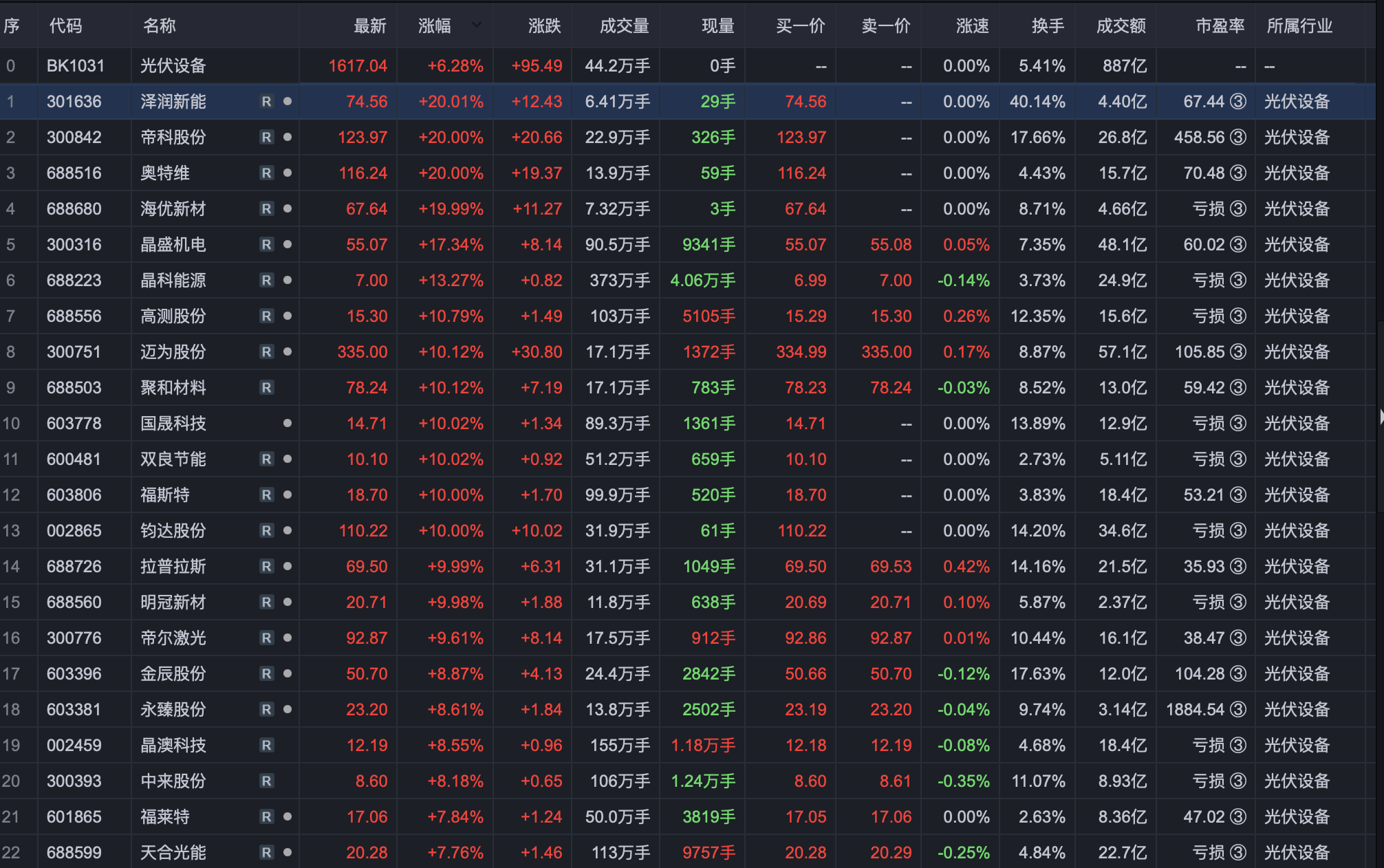
Core Viewpoint - The space photovoltaic sector is gaining momentum, driven by Elon Musk's support and significant developments in the industry, including SpaceX's acquisition of xAI and plans for deploying data centers in space [1][3]. Group 1: Market Performance - As of February 3, the photovoltaic ETF (515790.SH) closed at 1.122, with a remarkable increase of 6.05%. Several stocks, including Maiwei Co. (300751.SZ) and Junda Co. (002865.SZ), hit the daily limit, while Longi Green Energy (601012.SH) and Tongwei Co. (600438.SH) saw gains exceeding 4.5% [1]. - The photovoltaic equipment sector index (BK1031) rose by 6.28%, indicating strong market interest and activity [2]. Group 2: Industry Outlook - Institutions like Guosheng Securities and CICC express optimism about the future of space photovoltaics, predicting it could become a trillion-yuan market within five years due to increasing global demand for space energy and the restructuring of supply chains [3]. - CICC's research highlights that space photovoltaics are central to upgrading power systems in commercial aerospace, with a focus on low-orbit satellite applications, suggesting a new phase of technological advancement and industrial delivery [4]. Group 3: Technological Insights - The main photovoltaic technologies for space applications include silicon solar cells, gallium arsenide solar cells, and perovskite technology. Gallium arsenide offers superior performance but at a higher cost, while perovskite technology is noted for its low material costs and high power-to-weight ratio [5][6]. - Current market trends indicate that gallium arsenide technology dominates, but emerging technologies like HJT silicon and perovskite are expected to gain significant market share, with perovskite potentially achieving over 50% penetration [7]. Group 4: Company Developments - Companies such as Shanghai Port and Junda Co. are actively investing in space photovoltaic technologies, with Shanghai Port focusing on perovskite solar cells and Junda Co. securing contracts for related supplies [7]. - Major players like Trina Solar and JA Solar are also expanding their capabilities in crystalline silicon and perovskite technologies, indicating a robust competitive landscape in the photovoltaic sector [7].