
TRANSSION(688036)

Search documents
研报掘金丨申万宏源:维持传音控股“买入”评级,智能机出货量全球第四
Ge Long Hui A P P· 2025-11-19 09:05
Core Viewpoint - Transsion Holdings reported a year-on-year and quarter-on-quarter revenue increase in Q3 2025, but faced pressure on gross and net profit margins, with net profit falling below expectations [1] Group 1: Financial Performance - Q3 2025 revenue showed growth both year-on-year and quarter-on-quarter, indicating a strong seasonal performance [1] - Gross margin and net margin were under pressure, leading to a net profit that was lower than market expectations [1] Group 2: Market Position - Transsion Holdings ranks fourth globally in smartphone shipments, maintaining over 40% market share in Africa and leading positions in Pakistan, Bangladesh, and India [1] Group 3: AI Development - The company is actively developing practical AI features, with TECNO AI and Infinix AI supporting local dialects in Africa and South Asia, addressing low-resource language limitations [1] - AI applications include image enhancement, voice assistants, and AI writing, with a series of AI-assisted applications being developed to promote comprehensive AI integration [1] Group 4: Strategic Initiatives - Boomplay has maintained a leading market position and user base in Africa, showing progress in commercialization efforts [1] - The average PE ratio for comparable companies (Lingyi iTech, Luxshare Precision, Lens Technology) for 2025 is 29X, which is 63% higher than Transsion Holdings' 2025 PE of 18X, leading to a "Buy" rating [1]

业绩增长失速净利润近“腰斩” 传音控股欲寻港股上市脱困
Guan Cha Zhe Wang· 2025-11-19 06:39
Core Viewpoint - Transsion Holdings, known as the "King of African Mobile Phones," is facing significant financial challenges despite its past success in the African market and is planning to issue H-shares for listing on the Hong Kong Stock Exchange to enhance its international brand image and diversify financing channels [1][4]. Financial Performance - For the first three quarters of 2025, Transsion Holdings reported a revenue of 49.543 billion yuan, a slight decrease of 3.33% year-on-year, while net profit plummeted by 44.97% to 2.148 billion yuan, nearly halving [1][2]. - The company's net profit has been in negative growth for six consecutive quarters since Q2 2024, attributed to intensified market competition and rising supply chain costs, leading to a record low gross profit margin of 19.47% [2][3]. Market Dynamics - Transsion's core market, the mid-to-low-end segment priced between $100 and $200, is under severe pressure from domestic competitors like Xiaomi, Huawei, OPPO, and Vivo, which are aggressively entering the African market [3][7]. - The company has seen a significant reduction in institutional investors, with 609 fewer institutions holding shares by the end of September 2025 compared to the end of Q2 2025, indicating a cautious market sentiment [2]. Strategic Initiatives - The planned H-share issuance aims to raise funds for R&D in AI and product iteration, with a 17.26% year-on-year increase in R&D expenses to 2.139 billion yuan for the first three quarters of 2025 [4][5]. - Funds will also be allocated to expand international marketing and sales, as well as to enhance the ecosystem of IoT and AI through new product categories [4][8]. Future Outlook - The success of the Hong Kong listing and subsequent fundraising is uncertain, as the company must effectively utilize the raised capital to upgrade its product structure and expand its business footprint [5][6]. - Transsion is transitioning from a hardware manufacturer to a technology ecosystem company, leveraging digital services like Boomplay to enhance brand recognition and user retention [7][8].
存储芯片价格疯涨50% 手机电脑出货承压洗牌加剧
Zhong Guo Jing Ying Bao· 2025-11-18 13:19
Group 1: Market Outlook - The global consumer electronics market is facing challenges due to rising storage prices, leading to downward adjustments in production and shipment forecasts for smartphones and laptops for 2026, with expected declines of 2% and 2.4% respectively [1] - TrendForce indicates that inflation continues to disrupt consumer market performance, and the strong upward cycle of memory prices is increasing overall production costs, which will force terminal pricing to rise, impacting the consumer market [1][5] - If the imbalance between supply and demand for memory worsens, there is a risk of further downward adjustments in production and shipment forecasts [1] Group 2: Procurement Strategies - Reports suggest that several smartphone manufacturers, including Xiaomi, OPPO, and vivo, have paused storage chip procurement due to rising prices, with some manufacturers having DRAM inventory levels below three weeks [2] - Industry analysts believe that pausing procurement is unlikely as manufacturers would not want to forfeit market share, and instead, they may raise terminal product prices to cover rising component costs [2][3] Group 3: Cost Impact - The price increase of storage chips is expected to raise the overall BOM (Bill of Materials) cost of smartphones by an additional 5% to 7% in the coming year, following an 8% to 10% increase already observed [5][6] - The rising costs have already been reflected in the pricing of new smartphone models, with brands like vivo and OPPO increasing prices compared to previous generations [3][5] Group 4: Financial Performance - Transsion Holdings reported a revenue increase of 22.6% year-on-year in Q3, but its net profit declined by 11.06%, indicating that rising supply chain costs are impacting profitability [6] - Xiaomi's Q3 financial report showed an increase in both revenue and net profit, but also noted a rise in smartphone sales costs due to increased prices of core components [6] Group 5: Market Dynamics - The current market dynamics indicate that high-end smartphones can absorb cost increases better due to higher brand premiums, while mid to low-end models are more sensitive to cost fluctuations [6][7] - The ongoing supply tightness in memory chips is expected to lead to a market reshuffle, favoring larger brands as smaller manufacturers struggle to secure resources [7]

存储芯片价格飙升,手机厂商集体承压
Mei Ri Jing Ji Xin Wen· 2025-11-18 13:16
Core Viewpoint - The global memory chip industry is experiencing a significant price surge, particularly in the DDR5 and DDR4 segments, driven by increased demand from the AI sector and supply chain constraints [1][2][3]. Group 1: Price Surge and Market Impact - The price of DDR5 16Gb chips rose from $7.68 to $15.5 in just one month, marking a 102% increase, while DDR4 16Gb saw a rise of over 92% [1]. - Major manufacturers like Samsung, SK Hynix, and Micron have paused quotes due to rapid price increases, impacting the consumer electronics sector, particularly smartphone manufacturers [1][2]. - Tier 1 smartphone manufacturers have long-term supply agreements, preventing stockouts, but face pressure from the steep price increases, with LP4X/5X contract prices rising by 40% and UFS prices by 25% to 30% in Q4 [1][2]. Group 2: Supply Chain Dynamics - The demand for memory chips is being reshaped by AI, with AI servers requiring 8 times the DRAM and 3 times the NAND compared to regular servers [2]. - North American cloud service providers have significantly increased their stocking demands, leading to a projected supply shortage for memory chips throughout the next year [2]. Group 3: Cost Implications for Manufacturers - DRAM contract prices in Q4 2025 are expected to rise over 75% year-on-year, increasing the BOM cost for devices by 8% to 10% [3]. - Xiaomi's president acknowledged that the rising costs of memory chips are beyond expectations and will continue to escalate [3]. Group 4: Manufacturer Strategies - Smartphone manufacturers are adopting a strategy of slight price increases combined with a reduction in memory configurations to mitigate the impact of rising costs [4]. - For example, some manufacturers are downgrading RAM configurations from 16GB to 12GB without significantly affecting user experience [4]. Group 5: Challenges for Lower-End Market - The low-end smartphone market is facing more severe impacts from rising memory chip prices, leading to potential production bottlenecks and increased pressure on hardware profit margins [5]. - Smaller smartphone brands may struggle to secure resources, potentially leading to a market reshuffle favoring larger brands [5]. Group 6: Financial Performance of Companies - Transsion Holdings reported a revenue of 49.543 billion yuan for the first three quarters of 2025, a slight decline of 3.3%, with net profit down by 44.97% due to increased supply chain costs [6]. - The company is adjusting its pricing and product structure in response to rising memory chip costs [6]. Group 7: Future Outlook - TrendForce has revised its 2026 global smartphone production forecast from a 0.1% increase to a 2% decrease, indicating potential further downgrades if supply-demand imbalances worsen [7]. - The industry is expected to endure high-pressure conditions for at least another couple of quarters [7].


存储芯片价格猛涨,多家手机厂商已暂缓采购,部分库存不足三周!
Mei Ri Jing Ji Xin Wen· 2025-11-18 07:12
Core Insights - The global storage chip industry has experienced a significant price surge, with DDR5 16Gb prices increasing by 102% in one month, leading to procurement delays among smartphone manufacturers [1][2][3] - The demand for storage chips is driven by the AI boom, with data centers requiring significantly more DRAM and NAND compared to traditional servers [3][4] - The price increase is expected to continue into the first half of next year, causing smartphone manufacturers to adjust their product strategies and pricing [5][8] Industry Impact - Major smartphone manufacturers like Xiaomi, OPPO, and vivo are facing pressure due to the rapid price increases, with some reporting inventory levels below two months [1][2] - The average contract price for LP4X/5X memory has risen by 40% quarter-over-quarter, while UFS prices have increased by 25% to 30% [2] - The supply chain dynamics are shifting, with manufacturers potentially prioritizing higher-end models over low-end ones due to profit margin pressures [6][7] Company Responses - Transsion Holdings reported a revenue decline of 3.3% year-on-year, with net profit dropping by 44.97%, attributing this to increased supply chain costs and competition [7] - The company is actively adjusting its pricing and product structure in response to rising storage chip costs [7] - Analysts predict that the low-end smartphone market may face significant challenges, potentially leading to a reduction in the production of entry-level models [6][7]
价格猛涨,有产品一个月涨102%,多家手机厂商已暂缓采购,部分库存不足三周!分析师称“低端机恐做多亏多”,涨价背后竟是因为AI?
Mei Ri Jing Ji Xin Wen· 2025-11-18 06:26
Core Viewpoint - The global memory chip industry has experienced a significant price surge since the second half of 2025, particularly in the fourth quarter, with DDR5 memory prices doubling within a month, impacting smartphone manufacturers' procurement strategies [1][2][3]. Group 1: Price Surge and Impact on Smartphone Manufacturers - The price of DDR5 16Gb memory chips rose from $7.68 to $15.5 in just one month, marking a 102% increase, while DDR4 16Gb saw a rise of over 92% [1]. - Major smartphone manufacturers like Xiaomi, OPPO, and vivo have paused their memory chip purchases due to high price increases, with some DRAM inventories dropping below three weeks [1][2]. - The contract prices for LP4X/5X memory chips increased by 40% and UFS prices by 25% to 30% in the fourth quarter compared to the previous quarter [2]. Group 2: Supply Chain Dynamics and AI Demand - The demand for memory chips has surged due to the AI boom, with AI servers requiring significantly more DRAM and NAND than standard servers, leading to a supply shortage [3]. - North American cloud service providers have increased their procurement needs for the upcoming year, contributing to a projected supply gap in memory chips [3][4]. Group 3: Cost Implications and Manufacturer Strategies - The DRAM contract prices increased by over 75% year-on-year in the fourth quarter, raising the overall BOM cost for smartphones by an estimated 8% to 10% [4]. - Smartphone manufacturers are responding to rising costs by slightly increasing prices and strategically reducing memory configurations in their products [5]. - The low-end smartphone market may face significant challenges, with potential production losses as manufacturers shift focus to mid-to-high-end models [7]. Group 4: Financial Performance of Companies - Transsion Holdings reported a revenue of 49.543 billion yuan for the first three quarters of 2025, a slight decline of 3.3%, with a net profit drop of 44.97% attributed to rising supply chain costs [8]. - Analysts predict that Transsion's profitability will be pressured by memory price increases and market competition, but adjustments in product pricing may help restore profitability [9].


传音控股(688036):25Q3营收增长、利润率承压,通过H股发行议案:传音控股(688036):
Shenwan Hongyuan Securities· 2025-11-18 06:00
Investment Rating - The report maintains a "Buy" rating for Transsion Holdings (688036) [7] Core Views - The company reported a revenue of 49.54 billion yuan for the first three quarters of 2025, a year-on-year decrease of 3.33%, and a net profit attributable to shareholders of 2.15 billion yuan, down 44.97% year-on-year [7] - The decline in net profit is attributed to a decrease in gross margin and an increase in operating expenses [7] - The company is actively developing practical AI features to enhance local user experience in Africa and South Asia [7] - The mobile internet business has reached a monthly active user count exceeding 10 million, with significant progress in monetization [7] - The revenue forecast for 2025 has been adjusted down from 74.2 billion yuan to 70.3 billion yuan, and net profit forecast has been reduced from 6.2 billion yuan to 4.1 billion yuan [7] Financial Data and Profit Forecast - Total revenue for 2024 is projected at 68.72 billion yuan, with a year-on-year growth rate of 10.3% [6] - For 2025, total revenue is expected to be 70.31 billion yuan, with a growth rate of 2.3% [6] - The net profit attributable to shareholders for 2025 is forecasted at 4.1 billion yuan, reflecting a year-on-year decrease of 26.2% [6] - The gross margin is expected to be 20.3% in 2025, slightly recovering from 19.5% in 2025Q1-3 [6] - The return on equity (ROE) is projected to be 16.6% in 2025, up from 10.7% in 2025Q1-3 [6]
Omdia:成本压力加剧 三季度东南亚地区智能手机出货量同比下滑1%
智通财经网· 2025-11-18 05:52
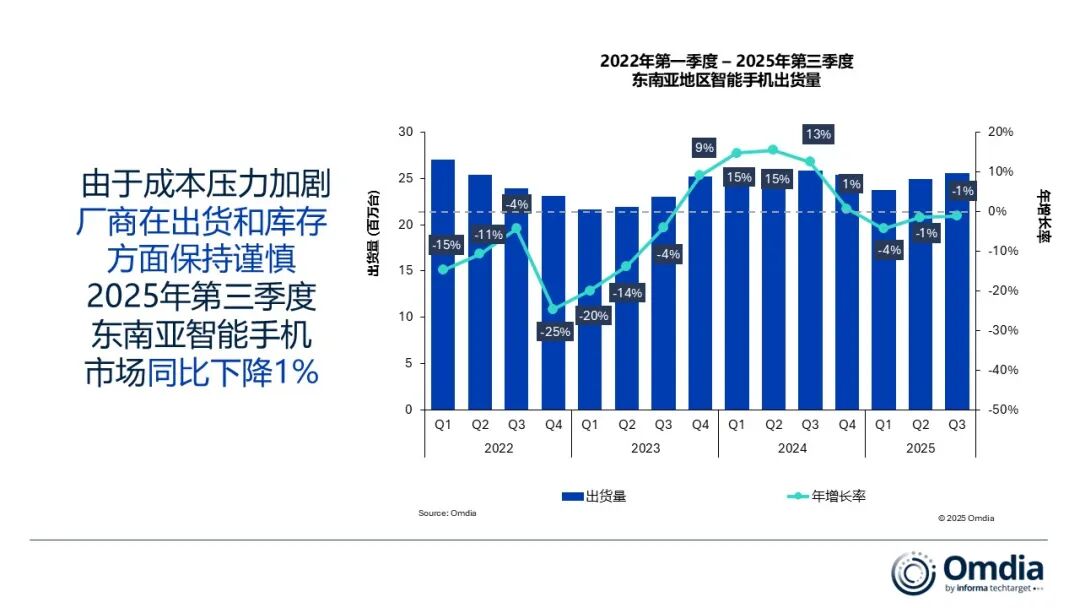
Core Insights - The Southeast Asian smartphone market is experiencing a decline, with a year-on-year decrease of 1% in Q3 2025, resulting in a total shipment of 25.6 million units, marking the third consecutive quarter of decline [1][9] Market Performance - Samsung leads the region with a shipment of 4.6 million units and an 18% market share, benefiting from a high-end product mix in markets like Thailand, Vietnam, and Malaysia [3] - Transsion follows closely with 4.6 million units and an 18% market share, maintaining slight year-on-year growth [4] - Xiaomi ranks third with 4.3 million units and a 17% market share, driven by the success of its POCO series [4] - OPPO is fourth with 3.8 million units and a 15% market share, facing a significant decline due to weak demand and channel adjustments [4] - Vivo rounds out the top five with 2.9 million units and an 11% market share, supported by its new Y series models [5] Competitive Strategies - The entry-level smartphone segment is becoming increasingly volatile, with brands like OPPO and Vivo focusing on value rather than volume, while Honor and Xiaomi aim to increase market penetration through higher shipments [5] - Transsion's competitive pricing in Indonesia and the Philippines is crucial, but rising memory and storage costs may challenge its pricing strategy [7] - Samsung's early launch of the A17 and A07 series has been pivotal in maintaining its lead in traditional strongholds like Thailand and Vietnam [7] - Xiaomi's strong performance in Malaysia, particularly with the Redmi 15, highlights its ability to accelerate the adoption of 5G devices in the mass market [7]
传音控股(688036):25Q3营收增长、利润率承压,通过H股发行议案
Shenwan Hongyuan Securities· 2025-11-18 04:45
Investment Rating - The investment rating for the company is "Buy" (maintained) [2][7] Core Insights - The company reported a revenue of 49.54 billion yuan for the first three quarters of 2025, a year-on-year decrease of 3.33%, and a net profit attributable to shareholders of 2.15 billion yuan, down 44.97% year-on-year [7] - The company is actively developing practical AI features to enhance user experience in local languages, particularly in Africa and South Asia [7] - The company has adjusted its profit forecasts downward due to lower-than-expected smartphone shipments and gross margins, maintaining a "Buy" rating based on comparative PE ratios [7] Financial Data and Profit Forecast - Total revenue for 2025 is projected at 70.31 billion yuan, with a year-on-year growth rate of 2.3% [6] - The net profit attributable to shareholders for 2025 is estimated at 4.10 billion yuan, reflecting a year-on-year decrease of 26.2% [6] - The gross margin is expected to be 20.3% in 2025, with a return on equity (ROE) of 16.6% [6] Market Position - The company ranks third globally in smartphone market share with a 14.0% share, and fourth in global smartphone market share with 8.7% [7] - In Africa, the company holds over 40% market share in the smartphone segment, leading in Pakistan, Bangladesh, and India as well [7] Business Development - The company's mobile internet business has reached over 10 million monthly active users, exploring localized business models [7] - The company has invested 2.14 billion yuan in R&D for the first three quarters of 2025, representing 4.32% of its revenue [7]
存储芯片价格上涨,低端手机市场可能面临做多亏多局面
Mei Ri Jing Ji Xin Wen· 2025-11-18 02:05
Core Viewpoint - The global memory chip industry has experienced a significant price surge since the second half of 2025, particularly in the fourth quarter, with DDR5 memory prices doubling within a month, impacting smartphone manufacturers' procurement strategies [1][3]. Price Surge and Impact - DDR5 16Gb memory prices rose from $7.68 to $15.5 in one month, marking a 102% increase, while DDR4 16Gb saw a price increase of over 92% [1]. - Major manufacturers like Samsung, SK Hynix, and Micron have paused quotes due to rapid price increases, leading to smartphone companies delaying storage chip purchases [1][2]. - The fourth quarter DRAM contract prices increased by 75% year-on-year, with low-power DRAM prices rising by 40% and UFS prices by 25% to 30% [3][4]. Supply Chain Dynamics - The demand for memory chips is driven by AI, with AI servers requiring significantly more DRAM and NAND than traditional servers, leading to a structural shift in production focus towards higher-margin products [3][4]. - Smartphone manufacturers are facing supply shortages, with many having inventory levels below two months, and some DRAM stocks dropping to three weeks [1][3]. Manufacturer Strategies - Smartphone manufacturers are adjusting their strategies by slightly increasing prices and reducing memory configurations to manage costs, such as downgrading RAM from 16GB to 12GB [5]. - The low-end smartphone market is expected to face more significant challenges, with potential production bottlenecks and increased pressure on hardware profit margins [6]. Financial Performance - Transsion Holdings reported a revenue of 49.543 billion yuan for the first three quarters of 2025, a slight decline of 3.3%, with net profit dropping by 44.97% due to competitive pressures and supply chain costs [7]. - The company is actively responding to rising storage chip prices through price adjustments and product structure changes [7]. Future Outlook - TrendForce has revised its forecast for global smartphone production in 2026 from a 0.1% increase to a 2% decrease, indicating potential further downward adjustments if supply-demand imbalances worsen [7]. - Predictions suggest that while price increases may moderate in the first half of next year, the smartphone industry will continue to face high-pressure conditions for at least a couple more quarters [8].