
NSIG(688126)

Search documents
【读财报】电子行业业绩预告透视:超五成预盈 工业富联、立讯精密预告净利润居前
Xin Hua Cai Jing· 2026-02-24 23:25
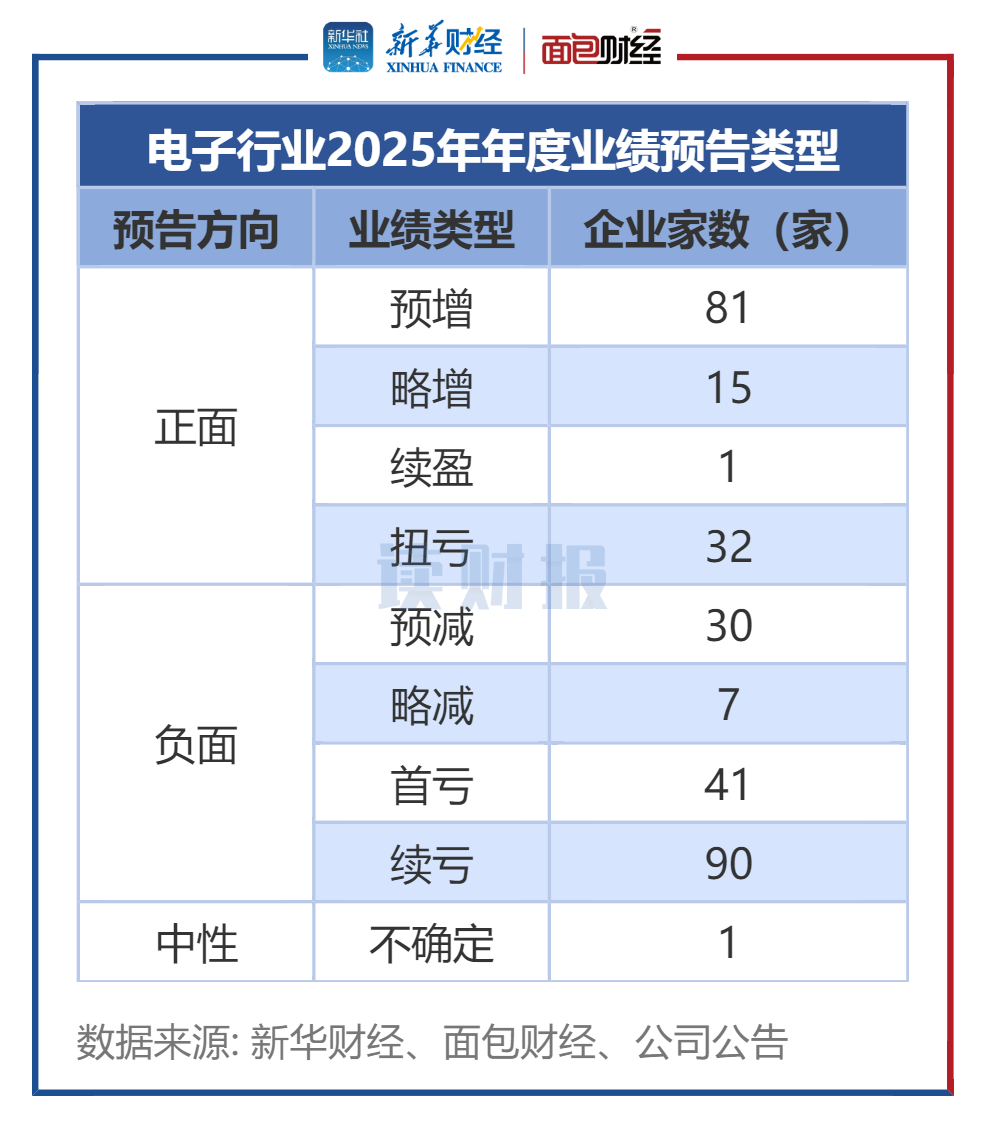
新华财经北京2月25日电截至最新数据,根据申万行业分类,A股电子行业上市公司共计495家,其中298家公司已公布2025年年度业绩预告。 整体来看,298家发布业绩预告的公司中有166家实现盈利,工业富联、立讯精密、TCL科技净利润居前;受益于行业复苏、算力需求攀升等多重因素,较上 年相比,近六成电子行业上市公司实现利润同比增长。 超五成公司预告盈利工业富联、立讯精密、TCL科技盈利规模居前 整体来看,已公布2025年年报业绩预告的298家电子上市公司中,业绩偏正面(包括预增、略增、续盈、扭亏)的企业合计为129家。 | 面问14 | | | | --- | --- | --- | | 电子行业2025年年度业绩预告类型 | | | | 企业家数 (家) 预告方向 | 业绩类型 | | | 正面 | 预增 | 81 | | 15 | 略増 | | | 绩盈 | | 1 | | 担同市场 | | 32 | | 负面 | 预减 | 30 | | 略減 | | 7 | | 首亏 | | 41 | | 续亏 | | 90 | | 中性 | 不确定 | 1 | | 数据来源: 新华财经、面包财经、公司公告 | | | ...




科创芯片ETF汇添富(588750)开盘涨0.95%,重仓股中芯国际涨0.94%,海光信息涨3.00%
Xin Lang Cai Jing· 2026-02-24 04:53
Core Viewpoint - The article discusses the performance of the Sci-Tech Chip ETF managed by Huatai-PineBridge, highlighting its recent gains and the performance of its major holdings [1] Group 1: ETF Performance - The Sci-Tech Chip ETF Huatai (588750) opened with a gain of 0.95%, priced at 1.800 yuan [1] - Since its establishment on December 18, 2024, the fund has achieved a return of 78.38%, with a monthly return of 5.60% [1] Group 2: Major Holdings Performance - Key stocks in the ETF include: - SMIC (中芯国际) up by 0.94% - Haiguang Information (海光信息) up by 3.00% - Cambricon (寒武纪) up by 1.39% - Lattice Technology (澜起科技) up by 3.27% - Zhongwei Company (中微公司) up by 1.26% - Tuojing Technology (拓荆科技) up by 0.92% - Chipone (芯原股份) up by 3.45% - Hua Hong Semiconductor (华虹公司) up by 0.16% - Shanghai Silicon Industry (沪硅产业) up by 1.12% - Dongxin Technology (东芯股份) up by 0.91% [1]





跟着大资金选股!公募调仓科创板,猛攻电子、医药
市值风云· 2026-02-14 10:09
Core Viewpoint - The article discusses the current funding logic in the market, highlighting the significant movements of public funds in the technology sector, particularly in the semiconductor and biopharmaceutical industries, as they adjust their portfolios based on performance and valuation metrics [3][8]. Group 1: Public Fund Movements - Public funds have shown a notable shift in their holdings, particularly in the STAR Market, with the STAR 50 Index rising by 12.1% this year [3][4]. - The total market capitalization of STAR Market companies reached 10.4 trillion yuan, with the technology sector dominating, accounting for 62.1% of the total market cap [5][6]. - The semiconductor industry remains the core focus for fund allocation, with 12 companies in the sector having a market capitalization exceeding 10 billion yuan [9][11]. Group 2: Semiconductor Sector Insights - The market's pricing anchor for the semiconductor sector has shifted from "valuation expansion" to "performance realization," emphasizing the importance of actual earnings [13][14]. - Key drivers for future growth in the semiconductor sector include strong order backlogs, profit growth through acquisitions and expansions, and sustained price increases in advanced processes [13][14]. - Public funds have significantly increased their holdings in semiconductor materials, chip design, and equipment, with companies like ShenGong Co. seeing an 11% increase in fund holdings [15][21]. Group 3: Biopharmaceutical Sector Insights - The biopharmaceutical sector is a critical area for public funds, with major holdings in companies like BeiGene and United Imaging Healthcare, although the sector has faced a reduction in holdings for several key companies [24][26]. - The article notes that innovative drug companies are currently under pressure, with significant reductions in holdings observed in companies like BaiLi TianHeng and RongChang Biopharma [26][28]. - Despite the challenges, companies with strong earnings potential and innovative drug pipelines are still attracting interest from public funds, indicating a selective investment approach [35][40].



科创芯片ETF汇添富(588750)开盘跌0.95%,重仓股中芯国际跌0.30%,海光信息跌0.89%
Xin Lang Cai Jing· 2026-02-13 03:34
Group 1 - The core viewpoint of the article highlights the performance of the Sci-Tech Chip ETF managed by Huatai-PineBridge, which opened at a decline of 0.95% on February 13, 2024, priced at 1.771 yuan [1] - The major holdings of the ETF include companies such as SMIC, Haiguang Information, and Cambrian, all of which experienced declines in their stock prices, with the largest drop being 2.78% for Chipone [1] - The ETF's performance benchmark is the Shanghai Stock Exchange Sci-Tech Board Chip Index, with a return of 78.76% since its inception on December 18, 2024, and a monthly return of 1.72% [1]

半导体材料国产替代破局之道:从技术突围到生态构建
大公国际资信评估· 2026-02-13 00:24
Investment Rating - The report does not explicitly provide an investment rating for the semiconductor materials industry Core Insights - The global semiconductor materials market is characterized by "long-term growth and cyclical fluctuations," with the market size expected to grow from $27.5 billion in 2000 to $67.47 billion by 2024, driven by the demand for advanced semiconductor materials in various high-tech applications [3][5] - China's semiconductor materials industry has made significant progress in mid-to-low-end products but still relies heavily on imports for high-end materials, indicating a substantial opportunity for domestic production and technological breakthroughs [1][10] - The report emphasizes the need for a dual approach of technological breakthroughs and ecosystem building to drive the development of the semiconductor materials industry, supported by government policies and strategic collaborations [1][23] Industry Overview - Semiconductor materials are critical strategic materials for the semiconductor industry, with the market experiencing long-term growth and cyclical fluctuations due to factors such as industry cycles and end-user demand [2][3] - The market structure is shifting as the industry chain relocates and domestic production increases, with China rapidly expanding its market share driven by local demand and government policies [5][10] - The report highlights the significant market concentration in the semiconductor materials sector, with a few leading companies dominating the market [10] Industry Bottlenecks - Despite achieving local supply capabilities in mid-to-low-end products, China still faces challenges in high-end semiconductor materials, which remain heavily reliant on imports [10][13] - Key areas such as silicon wafers, electronic specialty gases, and photoresists are identified as critical segments where domestic production is lagging behind, with high-end products still largely imported [13][18][21] - The report notes that the domestic supply of electronic specialty gases is weak, with an overall localization rate of about 15% expected in 2024, indicating a significant gap in high-end product capabilities [16] Path to Breakthrough - The semiconductor materials industry must focus on technological advancements and ecosystem development, emphasizing collaboration between academia, research institutions, and leading enterprises to address core technological challenges [23][24] - Establishing a robust and efficient results transformation chain is crucial, with a focus on concept validation, pilot testing, and mass production to enhance the commercialization of technological innovations [24][25] - The report advocates for a self-sufficient and sustainable industry ecosystem, extending upstream to secure high-purity raw materials and key equipment while deepening collaboration with downstream chip design and manufacturing companies [25] Policy Empowerment - National policies are increasingly directing the industry towards key areas, with a focus on advanced semiconductor materials as a strategic priority [26][27] - The establishment of pilot platforms for new materials is highlighted as a key initiative to support the industry's development, with plans to create approximately 300 local pilot platforms by 2027 [28] - Financial policies are also being implemented to support innovation and market transformation in the new materials sector, including insurance compensation for high-risk areas [29] Future Outlook - The semiconductor materials industry is expected to evolve towards a high-quality development phase, balancing quality and safety while fostering collaboration between domestic and international players [34] - The focus will shift from isolated breakthroughs to collaborative ecosystems, with an emphasis on meeting the increasing demands for material purity, performance, and stability from downstream applications [34]




半导体设备ETF华夏(562590)跌0.11%,半日成交额7136.72万元
Xin Lang Cai Jing· 2026-02-12 03:39
Group 1 - The semiconductor equipment ETF Huaxia (562590) closed at 1.897 yuan, down 0.11% with a trading volume of 71.3672 million yuan [1] - Major holdings in the ETF include North Huachuang down 0.59%, Zhongwei Company down 1.63%, and Tuo Jing Technology down 1.83%, while Changchuan Technology rose 0.22% and Hu Silicon Industry fell 0.19% [1] - The ETF's performance benchmark is the CSI Semiconductor Materials and Equipment Theme Index return, managed by Huaxia Fund Management Co., Ltd., with a return of 89.93% since its establishment on October 9, 2023, and a return of 0.38% over the past month [1]


半导体设备ETF华夏(562590)跌0.83%,半日成交额6419.00万元
Xin Lang Cai Jing· 2026-02-10 03:43
Group 1 - The semiconductor equipment ETF Huaxia (562590) closed down 0.83% at 1.904 yuan with a trading volume of 64.19 million yuan [1] - Major holdings in the ETF include: Beifang Huachuang down 0.70%, Zhongwei Company down 1.36%, Tuojing Technology down 0.82%, Changchuan Technology down 3.57%, Hu Silicon Industry down 0.62%, Huahai Qingke down 0.84%, Zhongke Feice down 3.71%, Nanda Guangdian up 1.92%, Anji Technology down 0.71%, and Xinyuanwei up 1.13% [1] - The ETF's performance benchmark is the CSI Semiconductor Materials and Equipment Theme Index return, managed by Huaxia Fund Management Co., Ltd., with a return of 92.01% since its establishment on October 9, 2023, and a return of 1.48% over the past month [1]
半导体产业发展势头正盛 国家大基金有序退出
Jin Rong Shi Bao· 2026-02-10 01:25
Core Insights - The recent announcements from the Shanghai Stock Exchange highlight significant movements in the semiconductor industry, particularly regarding the National Integrated Circuit Industry Investment Fund (National Big Fund) and its plans to reduce holdings in various companies, including Anlu Technology [1][2][3] Group 1: National Big Fund's Actions - Anlu Technology announced that shareholders, including the National Big Fund, plan to reduce their holdings by up to 4% of the total shares, with the National Big Fund specifically reducing up to 8.02 million shares, representing no more than 2% of total shares [1][2] - Other semiconductor companies, such as Hushi Industry and Huizhiwei, have also disclosed similar reduction plans, indicating a broader trend of the National Big Fund's divestment across the semiconductor sector [2][3] - The National Big Fund's recent actions are interpreted not merely as negative signals but as indicators of the maturation and confidence of China's semiconductor industry under national strategic capital [1][2] Group 2: Financial Performance and Future Outlook - Anlu Technology's 2025 performance forecast indicates a year-on-year revenue decline and continued net losses, although a recovery trend is noted from the second quarter onward [2] - Hushi Industry's announcement revealed a planned reduction of up to 3% of its total shares by the National Big Fund, following a previous reduction that raised approximately 1.26 billion yuan [2] - The National Big Fund's first phase, established in 2014, is now in a phase of investment recovery, having supported key companies in the semiconductor sector, which are now becoming self-sustaining and competitive [4][5] Group 3: Investment Strategy and Future Funds - The National Big Fund operates with a market-oriented approach, with its first phase focusing on chip manufacturing and the second phase targeting semiconductor equipment and materials [4][5] - The second and third phases of the National Big Fund are actively investing in strategic areas of the semiconductor industry, with the second phase entering a "dual investment and exit" phase while the third phase accelerates investments in core technologies [5][6]


大基金一期减持多家半导体公司 业内称大基金是正常投资退出
Xin Lang Cai Jing· 2026-02-09 12:02
Core Viewpoint - The National Integrated Circuit Industry Investment Fund (referred to as "National Big Fund") has been actively reducing its holdings in the semiconductor sector since the beginning of the year, which has drawn significant market attention [1] Group 1: Fund Reduction Activities - On February 8, Anlu Technology (688107.SH) announced that the Big Fund Phase I plans to reduce its holdings by no more than 2% of the company's total share capital within the next three months [1] - This marks the third time since 2025 that Anlu Technology has faced a reduction plan from the Big Fund [1] - Other semiconductor companies such as Hu Silicon Industry (688126.SH), Tailin Micro (688591.SH), and Huizhi Micro (688512.SH) have also recently disclosed the latest reduction progress or plans from the Big Fund [1] Group 2: Long-term Strategy - Despite the frequent short-term reduction activities, the industry generally views this as a normal exit behavior for an investment fund, indicating that the strategic direction of supporting domestic growth and facilitating domestic substitution remains unchanged [1]
大基金一期减持多家半导体公司 业内称正常投资推出
Di Yi Cai Jing· 2026-02-09 12:01
开年以来,国家集成电路产业投资基金(下称"国家大基金")在半导体板块的减持动作持续受到市场关 注。2月8日晚间,安路科技(688107.SH)发布公告称,股东大基金一期拟在未来三个月内减持不超过 公司总股本的2%。这已是安路科技自2025年以来第三次迎来大基金的减持计划。 与此同时,沪硅产业(688126.SH)、泰凌微(688591.SH)、慧智微(688512.SH)等多家半导体公司 也在近期相继披露了大基金的最新减持进展或计划。从已公布的信息来看,大基金一期、二期均有减持 操作,涉及公司多为已上市多年的半导体产业链企业。 尽管短期内减持动作频繁,但业内普遍认为,这是大基金作为产业投资基金的正常投资退出行为,长期 陪伴产业成长、助力国产替代的战略方向并未改变。 大基金多次减持安路科技、沪硅产业 在近期公告大基金减持计划或减持进展的半导体上市公司中,沪硅产业与安路科技都是在近半个月内迎 来二度减持。 截至公告日,大基金一期持有安路科技2295.45万股股份,占公司总股本的5.73%,均为IPO前取得。此 次减持计划显示,大基金拟在公告披露之日起15个交易日后的3个月内,通过集中竞价或大宗交易方式 减持不超过 ...