Roborock(688169)

Search documents
全球大公司要闻 | 台积电下一代1.4纳米工艺研发顺利,计划2027年启动风险试产
Wind万得· 2026-01-11 22:42
Group 1 - TSMC is progressing well with the development of its next-generation 1.4nm process, planning to start risk production in 2027 and gradually ramp up production in 2028. The company expects sales to reach NT$335 billion in December 2025, a year-on-year increase of 20.4%, slightly exceeding market expectations. Cumulative sales for 2025 are projected at NT$3.81 trillion, reflecting a year-on-year growth of 31.6% [2] - OpenAI is advancing audio AI technology and plans to release a more natural real-time voice model in 2026, aiming to replace screen interactions with voice. The company is also investing $1 billion with SoftBank Group in SB Energy to support its growth as a data center developer and operator [2] - Meta has reached agreements with nuclear power suppliers Oklo, Vistra, and TerraPower to potentially acquire up to 6.6 GW of nuclear power capacity by 2035, positioning itself as the largest nuclear energy buyer among tech giants to support its data center operations [2] - Merck is reportedly in talks to acquire cancer drug developer Revolution Medicines for between $28 billion and $32 billion, which would mark a significant transaction in the recent biotech merger wave and enhance its oncology product line [2] Group 2 - Geely Holding is likely to announce an expansion plan in the U.S. within the next 24 to 36 months, with brands like Zeekr and Lynk & Co potentially suitable for the U.S. market, aiming to accelerate its global layout and expand into high-end overseas markets [5] - BAIC New Energy has launched a pilot operation for the Arcfox Alpha S (L3 version) in collaboration with Beijing Mobility, with the first batch of vehicles expected to enter designated areas by Q2 2026, promoting the commercialization of autonomous driving technology [5] - China Resources Microelectronics has signed a strategic cooperation agreement with TCL Industries and Zhonghuan Lianxing, focusing on power devices, smart power modules, and MCUs to enhance competitiveness in the semiconductor supply chain [5] - Tencent's Chief AI Scientist stated that the company has a strong 2C gene and faces challenges in the 2B market in China, indicating a future exploration of differentiated development paths for 2B business [5] - Stone Technology has received approval from the CSRC for its Hong Kong IPO, planning to issue no more than 33.108 million shares, which will further expand its financing channels [6] Group 3 - Samsung Electronics' Galaxy S26 Ultra model will support eSIM and is expected to be released next month, while major tech companies like Google, Microsoft, and Meta are seeking memory supply support from Samsung and SK Hynix due to global memory shortages [11] - Toyota remains the top-selling car brand in Indonesia for 2025, while Tesla has surpassed Toyota in global market capitalization, reflecting ongoing market optimism for the electric vehicle sector and increasing pressure on traditional automakers [11] - Sumitomo Metal Mining is investing in a nickel wet processing plant in Indonesia to build a stable resource supply network, with Japan's nickel metal production expected to reach 106,000 tons by 2025 [11] - BMW Group expects global sales of 2.464 million units in 2025, a slight increase of 0.5% year-on-year, with a 12.5% decline in the Chinese market, while European and U.S. markets show growth of 7.3% and 5.0%, respectively [13] - LVMH is reportedly collaborating with Chinese beauty brand Mao Geping, although specific details of the partnership have not been disclosed, indicating its expansion in the beauty sector [13]






——《2026/01/05-2026/01/09》家电周报:石头科技等CES展秀肌肉,开能完成原能部分子公司股权收购-20260111
Shenwan Hongyuan Securities· 2026-01-11 11:50
Investment Rating - The report maintains a positive outlook on the home appliance sector, highlighting the potential for undervalued leading companies with high dividends and stable growth attributes [6]. Core Insights - The home appliance sector is experiencing a mixed performance, with air conditioning sales declining significantly while washing machines show growth in exports. The report emphasizes the importance of leading brands like Midea, Gree, and Haier in navigating market challenges and capitalizing on emerging opportunities [6][36][43]. Summary by Sections Air Conditioning - In November 2025, the air conditioning industry produced 10.577 million units, a year-on-year decrease of 36.70%. Total sales reached 10.492 million units, down 31.80%, with domestic sales at 4.052 million units (down 39.80%) and exports at 6.44 million units (down 25.60%). Midea led the market with a 36.20% share, followed by Gree at 19.50% [2][36][38]. Refrigerators - The refrigerator sector saw a slight overall decline, with production at 8.257 million units (down 3.9%) and sales at 8.0531 million units (down 2.99%). Domestic sales fell to 3.5611 million units (down 15.59%), while exports increased to 4.492 million units (up 10.04%) [2][40][41]. Washing Machines - The washing machine industry reported production of 8.605 million units (up 8.2%) and sales of 8.4619 million units (up 7.61%). Domestic sales were 4.0565 million units (down 5.47%), while exports rose to 4.4054 million units (up 23.31%) [3][43]. Market Performance - The home appliance sector underperformed compared to the broader market, with the sector index rising 2.3% against a 2.8% increase in the CSI 300 index. Key performers included Rongtai Health (up 15.7%) and Yitian Intelligent (up 11.2%), while companies like Lek Electric and Feike Electric faced declines [5][9]. Industry Dynamics - Notable developments include Stone Technology's CES debut of the G-Rover robot vacuum, showcasing advanced cleaning capabilities, and Kaineng Health's acquisition of subsidiaries from Yuaneng Group for 204 million yuan [5][12][13]. Investment Themes - The report identifies three main investment themes: 1. Leading white and black appliance companies with low valuations and high dividends. 2. Upstream core component manufacturers diversifying into robotics and new tech sectors. 3. Strong demand in emerging markets for home appliances, driven by favorable trade conditions [6].





家电周报:石头科技等CES展“秀肌肉”,开能完成原能部分子公司股权收购-20260111
Shenwan Hongyuan Securities· 2026-01-11 11:14
Investment Rating - The report maintains a positive outlook on the home appliance sector, highlighting the potential for growth in leading companies due to their low valuations, high dividends, and stable growth attributes [6]. Core Insights - The home appliance sector has shown mixed performance, with air conditioning sales declining significantly while washing machine exports continue to grow. The report emphasizes the resilience of leading brands in navigating market challenges and capitalizing on emerging opportunities [5][6]. - The report identifies three main investment themes: the undervaluation and growth potential of leading white and black appliance companies, the technological advancements in core component manufacturers, and the strong demand for small appliances in international markets [6]. Summary by Sections Air Conditioning - In November 2025, the air conditioning industry produced 10.577 million units, a year-on-year decrease of 36.7%. Total sales reached 10.492 million units, down 31.8%, with domestic sales falling by 39.8% and exports declining by 25.6%. Midea led the market with a 36.2% share, followed by Gree at 19.5% [2][41]. Refrigerators - The refrigerator sector saw a slight overall decline, with production at 8.257 million units, down 3.9% year-on-year. Sales totaled 8.0531 million units, a decrease of 2.99%. Domestic sales dropped by 15.59%, while exports increased by 10.04% [2][43]. Washing Machines - The washing machine industry experienced growth, with production reaching 8.605 million units, up 8.2% year-on-year. Sales were 8.4619 million units, an increase of 7.61%. Domestic sales fell by 5.47%, but exports surged by 23.31% [3][47]. Industry Dynamics - Notable developments include the CES debut of the G-Rover robot vacuum by Stone Technology, showcasing innovative cleaning technology, and the acquisition of subsidiaries by Kaineng Health, indicating strategic expansion efforts [5][12][13]. Component Data - In November 2025, the sales of rotary compressors decreased by 13.6%, while the sales of refrigerator compressors increased by 7.2%. The report highlights the contrasting performance of different components within the appliance sector [23][32].


家用电器行业周度跟踪:消费机器人向具身智能迈进,供应链国产替代下降本可期-20260111
Western Securities· 2026-01-11 10:52
Investment Rating - The industry investment rating is "Overweight" [5][9] Core Insights - The report highlights Midea's acquisition of Carestream Health's global business, which is expected to create synergies with Midea's existing medical business in terms of channels and equipment resources [5][6] - The consumer robotics sector is advancing towards embodied intelligence, with a notable decline in domestic supply chain substitution expected [2][4] - The report emphasizes the performance of major brands in the vacuum cleaner market, noting a significant sales decline for some brands while others, like Roborock, have shown growth [2][3] Summary by Sections White Goods - Midea's acquisition of Carestream Medical's global business is expected to enhance its existing medical operations through effective resource synergy [5][6] Consumer Robotics - December sales data shows a year-on-year decline of 29% for the overall market, with leading brands like Ecovacs and Roborock experiencing varying sales changes [2] - New product launches at CES include Roborock's G-Rover, which is the world's first stair-climbing vacuum robot, and Ecovacs' T90 pro omni, which features upgraded roller lengths and new pre-spray functions [3] Laser Technology in Robotics - Hesai Technology announced that it will lead the market in 3D LiDAR shipments for lawn mowing robots by 2025, showcasing its new models at CES 2026 [4] - The integration of digital all-solid-state LiDAR in new lawn mowing robots was highlighted by Ninebot and other companies [4] Investment Recommendations - The report recommends focusing on white goods, particularly Haier, Midea, and Gree, due to their strong market positions and potential benefits from the current economic environment [7] - It also suggests selecting consumer technology stocks like Ecovacs and others, while keeping an eye on companies like TCL Electronics for overseas growth opportunities [7]


一场关于家的自动化实验:家务机器人的模式分野
机器人大讲堂· 2026-01-11 09:39
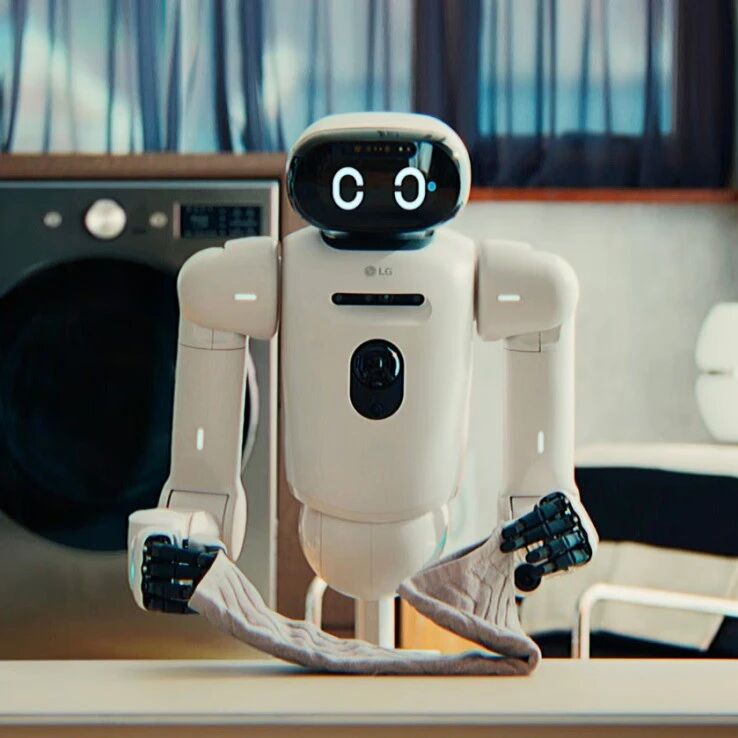
Core Viewpoint - The emergence of household robots is driven by the increasing demand for time-saving solutions in dual-income families and the growing need for improved living quality, leading to a significant market opportunity in the home service sector [2][3]. Market Demand and Technology - The global household service robot market is projected to reach a scale of over $10 billion by 2025, with a compound annual growth rate (CAGR) exceeding 25%, expected to surpass $100 billion by the early 2030s [3]. - The Chinese home service market has exceeded 1 trillion yuan, with a consumption penetration rate of 81.69%, highlighting a substantial demand-supply gap in the industry [2]. Technological Evolution - The integration of large language models with robotics is enabling machines to understand vague commands and autonomously plan tasks, marking a shift from simple execution to task comprehension [4]. - Robots are evolving from isolated tools to intelligent agents capable of managing complex three-dimensional home environments, enhancing their functionality beyond basic cleaning tasks [4]. Pathways and Future Directions - **Home Collaboration Hub**: LG's CLOiD robot exemplifies a "Zero Labor Home" strategy, acting as a mobile control center that integrates with smart home systems to automate household tasks [5][7]. - **General Household Assistant**: 1X Technologies' Neo robot, powered by OpenAI's model, aims to serve as a versatile household assistant capable of understanding complex user requests and providing personalized solutions [8][10]. - **Professional Cleaning Expert**: Companies like Roborock are focusing on specialized cleaning robots that can navigate and manage three-dimensional spaces, showcasing a practical approach to addressing specific household pain points [11][13]. Future Landscape - The future of household automation is envisioned as a mixed ecosystem where specialized robots dominate the market, addressing specific needs while humanoid robots validate their reliability in controlled environments [19][20]. - The ultimate goal is to create a lightweight AI hub that understands user intentions, supported by various specialized robots executing tasks efficiently, shifting the focus from owning a single robot to enjoying seamless service [19][20].
本周新增石头科技、海致科技等5家企业港股发行上市获证监会备案
Sou Hu Cai Jing· 2026-01-11 06:54
Core Viewpoint - The China Securities Regulatory Commission (CSRC) has disclosed that five companies have recently obtained approval for overseas issuance and listing or full circulation of unlisted shares in China, all targeting the Hong Kong Stock Exchange and are in the process of secondary applications [1] Group 1: Company Summaries - Stone Technology, once known as a "sweeping broom" in the A-share market, saw its stock price peak at 1494.99 yuan per share in June 2021, with a market capitalization of 99.266 billion yuan, but has since decreased to a total market value of 42.361 billion yuan, representing a decline of over 50%. The company plans to issue no more than 33.108 million shares [1] - Haizhi Technology, an AI application company founded by former Baidu executives and backed by Hillhouse Capital, focuses on products like the Atlas mapping solution and Atlas intelligent agents. It intends to issue no more than 47.5846 million shares and convert 372 million shares held by shareholders into H-shares [1] - Yushi Technology specializes in L4-level autonomous driving technology, with investors including Innovation Works. The company plans to issue no more than 18.9142 million shares and convert 112 million shares held by shareholders into H-shares [1] - Deshi Biotech aims to become the first company to launch a medical imaging large model, planning to issue no more than 31.004 million shares and convert 80.88 million shares held by shareholders into H-shares [1] - Shangmi Technology, a provider of commercial IoT (BIoT) solutions with shareholders including Ant Group, Meituan, and Xiaomi, plans to issue no more than 46.004 million shares and convert 261 million shares held by shareholders into H-shares [1]
供应链与技术创新双赋能!中国智能家电加速出海 全球市场份额持续攀升
Yang Shi Wang· 2026-01-10 07:59
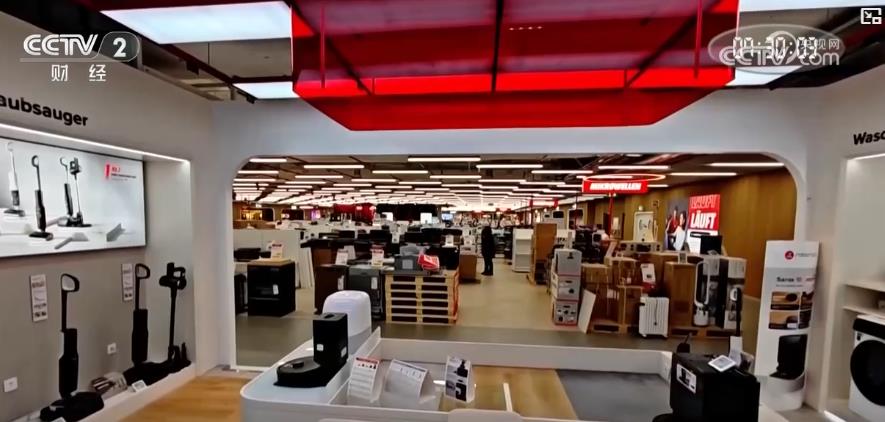
Core Insights - Chinese robotic vacuum cleaners are becoming a popular choice among global consumers, both at technology exhibitions and in retail markets across Europe and Southeast Asia [1] Market Presence - In Germany, Chinese brands like Roborock and Dreame occupy prominent positions in the robotic vacuum cleaner section, with prices ranging from €200 to €2000, and many consumers prioritize these products when shopping for smart home devices [3] - Germany is one of the most important overseas markets for Chinese robotic vacuum cleaners, with GfK data indicating that over 60% of robotic vacuums sold in Western Europe are from China [5] Market Growth - In Southeast Asia, the market share of Chinese robotic vacuum cleaners has significantly increased from 38.8% in 2024 to 64.1% in 2025, marking it as a rapidly growing emerging market [5] - In Ho Chi Minh City, Vietnam, numerous small appliance stores showcase cutting-edge Chinese brand robotic vacuums, with the Ecovacs brand having dozens of dedicated stores and hundreds of sales points [5] Global Shipment Data - According to IDC, the total global shipment of smart robotic vacuums reached 17.424 million units in the first three quarters of 2025, representing a year-on-year growth of 18.7% [7] - Chinese brands such as Roborock, Ecovacs, Dreame, Xiaomi, and Yunji dominate the global market, collectively accounting for nearly 70% of the total shipment volume [7] Competitive Advantage - The strong performance of Chinese brands is attributed to their robust supply chain advantages and superior innovation capabilities in robotic vacuum technology, allowing them to lead overseas markets by one to two generations in terms of technological advancements [7]

中国扫地机器人扫全球!中国扫地机器人占全球份额近70%
Ge Long Hui· 2026-01-10 04:56
Core Viewpoint - The 2026 Consumer Electronics Show in Las Vegas showcased the latest technologies in smart home cleaning devices, particularly highlighting the advancements in AI-integrated robotic vacuum cleaners from Chinese companies [1] Industry Summary - The event featured multiple new robotic vacuum models that incorporate artificial intelligence, demonstrating significant capabilities in perception, decision-making, and execution [1] - Chinese products dominated the exhibition, indicating a strong presence in the global smart home market [1] Market Performance - By the third quarter of 2025, the global shipment of smart robotic vacuums reached 17.424 million units, marking an 18.7% year-on-year increase [1] - Leading Chinese brands such as Roborock, Ecovacs, Dreame, Xiaomi, and Yunji captured nearly 70% of the global market share, ranking as the top five in worldwide shipments [1]

【环时深度】2026 CES展,中国AI企业拉高国际能见度
Huan Qiu Shi Bao· 2026-01-09 22:37
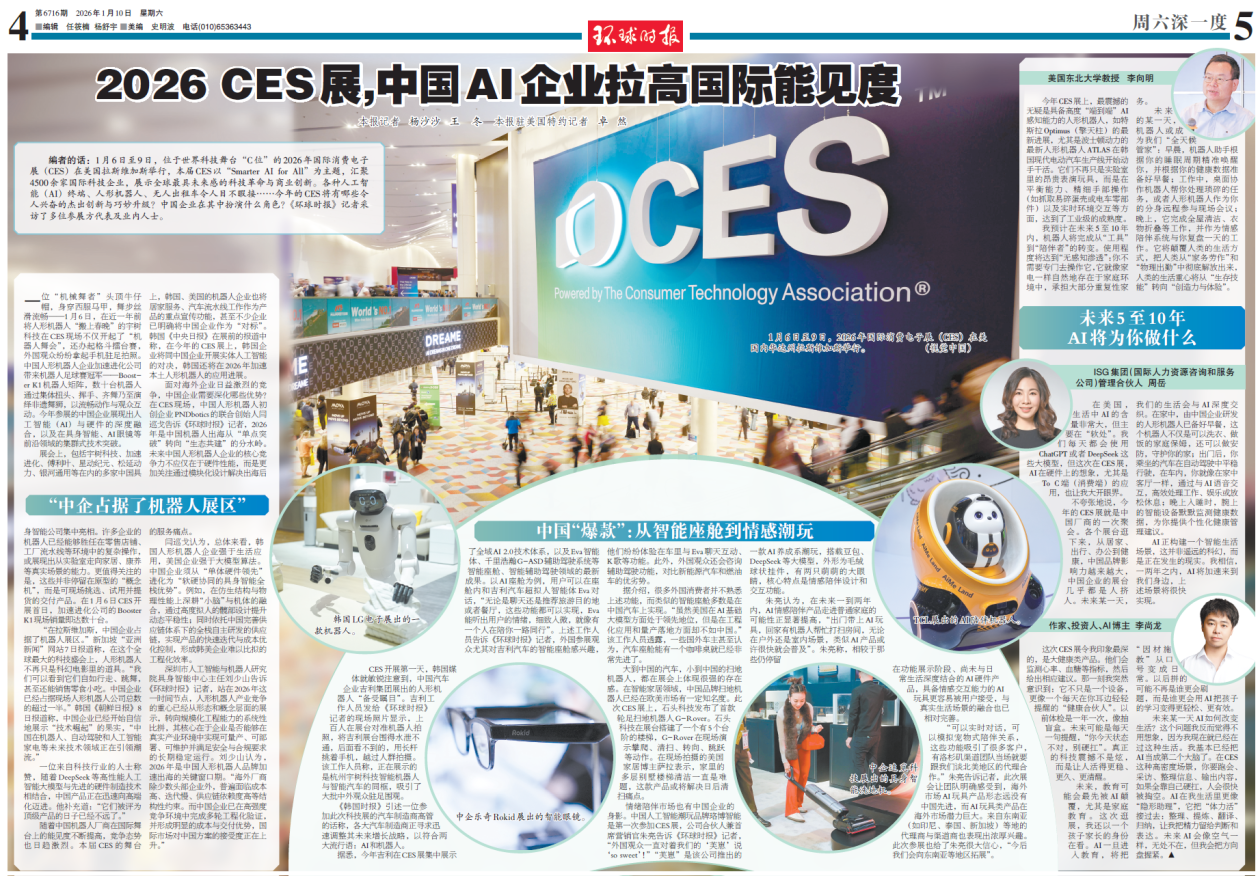
Group 1 - The 2026 International Consumer Electronics Show (CES) in Las Vegas showcased over 4,500 international tech companies, focusing on the theme "Smarter AI for All" [2] - Chinese companies demonstrated significant advancements in humanoid robots and AI integration, with many products ready for immediate purchase and use [5][10] - The presence of Chinese firms in the humanoid robot sector exceeded half of the total exhibitors, indicating a strong competitive stance against Korean and American companies [5][11] Group 2 - Chinese humanoid robot companies are evolving from hardware-centric approaches to a focus on modular design and service solutions for international markets [7] - The competition in the humanoid robot industry is shifting towards the ability to produce scalable, deployable, and maintainable systems that meet safety and compliance standards [9] - Chinese brands are increasingly recognized for their engineering efficiency and cost advantages, enhancing their acceptance in international markets [9] Group 3 - The automotive sector, represented by companies like Geely, highlighted the integration of AI in smart cabins and autonomous driving systems, attracting significant attention from international audiences [11][12] - The CES showcased a variety of AI products, from smart home devices to emotional companion toys, indicating a growing market for AI in everyday life [12][15] - The potential for AI to transform daily living is emphasized, with expectations for AI to become an integral part of household management and personal assistance in the near future [18][21]

西方营销模式正在失效,中国市场进入“本土规则”时代
Sou Hu Cai Jing· 2026-01-09 15:40
Core Insights - The global floor cleaning robot industry is witnessing a significant shift, with the acquisition of iRobot by its Chinese manufacturing partner, marking the end of an era for the former industry leader [2] - Local brands in China are rapidly gaining market share, forcing international brands like Starbucks, Nike, and Adidas to adapt or face decline [2] - A survey indicates that 85.79% of consumers prefer domestic trendy brands, highlighting the rise of local brands in various consumer sectors [2] Industry Trends - The traditional Western marketing models are becoming ineffective in the Chinese market, as local brands redefine the rules of engagement [4][7] - The previous reliance on mass advertising and standardized marketing strategies is being replaced by personalized and emotionally resonant approaches [9][10] - The emergence of new consumer behaviors emphasizes the importance of emotional connections and personalized experiences over traditional functional marketing [10][11] Brand Strategies - Successful local brands like Qingdao White Beer are leveraging cultural symbols and emotional narratives to resonate with consumers [19][21] - Qingdao White Beer has effectively created immersive experiences that connect with local culture, enhancing brand visibility and consumer engagement [21][22] - The focus has shifted from merely selling products to creating emotional experiences that align with consumers' lifestyles and values [22]