
OPTOWIDE(688195)

Search documents
光通信模块板块走强
Mei Ri Jing Ji Xin Wen· 2025-11-17 02:08
Group 1 - The optical communication module sector is leading the market with an increase of 2.69% [1] - Tengjing Technology saw a significant rise of 14.55% [1] - Changxin Bochuang increased by 7.23% [1] - Guangku Technology experienced a growth of 5.58% [1] - Companies such as Xingsen Technology, Zhongji Xuchuang, and Xingshuai'er all rose over 4% [1]





人工智能(AI)在农业育种行业的应用现状与商业化前景
QYResearch· 2025-11-17 01:21
Industry Background: Transition to a "Data-Driven" Era in Breeding - Traditional breeding relies heavily on time-consuming field trials and personal experience, typically requiring 7-12 years for completion, which is costly and has a limited success rate. The global breeding industry is undergoing a fundamental shift from "experience-driven" to "data + model-driven" due to the significant decrease in genome sequencing costs, widespread application of high-throughput phenotyping technologies, and continuous enhancement of AI computing power [2]. Core Applications of AI in the Breeding Industry - **Genomic Selection**: This technology analyzes vast amounts of genetic markers to accurately predict key traits such as crop yield, quality, and disease resistance. AI can reduce the breeding cycle from 7-10 years to 4-6 years and improve trait prediction accuracy by 10-25%, while significantly lowering field validation costs. Leading companies like Bayer and KWS have implemented this at scale for major crops [6]. - **Phenotypic Analysis**: AI enhances the efficiency and accuracy of collecting phenotypic data through automated analysis of plant growth, disease severity, and canopy structure using drones and hyperspectral cameras. This technology increases selection efficiency by 5-10 times and provides objective quantitative data for field trials [7]. - **Hybrid Combination Prediction**: AI integrates multi-dimensional data to improve the accuracy of predicting successful hybrid combinations, addressing the issue where over 95% of traditional combinations fail to meet expectations. This allows for the early elimination of ineffective combinations, focusing resources on high-potential materials [8]. - **Environmental Modeling**: AI constructs G×E (genotype × environment) models to predict how different genotypes perform in various environments, facilitating a shift from reliance on multi-site trials to model-driven predictions, thus overcoming geographical limitations in breeding [10]. Global Application Status: From Experimental Exploration to Large-Scale Implementation - The global breeding industry has formed three distinct tiers in AI application: - Leading seed companies like Bayer and Syngenta have established comprehensive data infrastructures and AI breeding systems, creating high technical barriers [12]. - Research institutions such as CGIAR and USDA are driving innovation in AI breeding projects for staple crops, providing theoretical and technical support [13]. - Small and medium enterprises are gaining capabilities through SaaS platforms, allowing them to access advanced breeding tools at lower costs [13]. Commercialization Models and Industry Transformation Directions - Three main commercialization models have emerged in AI breeding: - **SaaS Software Subscription Model**: Targets small and medium breeding companies, offering tiered pricing based on image processing volume or trial area, lowering the application threshold for AI technology [15]. - **Data Analysis Service Model**: Provides specialized services for specific breeding projects, converting professional knowledge into value [15]. - **AI-Driven New Variety Commercialization**: This mainstream model for seed companies enhances breeding efficiency, leading to faster market introduction and more stable traits, ultimately increasing seed sales revenue [15]. Future Prospects: AI Will Reshape the Global Breeding Competitive Landscape - The breeding industry is expected to undergo three distinct development stages driven by AI: - **Short-term (1-3 years)**: Rapid commercialization of single-point AI tools, with phenotypic analysis AI leading the way and genomic selection solidifying its mainstream status [17]. - **Mid-term (3-7 years)**: AI will evolve from single-point tools to a full-process breeding system, with digital field trials becoming common and hybrid combination prediction transitioning into routine production [17]. - **Long-term (7-10 years)**: The deep integration of AI with gene editing technologies will create a closed-loop system, significantly reducing breeding costs by 40-60% and shortening cycles by 30-50% [17]. Domestic Development Status: Breakthroughs in China's AI Breeding Field - The year 2025 is projected to be a landmark year for China's AI breeding, with several innovative achievements: - The Shanghai AI Laboratory, in collaboration with other institutions, launched the first autonomous scientific discovery system in biological breeding, capable of simulating molecular biologist functions [19]. - Zhejiang University and Huawei developed an "AI Breeder" that enhances cotton hybrid breeding efficiency by 20 times and reduces the breeding cycle from 6-8 years to 3-4 years [19]. - The establishment of a unified data platform by the Qiaozhou Bay National Laboratory and Huawei significantly improves breeding efficiency through standardized data collection [19]. Conclusion: AI Initiates the "Second Revolution" in the Breeding Industry - AI is leading the most profound transformation in the breeding industry since the advent of hybrid breeding technology, marking a shift from reliance on experience to data-driven predictions. This revolution fundamentally changes the breeding paradigm from "art" to "science," establishing quantifiable and predictable mathematical models [21]. The integration of AI with gene editing technologies will usher in an era of "precise design" in breeding, redefining competitive dynamics in the global seed industry [21].



光学光电子板块11月13日涨0.34%,天山电子领涨,主力资金净流出3.43亿元
Zheng Xing Xing Ye Ri Bao· 2025-11-13 08:44
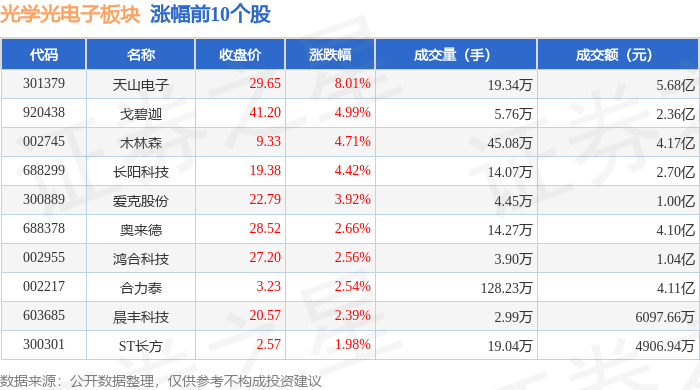
Core Insights - The optical and optoelectronic sector saw a slight increase of 0.34% on November 13, with Tianshan Electronics leading the gains [1] - The Shanghai Composite Index closed at 4029.5, up 0.73%, while the Shenzhen Component Index closed at 13476.52, up 1.78% [1] Stock Performance - Tianshan Electronics (301379) closed at 29.65, with an increase of 8.01% and a trading volume of 193,400 shares, amounting to 568 million yuan [1] - Other notable gainers included: - Gobi Jia (920438) at 41.20, up 4.99% [1] - Mulinsen (002745) at 9.33, up 4.71% [1] - Changyang Technology (6628899) at 19.38, up 4.42% [1] - Conversely, the following stocks experienced declines: - Visionox (002387) at 9.66, down 4.36% [2] - Qianzhao Optoelectronics (300102) at 14.22, down 4.05% [2] - ST Yushun (002289) at 35.80, down 2.27% [2] Capital Flow - The optical and optoelectronic sector experienced a net outflow of 343 million yuan from institutional investors, while retail investors saw a net inflow of 324 million yuan [2] - Notable capital flows included: - Tianshan Electronics had a net outflow of 58.29 million yuan from institutional investors [3] - Mulinsen saw a net inflow of 37.24 million yuan from institutional investors [3] - Aolaide (688378) had a net inflow of 35.93 million yuan from institutional investors [3]


光学光电子板块11月11日跌0.67%,腾景科技领跌,主力资金净流出13.1亿元
Zheng Xing Xing Ye Ri Bao· 2025-11-11 08:37
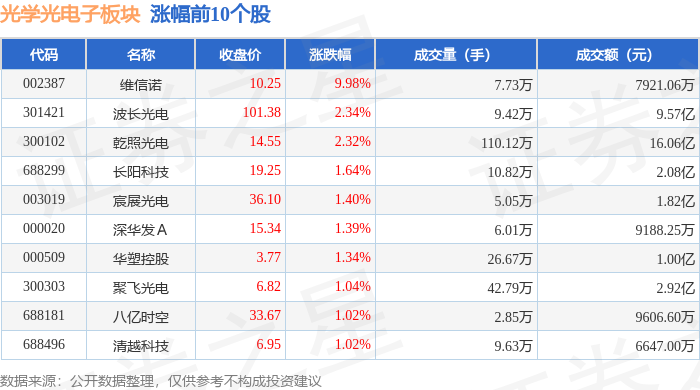
Market Overview - The optical and optoelectronic sector experienced a decline of 0.67% on November 11, with Tengjing Technology leading the drop [1] - The Shanghai Composite Index closed at 4002.76, down 0.39%, while the Shenzhen Component Index closed at 13289.0, down 1.03% [1] Stock Performance - Notable gainers in the optical and optoelectronic sector included: - Visionox (002387) with a closing price of 10.25, up 9.98% [1] - Wavelength Optoelectronics (301421) with a closing price of 101.38, up 2.34% [1] - Qianzhao Optoelectronics (300102) with a closing price of 14.55, up 2.32% [1] - Major decliners included: - Tengjing Technology (688195) with a closing price of 119.60, down 7.99% [2] - Lante Optics (688127) with a closing price of 30.50, down 5.89% [2] - Shida Weige (300331) with a closing price of 31.47, down 3.88% [2] Capital Flow - The optical and optoelectronic sector saw a net outflow of 1.31 billion yuan from institutional investors, while retail investors contributed a net inflow of 821 million yuan [2][3] - Key stocks with significant capital flow included: - Dongtian Micro (301183) with a net inflow of 81.75 million yuan from institutional investors [3] - Wavelength Optoelectronics (301421) with a net inflow of 60.91 million yuan from institutional investors [3] - Guoxing Optoelectronics (002449) with a net inflow of 27.93 million yuan from institutional investors [3]
算力硬件股午后持续走低
Di Yi Cai Jing· 2025-11-11 05:35
Core Viewpoint - The stocks of Tianfu Communication and Tengjing Technology fell over 8%, with Cambridge Technology, Jingwang Electronics, Shenghong Technology, Zhongji Xuchuang, and Industrial Fulian also experiencing significant declines [1] Group 1 - Tianfu Communication and Tengjing Technology saw a drop exceeding 8% in their stock prices [1] - Cambridge Technology, Jingwang Electronics, Shenghong Technology, Zhongji Xuchuang, and Industrial Fulian were among the companies with the largest declines [1]


腾景科技迎福建省委副书记、福州市委书记调研,光电龙头强链攻坚
Quan Jing Wang· 2025-11-11 02:12
Core Insights - Tengjing Technology (688195.SH) is advancing in the high-end optical components sector, focusing on domestic substitution and leveraging core technologies for growth [1][2] - The company has transitioned from a startup to a publicly listed entity in eight years, becoming a key player in optical communication, semiconductor equipment, and quantum technology [1] - The company is committed to enhancing R&D investment and tackling key technologies to lead industry innovation and contribute to a competitive optical advanced manufacturing cluster [1][2] Company Developments - On November 7, the Deputy Secretary of the Fujian Provincial Committee visited Tengjing Technology to discuss the company's innovations and market strategies [1] - Tengjing Technology provides customized precision optical components for high-speed optical modules and subsystems, supporting advancements in telecommunications and data centers [1] - The company has achieved industry-leading levels in several core technologies and has filled domestic gaps in various niche markets [1] Future Outlook - Tengjing Technology aims to align with the national "14th Five-Year" plan, focusing on precision optics and advanced optoelectronic technology innovation [2] - The company is set to accelerate technological breakthroughs and product applications in optical communication and semiconductors, contributing to AI computing and semiconductor localization efforts [2] - The goal is to transition from a "pioneer" to a "leader" in the new round of industrial competition, enhancing the international competitiveness of the optical advanced manufacturing sector [2]
光学光电子板块11月10日涨0.75%,腾景科技领涨,主力资金净流入5.51亿元
Zheng Xing Xing Ye Ri Bao· 2025-11-10 08:42
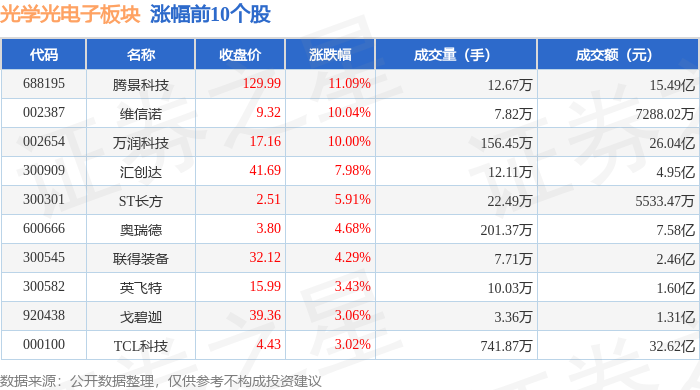
Core Insights - The optical and optoelectronic sector experienced a rise of 0.75% on November 10, with Tengjing Technology leading the gains [1] - The Shanghai Composite Index closed at 4018.6, up 0.53%, while the Shenzhen Component Index closed at 13427.61, up 0.18% [1] Stock Performance - Tengjing Technology (681889) closed at 129.99, with a significant increase of 11.09% and a trading volume of 126,700 shares, totaling a transaction value of 1.549 billion [1] - Visonic (002387) saw a rise of 10.04%, closing at 9.32 with a trading volume of 78,200 shares, amounting to 72.8802 million [1] - Wanrun Technology (002654) increased by 10.00%, closing at 17.16 with a trading volume of 1,564,500 shares, totaling 2.604 billion [1] - Other notable performers included Huichuangda (300909) with a 7.98% increase and a closing price of 41.69, and ST Changfang (300301) with a 5.91% increase [1] Fund Flow Analysis - The optical and optoelectronic sector saw a net inflow of 551 million from institutional investors, while retail investors experienced a net outflow of 354 million [2] - Major stocks like Wanrun Technology and TCL Technology attracted significant institutional investment, with net inflows of 486 million and 298 million respectively [3] - Conversely, stocks like Su Da Weige (300331) and Aobi Zhongguang (688322) faced net outflows from both institutional and retail investors, indicating a shift in market sentiment [2][3]


腾景科技股价涨5.49%,易方达基金旗下1只基金重仓,持有44.86万股浮盈赚取288.02万元
Xin Lang Cai Jing· 2025-11-10 05:53
Group 1 - The core viewpoint of the news is that Tengjing Technology has seen a significant stock price increase of 5.49%, reaching 123.43 CNY per share, with a trading volume of 8.88 billion CNY and a market capitalization of 159.66 billion CNY [1] - Tengjing Technology, established on October 12, 2013, and listed on March 26, 2021, specializes in the research, production, and sales of various precision optical components and fiber optic devices [1] - The company's main business revenue composition includes precision optical components at 78.87%, fiber optic devices at 16.65%, optical testing instruments at 4.43%, and other products at 0.05% [1] Group 2 - According to data from the top ten holdings of funds, one fund under E Fund has a significant position in Tengjing Technology, with 448,600 shares held, accounting for 2.96% of the fund's net value [2] - The E Fund Science and Technology Innovation Board Two-Year Open Mixed Fund (506002) has achieved a return of 63.15% year-to-date, ranking 460 out of 8,219 in its category [2] - The fund's total scale is 1.793 billion CNY, and it has generated a floating profit of approximately 2.8802 million CNY from its investment in Tengjing Technology [2]
科创板50指数震荡拉升大涨3.3%,科创板50ETF(588080)等产品成交放量
Mei Ri Jing Ji Xin Wen· 2025-11-07 00:27
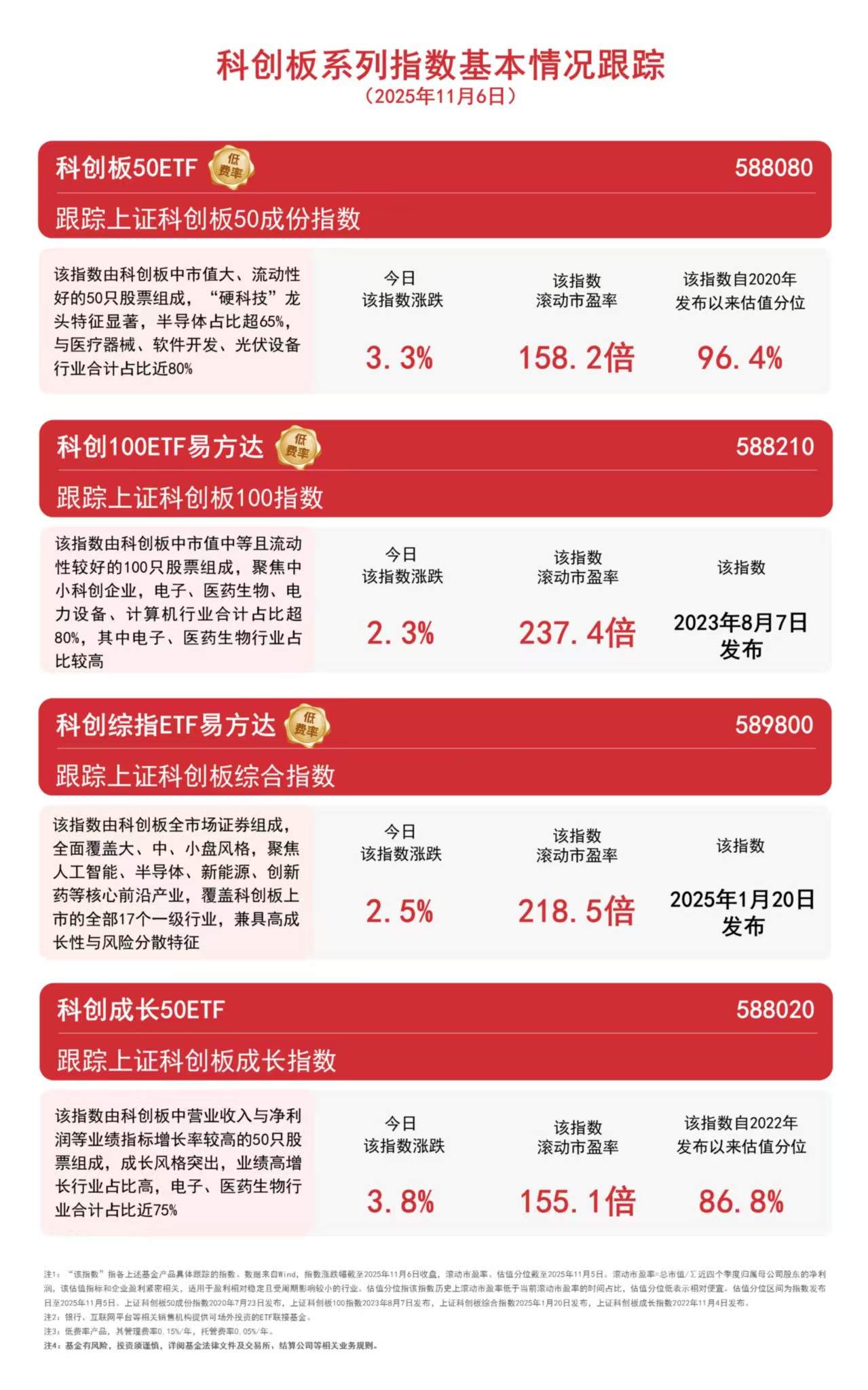
Group 1 - The technology sector showed strong performance today, with notable gains in computing hardware stocks, including Changguang Huaxin up 20%, Yuanjie Technology up over 16%, and Shijia Photon up over 12% [1] - The power concept stocks were also active, with Huasheng Lithium Battery hitting a 20% limit up and Yishitong rising over 10% [1] - The indices reflected this positive trend, with the Sci-Tech Growth Index rising by 3.8%, the Sci-Tech 50 Index up 3.3%, the Sci-Tech Comprehensive Index increasing by 2.5%, and the Sci-Tech 100 Index up by 2.3% [1] - The trading volume for the Sci-Tech 50 ETF (588080) significantly increased compared to the previous day [1]




光学光电子板块11月6日涨0.46%,东田微领涨,主力资金净流出5.21亿元
Zheng Xing Xing Ye Ri Bao· 2025-11-06 08:51
Market Overview - The optical and optoelectronic sector increased by 0.46% on November 6, with Dongtian Micro leading the gains [1] - The Shanghai Composite Index closed at 4007.76, up 0.97%, while the Shenzhen Component Index closed at 13452.42, up 1.73% [1] Stock Performance - Dongtian Micro (301183) closed at 108.70, with a significant increase of 14.00% and a trading volume of 146,400 shares [1] - Tengjing Technology (688195) rose by 9.95% to 117.71, with a trading volume of 86,300 shares [1] - Other notable performers include Aobi Zhongguang (688322) with a 4.41% increase, and Aolaide (688378) with a 3.81% increase [1] Capital Flow - The optical and optoelectronic sector experienced a net outflow of 521 million yuan from institutional investors, while retail investors saw a net inflow of 385 million yuan [2] - The overall capital flow indicates a mixed sentiment, with institutional investors withdrawing funds while retail investors are actively buying [2] Individual Stock Capital Flow - Dongtian Micro had a net inflow of 53.57 million yuan from institutional investors, but a net outflow of 90.47 million yuan from retail investors [3] - Other stocks like Su Da Weige (300331) and Shuijing Optoelectronics (002273) also showed significant net inflows from institutional investors, indicating strong interest [3] - Conversely, stocks like Aolaide (688378) and Tengjing Technology (688195) faced net outflows from retail investors, suggesting caution among smaller investors [3]


